Top AgentMail Alternatives in 2026
Here for AgentMail itself? See the full AgentMail profile, pricing & reviews →
Suggest a change- If you're a founder who wants company email set up fast and already lives in Google Docs and Meet, choose Gmail. Google Workspace bundles a custom-domain inbox with Drive, Docs, and Meet under one bill starting at $7 a seat a month. It's a mailbox for people, not a way to provision inboxes for an agent.
- If you just need the cheapest real business inbox on your own domain, choose Zoho Mail. Mail Lite starts at $1 per user a month with a published price and no sales call needed. It's still a human mailbox, not an API that hands out new inboxes.
- If you're a technical team that also wants an AI assistant to act on the same mailbox, choose Fastmail. it shipped its own MCP server in April 2026, about a week before Zoho Mail's, and covers mail, calendar, and contacts instead of just the inbox. That server connects an assistant to a mailbox you already set up. It doesn't provision new ones on demand.
- If you're building an AI agent that needs to send and receive mail under its own address, choose stay on AgentMail. none of these providers give you an API to provision inboxes and get webhooks on incoming mail the way AgentMail does.
AgentMail gives software agents their own email inboxes through an API. It has no webmail client, so if you actually need a normal inbox for a person or a team to read and reply to, you are shopping in a different category entirely.
None of the providers below are true substitutes for AgentMail's API. They're general-purpose inboxes built for a person to check mail, not infrastructure for an agent to run one on its own. We kept the three closest matches on the market today: Gmail, Fastmail, and Zoho Mail, each of which ships some form of programmatic access (an API, JMAP, or an MCP server) that lets code or an AI assistant work with the mailbox. That's closer to AgentMail's job than a pure webmail client like Proton Mail, Tuta, HEY, or Outlook, none of which offer that kind of access, so we left them out of this ranking.
If you're actually building or running an AI agent and need a real substitute for AgentMail's API, look at developer-facing email platforms like Postmark, Mailgun, or Nylas, which let code send and receive mail and route incoming messages to webhooks. We haven't reviewed those here yet, but they're the closer comparison for that job.
AgentMail alternatives compared
| Tool | Best for | Starting price | Free option | Last update |
|---|---|---|---|---|
| GmailBest all-around pick for a small team's human inbox | People who just want a free, reliable personal inbox with strong spam filtering | $7/seat/mo | Yes | July 2026 |
| FastmailBest for technical teams already using AI tools on their own mailbox | Privacy-focused individuals who want to pay for email instead of being the product | $3/seat/mo | Trial (30 days, no credit card required) | April 2026 |
| Zoho MailBest value for a bare-bones business inbox | Small businesses and solo founders who want a custom-domain inbox for close to nothing | $1/seat/mo | Yes | May 2026 |
Why teams switch from AgentMail
There's no web or mobile inbox to read mail yourself
AgentMail is built purely as an API for agents. Teams that actually need a person to read and reply to email by hand have to look elsewhere, since there's no webmail client at all.
The pricing jumps 10x with nothing in between
The Developer plan tops out at 10 inboxes for $20 a month, and the next tier up, Startup, jumps straight to $200 a month for 150 inboxes. A team that outgrows 10 inboxes but doesn't need 150 faces a 10x price jump with no plan in between.
Enterprise pricing is quote-only
SSO, dedicated IPs, white-labeling, and bring-your-own-cloud deployment only show up on the Enterprise tier, and that price isn't published, so a larger team needs a sales call just to see the number.
The best AgentMail alternatives, ranked
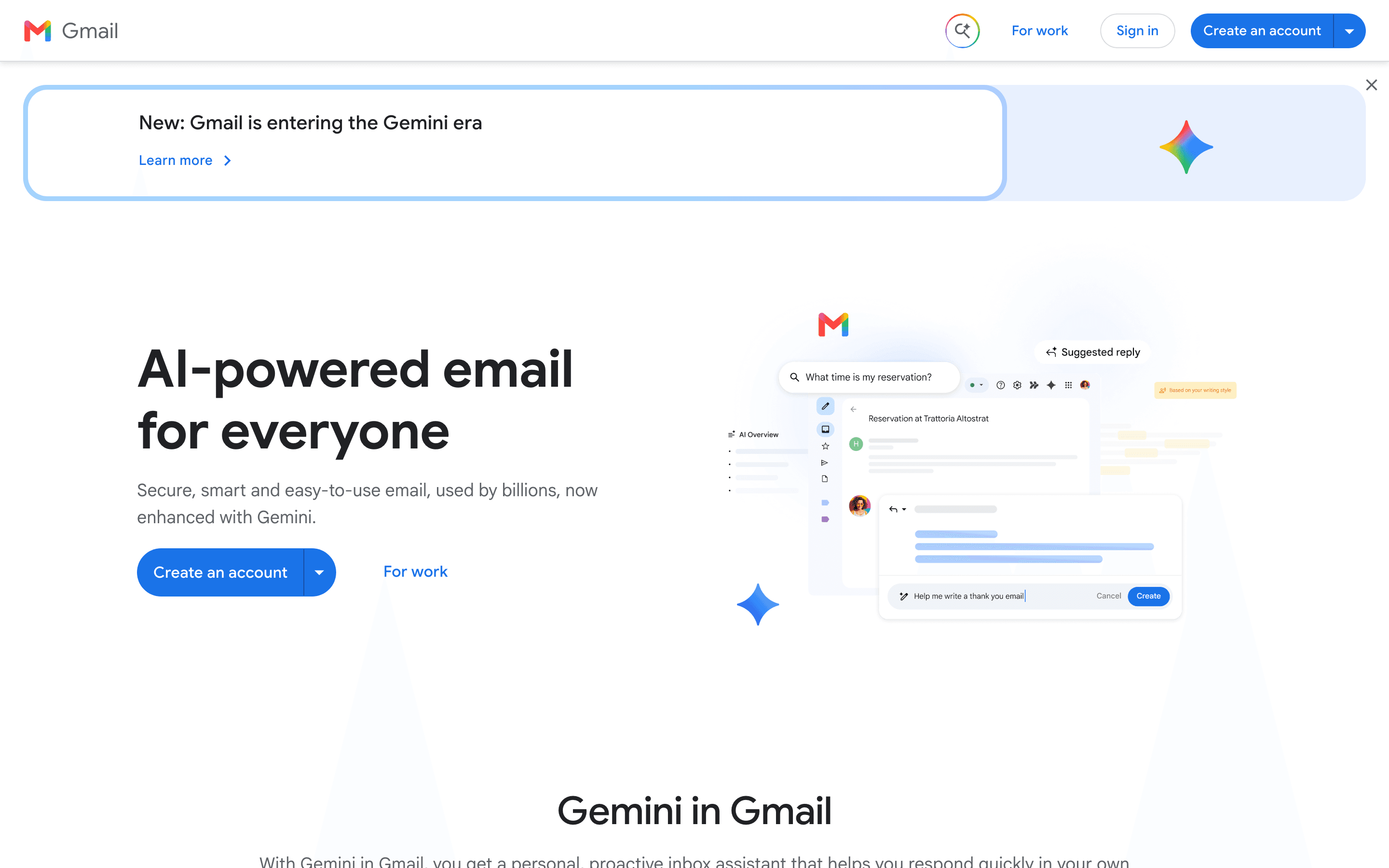
Gmail is the default pick for anyone who wants email that every vendor, client, and contractor already knows how to work with. Personal @gmail.com accounts are free forever, with 15GB of storage and best-in-class spam filtering. For a business address on your own domain, you buy Google Workspace, which starts at $7 per user a month billed annually and bundles Drive, Docs, and Meet in with the inbox. The catch is you cannot buy just the email: Workspace forces you into the whole office suite, and Gemini's AI writing tools inside Gmail itself require a paid plan even on top of that. Monthly, no-commitment pricing also runs about 20% higher than the annual rate. For teams that already live in Google's other apps, one bill covering everything is a real convenience, not just an upsell. None of this makes Gmail a stand-in for AgentMail: the Gmail API reads and sends mail on an account you already set up by hand, it doesn't provision new inboxes on demand or push a webhook when mail arrives the way AgentMail does.
Pros
- + Free personal tier is genuinely free forever, not a time-limited trial
- + Spam filtering and deliverability are best-in-class since most of the internet's inboxes are Gmail
- + Business plans bundle Drive, Docs, Meet, and Calendar, so one subscription covers most of what a small company needs
Cons
- – You cannot buy a standalone business email account. Google Workspace pricing forces you into the full productivity suite even if you only want mail
- – The free personal tier does not include Gemini's AI writing tools inside Gmail itself, only the separate Gemini chat app
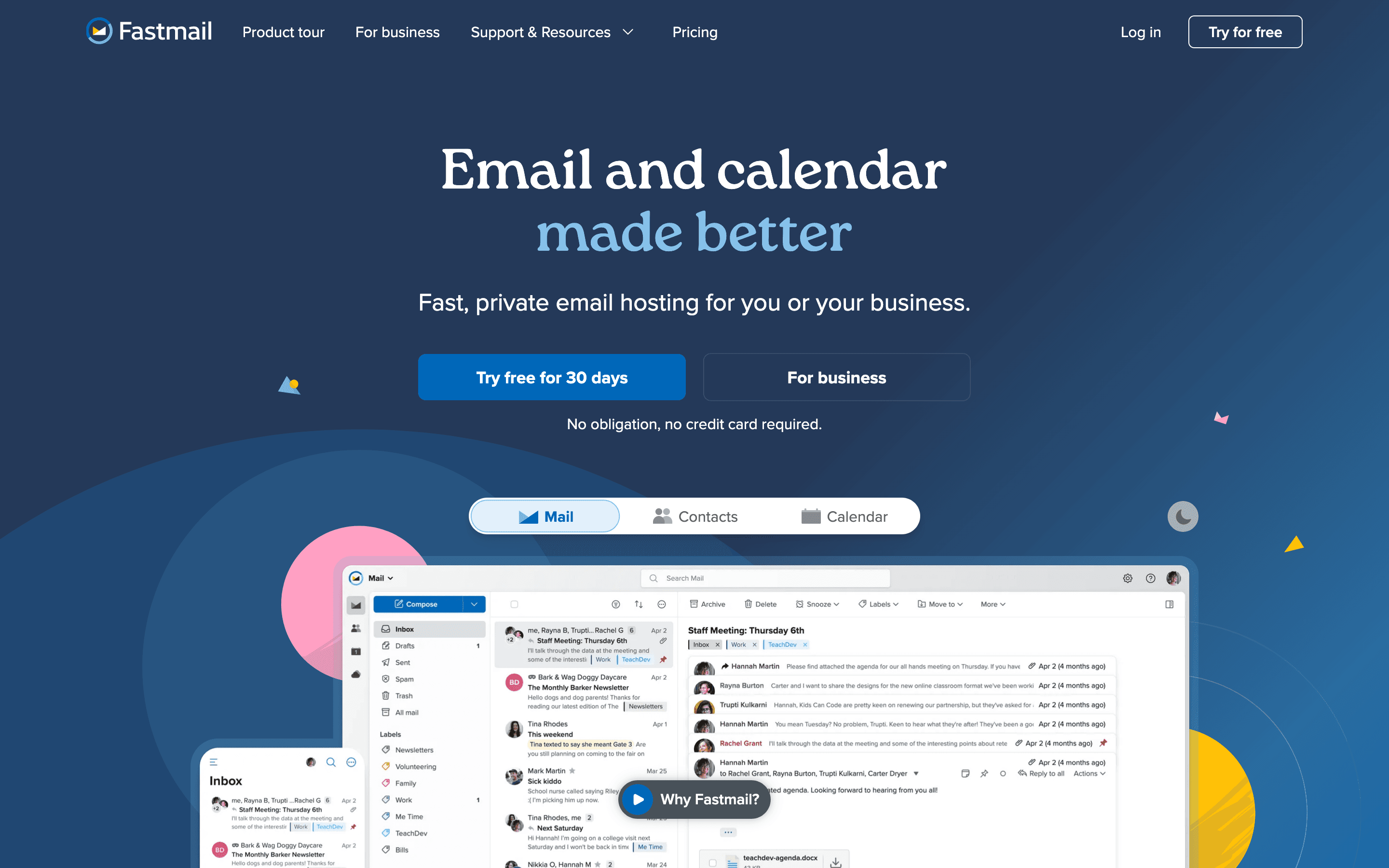
Fastmail sells mailboxes instead of running ads against them, and it has done so since 1999, going independent and employee-owned after a 2013 staff buyout from Opera. There is no free plan, but a 30-day trial needs no credit card, and paid plans start at $5/month for one person or $3 per user a month for the cheapest business tier, both billed annually. What sets it apart here is technical depth: it built JMAP as a faster open alternative to IMAP, and in April 2026 it shipped an MCP server so AI assistants like Claude can read and act on your mail, calendar, and contacts with scoped permissions. Zoho Mail added its own MCP server about a week later, in May 2026, but scoped to the mailbox only. The tradeoff is thinner storage on its cheapest business tier and no bundled office suite the way Gmail or Zoho offer. Even with the MCP server, Fastmail is still a mailbox you set up once and connect an assistant to, not an API for spinning up new inboxes the way AgentMail does.
Pros
- + No ads, no free tier funded by scanning your mail
- + Independent and employee-owned since a 2013 staff buyout from Opera Software, running continuously since 1999
- + Fast, capable webmail and mobile apps built on JMAP, the open protocol Fastmail itself designed
Cons
- – No free plan at all, unlike Gmail, Outlook, or Proton Mail's limited free tier
- – Storage on the cheapest business tier (6 GB per user) is thin next to Google Workspace or Microsoft 365
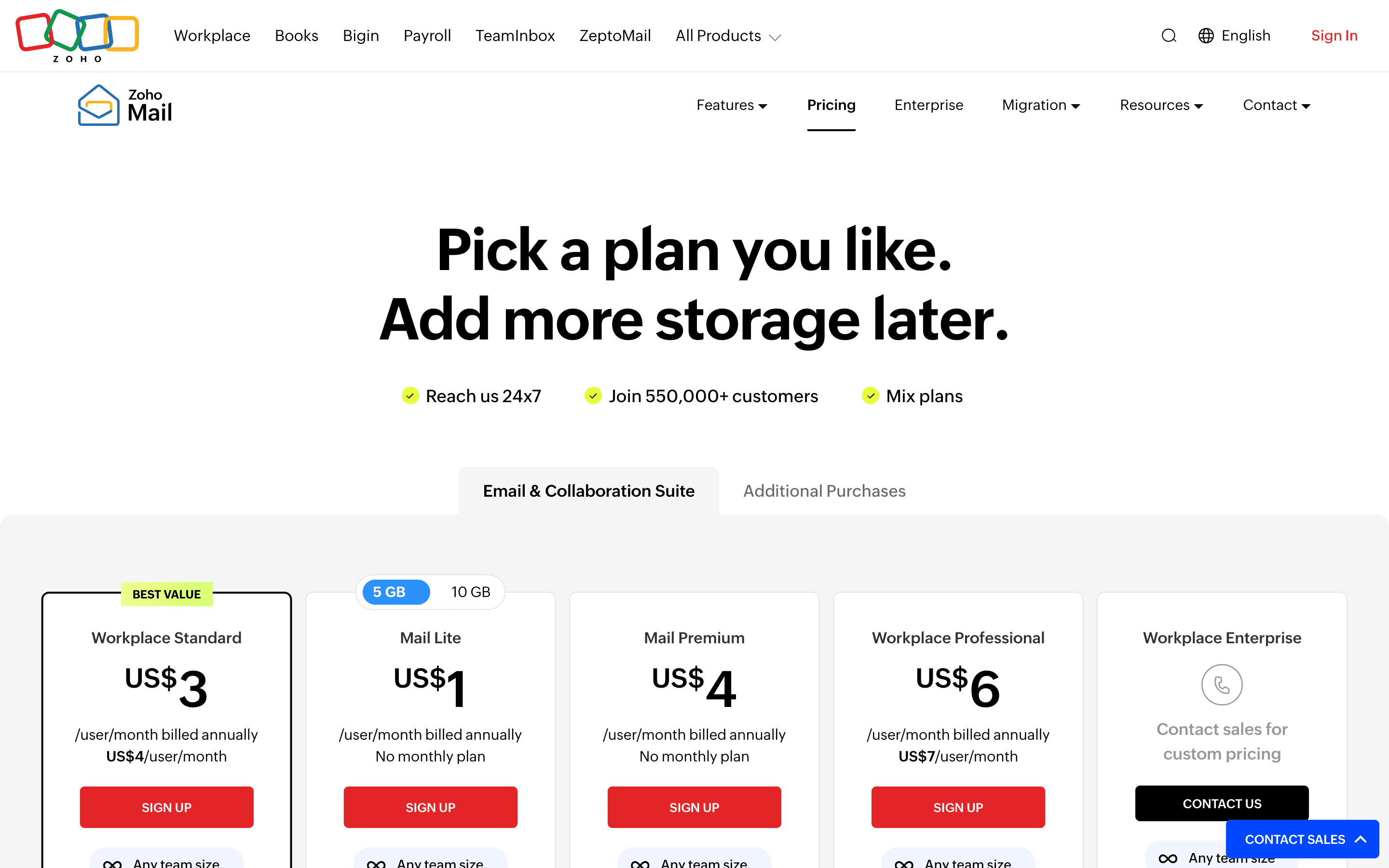
Zoho Mail is the cheapest named-tier business email on this list, with Mail Lite starting at $1 per user a month billed annually and its Forever Free plan covering up to 5 users on a real custom domain. The catch on the free plan is it dropped IMAP, POP, and ActiveSync access, so it's web-only unless you upgrade. Workplace Standard and Professional plans add a full office suite (WorkDrive, Writer, Sheet, Cliq, Meeting) at roughly the same per-user price as mail-only competitors, which makes Zoho a strong pick for a small business trying to avoid Google Workspace or Microsoft 365 prices. In May 2026 it also added its own MCP server so AI agents can manage a mailbox through prompts, arriving about a week after Fastmail's broader mail, calendar, and contacts version. Support response times are a recurring complaint, and Mail Lite and Mail Premium only bill annually with no monthly option to test the water first. Like Fastmail's, Zoho's MCP server connects an assistant to a mailbox you already own; it's not a way to provision new inboxes for an agent the way AgentMail does.
Pros
- + Cheapest named-tier pricing of any major business email provider, starting at $1/user/month
- + Free plan supports a real custom domain for up to 5 users
- + Workplace plans bundle a full office suite (docs, drive, chat, meetings) at the same per-user price as mail-only competitors
Cons
- – Free plan no longer includes IMAP, POP, or ActiveSync, so it's web-only unless you pay
- – Mail Lite and Mail Premium only bill annually, no monthly option if you want to try before committing
Should your product be on this email providers list?
If you build a tool that belongs next to the ones above, submit it. A human reviews every submission. Approved products get their own page with pricing and screenshots, plus a place in the comparisons where they fit. It is free. You sign in with your work email so you can follow the decision, and there is no password to create.
AgentMail alternatives: FAQ
What's the closest alternative to AgentMail if I actually just need email for my team?+
Gmail, through Google Workspace, is the safest default. It's the provider most vendors and clients already know how to work with, and it bundles the inbox with Docs, Drive, and Meet starting at $7 per seat a month.
Is there a cheaper alternative to AgentMail's business plans for a normal company inbox?+
Zoho Mail's Mail Lite tier starts at $1 per user a month billed annually, the lowest published business email price on this list, though it's separate from AgentMail's own agent-focused pricing.
Which alternative is best for a technical team that wants AI to work inside the mailbox itself?+
Fastmail shipped an MCP server in April 2026 that lets an assistant like Claude read and act on mail, calendar, and contacts with scoped permissions. Zoho Mail followed about a week later with a similar server scoped to the mailbox only.
Can any of these replace AgentMail for an AI agent that needs to send and receive its own email?+
No. Gmail, Fastmail, and Zoho Mail are all mailboxes built for a person to set up once, even the two with MCP servers just connect an assistant to that existing mailbox. None of them offer an API to provision inboxes on demand or push webhooks on incoming mail the way AgentMail does.
What should a developer look at instead, if none of these really replace AgentMail?+
Look at email platforms built for the same job as AgentMail: providers like Postmark, Mailgun, and Nylas let code send and receive mail and route incoming messages to webhooks, closer to what AgentMail does than any inbox on this list. We haven't reviewed them here yet.
AgentMail alternatives: pricing compared
Entry price, billing model, and whether pricing is public. 4 of 4 publish pricing you can check without talking to sales.
How we made these picks. We compare tools on public pricing, features, and hands-on assessment, then verify every price against the vendor's own page. We never accept payment for rankings. Read the full methodology. Spotted an error? Report it.
More email providers comparisons
Further reading
- Email inbox for AI agents: how to set one up - Agents need a real inbox with an API and webhooks, not a login. AgentMail is built for that; Gmail, Fastmail, and Zoho only bolt on partial access.