Top Firecrawl Alternatives in 2026
Here for Firecrawl itself? See the full Firecrawl profile, pricing & reviews →
Suggest a change- If you're scraping sites with heavy anti-bot protection at real volume, choose Bright Data. its residential and mobile IP pool plus 1,000+ site-specific scrapers are built for targets that fight back harder than Firecrawl's stealth mode is priced to handle.
- If you want a marketplace of ready-made scrapers instead of building extraction logic yourself, choose Apify. its Actor Store already has thousands of pre-built scrapers for sites like Amazon and LinkedIn, plus an MCP server so AI agents can call them directly as tools.
- If your scraping volume is spiky and you don't want to pay for a monthly credit block you might not use, choose Zyte. it bills per successful request with no monthly minimum, unlike Firecrawl's subscription-only tiers where unused credits expire.
- If you want a simpler feature surface than Bright Data or Octoparse, with an API shape close to Firecrawl's, and can live with weaker results on the toughest sites, choose ScrapingBee. plans start at $49/month, cheaper than Bright Data's $499/month Scale plan or Octoparse's $69-83/month cloud tiers, though independent testing shows only about a 31% success rate on the most heavily-protected targets.
- If your team wants to build scrapers by clicking on a page for bulk, template-based extraction rather than calling an API, choose Octoparse. its point-and-click template builder and 500+ preset templates are built for large one-off or scheduled batch pulls with no code, which fits ops and research teams better than Firecrawl's API-first design.
- If you want to monitor a page for changes and get alerted, not run a one-time bulk extraction, choose Browse AI. it trains a robot by clicking through a page once, then reruns it on a schedule and sends alerts or exports to Google Sheets, Airtable, or Zapier when something changes.
- If you're building an AI or RAG pipeline and want one API call to clean markdown or JSON, choose stay on Firecrawl. none of these alternatives package markdown output, a research index, and PII redaction as tightly for LLM pipelines, and its free tier and $19/month entry price are hard to beat for that specific job.
Firecrawl turns a URL into clean markdown or JSON with one API call, which is why so many AI and RAG pipelines default to it. Teams start looking elsewhere when they hit its credit ceiling: no pay-as-you-go option, credits that expire unused each month, and roughly a 5x credit cost for pages that fight back with bot detection.
The tools below split into two groups. Apify, Bright Data, Zyte, and ScrapingBee are code-first scraping APIs a developer can drop into a pipeline the same way they'd use Firecrawl. Octoparse and Browse AI are point-and-click builders for ops and research teams who want structured data without writing a script.
Firecrawl alternatives compared
| Tool | Best for | Starting price | Free option | Last update |
|---|---|---|---|---|
| ApifyBest marketplace of ready-made scrapers | Developers who want a large library of ready-made scrapers instead of building one from scratch | $29/mo | Yes | June 2026 |
| Bright DataBest for anti-bot heavy targets | Data teams scraping heavily-protected or high-volume sites that need a large, reliable IP pool | Usage-based | Yes | June 2026 |
| ZyteLowest floor for pay-per-success pricing | Developers who want a single API call to handle proxy rotation, browser rendering, and anti-bot bypassing instead of building that stack themselves | Usage-based | Yes | November 2025 |
| ScrapingBee | Developers who want a single API call instead of running their own headless browser and proxy pool | $49/mo | Trial (1,000 API credits, no credit card required) | January 2026 |
| Octoparse | Ops, research, or marketing teams that want scraped data without writing code | $69/mo | Yes | July 2026 |
| Browse AIBest no-code option for monitoring | Ops, marketing, and research teams who need structured data from websites without writing scraper code | $19/mo | Yes | June 2025 |
Why teams switch from Firecrawl
No pay-as-you-go plan, only monthly subscriptions
Firecrawl's own pricing FAQ confirms every paid tier is a subscription with no usage-only option, so teams with occasional or bursty scraping needs still pay for a full month of credits.
Credits don't roll over and expire unused each month
Standard plans lose unused credits at the end of the billing cycle, with exceptions only for auto-recharge credits and custom annual Scale/Enterprise deals.
Bot-protected pages cost roughly 5x the normal credit rate
Enhanced/stealth mode for sites that block plain scraping runs about 5 credits per page instead of 1, so scraping harder targets burns through a plan fast.
Concurrency is capped by plan, which bottlenecks large batch jobs
Concurrent requests range from 2 on Free up to 150 on Scale, so lower and mid tiers can queue up on big crawl jobs.
The best Firecrawl alternatives, ranked
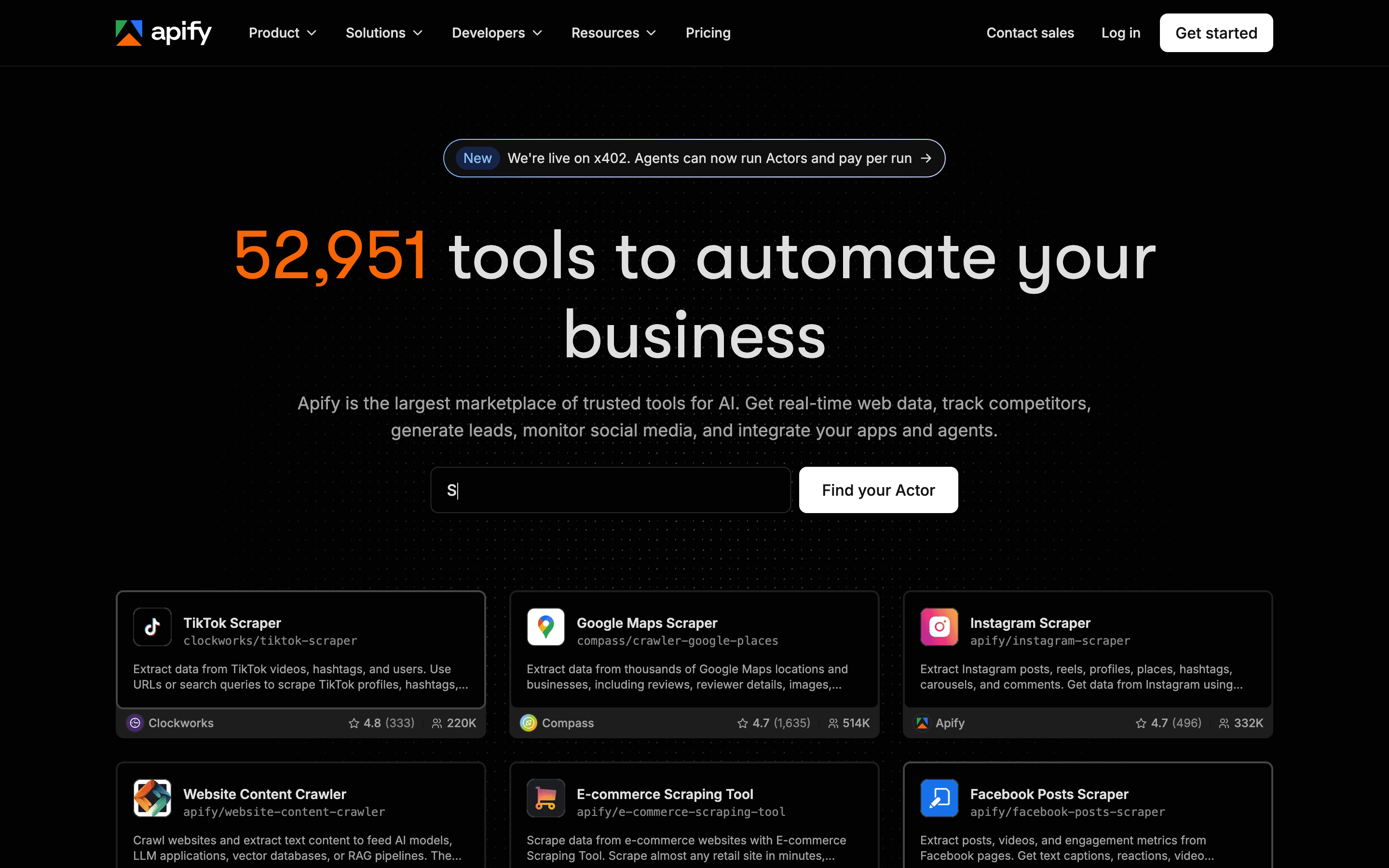
Apify is the biggest step up from Firecrawl if you want a marketplace instead of writing extraction logic yourself. Its Store has thousands of pre-built Actors for sites like Google Maps, Instagram, and Amazon, so jobs that would need a custom Firecrawl crawl config are often already built by someone else. Pricing starts at $29/month with a matching credit allowance, plus separate meters for compute units, proxy bandwidth, and storage, so the bill has more moving parts than Firecrawl's single credit pool. The free plan itself never expires or converts to a paid trial, but like every Apify tier its $5/month credit allotment does not roll over: unused credits are gone at the end of the month. Apify also runs an MCP server so AI agents can call Actors directly as tools, matching Firecrawl's own agent-pipeline audience. The tradeoff is a less predictable bill, since heavy anti-bot targets can push proxy costs past the subscription itself.
Pros
- + Huge marketplace of ready-made Actors, so many scraping jobs need zero code
- + Free plan is genuinely usable for small, occasional jobs, not just a trial
- + Handles the annoying parts of scraping at scale: proxy rotation, browser automation, and result storage
Cons
- – Monthly credits expire with no rollover, so uneven usage months mean paying for credits you don't use
- – Billing has several separate meters (compute units, proxy bandwidth, storage, per-Actor fees from third-party developers), which makes total cost hard to predict in advance
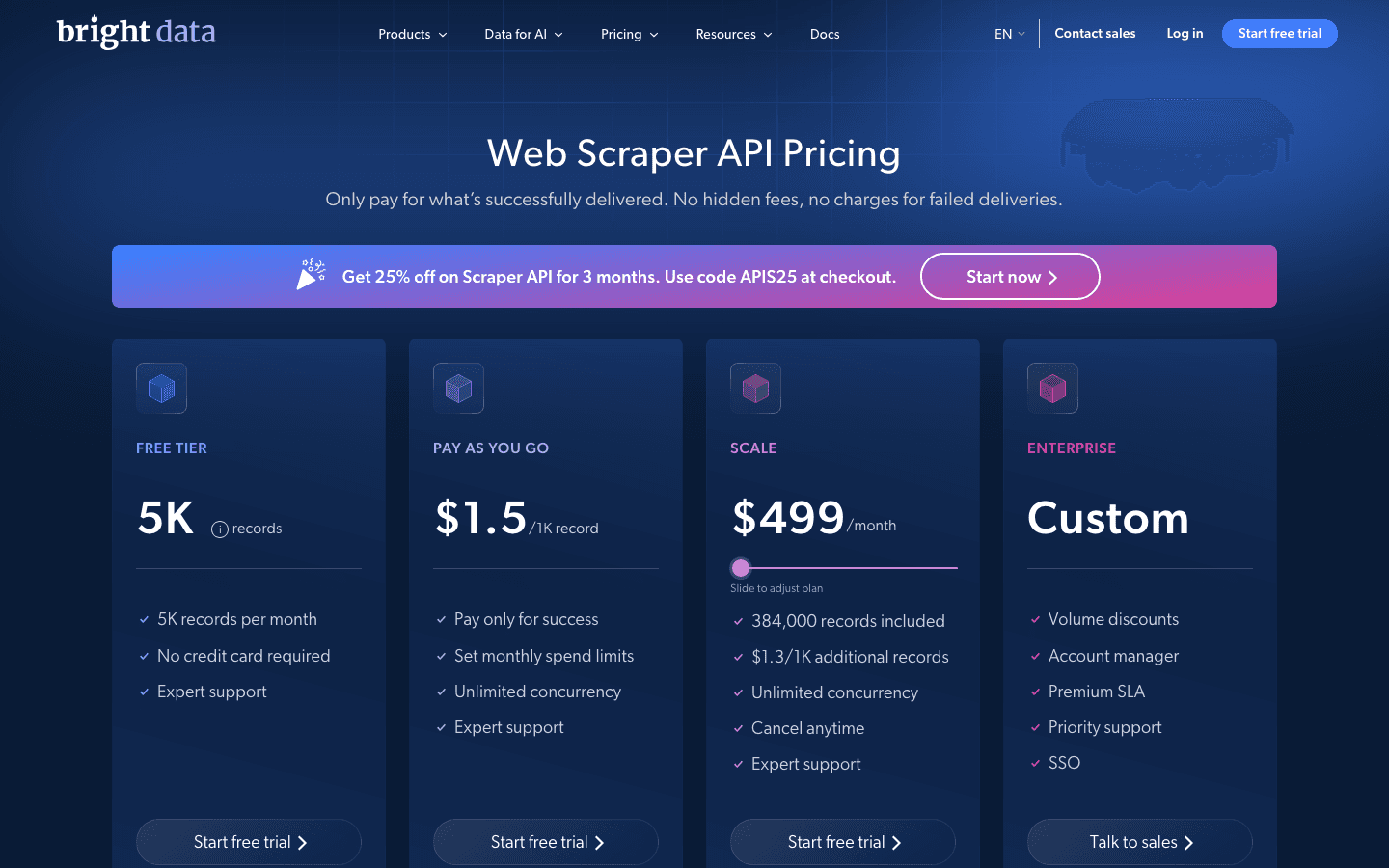
Bright Data is the pick once Firecrawl's credit system stops covering the sites you actually need. It runs one of the larger residential, datacenter, and mobile IP pools in the industry, plus 1,000+ pre-built scrapers for specific sites, which matters once a target starts blocking Firecrawl's stealth mode. Pricing is usage-based rather than a flat subscription: Web Scraper API and SERP API pay-as-you-go both start at $1.50 per 1,000 successful records, dropping to $1.30 on the $499/month Scale plan, and you're only billed for successful deliveries. The free tier gives 5,000 shared credits a month with no card required. The cost of that scale is complexity: pricing is split across separate pages for proxies, the Scraper API, SERP API, and Datasets, so estimating a real monthly bill takes more work than reading Firecrawl's single pricing page.
Pros
- + IP pool size and geographic coverage are hard to match, useful for high-volume or heavily geo-restricted targets
- + 1,000+ pre-built scrapers mean you often don't have to write scraping logic for popular sites
- + You aren't billed for failed requests on the Web Scraper API and SERP API pay-as-you-go plans, only successful deliveries
Cons
- – Pricing is spread across many separate product pages (proxies, Web Scraper API, SERP API, Scraping Browser, Datasets), so working out your real monthly cost takes effort
- – Pay-as-you-go rates run noticeably higher per unit than the committed monthly plans, which pushes usage-heavy teams toward locking into a $499+/month plan
Zyte is the closest match to Firecrawl's own pitch: point an API at a URL and get back content, with proxy rotation, headless rendering, and anti-bot handling done for you. The real difference is billing. Zyte charges per successful request rather than per monthly credit block, from about $0.06 to $1.27 per 1,000 HTTP requests depending on commitment tier, with no monthly minimum on the pay-as-you-go plan. That suits teams with spiky or occasional volume that Firecrawl's subscription-only tiers punish. Browser-rendered requests cost up to about 13x plain HTTP, a steeper multiplier than Firecrawl's own roughly 5x stealth-mode markup, so JavaScript-heavy targets can cost more here, not less. Zyte also owns Scrapy Cloud, useful if your team already builds spiders in the open-source Scrapy framework instead of calling a hosted API.
Pros
- + Per-request pricing means you don't pay for failed or blocked requests
- + Handles proxy rotation, headless browser rendering, and CAPTCHA/anti-bot bypass in one API instead of separate tools
- + Scrapy Cloud and the Web Scraping Copilot VS Code extension give existing Scrapy users a direct path from local development to hosted spiders
Cons
- – Browser-rendered requests cost up to roughly 13x the equivalent HTTP request, so costs scale fast on JavaScript-heavy sites
- – Zyte API and Zyte Data are paid only, with just a $5 signup credit for the first billing month; the genuinely free plan lives on the separate Scrapy Cloud product and caps crawls at 1 hour
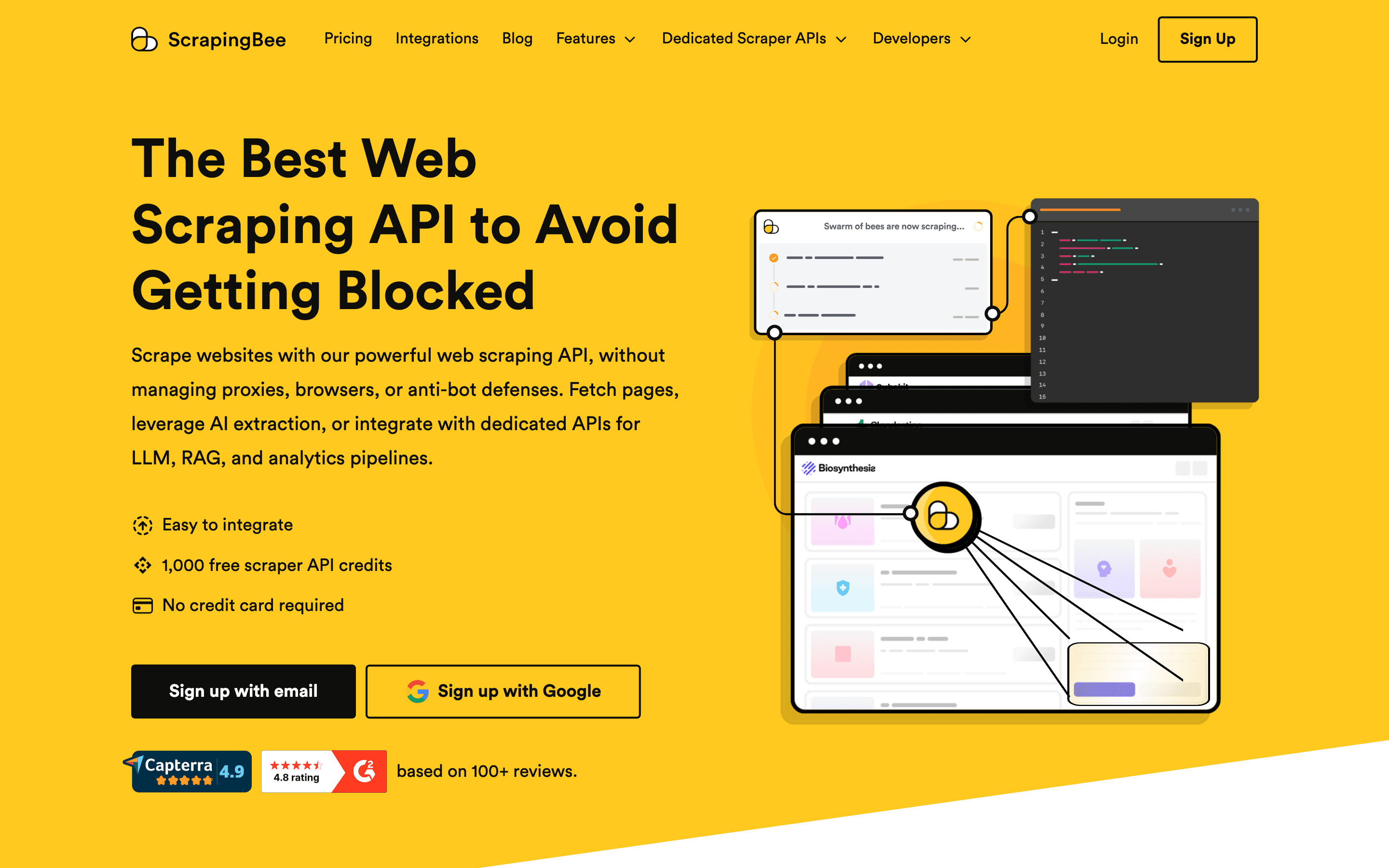
ScrapingBee fits teams that want an API as simple as Firecrawl's but with a lighter feature set. Plans start at $49/month for 250,000 credits, with a 1,000-credit free trial and no card required to test it. That's pricier to start than Firecrawl's free tier or its $19/month entry plan, but cheaper than Bright Data's $499/month Scale plan or Octoparse's $69-83/month cloud tiers. Its credit math has the same trap as Firecrawl's stealth mode: a plain request costs 1 credit, but JS rendering costs 5 and stealth proxies cost 75, so the headline credit count overstates real capacity once you turn on the features most scraping jobs actually need. Independent benchmarking puts its success rate on 13 heavily-protected sites at around 31%, with some major targets near 0%, so it works well for general-purpose targets but isn't the pick for LinkedIn- or Amazon-scale anti-bot fights. It joined the Oxylabs group in January 2026, with existing prices unchanged.
Pros
- + One API call replaces your own proxy rotation, headless browser, and CAPTCHA handling
- + Free 1,000-credit trial with no credit card, enough to test real workloads before paying
- + Support is consistently rated responsive, and the team doubled after the Oxylabs acquisition
Cons
- – Credit pricing is easy to misjudge. JavaScript rendering costs 5x a plain request, premium proxies 10 to 25x, and stealth proxies 75x, and JS rendering is on by default, so the advertised credit count on each plan overstates real capacity
- – Credits don't roll over month to month, and a request the target site blocks that still returns a 200 costs credits even though you got no usable data
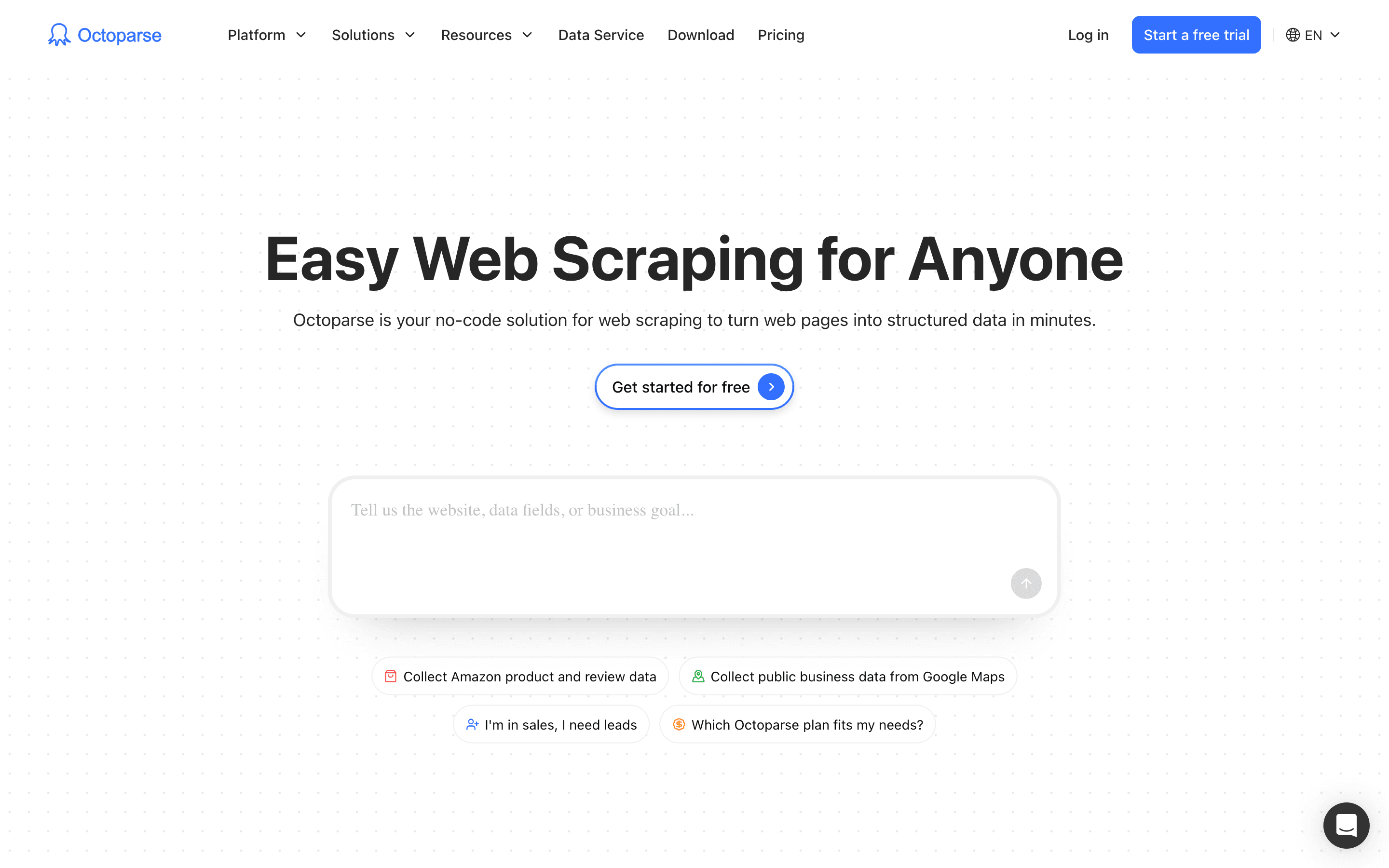
Octoparse is for the ops or research side of the reader base rather than the developer side: a desktop app where you click the fields you want on a page and it builds the scraper for you, no API call required. The free plan is a genuine forever tier (50,000 rows/month), and paid plans add cloud scheduling, IP rotation, and automatic CAPTCHA solving starting at $69/month billed annually ($83/month month-to-month). 500+ preset templates cover common sites out of the box. The catch is the jump between tiers: Standard caps out at 100 tasks and 3 concurrent cloud runs, so bigger jobs push you straight to the $249/month Professional plan (billed annually; $299/month month-to-month), and residential proxies and CAPTCHA solving are separate add-ons on top of whatever plan you're on.
Pros
- + Visual template builder gets a working scraper running in minutes without writing selectors
- + Free plan is a real free tier, not a time-limited trial, with 50,000 rows a month
- + 500+ prebuilt templates for common sites cut setup time for popular targets
Cons
- – Standard price jumps from free to $83/month (or $69/month billed annually) with no mid-tier option, and Professional jumps again to $299/month ($249/month billed annually)
- – Residential proxies ($3/GB), CAPTCHA solving ($1-1.5 per 1,000), and premium pay-per-result templates ($0.001-3 per 1,000 results) are billed as separate add-ons on top of the plan price
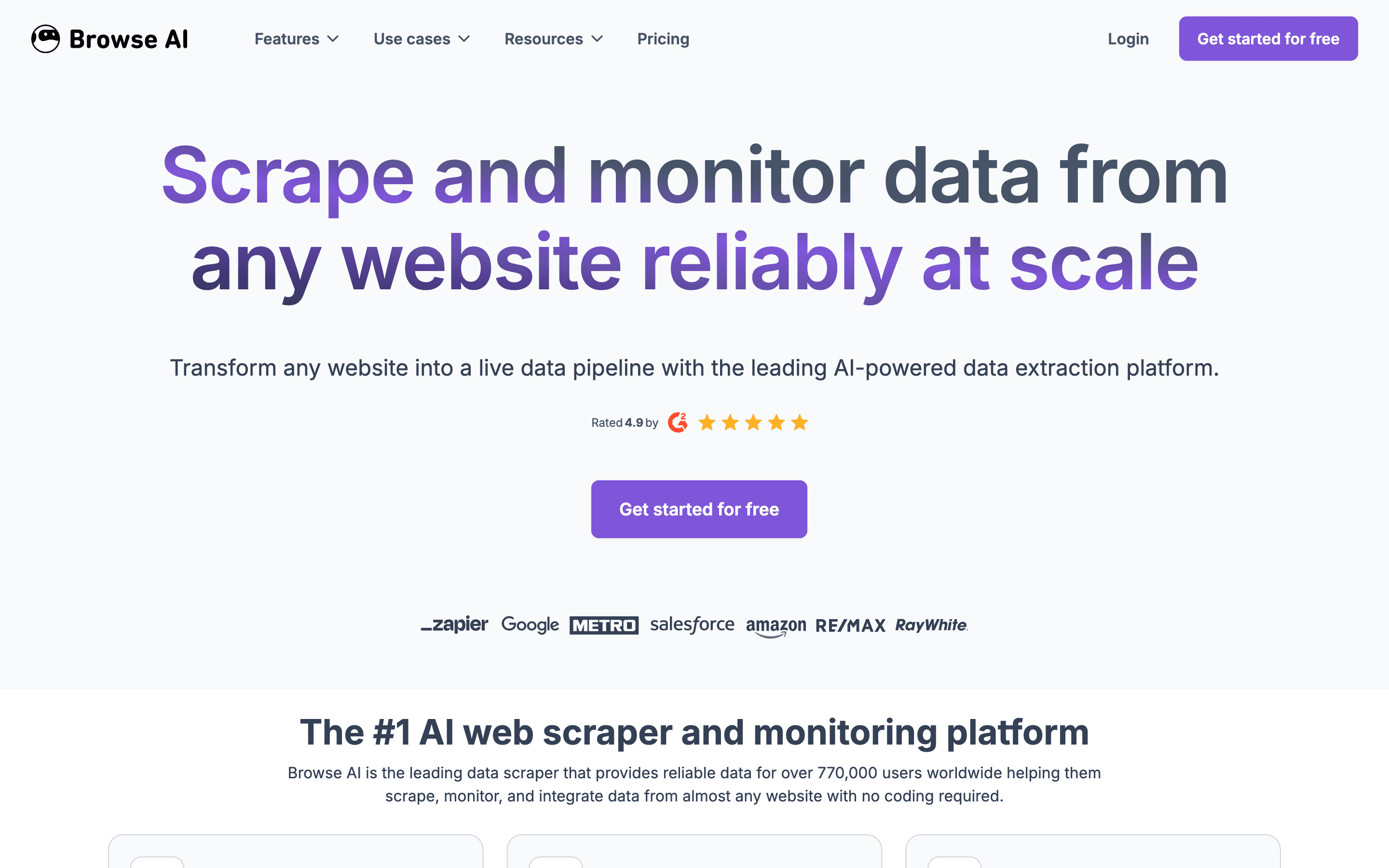
Browse AI covers the same no-code job as Octoparse but leans harder into monitoring: train a robot by clicking on a page once, then have it re-run on a schedule and alert you when something changes, with exports straight to Google Sheets, Airtable, or Zapier. The free plan gives 50 credits a month (1 credit equals 10 rows or 1 screenshot) across 2 websites, and paid tiers start at $19/month billed annually for 12,000 credits/year and 5 websites. It's SOC 2 Type 2 certified, which matters if scraped data touches client work. The gap versus Firecrawl is the same as Octoparse's: no code-first API or SDK layer, and G2 reviewers most often flag the free plan's credit limits as the thing they'd change.
Pros
- + Point-and-click robot training with prebuilt robots for common sites, no code required
- + Handles both scheduled monitoring and one-off bulk scraping from thousands of URLs in a single CSV upload
- + Wide range of export options: Google Sheets, Airtable, webhooks, API, and Zapier/Make
Cons
- – Credit-based pricing means heavy scraping and monitoring jobs can burn through your monthly allowance quickly, and G2 reviewers most often cite the free plan's credit limits as the thing they'd change
- – Jump from Personal ($19/month annual) to Professional ($69/month annual) is steep if you outgrow 5 websites or need more credits
Should your product be on this web scraping & data extraction list?
If you build a tool that belongs next to the ones above, submit it. A human reviews every submission. Approved products get their own page with pricing and screenshots, plus a place in the comparisons where they fit. It is free. You sign in with your work email so you can follow the decision, and there is no password to create.
Firecrawl alternatives: FAQ
What's the closest alternative to Firecrawl?+
Zyte and Apify are the closest matches. Both are APIs that take a URL and hand back structured content with proxy rotation and anti-bot handling built in, the same core job Firecrawl does. Zyte bills per successful request instead of a monthly credit block, while Apify adds a large marketplace of pre-built scrapers.
Is there a free alternative to Firecrawl?+
Yes. Apify's free plan gives $5 in credits a month on a plan that doesn't expire, and Bright Data's free tier includes 5,000 shared credits a month across its API products, both with no credit card required.
What's the best Firecrawl alternative for sites that block scrapers?+
Bright Data, because of its large residential and mobile IP pool and 1,000+ pre-built, site-specific scrapers. Zyte is a close second, with anti-bot handling built into its per-request API.
Is there a no-code alternative to Firecrawl?+
Octoparse and Browse AI both let you build a scraper by clicking on the fields you want on a page, with no API call required. Octoparse leans toward scheduled recurring jobs with 500+ preset templates, while Browse AI leans toward monitoring pages for changes and alerting you.
Firecrawl alternatives: pricing compared
Entry price, billing model, and whether pricing is public. 7 of 7 publish pricing you can check without talking to sales.
| Tool | Starting price | Billing | Free option | Pricing disclosed |
|---|---|---|---|---|
| Firecrawl | $19/mo | tiered | Yes | Partly public |
| Apify | $29/mo | tiered | Yes | Partly public |
| Bright Data | Usage-based | usage-based | Yes | Partly public |
| Zyte | Usage-based | usage-based | Yes | Partly public |
| ScrapingBee | $49/mo | usage-based | Trial (1,000 API credits, no credit card required) | Partly public |
| Octoparse | $69/mo | tiered | Yes | Partly public |
| Browse AI | $19/mo | tiered | Yes | Public |
How we made these picks. We compare tools on public pricing, features, and hands-on assessment, then verify every price against the vendor's own page. We never accept payment for rankings. Read the full methodology. Spotted an error? Report it.
More web scraping & data extraction comparisons
Further reading
- Best web scraping tools for AI agents in 2026 - Firecrawl is the default for clean markdown and JSON, but Apify, Bright Data, and ScrapingBee win when proxies, scale, or no-code monitoring matter more.