Top Proton Mail Alternatives in 2026
Here for Proton Mail itself? See the full Proton Mail profile, pricing & reviews →
Suggest a change- If encryption is the whole reason you're on Proton and you want it taken further, choose Tuta. Tuta encrypts subject lines by default and runs post-quantum cryptography on every plan, including free, which goes beyond what Proton's OpenPGP-based encryption covers.
- If you want a paid, ad-free mailbox with full IMAP access and a long track record, choose Fastmail. Fastmail has run continuously since 1999, has no free tier funded by ads or data mining, and gives every business plan real IMAP and CalDAV access so any mail client can connect.
- If you're a small business that wants a custom-domain inbox and office apps for almost nothing, choose Zoho Mail. Zoho's Mail Lite tier starts at $1 per user per month and its Workplace plans bundle WorkDrive, Writer, Sheet, and chat at the same per-user price as mail-only competitors.
- If your team already lives in Google Docs, Drive, and Meet, choose Gmail. Google Workspace bundles Gmail with the whole productivity suite your team already uses under one subscription and one login.
- If your team already runs on Microsoft 365 for Word, Excel, and Teams, choose Microsoft Outlook. Outlook comes bundled with the same Microsoft 365 subscription that already covers your office apps, so email rides along on a bill you're already paying.
- If you want VPN, a password manager, and encrypted mail from one company at one price, choose stay on Proton Mail. no alternative here bundles a full VPN, a fully-featured password manager, encrypted mail, and cloud storage the way Proton Unlimited and its household plans do.
Proton Mail's pitch is simple: encrypted email from a Swiss company, with a free plan that's actually free forever. It works well for people who want privacy without configuring anything themselves, and it saves money if you only need the full VPN and password manager bundle that arrives on Unlimited and up.
Where people start looking elsewhere: monthly billing costs noticeably more than annual on every tier, Proton raised its monthly Unlimited price in 2023, and subject lines and metadata stay unencrypted despite the privacy branding. Free-plan users also report slow support. The alternatives below range from stronger encryption to cheaper business bundles to mainstream office-suite email, depending on which part of Proton's job you actually need done.
Proton Mail alternatives compared
| Tool | Best for | Starting price | Free option | Last update |
|---|---|---|---|---|
| TutaBest for stronger encryption | Privacy-focused individuals who want encrypted email, calendar, and contacts without paying much | EUR 3/mo | Yes | July 2026 |
| Fastmail | Privacy-focused individuals who want to pay for email instead of being the product | $3/seat/mo | Trial (30 days, no credit card required) | April 2026 |
| Zoho MailBest for a small business bundle | Small businesses and solo founders who want a custom-domain inbox for close to nothing | $1/seat/mo | Yes | May 2026 |
| GmailBest for teams already on Google | People who just want a free, reliable personal inbox with strong spam filtering | $7/seat/mo | Yes | July 2026 |
| Microsoft Outlook | Small businesses that already plan to use Word, Excel, PowerPoint, and Teams and want one bill for all of it | $5.4/seat/mo | Yes | June 2026 |
| HEYBest for cutting inbox noise | People who get buried in cold email, newsletters, and marketing mail and want a hard gate before any of it reaches them | $99/yr | Trial (30 days on HEY for You, no credit card required) | January 2026 |
Why teams switch from Proton Mail
Monthly billing costs much more than annual, and Proton has raised the monthly rate before
Proton raised its monthly (non-annual) Unlimited plan price from $11.99 to $12.99 in 2023, citing added Pass features and rising Swiss data center costs, while leaving annual subscribers unaffected.
Free-plan users get slow or no support response
Free-plan users report slow or no response from Proton support, since paid accounts get priority handling.
The encryption doesn't cover everything people expect
Subject lines and metadata like sender, recipient, and timestamps are not encrypted, a limit of the OpenPGP standard Proton relies on, which surprises buyers who assumed the whole message was protected.
The best Proton Mail alternatives, ranked
Tuta is the alternative that takes Proton's privacy pitch and pushes it further. It encrypts subject lines by default, something Proton's OpenPGP-based system leaves in plain text alongside sender, recipient, and timestamp metadata. Every Tuta plan, including the free one, runs post-quantum cryptography rather than treating it as an add-on for higher tiers. Pricing undercuts Proton too: the Revolutionary plan unlocks a custom domain, unlimited calendars and labels, and 20 GB of storage for 3 euros a month billed annually, cheaper than Proton's Mail Plus. The tradeoffs are real. Tuta doesn't support standard IMAP, so you can't point Apple Mail or Outlook at it the way you can with Gmail or Fastmail, and new signups go through a manual anti-abuse review that Tuta says takes up to 48 hours, with one reviewer waiting five days. For anyone whose main reason for wanting Proton is encryption, not the VPN or password manager bundle, Tuta is the tighter fit.
Pros
- + End-to-end encrypts subject lines too, not just message bodies, which most competitors don't do
- + Post-quantum encryption is standard on every plan, including free
- + Cheapest paid tier (Revolutionary) unlocks a custom domain, unlimited calendars, and 20 GB for €3/month billed annually
Cons
- – No inline image embedding and image previews show a warning frame that some users find intrusive
- – Monthly billing costs noticeably more than annual billing on every plan (for example Revolutionary is €3.60/month monthly vs €3/month annual)
Fastmail
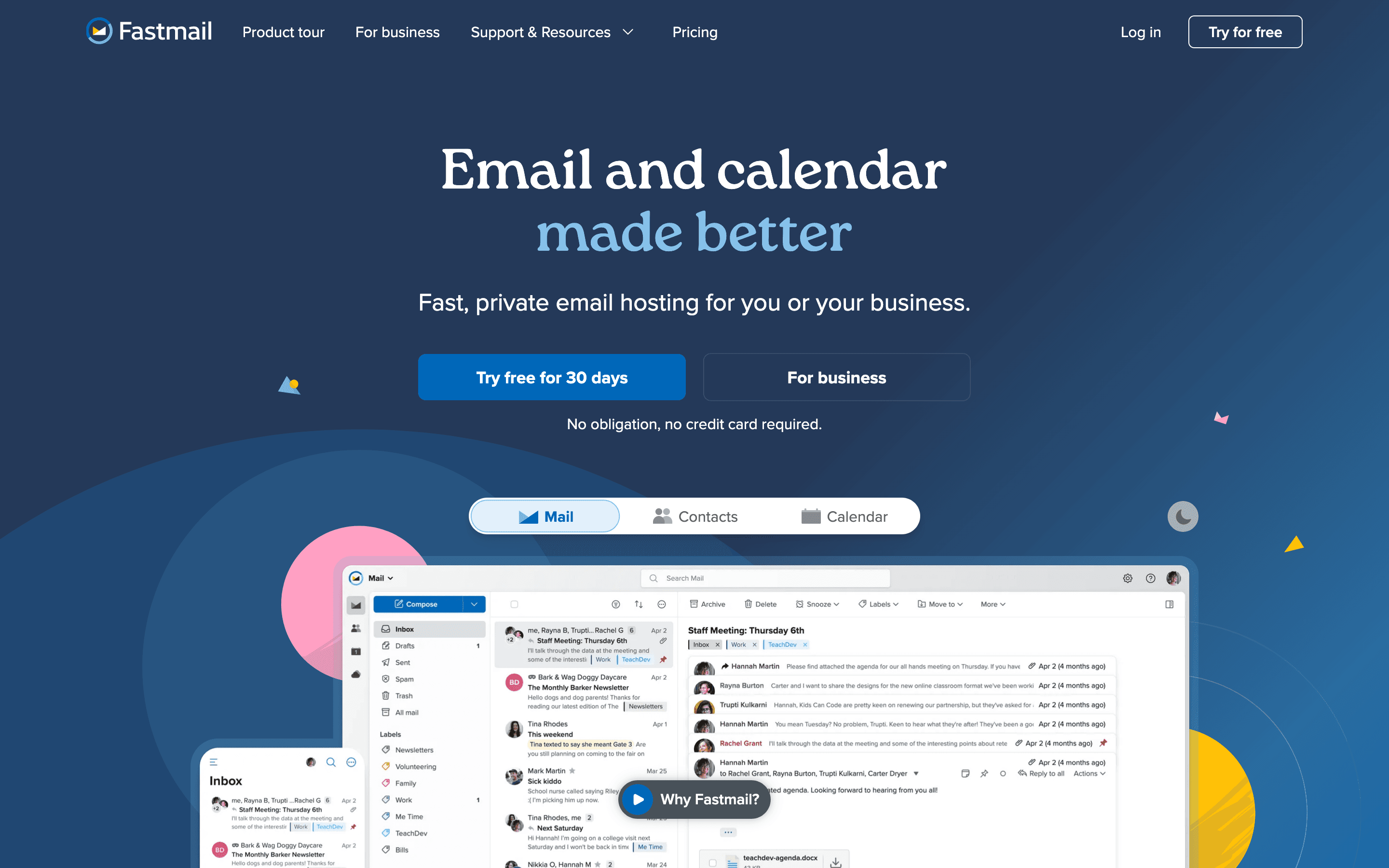
Fastmail skips the privacy marketing and sells the plain thing: a fast, reliable, ad-free mailbox you pay for directly, with no free tier funding the business off your data. It has run continuously since 1999 and went employee-owned after a 2013 buyout from Opera, which is most of its pitch to Proton switchers who want a company with a long track record rather than encryption promises. Every plan includes masked email aliases and real IMAP and CalDAV access, though Business Basic, the $3-per-user entry seat, holds third-party client access back for Standard and up. It recently shipped an MCP server so AI assistants can read and act on mail with scoped permissions. What it doesn't do is encrypt messages end to end the way Proton or Tuta do, and there's no free plan at all, just a 30-day trial.
Pros
- + No ads, no free tier funded by scanning your mail
- + Independent and employee-owned since a 2013 staff buyout from Opera Software, running continuously since 1999
- + Fast, capable webmail and mobile apps built on JMAP, the open protocol Fastmail itself designed
Cons
- – No free plan at all, unlike Gmail, Outlook, or Proton Mail's limited free tier
- – Storage on the cheapest business tier (6 GB per user) is thin next to Google Workspace or Microsoft 365
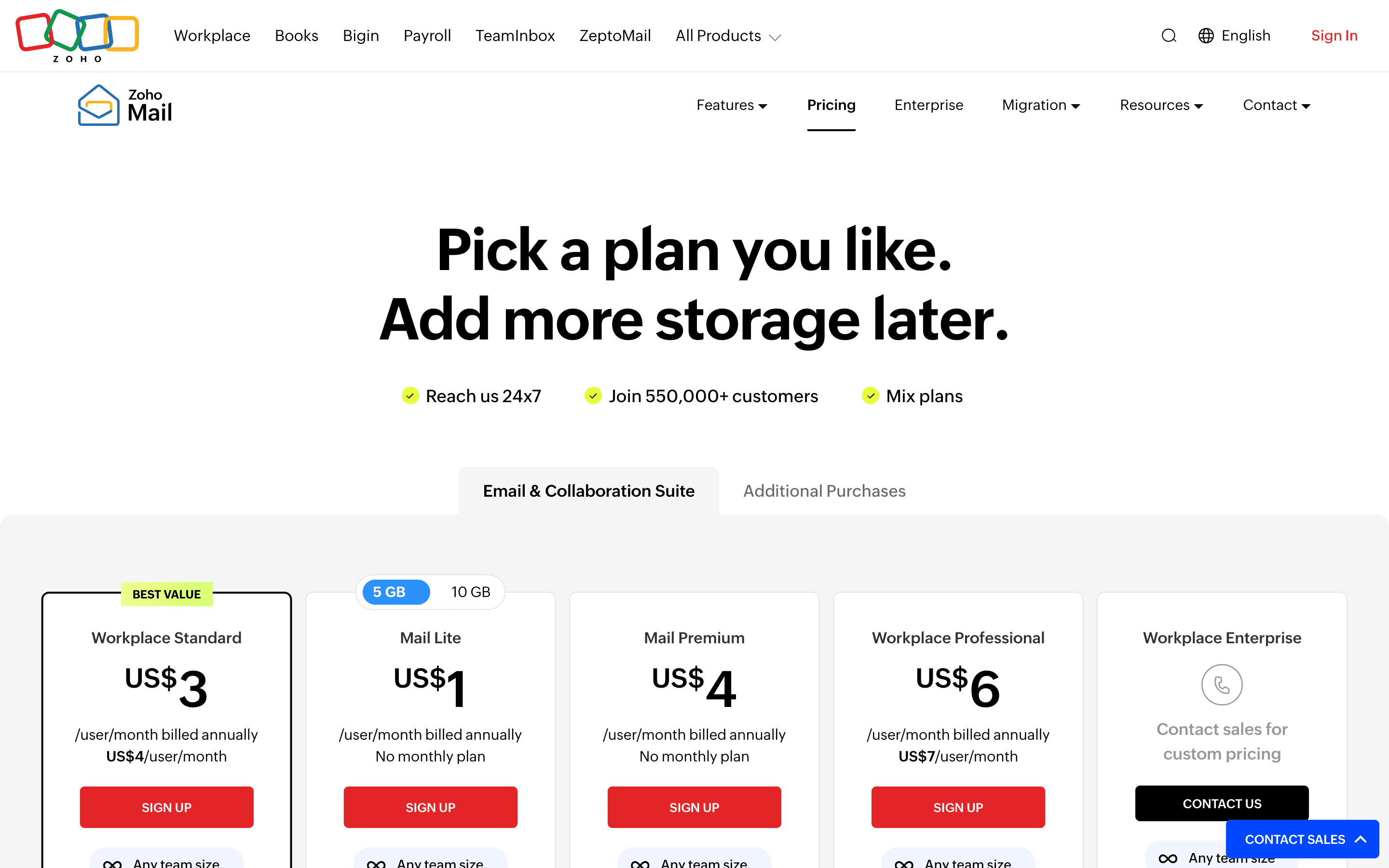
Zoho Mail is the pick for small businesses that want a custom-domain inbox and an office suite for close to nothing. Paid tiers start at $1 per user per month for Mail Lite, and Workplace plans add WorkDrive, Writer, Sheet, Show, Cliq, and Meeting at the same per-user price point as mail-only competitors elsewhere. Its Forever Free plan covers up to 5 users on one custom domain, more generous for teams than Proton's single-address free plan, though it's web-only with no IMAP, POP, or ActiveSync. Zoho doesn't encrypt mail end to end and doesn't bundle a VPN or password manager the way Proton's higher tiers do, so it's a fit for buyers who came to Proton mainly for an affordable business inbox rather than the privacy suite. Support response times are a recurring complaint, especially during setup.
Pros
- + Cheapest named-tier pricing of any major business email provider, starting at $1/user/month
- + Free plan supports a real custom domain for up to 5 users
- + Workplace plans bundle a full office suite (docs, drive, chat, meetings) at the same per-user price as mail-only competitors
Cons
- – Free plan no longer includes IMAP, POP, or ActiveSync, so it's web-only unless you pay
- – Mail Lite and Mail Premium only bill annually, no monthly option if you want to try before committing
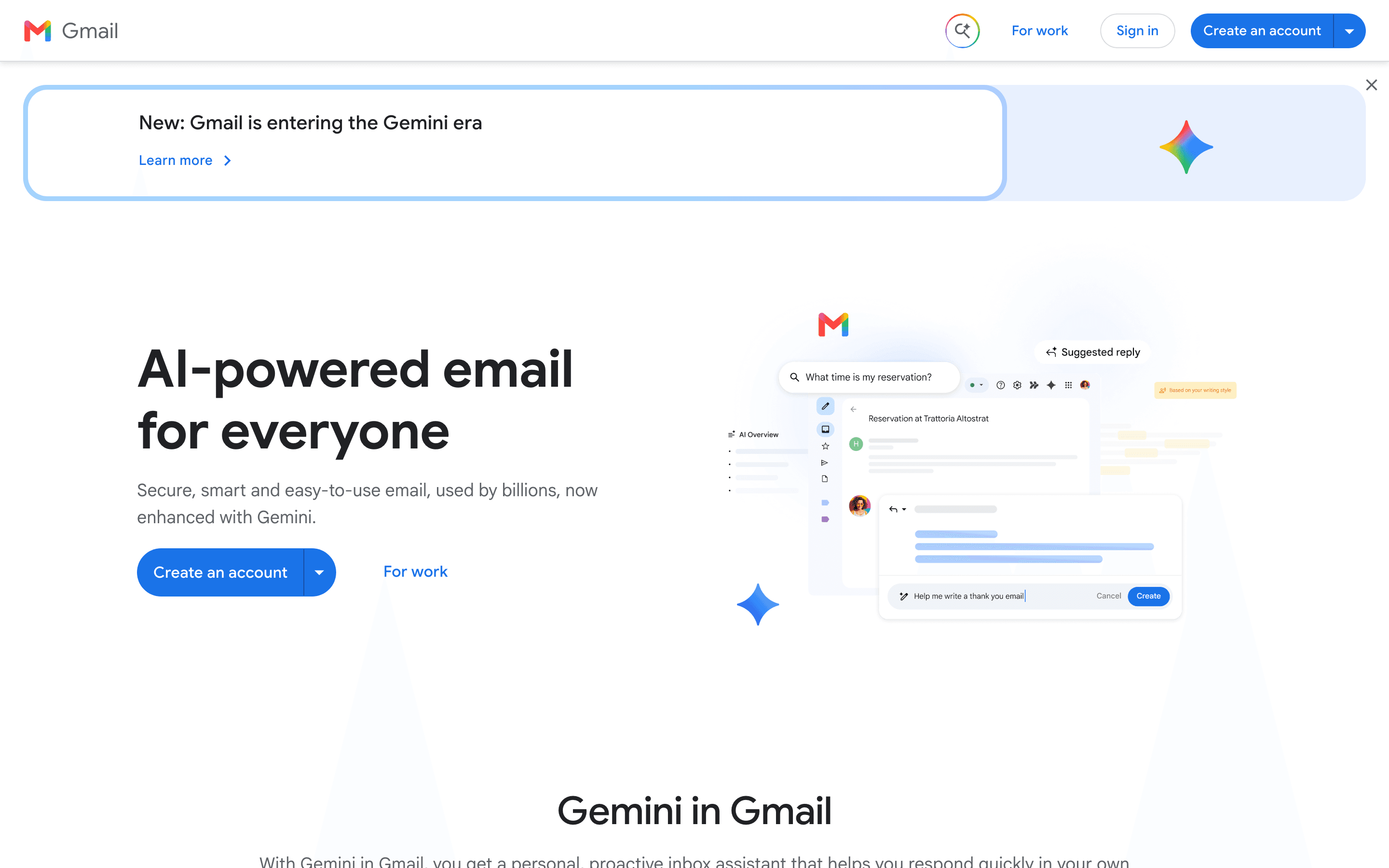
Gmail is the obvious landing spot for anyone who values compatibility and team tools over privacy guarantees. There's no way to buy just a business inbox: Google Workspace bundles Gmail with Drive, Docs, Meet, and Calendar starting at $7 per user per month billed annually, so switching also means adopting Google's whole office suite. Gemini is built into Gmail on every paid tier for drafting and summarizing, and deliverability benefits from the fact that most of the internet's inboxes already run on Gmail. The personal @gmail.com tier is free forever with 15 GB shared across Gmail, Drive, and Photos. What you give up coming from Proton is the privacy positioning entirely: Gmail runs ads on the free tier and keeps mail inside Google's broader ad and AI ecosystem.
Pros
- + Free personal tier is genuinely free forever, not a time-limited trial
- + Spam filtering and deliverability are best-in-class since most of the internet's inboxes are Gmail
- + Business plans bundle Drive, Docs, Meet, and Calendar, so one subscription covers most of what a small company needs
Cons
- – You cannot buy a standalone business email account. Google Workspace pricing forces you into the full productivity suite even if you only want mail
- – The free personal tier does not include Gemini's AI writing tools inside Gmail itself, only the separate Gemini chat app
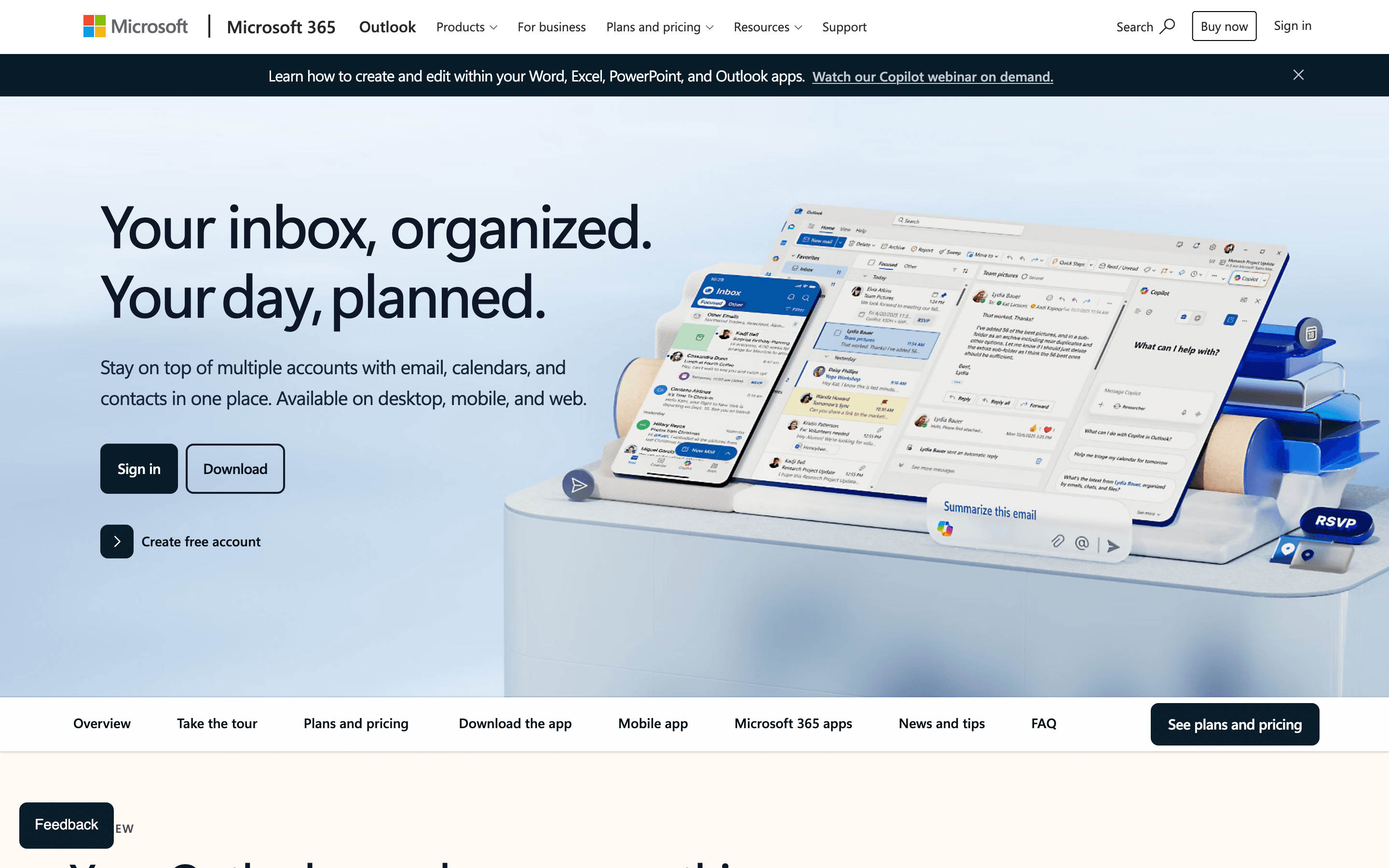
Outlook fits teams that already run on Microsoft 365 for Word, Excel, and Teams and want one bill covering email too. A free Outlook.com inbox gives 15 GB of storage, but a real business address needs at least the Business Basic tier without Teams, at $5.40 per user per month billed annually. The Teams-included Business Basic tier costs $7 and rose 16.7% in a July 2026 price increase, the sharpest since 2022. Copilot email drafting isn't part of either Business Basic tier or plain Business Standard. It's bundled only on the separate Business Standard with Copilot tier at $23.50 per user per month, or on the Microsoft 365 Personal plan at $9.99 a month. Coming from Proton, the biggest gap is privacy: New Outlook for Windows has been reported to route third-party account passwords through Microsoft's own servers, and German regulators have said Microsoft 365 doesn't meet GDPR requirements for schools and public bodies, the opposite of Proton's Swiss, privacy-first positioning.
Pros
- + One subscription covers email, calendar, Word, Excel, PowerPoint, and Teams, so there's no separate email bill for teams already on Microsoft 365
- + Copilot can draft, summarize, and reply to email directly inside Outlook, no separate AI tool needed
- + Familiar interface most people have already used at a past job or school
Cons
- – Microsoft raised Business Basic and Business Standard prices 12-17% in July 2026, the sharpest jump since 2022, and the cheapest per-seat rate requires an annual commitment
- – You cannot buy Outlook alone at the advertised low prices; a real business email address needs at least the Business Basic seat
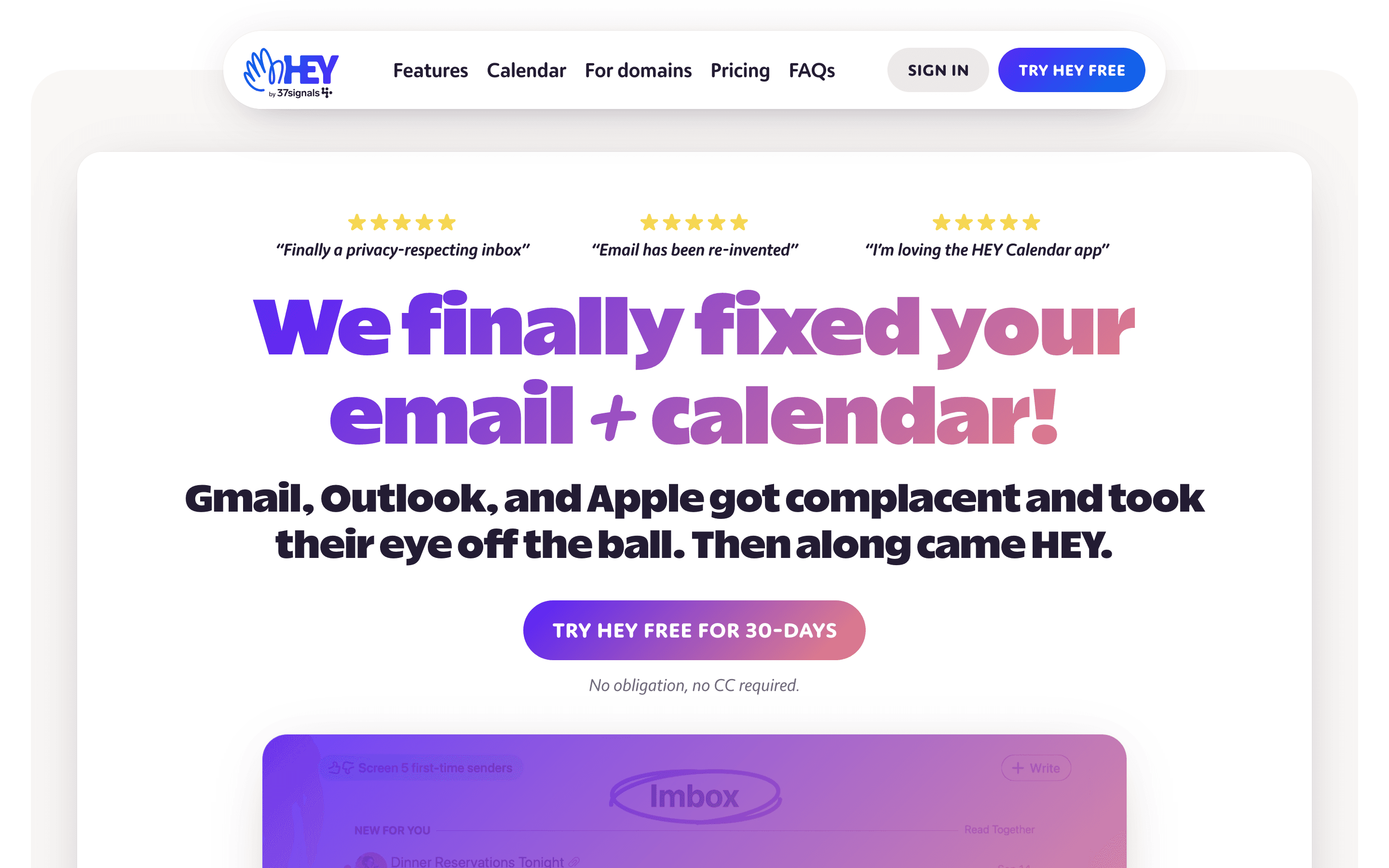
HEY solves a different problem than Proton does: not who can read your mail, but who gets into your inbox in the first place. New senders sit in a screener until you approve them, and approved mail sorts itself into Imbox, Feed, and Paper Trail automatically. HEY for You is a flat $99 a year with no seat math, and HEY for Domains extends the same screening to a company domain at $12 per user per month. It has no end-to-end encryption and no IMAP or POP support, so third-party clients can't connect. For a Proton user whose real complaint is inbox noise, cold email, and read tracking rather than encryption strength, HEY is a better-matched alternative than any of the other tools here.
Pros
- + The screener genuinely stops unwanted senders before they hit your inbox, not after
- + Imbox, Feed, and Paper Trail auto-sorting cuts down on manual filing
- + Calendar, blog (HEY World), and email all live in one account with one login
Cons
- – No free tier. You pay $99/year even for a single personal address once the trial ends
- – Short @hey.com addresses cost far more ($349/year for 3 characters, $999/year for 2 characters)
Should your product be on this email providers list?
If you build a tool that belongs next to the ones above, submit it. A human reviews every submission. Approved products get their own page with pricing and screenshots, plus a place in the comparisons where they fit. It is free. You sign in with your work email so you can follow the decision, and there is no password to create.
Proton Mail alternatives: FAQ
What's the best free alternative to Proton Mail for a business domain?+
Zoho Mail's Forever Free plan supports up to 5 users on one custom domain, which is more generous for a small team than Proton's free plan, which is limited to a single address. It's web-only, though, with no IMAP, POP, or ActiveSync access.
Is any alternative more private or more encrypted than Proton Mail?+
Tuta goes further than Proton on encryption. It encrypts subject lines, which Proton leaves in plain text, and runs post-quantum cryptography by default on every plan rather than as an upgrade.
What's the cheapest paid alternative to Proton Mail?+
Zoho Mail's Mail Lite tier is $1 per user per month billed annually. Tuta's Revolutionary plan, which adds a custom domain, is 3 euros a month billed annually.
Which alternative works best if my team already uses Google or Microsoft tools?+
Use Gmail through Google Workspace if your team is already on Docs, Drive, and Meet. Use Outlook through Microsoft 365 if your team already runs Word, Excel, and Teams. Both bundle email with the office suite you're already paying for.
Proton Mail alternatives: pricing compared
Entry price, billing model, and whether pricing is public. 7 of 7 publish pricing you can check without talking to sales.
| Tool | Starting price | Billing | Free option | Pricing disclosed |
|---|---|---|---|---|
| Proton Mail | EUR 3.99/seat/mo | tiered | Yes | Public |
| Tuta | EUR 3/mo | tiered | Yes | Public |
| Fastmail | $3/seat/mo | per-seat | Trial (30 days, no credit card required) | Public |
| Zoho Mail | $1/seat/mo | per-seat | Yes | Partly public |
| Gmail | $7/seat/mo | freemium (personal) / per-seat (Google Workspace for business) | Yes | Partly public |
| Microsoft Outlook | $5.4/seat/mo | tiered | Yes | Public |
| HEY | $99/yr | flat | Trial (30 days on HEY for You, no credit card required) | Public |
How we made these picks. We compare tools on public pricing, features, and hands-on assessment, then verify every price against the vendor's own page. We never accept payment for rankings. Read the full methodology. Spotted an error? Report it.