Best HR software for startups under 50 employees
Gusto wins on price and setup for single-state US payroll under 50 people. Rippling wins once IT ties to HR, and Deel wins for hiring outside the US.
The best HR software for startups under 50 employees
Five tools compete for this job, but the fit is straightforward once you know your situation. The best HR software for startups under 50 people is Gusto for single-state US payroll, Rippling once IT and device management need to sit on the same employee record as HR, and Deel the moment your first hire outside the US shows up. BambooHR and HiBob solve a narrower problem: stronger hiring, onboarding, or culture tools once payroll is already handled elsewhere. None of the five is free, and per-employee fees mean the real bill runs bigger than the headline number once you add the base fee, the add-ons, and your actual headcount.
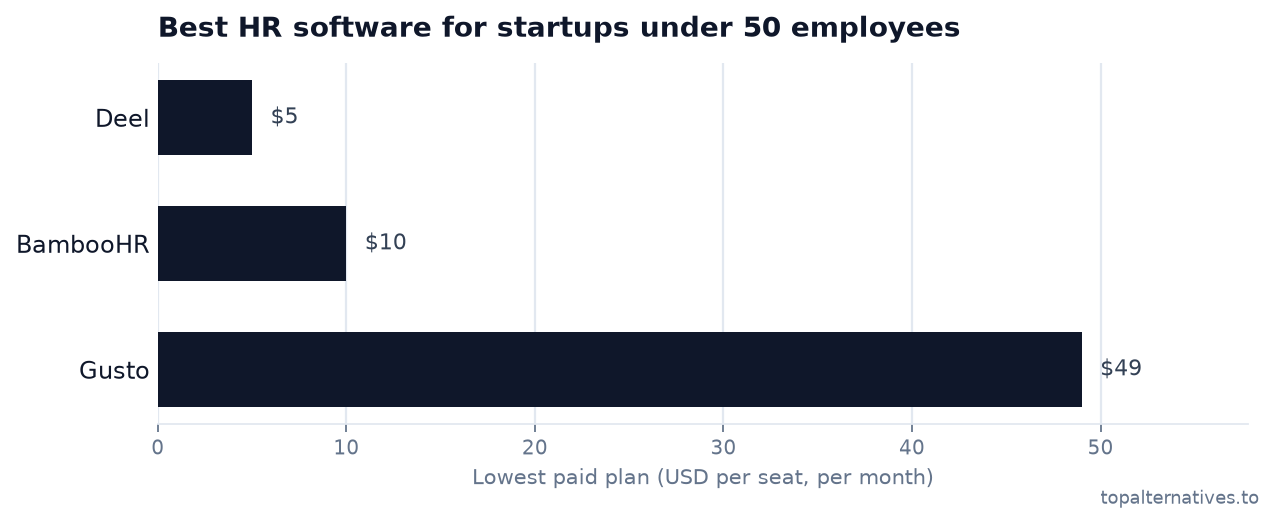
Here's how the math and the fit break down at this size.
The five options, side by side
| Tool | Starting price | Pricing model | Best fit under 50 people |
|---|---|---|---|
| Gusto | $49/mo base + $6/mo per person (Simple) | Published, flat base + per-seat | US-only, single-state payroll, wants self-serve setup |
| Rippling | No published price; demo required | Quote-only, per-module PEPM | Wants HR, payroll, and IT device management on one record |
| Deel | $5/mo per person (Core HR only, no payroll) | Published per product line | Hiring or paying people outside the US |
| BambooHR | $10/mo per person (Core), $250/mo minimum under 25 people | Published tiers, quote to sign up | Wants stronger hiring and onboarding than Gusto offers |
| HiBob | No published price; demo required | Quote-only, per employee + modules | Culture and engagement tools matter as much as core HR |
All five prices come from each vendor's own pricing page as checked in our tool profiles on 2026-07-06. Confirm your own quote before budgeting, since add-ons and negotiated terms move the real number.
Payroll-first: Gusto is the default at this size
Most startups under 50 people don't need a platform. They need payroll that runs correctly, taxes filed on time, and benefits that don't require a call to set up. That's Gusto's whole pitch, and its pricing is built for a company this size: Simple is $49/month plus $6/month per person, covers single-state payroll, unlimited payroll runs, and full tax filing. A 20-person company on Simple pays about $169/month, no sales call required.
The catch shows up the moment you have people in more than one state. Simple only supports single-state payroll, and multi-state work forces an upgrade to Plus at $80/month plus $12/month per person, which for that same 20-person team jumps the bill to $320/month. Core HR extras like a dedicated HR resource center or priority support aren't included at any tier below Premium ($180/month plus $22/month per person); they're separate paid add-ons on top. And Gusto's Simple base fee itself rose from $40 to $49 in March 2026, so the plan is getting less cheap over time, not more.
For a US-only startup that wants payroll and basic benefits handled without friction, Gusto is still the right starting point. Full details are in our Gusto profile, and if you want to see who else competes for that job, our Gusto alternatives ranking covers the field.
All-in-one: Rippling once IT joins the HR conversation
Rippling's pitch is different from Gusto's. It's not trying to be the cheapest payroll tool. It's trying to be the one employee record that also runs your IT: laptops, SaaS app provisioning, device management, and spend controls, all tied to the same hire, role change, or termination event that updates payroll.
That matters more than it sounds like at a 30-40 person startup, where someone in ops is usually manually deprovisioning a departing employee's Slack, Gmail, and GitHub access by hand. Rippling automates that off the same HR record.
The tradeoff is real: Rippling publishes no pricing anywhere on its site. Every quote requires a sales demo, and Rippling's own FAQ confirms each module, payroll, benefits, device management, is billed separately per employee per month on top of a required base platform fee. Third-party contract-data trackers (not Rippling's own numbers) put typical blended costs around $15-50 per employee per month once several modules are active, well above Gusto's flat published fees, and multi-year contracts are common. If your team is mostly non-technical and nobody's asking for device management, that's cost you don't need. See the full Rippling profile and the Rippling alternatives hub for how it stacks up against the rest of the field.
Global: Deel when your first hires aren't all in the US
A growing number of startups under 50 people have their second or fifth hire sitting in another country before they have a US entity strategy figured out, let alone a foreign one. That's the specific problem neither Gusto nor Rippling's core plan solves well. Gusto's full-time payroll only reaches the US plus 12 countries through its Gusto Global service. Rippling requires a custom quote to even see what global payroll costs.
Deel's Core HR module starts at $5/employee/month, the cheapest published entry point on this list, though that's a bare HR layer, not payroll. Standard contractor management is $49/contractor/month with no fee charged to the contractor for USD payouts. If you need to legally employ someone full-time abroad, Deel's Employer of Record product covers 110+ countries, starting at $599/employee/month for Standard and rising to $899 for Enterprise. That's a steep number next to Gusto's domestic tiers, but it replaces the cost and time of setting up a foreign legal entity, which for a startup under 50 people usually isn't worth doing for one or two hires. Read the Deel profile for the full breakdown across its contractor, payroll, and EOR product lines, or see the Deel alternatives hub for the rest of the global-hiring field.
Point HR: BambooHR and HiBob when payroll isn't the problem
Some startups already have payroll sorted, through a PEO, an accountant, or one of the tools above, and the actual gap is hiring, onboarding, or keeping people engaged as headcount climbs past 20 or 30.
BambooHR publishes real per-employee prices, unusual for this category: Core at $10/employee/month, Pro at $17, Elite at $25, with a flat $250/month minimum for companies of 25 or fewer people. It covers hiring, onboarding, time-off tracking, and (as a separate US-only add-on) payroll. You still have to submit a quote request to sign up, so it's not fully self-serve, but at least you know the number going in.
HiBob is built more for the 75-5,000 employee range, so it's a stretch at under 50 people, but some startups pick it anyway for the interface and culture tools: a social home feed, shoutouts, engagement surveys. There's no published price. Every deal is quote-only, calculated per employee plus a reported 10-20% implementation fee, so budgeting ahead of a sales call is hard. If culture tooling is the actual priority and you can stomach the sales process, it's worth a demo. Otherwise, at under 50 employees, BambooHR is the more proportionate point-HR pick. See the BambooHR profile and HiBob profile for the rest of what each one covers.
The actual per-employee math
Sticker prices don't tell you what a 20-person or 40-person startup pays, because base fees and per-seat charges combine differently on each tool.
- Gusto Simple, 20 people: $49 + (20 x $6) = $169/month, or about $8.45/person/month blended.
- Gusto Plus, 20 people (multi-state): $80 + (20 x $12) = $320/month, or $16/person/month blended.
- BambooHR Core, 20 people: $10 x 20 = $200/month, no base fee, but companies with 25 or fewer people pay the $250/month minimum instead, whichever is higher.
- Deel Core HR only, 20 people: $5 x 20 = $100/month, but this doesn't include payroll.
- Rippling and HiBob: no way to run this math without a quote. Treat any number a sales rep gives you as a starting point for negotiation, not a final price.
At under 50 employees, the base fee on Gusto and the $250 BambooHR minimum matter more than the per-seat rate. A 12-person startup on Gusto Simple pays $49 + $72 = $121/month; the same team on BambooHR pays the $250 minimum, more than double, because BambooHR's per-seat math doesn't clear its own minimum until you're past 25 people.
FAQ
What's the cheapest HR software for a startup under 50 employees?
Gusto's Simple plan is the cheapest way to get payroll, tax filing, and basic HR running, at $49/month plus $6/month per person for single-state US payroll. Deel's Core HR module is technically cheaper per seat at $5/employee/month, but it doesn't include payroll.
Do I need Rippling or Deel if I'm US-only with fewer than 50 employees?
Not necessarily. Rippling's value is tying HR to IT device management and app provisioning, which mostly matters once you have real device/access sprawl to manage. Deel's value is legal employment outside the US. If every employee is a US-based W-2 hire and nobody needs device management, Gusto or BambooHR covers the job for less.
Does any of these five have a free plan?
No. None of Gusto, Rippling, Deel, BambooHR, or HiBob offer a free-forever tier. Deel's Core HR at $5/employee/month is the cheapest entry point, and Gusto's sign-up is free only until you run payroll.
When does it make sense to upgrade from Gusto to Rippling or Deel?
Move to Rippling when you're managing enough devices and SaaS accounts that manual IT offboarding is a real cost. Move to Deel when you're hiring your first full-time employee in a country Gusto Global doesn't cover, since Gusto's EOR service reaches only the US plus 12 countries.
Keep reading
FAQ
What's the cheapest HR software for a startup under 50 employees?+
Gusto's Simple plan is the cheapest way to get payroll, tax filing, and basic HR running, at $49/month plus $6/month per person for single-state US payroll. Deel's Core HR module is technically cheaper per seat at $5/employee/month, but it doesn't include payroll.
Do I need Rippling or Deel if I'm US-only with fewer than 50 employees?+
Not necessarily. Rippling's value is tying HR to IT device management and app provisioning, which mostly matters once you have real device or access sprawl to manage. Deel's value is legal employment outside the US. If every employee is a US-based W-2 hire and nobody needs device management, Gusto or BambooHR covers the job for less.
Does any of these five have a free plan?+
No. None of Gusto, Rippling, Deel, BambooHR, or HiBob offer a free-forever tier. Deel's Core HR at $5/employee/month is the cheapest entry point, and Gusto's sign-up is free only until you run payroll.
When does it make sense to upgrade from Gusto to Rippling or Deel?+
Move to Rippling when you're managing enough devices and SaaS accounts that manual IT offboarding is a real cost. Move to Deel when you're hiring your first full-time employee in a country Gusto Global doesn't cover, since Gusto's EOR service reaches only the US plus 12 countries.
Sources
Should your product be on this list?
If you build a tool that belongs next to the ones above, submit it. A human reviews every submission. Approved products get their own page with pricing and screenshots, plus a place in the comparisons where they fit. It is free. You sign in with your work email so you can follow the decision, and there is no password to create.
Spotted something wrong or out of date? Report it and we'll check it against the source.