Top Crisp Alternatives in 2026
Here for Crisp itself? See the full Crisp profile, pricing & reviews →
Suggest a change- If you want to self-host your support inbox and avoid per-seat pricing for the basics, choose Chatwoot. its self-hosted Community edition is free with no agent cap, a trade Crisp doesn't offer at any price.
- If you're a small support or ecommerce team that wants chat, a shared inbox, and an AI bot without Crisp's workspace seat caps, choose Tidio. its Free plan covers 10 seats and 50 conversations a month, more free seats than Crisp gives away.
- If you need a mature, dedicated live chat widget with channels like SMS and Apple Messages for Business, choose LiveChat. its per-agent tiers publish real prices and Business unlocks those extra channels alongside a longer track record than Crisp's widget.
- If you want an AI agent that resolves a high share of tickets end-to-end across chat, email, and phone and you can absorb usage fees for it, choose Intercom. Fin bills per resolved outcome and is built for autonomous resolution at a scale Crisp's credit-metered Hugo bot doesn't match.
- If you're a 2-person team that just wants chat, or a 4-person team that also wants email in the same inbox, choose stay on Crisp. Free covers chat at no cost, and Mini ($45/month, 4 seats) is the entry point once you need email too, both priced by workspace rather than by seat.
Crisp bundles a chat widget, a shared inbox, and an AI chatbot into one flat, per-workspace price, which is what makes it attractive to small support and growth teams. Teams outgrow it in a few specific ways: seat caps that force a full plan upgrade instead of adding one agent, an AI credit allowance that a busy Hugo bot burns through before the month ends, and a per-workspace bill that multiplies fast for anyone running more than one brand.
The tools below cover what Crisp buyers actually switch to: budget-friendly bundles built for the same small-team job (Tidio, Chatwoot), a more mature dedicated chat widget (LiveChat), and a heavier AI-first platform for teams ready to pay more for automated resolution (Intercom). Drift isn't ranked here: its owner is actively sunsetting the product and referring customers to a different vendor, and it was built for B2B sales qualification, not the support-inbox job Crisp does.
Crisp alternatives compared
| Tool | Best for | Starting price | Free option | Last update |
|---|---|---|---|---|
| TidioBest for small support and ecommerce teams | Small ecommerce or SaaS support teams that want live chat, a shared inbox, and a basic AI bot without stitching together separate tools | $29/mo | Yes | — |
| ChatwootBest free alternative | Teams that want to self-host their support inbox instead of trusting a vendor's cloud | $19/seat/mo | Yes | June 2026 |
| LiveChatBest dedicated chat widget | Support teams that want a dedicated, mature live chat widget and are fine paying per agent | $19/agent/mo | Trial (14 days, no credit card required) | June 2026 |
| IntercomBest for AI-driven automatic resolution | Support teams that want an AI agent (Fin) to resolve a large share of tickets on its own across chat, email, and phone | $19/seat/mo | Trial (14 days, no credit card required) | July 2026 |
Why teams switch from Crisp
Adding agents past your plan's seat cap forces a full plan upgrade
Extra seats only sell as an add-on on the Plus plan, so a team on Mini or Essentials that needs one more agent has to move up the entire plan rather than pay for a single extra seat.
Hugo's AI credit allowance runs out before the month does
Mini and Essentials only include $5 and $25 a month in AI credits, roughly 90 and 450 automated conversations, so an active chatbot can hit its cap well before the billing period ends.
Running more than one brand multiplies the bill
Crisp charges per workspace, not per organization, so a company running multiple products or storefronts pays for a separate subscription for each one.
The best Crisp alternatives, ranked
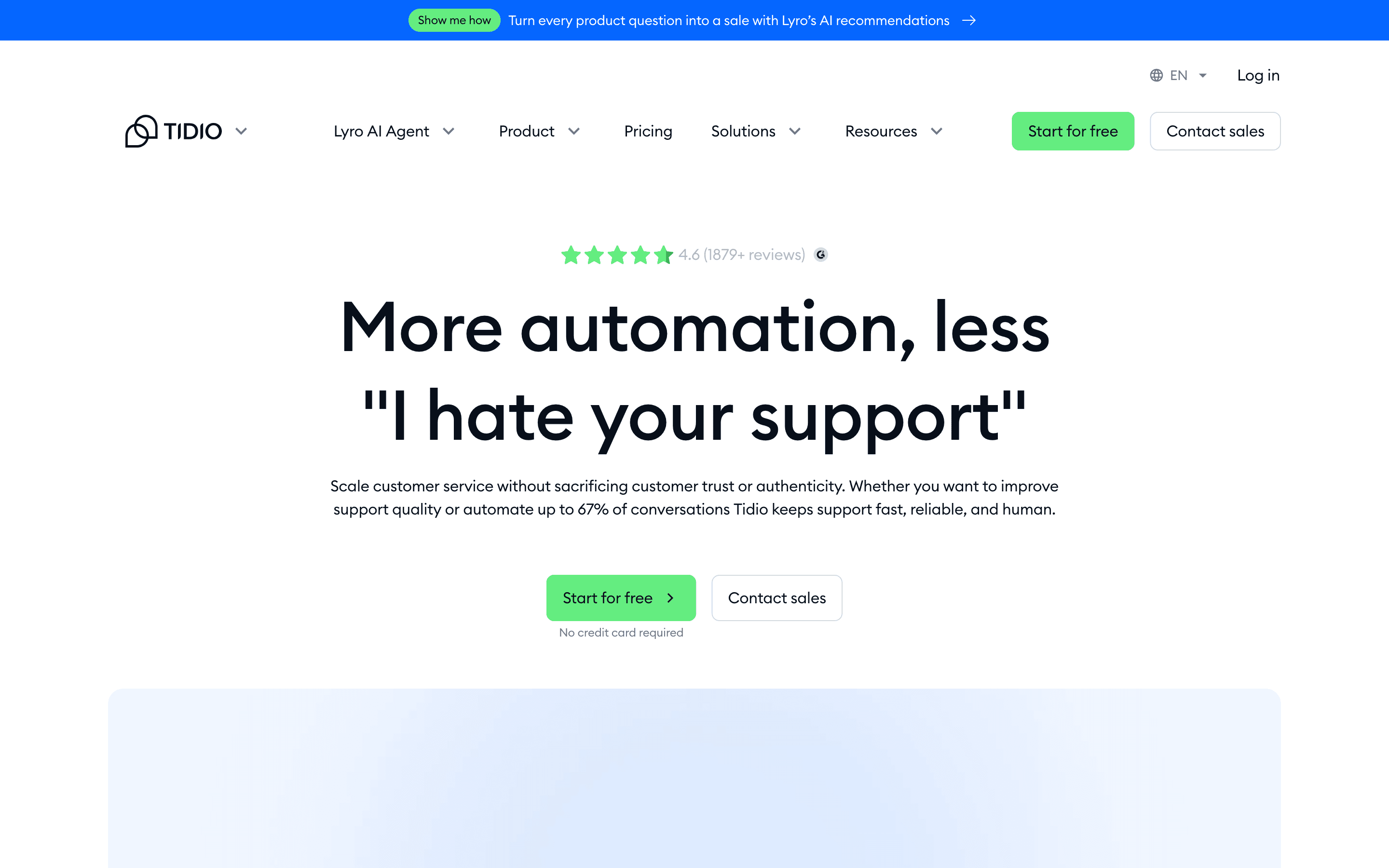
Tidio is the closest match to Crisp's target buyer: a small support or ecommerce team that wants chat, a shared inbox, and an AI agent without hiring a dedicated ops person. Its Free plan covers 10 seats and 50 billable conversations a month, more seats than Crisp gives away for free. Lyro, Tidio's AI agent, reads your help center content the same way Hugo does, but Tidio bills it as a separate add-on starting at $39/month even on paid plans, so your real AI bill sits apart from the plan price. Growth scales with conversation volume up to $349/month, then jumps hard to $749/month for Plus, with nothing in between. Tidio also restructured its pricing in December 2024 and drew Trustpilot and Capterra complaints about bills doubling with little warning, so read the fine print before you commit.
Pros
- + Free plan covers 10 seats and 50 billable conversations, which is workable for a small team just trying chat
- + Lyro AI reads your help center and existing content without a lot of setup
- + One tool covers live chat, a shared inbox, and basic ticketing, so support teams don't need a separate help desk for simple cases
Cons
- – Lyro and Flows are billed separately from the base plan on Free, Starter, and Growth, so the advertised plan price understates what you'll actually pay for AI
- – No middle tier between Growth (which tops out at $349/month for 2,000 conversations) and Plus (from $749/month), which is a hard jump for a team that outgrows Growth's conversation limits
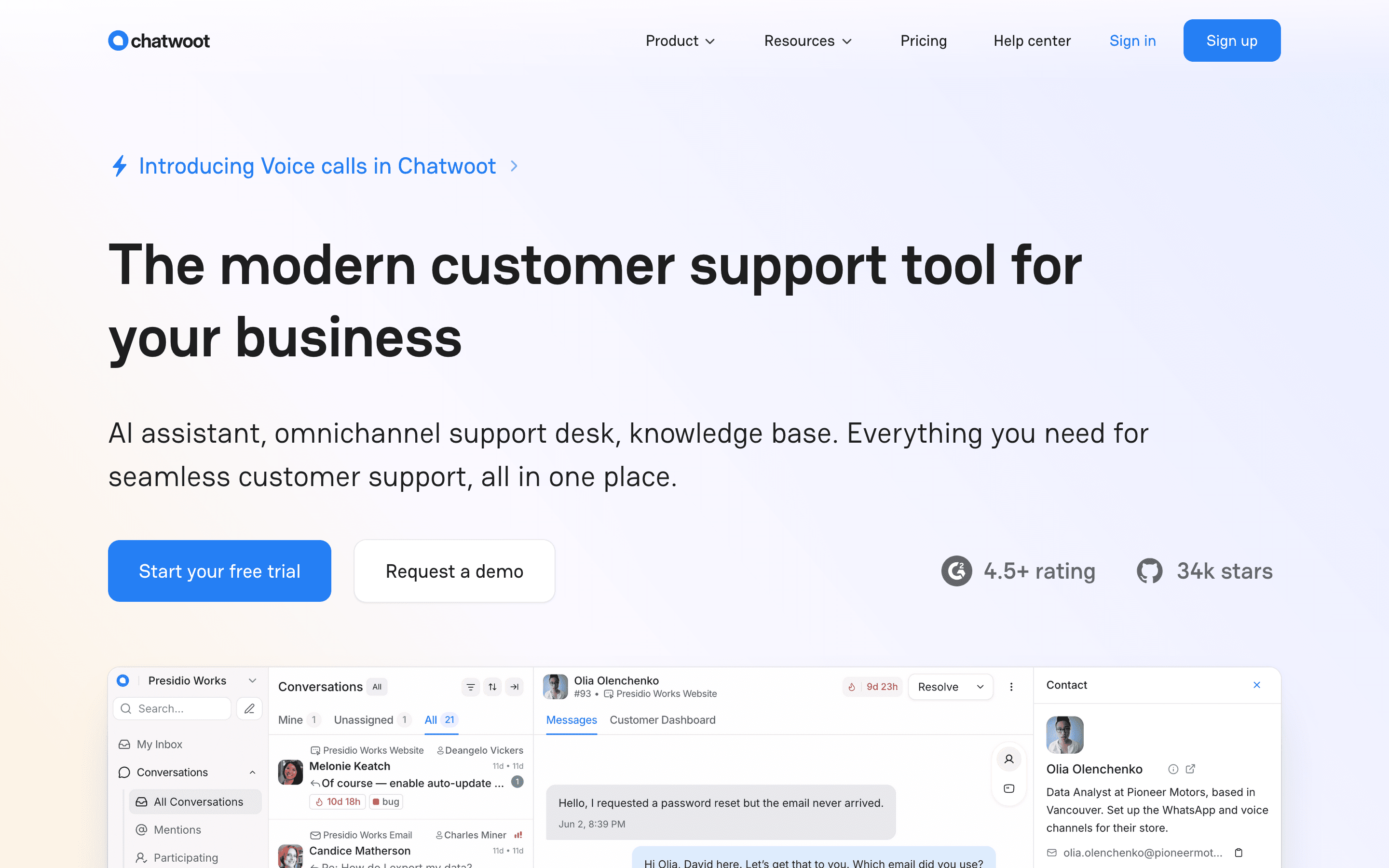
Chatwoot is the pick for teams that want to own their support stack instead of renting it. The self-hosted Community edition is free with no agent cap, the same trade Crisp doesn't offer at any price. Cloud pricing starts at $19/agent/month for unlimited conversations across live chat, email, WhatsApp, and Instagram, plus Captain, an AI copilot that drafts replies and summarizes conversations for your human agents. Captain doesn't talk to customers on its own, so it isn't a swap for Hugo: if you're leaving Crisp because Hugo's bot credits run out, Chatwoot's AI story is agent-assist, not autonomous resolution, and Tidio or Intercom are the closer substitutes for that job. The catch: self-hosting still costs you a server (Chatwoot's own minimum spec is 4GB RAM and 2 CPU cores), and Captain's per-conversation credit cost isn't published, so AI spend is hard to forecast either way. SSO and audit logs sit behind the $99/agent Enterprise tier, a roughly 2.5x jump from Business. For a team that wants channel breadth and doesn't mind managing infrastructure, Chatwoot beats Crisp on flexibility and total channel count.
Pros
- + Genuinely free, unlimited-agent self-hosted Community edition if you're willing to run the server yourself
- + One inbox covers live chat, email, WhatsApp, Instagram, and now voice
- + Open-source codebase means no vendor lock-in on your data
Cons
- – The free Hacker cloud plan caps out at 500 conversations a month, about 17 a day, too low for a real support queue
- – SSO/SAML and audit logs sit behind the Enterprise tier only, a roughly 2.5x per-seat jump from Business ($39 to $99/agent)
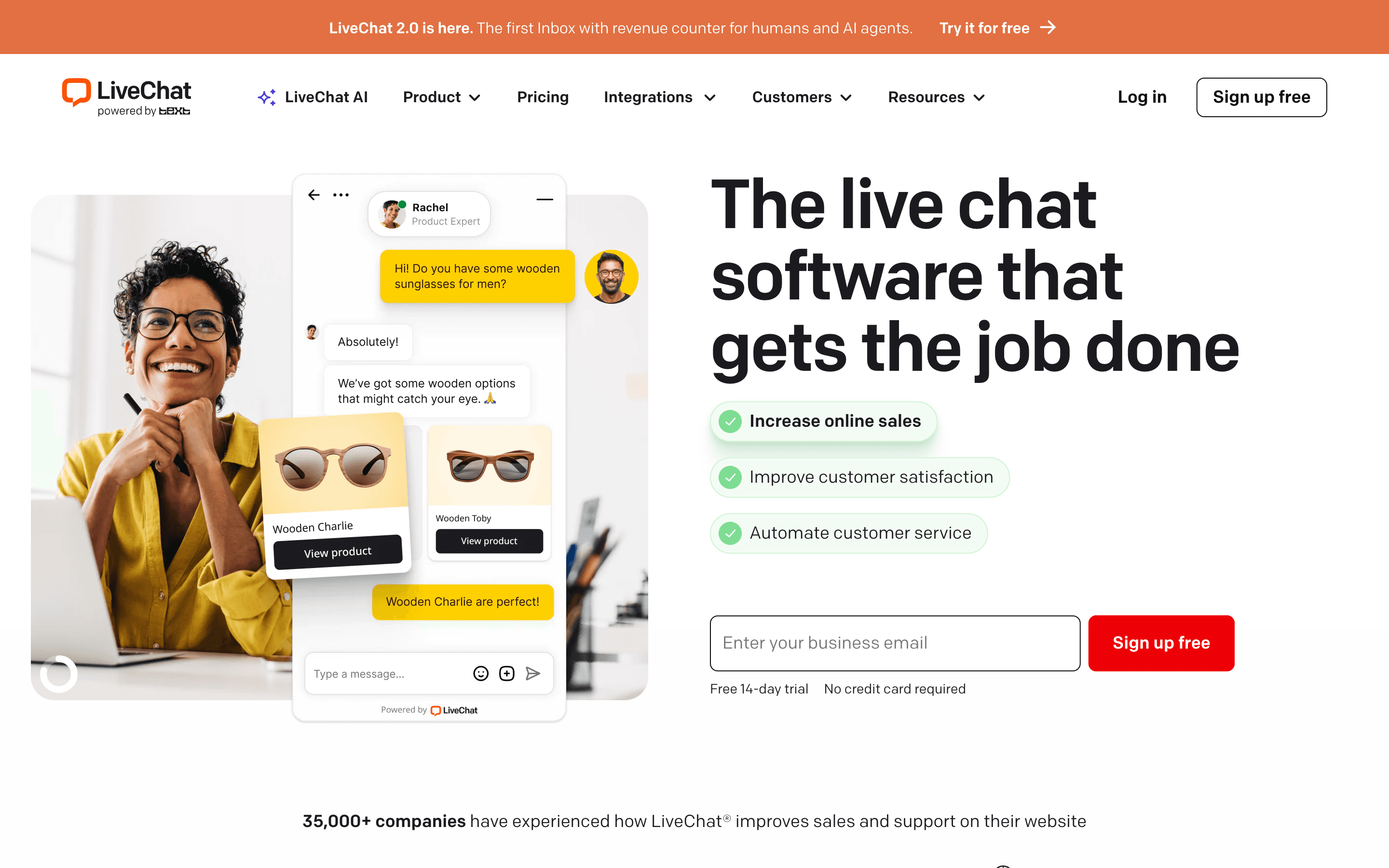
LiveChat is the more mature, more expensive version of what Crisp does with its base widget. There's no free plan, just a 14-day trial, and pricing is strictly per agent: $19/agent/month for Starter up to $79/agent/month for Business, all billed annually. What you get for that is a longer track record, a bigger integration library, and channels like SMS and Apple Messages for Business at the Business tier. What you don't get bundled is a chatbot or a ticketing help desk: both are separate paid products from the same company, Text SA, so a team replicating Crisp's all-in-one inbox ends up stacking three subscriptions instead of one. Capterra reviewers already flag the price as high next to competitors. Pick LiveChat if you specifically want a dedicated, reliable chat widget and are fine buying the rest separately.
Pros
- + Mature, reliable chat widget with a long track record and a large integration library
- + Clear per-tier feature breakdown, with real prices published for every plan except Enterprise
- + SMS and Apple Messages for Business are available as built-in channels on Business
Cons
- – No free plan, only a 14-day trial
- – Visitor tracking is capped per tier (100 on Starter, 400 on Team, 1,000 on Business), which forces an upgrade purely for tracking volume
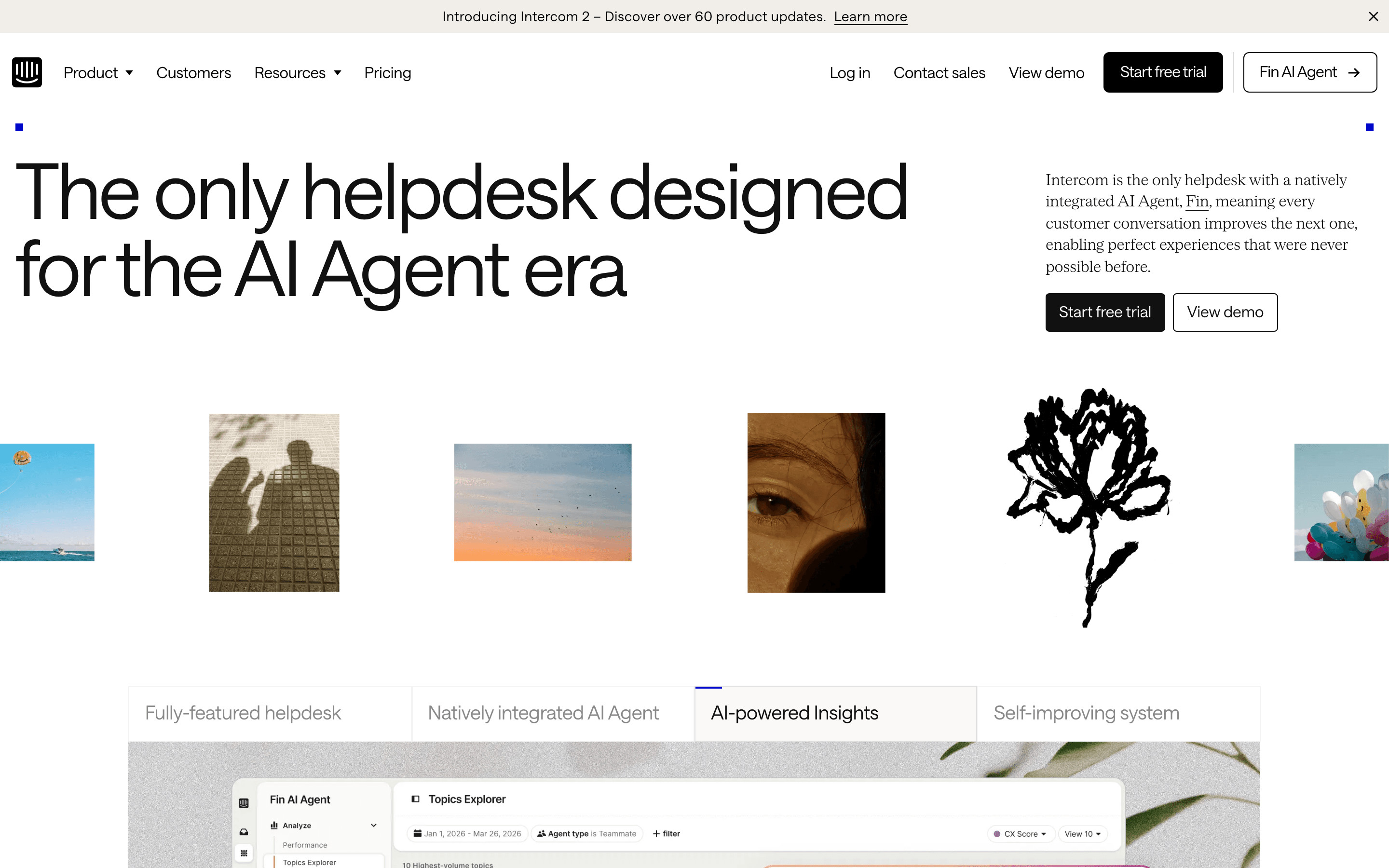
Intercom is the step up from Crisp for teams that want an AI agent doing real work, not just answering FAQs. Essential starts at $19/seat/month, but that price requires annual billing and is a live promotional A/B test on Intercom's own pricing page, not a guaranteed list price; the non-annual, monthly-billed equivalent is $39/seat. Even at the promotional annual rate it bundles the Fin AI agent, a shared inbox, ticketing, and a public help center, and works out to about double what Crisp charges for its cheapest tier with a comparable AI chatbot: Essentials, at $95/month for 10 seats, works out to roughly $9.50/seat. Skip the promo or the annual commitment and the real gap is closer to 4x. Crisp also has a genuinely free 2-seat plan that Intercom doesn't match at any price. The gap widens as you scale: Fin bills $0.99 per resolved conversation on top of seats, and Advanced ($85/seat) adds workflow automation and multiple team inboxes, while Expert ($132/seat) is required for SSO and HIPAA support, far past anything Crisp charges. Intercom is also mid-rebrand to Fin and facing a pending $3.6 billion Salesforce acquisition, so there's real uncertainty about where the product goes next. Choose it if your priority is autonomous ticket resolution at scale and you can absorb both the seat and usage costs.
Pros
- + Fin AI Agent resolves a large share of support volume end-to-end across chat, email, WhatsApp, SMS, phone, and Slack, and is priced per outcome instead of a flat AI add-on
- + One shared inbox spans chat, email, and phone with workflows, macros, and SLA automation built in
- + Frequent, granular product updates, sometimes several in the same week (for example phone workflow triggers and call-outcome automation on 2026-07-03)
Cons
- – No forever-free plan, only a 14-day trial
- – Total cost is hard to predict upfront. Seat price, Fin's $0.99-per-outcome fee, and separate add-ons (Copilot, Pro, Proactive Support Plus) all stack on top of each other.
Should your product be on this website chat & chatbots list?
If you build a tool that belongs next to the ones above, submit it. A human reviews every submission. Approved products get their own page with pricing and screenshots, plus a place in the comparisons where they fit. It is free. You sign in with your work email so you can follow the decision, and there is no password to create.
Crisp alternatives: FAQ
What is the best free alternative to Crisp?+
Chatwoot's self-hosted Community edition is free with no agent cap, though you have to run it on your own server. Its cloud Hacker plan is also free for up to 2 agents and 500 conversations a month if you'd rather not self-host.
Why do teams leave Crisp?+
The most common reasons are seat caps that force a full plan upgrade instead of adding one agent, an AI credit allowance that a busy Hugo bot can burn through before the month ends, and per-workspace billing that multiplies fast for teams running more than one brand.
Is there a cheaper way to add agents than Crisp's Plus plan?+
Tidio's Free plan covers up to 10 seats, more than double Crisp's 2-seat free plan, and Chatwoot's self-hosted Community edition has no agent cap at all if you run your own server.
Which Crisp alternative has the strongest AI agent?+
Intercom's Fin is built to resolve conversations end-to-end across chat, email, and phone, and is priced per resolved outcome at $0.99 each, a heavier and more expensive setup than Crisp's credit-metered Hugo bot.
Crisp alternatives: pricing compared
Entry price, billing model, and whether pricing is public. 5 of 5 publish pricing you can check without talking to sales.
| Tool | Starting price | Billing | Free option | Pricing disclosed |
|---|---|---|---|---|
| Crisp | $45/seat/mo | flat | Yes | Partly public |
| Tidio | $29/mo | tiered | Yes | Partly public |
| Chatwoot | $19/seat/mo | per-seat | Yes | Public |
| LiveChat | $19/agent/mo | per-seat | Trial (14 days, no credit card required) | Partly public |
| Intercom | $19/seat/mo | per-seat | Trial (14 days, no credit card required) | Public |
How we made these picks. We compare tools on public pricing, features, and hands-on assessment, then verify every price against the vendor's own page. We never accept payment for rankings. Read the full methodology. Spotted an error? Report it.