Top Eqvista Alternatives in 2026
Here for Eqvista itself? See the full Eqvista profile, pricing & reviews →
Suggest a change- If you've grown past 50 stakeholders and don't want per-head pricing to keep climbing, choose Mantle. Mantle charges one flat annual fee with unlimited stakeholders on every plan, so adding employees or advisors never pushes you into a higher tier the way Eqvista's per-seat pricing does above 50 people.
- If you're pre-seed and want a free plan that scales into a bundled 409A valuation the same way Eqvista does, choose Cake Equity. Cake Equity's Free plan covers cap table and SAFE tracking for up to 5 stakeholders, and its Team plan bundles two 409A valuations a year into a $2,750 annual price, plus a My Cake portal where employees can see and exercise their own equity.
- If you need your cap table format instantly recognized by VCs, auditors, and 409A reviewers, choose Carta. Carta is the market default, and its free Launch plan plus add-on 409A, ASC 718, and IPO advisory services are the ones investors and auditors already know how to read.
- If you want published pricing you can act on without booking a sales call, choose Pulley. Pulley lists real numbers on its site, $1,200 a year for your first 25 stakeholders and $3,500 a year with 409A valuations and option exercises included for up to 40, instead of Eqvista's shift to custom pricing once you pass 50 stakeholders.
- If you're a European company that wants a bigger free tier than Eqvista's, choose Ledgy. Ledgy's Launch plan is free forever for up to 50 stakeholders, more than double Eqvista's 20-stakeholder cap, and its paid tiers add HRIS integrations and reporting built around EU and UK compliance.
- If you're pre-revenue or early seed and want the cheapest bundled cap table and 409A valuation you can find, choose stay on Eqvista. Eqvista's $990-a-year bundle covers unlimited 409A updates and renewals for the year plus the Premium Cap Table for pre-revenue companies, undercutting every published bundled price among these alternatives.
Eqvista built its business on a simple pitch: a free cap table under 20 stakeholders, a cheap $2-per-seat premium tier, and a 409A valuation done in-house and bundled by funding stage starting at $990 a year. That combination is hard to beat for the earliest-stage companies. Teams start looking elsewhere once they pass 50 stakeholders or Series B, where Eqvista's published rates disappear into custom quotes, or when they hit its email-only support and, in at least one reported case, got billed after cancelling with no refund for the unused period.
The alternatives below cover the same job, cap table management plus 409A-style valuations, from flat-rate no-stakeholder-fee tools to the market-default platform most investors already recognize. None of them beat Eqvista's $990 pre-revenue bundle outright, so the right pick depends on what specifically is pushing you off Eqvista.
Eqvista alternatives compared
| Tool | Best for | Starting price | Free option | Last update |
|---|---|---|---|---|
| MantleBest for outgrowing Eqvista's stakeholder cap | Early-stage founders who want a real cap table on a free plan instead of a trial | Free tier + custom | Yes | June 2026 |
| Cake EquityBest value for a bundled 409A | Early-stage startups that want a free or low-cost cap table before they need 409A valuations | $1000/yr | Yes | July 2026 |
| CartaBest for VC-recognized cap tables | Very early companies under 25 stakeholders and $1M raised that qualify for the free Launch plan | Free tier + custom | Yes | April 2026 |
| Pulley | Early-stage startups that want a straightforward cap table without Carta's reputation for aggressive upsells | $1200/seat/yr | No | October 2025 |
| LedgyBest for European teams | European startups that want a cap table platform built around EU/UK equity and compliance rules rather than a US-first product | Free tier + custom | Yes | April 2026 |
Why teams switch from Eqvista
Billed for a cycle after cancelling, with no refund for the unused period
A reviewer reported Eqvista continued charging after they cancelled and did not refund the unused portion.
Email-only support that slows down on larger cap tables
Multiple reviewers flag that Eqvista has no live chat or phone support, and that large cap tables can slow the system enough that some users pull reports into Excel to work around it.
Pricing goes custom past 50 stakeholders or Series B
Eqvista's published per-seat and 409A rates stop applying once a company grows past 50 stakeholders or reaches Series B, at which point pricing becomes negotiated rather than listed.
The 409A price you see isn't necessarily yours
Eqvista's 409A bundle price steps up by funding stage, from $990 pre-revenue to $2,590 at Series A, rather than charging one flat rate for every early-stage company.
The best Eqvista alternatives, ranked
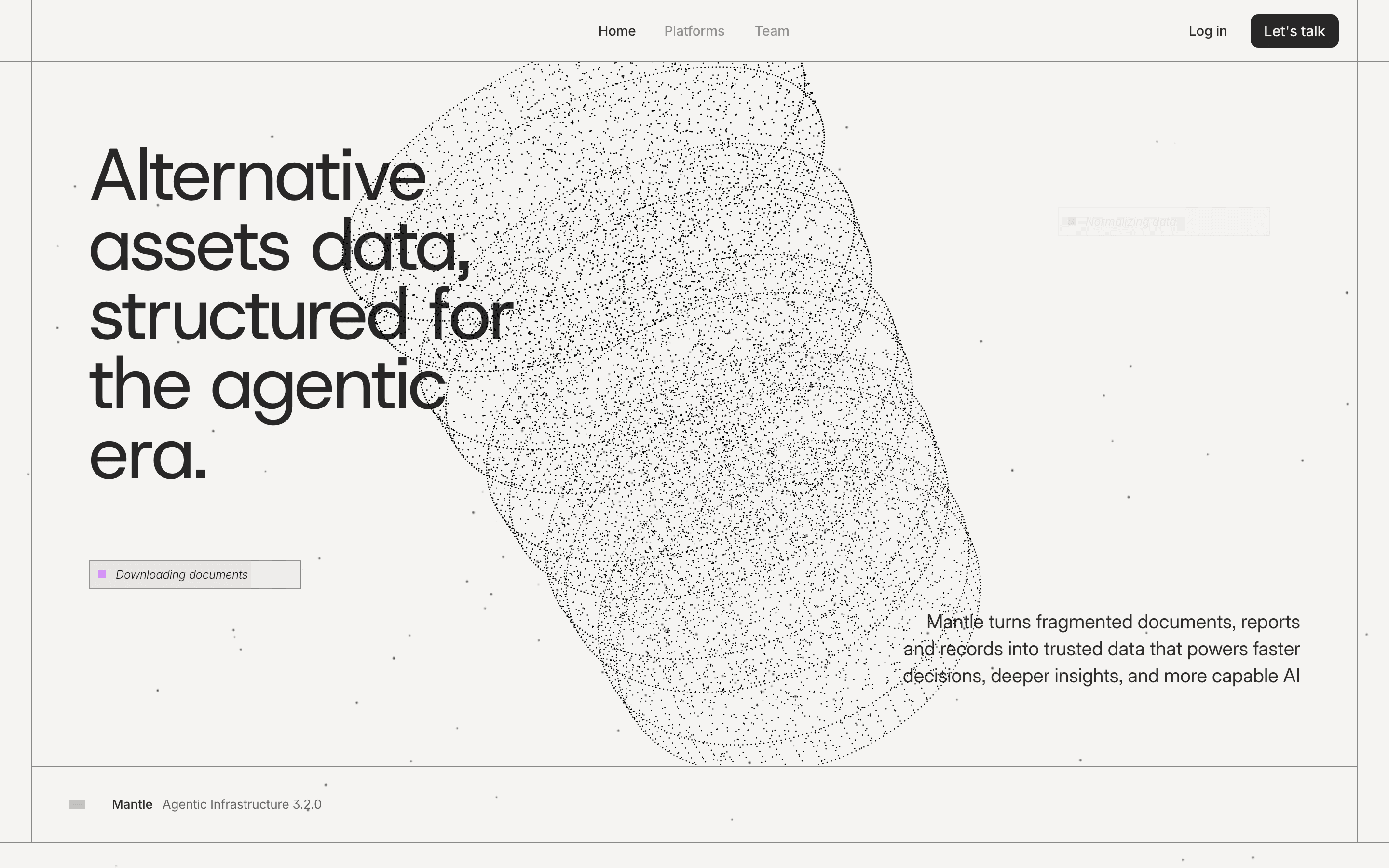
Mantle flips the pricing model Eqvista buyers often outgrow. Instead of charging per stakeholder, every plan is a flat annual fee, and the free Starter tier includes unlimited stakeholders rather than Eqvista's 20-person cap. Essentials runs $1,200 a year for e-signing, board actions, and option exercising, and Growth at $3,000 a year bundles one 409A valuation, with extra valuations at $1,800 each. That's a real jump from Eqvista's $990 pre-revenue bundle, but the math flips once your stakeholder count grows, since Mantle never charges more for adding people. Mantle Clerk, its AI assistant launched in June 2026, reads legal documents and drafts the resulting cap table entries. The tradeoffs: no monthly billing, a login flow that emails a fresh link on every access that some users find annoying, and no stock-based compensation calculator for finance teams that need one.
Pros
- + Free Starter plan includes unlimited stakeholders, not a capped trial
- + Flat annual pricing means adding employees or advisors doesn't push you into a higher tier
- + All three prices are public on the pricing page, no sales call needed
Cons
- – No monthly billing, only annual, so you commit for a full year to get off the free plan
- – Some users report Mantle emails a fresh login link every time you access the account rather than a persistent session

Cake Equity mirrors Eqvista's core idea, price by stakeholder count and bundle the 409A valuation in, but starts smaller and scales differently. The Free plan covers just 5 stakeholders versus Eqvista's 20, while Build stretches to 25 for $1,000 a year and Team to 40 for $2,750 a year with two audit-ready 409A valuations included annually. Extra stakeholders cost $1 each on Build and $5 each on Team, so costs climb with headcount much like Eqvista's per-seat model does. The My Cake employee portal lets stakeholders view and exercise their own equity, a feature Eqvista doesn't offer. Reviewers say the option distribution logic takes real effort to learn and that cap table recalculation can lag. Pro, the top tier for international or more complex cap tables, is quote-only.
Pros
- + Free plan covers up to 5 stakeholders with real cap table, options, and SAFE features, not just a demo
- + Team plan bundles two 409A valuations a year instead of billing them separately
- + My Cake portal gives employees a place to see and exercise their own equity
Cons
- – Cost climbs fast once you pass the included stakeholder count: $5 per extra stakeholder on Team adds up for larger teams
- – Top Pro tier is quote-only, so you can't compare it against competitors without a sales call
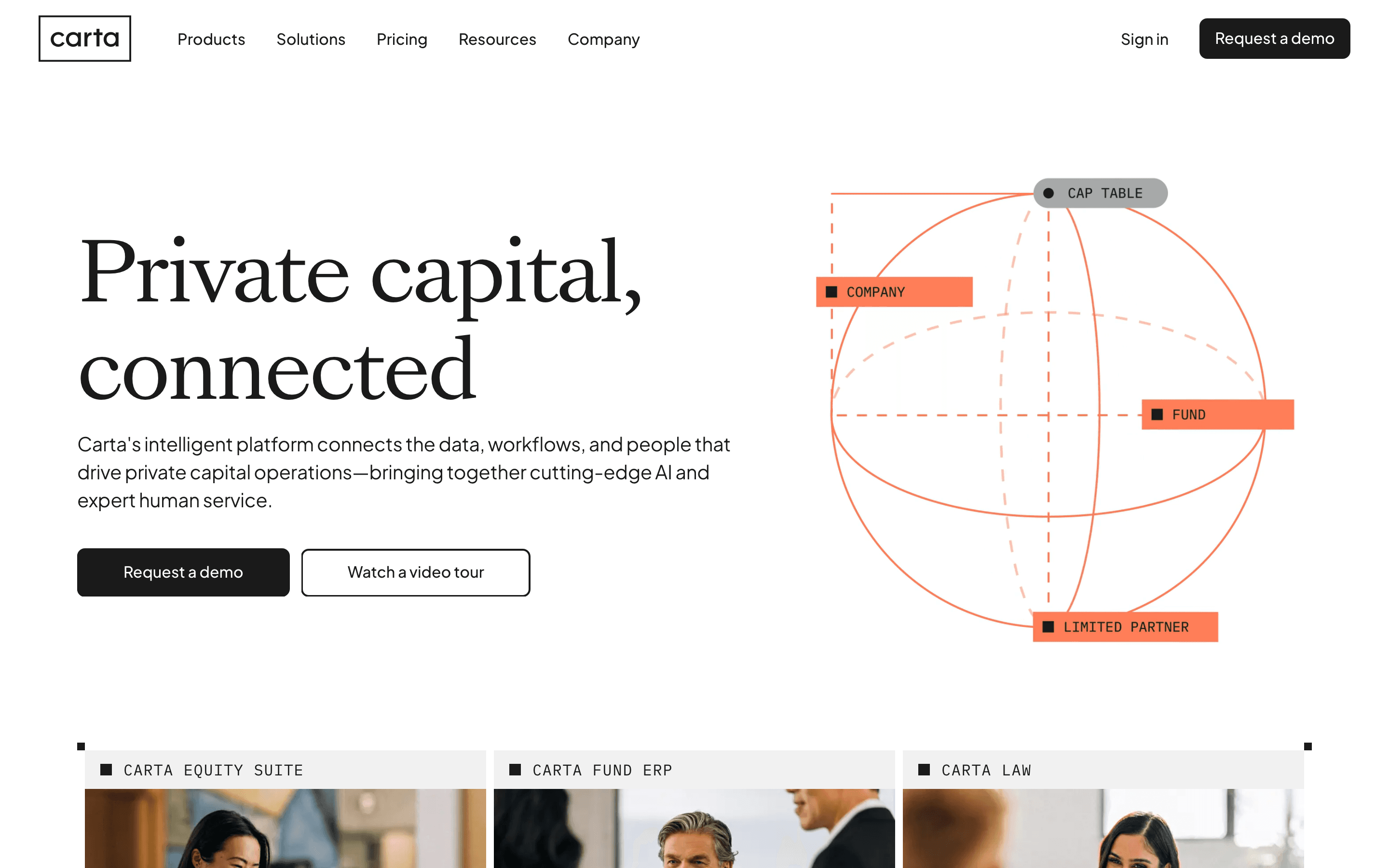
Carta is the category's default, and for founders leaving Eqvista chiefly for name recognition, that matters: most VCs, lawyers, and auditors already know how to read a Carta cap table. Its free Launch plan covers up to 25 stakeholders and $1M raised, a notch above Eqvista's 20-stakeholder cutoff, and Carta also acts as its own SEC-registered transfer agent for option exercises. The catch is pricing. Every paid tier past Launch, Build, Grow, and Scale, is a custom quote with no published number, and third-party write-ups based on real customer contracts describe renewal jumps as steep as $99 to $3,000 in one case. Board meetings, 409A valuations, and GAAP/IFRS reporting sit behind the higher Grow and Scale tiers rather than Build, so budget-conscious switchers should expect to negotiate.
Pros
- + Free Launch plan is genuinely free, not a trial, for companies under 25 stakeholders and $1M raised
- + Acts as its own SEC-registered transfer agent, so option exercises and share transfers happen without a separate vendor
- + 409A valuations, ASC 718 audit support, and IPO advisory are all available as add-ons under one account, useful once a company outgrows basic cap table needs
Cons
- – No public pricing past the free tier. You have to book a demo and negotiate a quote to know what you'll pay
- – Customer reviews describe steep, unannounced renewal increases, in one case pricing moving from $99 to $3,000
Pulley
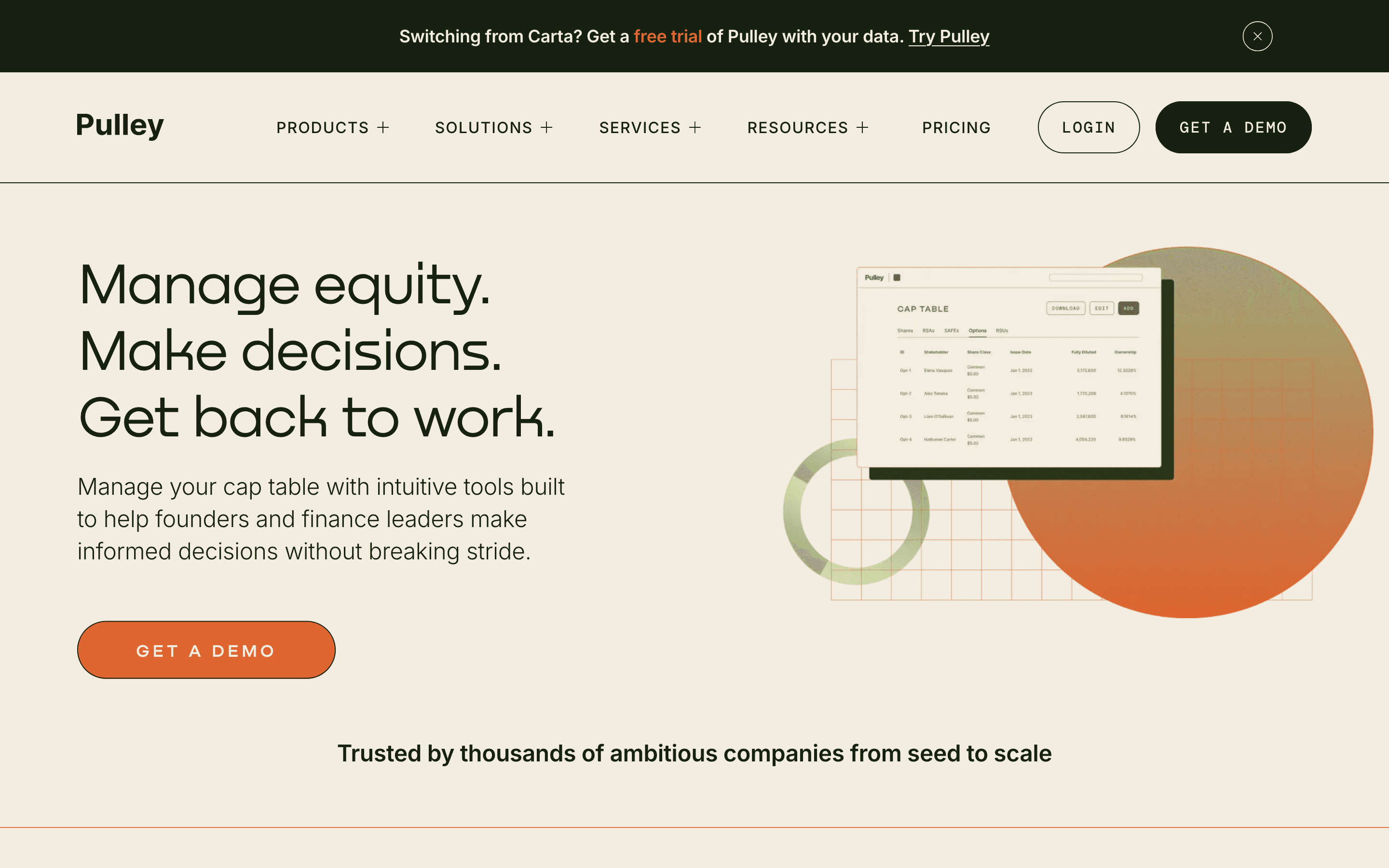
Pulley was built to compete directly with Carta, and it shares Eqvista's instinct for publishing real prices instead of hiding behind a sales call. Startup runs $1,200 a year for your first 25 stakeholders, and Growth is $3,500 a year for up to 40, bundling 409A valuations, option exercises, and Rule 701/Form 3921 support rather than charging for them separately. That's more than Eqvista's cheapest pre-revenue bundle, and still more than Eqvista's Seed ($1,990) and Series A ($2,590) bundles, which already include the cap table at no extra charge. Pulley's edge here is published pricing and no funding-stage step-up, not a lower sticker price. There's no free plan, and stakeholder caps mean growing past 40 people pushes you into a custom Enterprise quote, the same kind of wall Eqvista hits at 50. One G2 reviewer also flagged that canceling isn't self-service.
Pros
- + Both paid tiers show real numbers on the pricing page instead of forcing a sales call for basic cap table access
- + 409A valuations and option exercises are included in Growth rather than sold as costly add-ons
- + Onboarding is concierge-assisted, and switching from Carta includes a free trial with your data already loaded
Cons
- – No free plan. Even a 25-stakeholder cap table costs $1,200/year
- – Stakeholder caps mean you can outgrow Startup or Growth and get pushed into a quote-only Enterprise tier
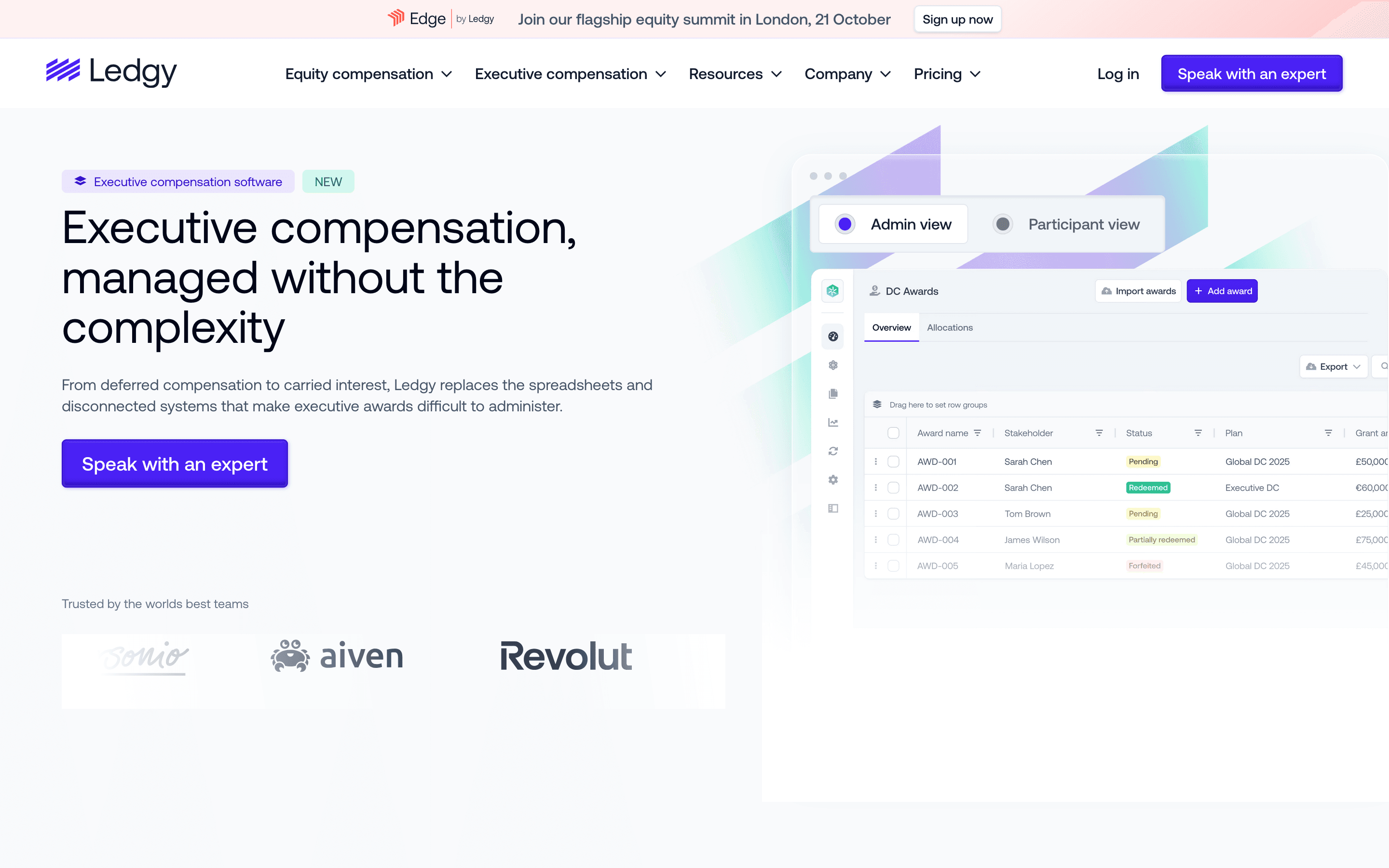
Ledgy's biggest edge over Eqvista is the free tier's size: Launch is free forever for up to 50 stakeholders, more than double Eqvista's 20-person cutoff, and covers real cap table management and equity plan automation, not a stripped demo. Past that, Scale, Enterprise, and Public are all custom quotes, with Ledgy's own site suggesting Scale starts around 4,000 euros a year, a rough floor rather than a fixed price. It adds 70+ HRIS integrations, a vesting tranche builder with performance conditions, and an AI Auditor that checks equity documents against recorded transactions for mismatches. Ledgy is built around European and UK compliance first, and reviewers outside Europe flag the lack of phone support or 24/7 coverage as a real gap worth weighing if your team isn't on European hours.
Pros
- + Launch plan is genuinely free for up to 50 stakeholders, not a time-limited trial
- + Covers both private cap table management and public company share plan administration on one platform
- + 70+ HRIS integrations and a vesting tranche builder with performance conditions on the Scale tier
Cons
- – No public pricing past the free tier. Every paid plan requires a sales conversation to get a number
- – No phone support and no round-the-clock bot coverage, which reviewers flag as a gap for teams outside European working hours
Should your product be on this cap table & equity management list?
If you build a tool that belongs next to the ones above, submit it. A human reviews every submission. Approved products get their own page with pricing and screenshots, plus a place in the comparisons where they fit. It is free. You sign in with your work email so you can follow the decision, and there is no password to create.
Eqvista alternatives: FAQ
What's the best free alternative to Eqvista?+
Mantle's free Starter plan has no stakeholder cap at all, while Eqvista's free tier stops at 20 stakeholders and Ledgy's stops at 50.
Which Eqvista alternative is cheapest for a bundled 409A valuation?+
Cake Equity's Team plan bundles two 409A valuations a year into its $2,750 annual price, and Pulley's Growth plan bundles a 409A into $3,500 a year, though Eqvista's own $990 pre-revenue bundle is still cheaper for the earliest-stage companies.
Is Carta a good replacement for Eqvista?+
Carta is worth it if you want the cap table format VCs and auditors already recognize, but its paid tiers are all custom quotes and reviews describe steep renewal increases, so get an actual quote before assuming it costs less than Eqvista.
Do any Eqvista alternatives avoid per-stakeholder pricing entirely?+
Yes. Mantle charges one flat annual fee regardless of headcount, so it's the only tool in this list where adding stakeholders never increases your bill.
Eqvista alternatives: pricing compared
Entry price, billing model, and whether pricing is public. 4 of 6 publish pricing you can check without talking to sales.
| Tool | Starting price | Billing | Free option | Pricing disclosed |
|---|---|---|---|---|
| Eqvista | $2/seat/mo | tiered | Yes | Public |
| Mantle | Free tier + custom | tiered | Yes | Partly public |
| Cake Equity | $1000/yr | tiered | Yes | Partly public |
| Carta | Free tier + custom | quote-only | Yes | Not disclosed |
| Pulley | $1200/seat/yr | tiered | No | Partly public |
| Ledgy | Free tier + custom | tiered | Yes | Not disclosed |
How we made these picks. We compare tools on public pricing, features, and hands-on assessment, then verify every price against the vendor's own page. We never accept payment for rankings. Read the full methodology. Spotted an error? Report it.