Carta Review
Cap table, 409A valuation, and equity management platform for private companies
Is this your product? Claim this page · Request a change
Looking for a Carta alternative? See our ranked comparison.→What is Carta?
Carta is equity management software for tracking who owns what: stakeholders, share classes, option grants, vesting, and the paperwork tied to each. It also runs 409A valuations, handles option exercises as a registered transfer agent, and generates the compliance forms (Rule 701, Form 3921, ASC 718) that start to matter once a company has real headcount and investors.
It's the market's default cap table tool, which means most VCs, lawyers, and auditors already know how to work with a Carta cap table. That network effect is a real reason companies stay even when the price stings.
Pricing is opaque past the free tier. Every paid plan is a custom quote, and public write-ups (based on real contract and G2 review data, not Carta's own site) describe sharp increases at renewal for some customers.
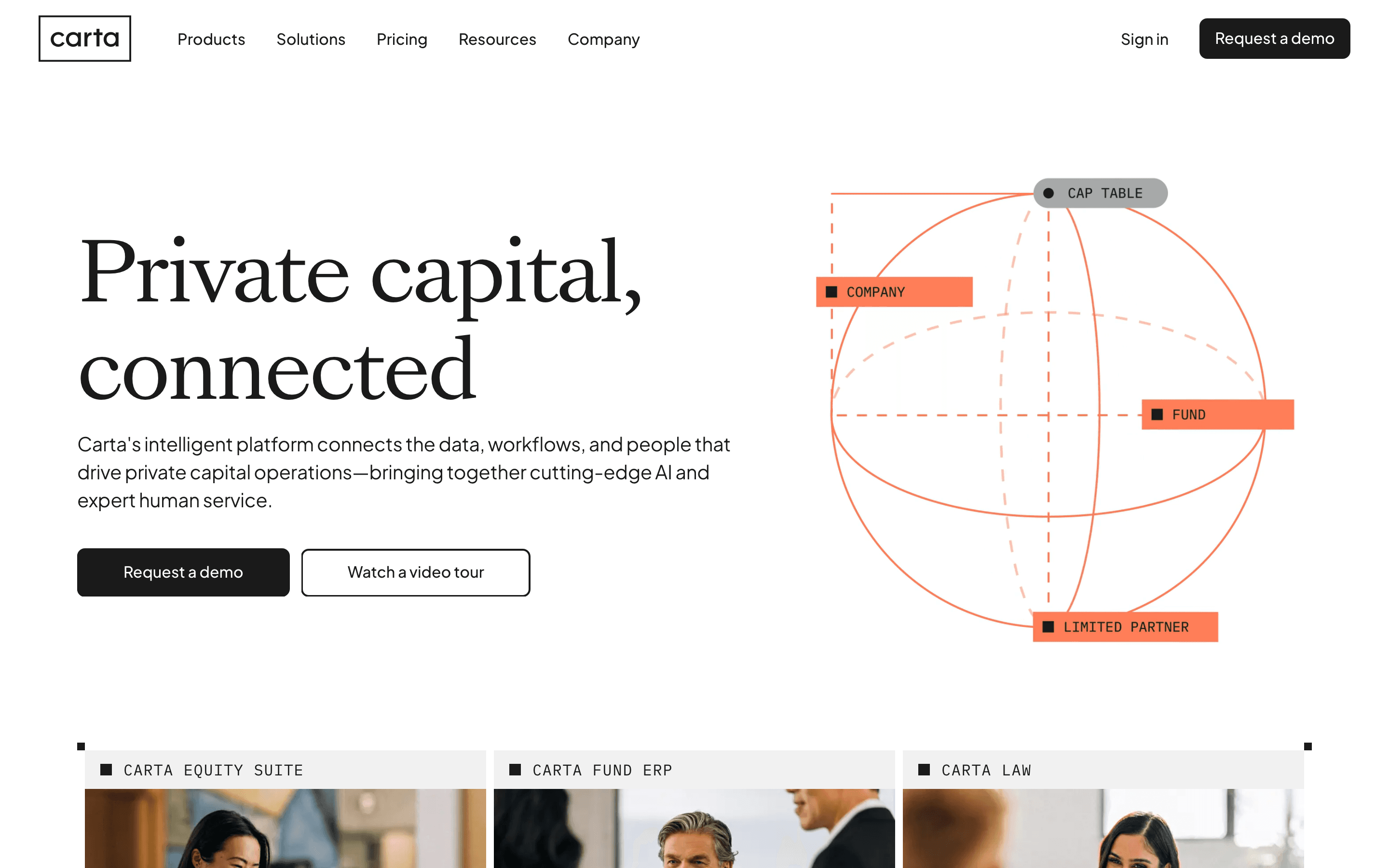
Carta screenshots
Who it's for
- ✓ Very early companies under 25 stakeholders and $1M raised that qualify for the free Launch plan
- ✓ Companies that need their cap table format to be instantly recognizable to VCs, auditors, and 409A reviewers
- ✓ Teams that want 409A valuations, ASC 718 reporting, and transfer agent services from the same vendor as the cap table
Who should look elsewhere
- ✗ Cost-conscious teams past the free tier who want to see a real price before talking to sales
- ✗ Companies that have had past run-ins with Carta's renewal pricing or want to avoid stakeholder-count upsells
Pros
- + Free Launch plan is genuinely free, not a trial, for companies under 25 stakeholders and $1M raised
- + Acts as its own SEC-registered transfer agent, so option exercises and share transfers happen without a separate vendor
- + 409A valuations, ASC 718 audit support, and IPO advisory are all available as add-ons under one account, useful once a company outgrows basic cap table needs
Cons
- – No public pricing past the free tier. You have to book a demo and negotiate a quote to know what you'll pay
- – Customer reviews describe steep, unannounced renewal increases, in one case pricing moving from $99 to $3,000
- – Board meetings, 409A valuations, and GAAP/IFRS reporting are locked behind the higher Grow and Scale tiers, not available on Build
Carta pricing
What you pay for
Carta doesn't publish prices for its paid plans. You get a free tier if your company is small enough, and everything past that is a custom quote based on how many stakeholders are on your cap table and which add-ons (409A valuations, ASC 718 reporting, IPO advisory) you attach. That makes it hard to compare against competitors without actually requesting a demo.
No public entry price to compare, so budget depends on a sales quote.
| Plan | Price | Highlights |
|---|---|---|
| Launch | Free | Up to 25 stakeholders and $1M raised · Cap table management · Securities issuance · ISO management · SAFE modeling and fundraising · Email, chat, and phone support |
| Build | Custom | Up to 50 stakeholders · Priced round modeling · Deal closings and pro forma · White-glove onboarding |
| Grow | Custom | Flexible stakeholder limit · Board meetings · 409A valuations and audit support · Form 3921 |
| Scale | Custom | Flexible stakeholder limit · ASC 718/US GAAP and IFRS reporting · Exit modeling · IPO advisory · SSO for admins |
Carta's own pricing page shows no dollar figures beyond the free Launch tier. Build, Grow, and Scale all require a sales demo and a custom quote based on stakeholder count and add-ons; there's no self-serve price list. Third-party aggregations of real contracts (Failory, citing G2 and customer data) put typical paid plans around $1,000-$2,500/year for small cap tables, with 409A valuations often billed separately.
Pricing verified July 16, 2026 · source
How Carta's pricing compares
Carta next to its closest alternatives on entry price, billing, and whether pricing is public.
| Tool | Starting price | Billing | Free option | Pricing disclosed |
|---|---|---|---|---|
| Carta | Free tier + custom | quote-only | Yes | Not disclosed |
| Pulley | $1200/seat/yr | tiered | No | Partly public |
| Ledgy | Free tier + custom | tiered | Yes | Not disclosed |
| Cake Equity | $1000/yr | tiered | Yes | Partly public |
| Eqvista | $2/seat/mo | tiered | Yes | Public |
| Vestd | GBP 2200/seat/yr | tiered | No | Partly public |
| Mantle | Free tier + custom | tiered | Yes | Partly public |
Is Carta still actively developed?
Last significant update: April 2026. Carta launched a Cap Table Plugin that connects Claude to your live Carta data, so you can ask plain-language questions about ownership, 409A validity, and exit waterfalls instead of digging through the platform. It's read-only for now; option issuance and other write actions are planned next.
Top Carta alternatives
Further reading
- Cap table software pricing in 2026: 7 vendors compared - Cap table software pricing ranges from free to custom quotes. Here is what Carta, Pulley, Ledgy, and five more actually charge, checked July 2026.
Carta FAQ
Is Carta free?+
Only the Launch plan, and only if your company has under 25 stakeholders and has raised up to $1M. Anything past that requires a paid, custom-quoted plan.
How much does Carta cost past the free plan?+
Carta doesn't publish a price list for Build, Grow, or Scale. You need a sales demo to get a quote, and it's based on stakeholder count and which add-ons you pick.
Does Carta's price go up at renewal?+
Multiple customer reviews describe large, unannounced increases at renewal, including one case where pricing jumped from $99 to $3,000. Carta's own pricing page doesn't disclose renewal terms.