Top Webflow Alternatives in 2026
Here for Webflow itself? See the full Webflow profile, pricing & reviews →
Suggest a change- If you want Webflow's free-form design canvas and a real CMS but at a lower starting price and a shorter learning curve, choose Framer. Framer's design canvas is the closest match to Webflow's own, its CMS starts at $10 a month while staging and branching need the $30 Pro plan, and its AI page generator gets a first draft up fast.
- If ecommerce and booking matter more to you than pixel-level design control, choose Wix. Core and up bundle a full store, scheduling, and marketing tools into one editor, something Webflow's own site plans don't include at all.
- If you want a professional-looking site out of the box without hand-building every layout, choose Squarespace. its templates look finished on day one and the commerce transaction fee drops to zero from the Core plan up.
- If your site is really about content and you want the biggest plugin ecosystem at the lowest entry price, choose WordPress.com. Personal starts at $9 a month, undercutting every paid Webflow tier, and any paid plan unlocks the same 60,000-plus plugin marketplace.
- If you already run a CMS-heavy site with custom code and pay for Webflow's Team workspace plan, choose stay on Webflow. none of these alternatives match Webflow's clean code export and CMS collection depth for a complex, multi-editor content site.
Webflow gives you a design canvas that behaves like real CSS and a CMS built for content-driven sites, which is why designers and agencies pick it over template builders. But that control comes with a learning curve, and the May 2026 pricing overhaul made the real monthly cost harder to predict, especially once bandwidth overages and a separate Team workspace plan enter the picture.
The alternatives below are the tools a Webflow buyer would actually put on a shortlist: other visual builders and hosted platforms that can carry a real multi-page, CMS-backed site. Single-page builders and link-in-bio tools are a different job entirely, so they are left out even though they share the same broad category.
Webflow alternatives compared
| Tool | Best for | Starting price | Free option | Last update |
|---|---|---|---|---|
| FramerBest for design control | Founders and designers who want a marketing site that looks custom-built, not templated, and can be live in days | $10/site/mo | Yes | July 2026 |
| SquarespaceBest for polish without the learning curve | Founders and marketers who need a professional-looking site live this week without a developer | $19/mo | Trial (14 days, no credit card required) | May 2026 |
| WixBest for ecommerce and bookings | Founders and small teams who need a working site or store live this week without hiring a developer | $17/mo | Yes | June 2026 |
| WordPress.comBest value for content-heavy sites | Founders and marketers who want a working site live today without touching code or a server | $9/mo | Yes | July 2026 |
Why teams switch from Webflow
Webflow's May 2026 pricing overhaul cut default bandwidth on the merged Premium plan to 50 GB, and some customers reported bills jumping as much as 320% at renewal once overages and the new tier structure kicked in.
Customers paying monthly instead of annually saw sharper increases, with Premium rising as much as 56% month-to-month versus the annual rate, pushing some to compare Webflow against other builders.
A team of more than a couple of full-time builders needs a separate Team workspace plan on top of site costs, at $2,500/month on an annual contract, which pushes total cost far past the per-site sticker price.
The best Webflow alternatives, ranked
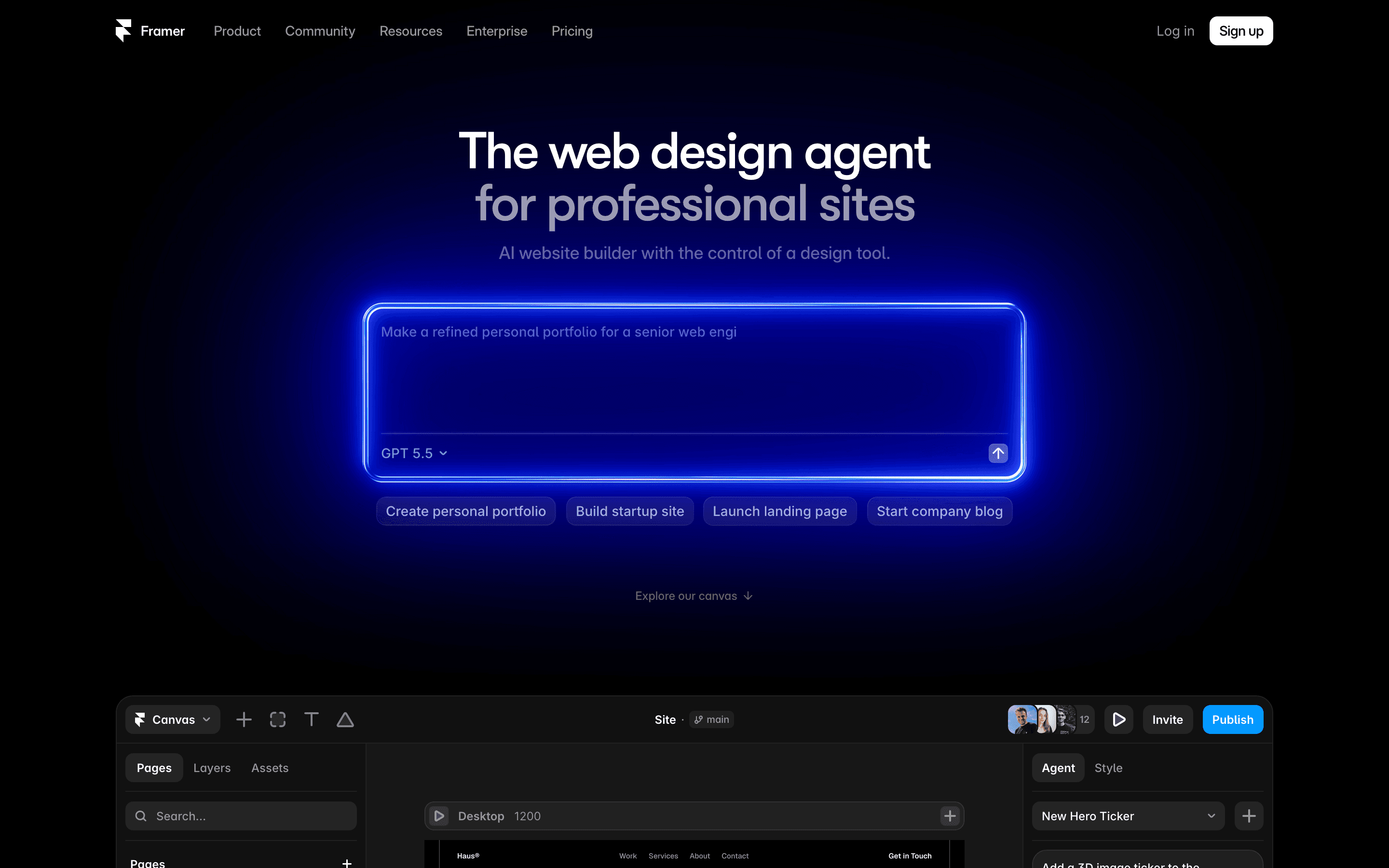
Framer is the closest match to Webflow's actual design experience. Both work from a real canvas where you control layout the way a designer expects, instead of filling in a form-based template. Framer ships a CMS and built-in SEO fields on every paid plan, so carrying over a Webflow site's structure is a familiar move. Pricing starts at $10/month for Basic, cheaper than Webflow's $15/month Basic tier, and the Free plan is usable enough to test a real project before paying. The Basic CMS is capped at 2 collections and 2,500 items, and staging with branching only shows up on the $30/month Pro plan, so a team that needs to preview changes before publishing has to budget for Pro, not Basic. The catch is team size too: every extra editor costs $20/month on top of the plan price, so a five-person team costs meaningfully more than the headline number suggests. Bandwidth and CMS items are also metered add-ons past the plan default, the same trap Webflow buyers are often trying to escape.
Pros
- + Real visual design control, closer to Figma than to a typical drag-and-drop builder
- + CMS, hosting, staging, and AI page generation are all in one product with no plugins to wire together
- + Free plan is usable for testing a real site, not just a stripped-down demo
Cons
- – Extra editor seats cost $20/month each on every paid plan, so team pricing climbs fast past the headline number
- – Bandwidth, CMS collections, and page limits are all separate paid add-ons once you exceed the plan default
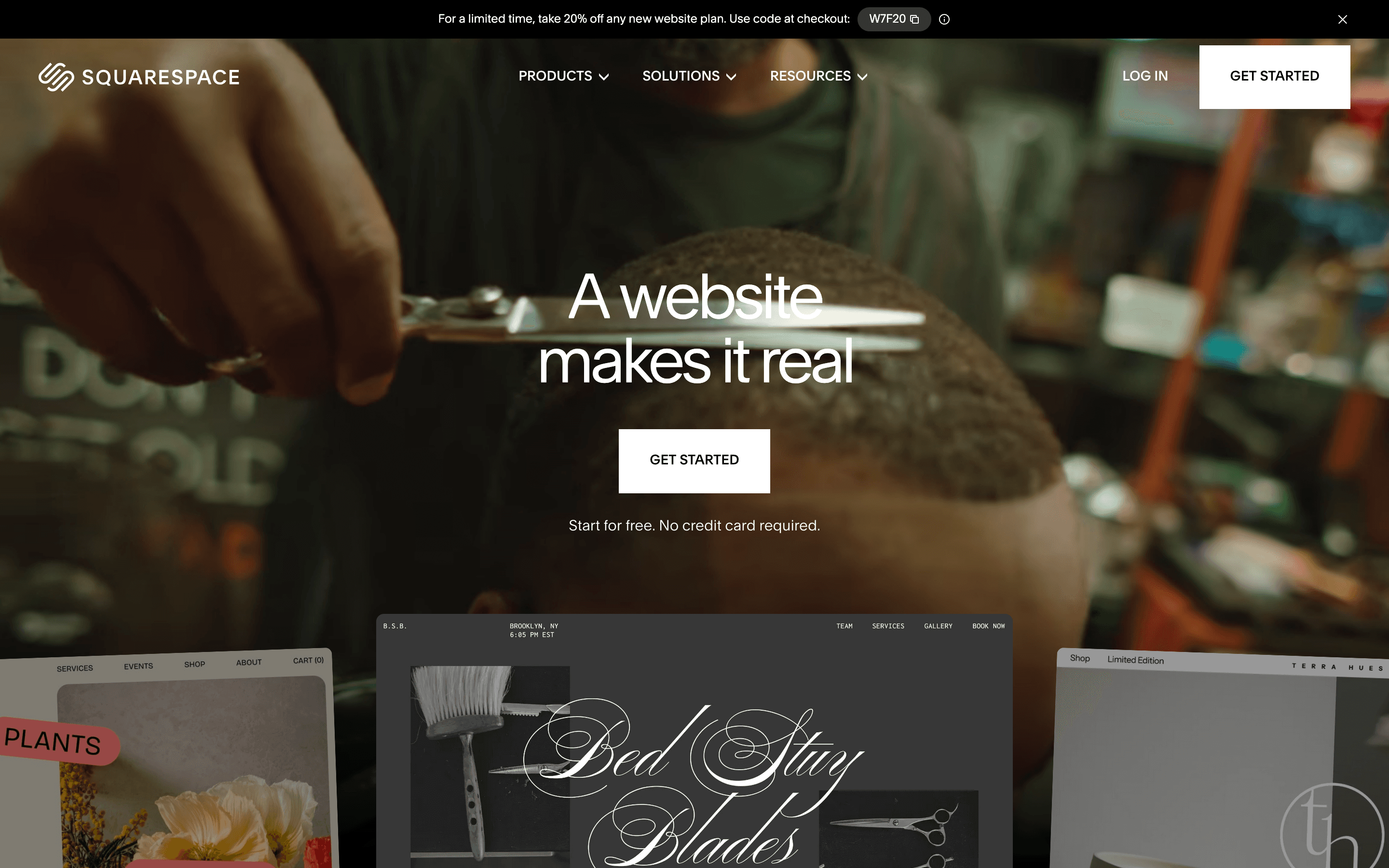
Squarespace trades Webflow's from-scratch design control for templates that look finished the day you publish. If the priority is a professional-looking multi-page site with ecommerce, a blog, and hosting in one subscription, Squarespace gets there faster than Webflow's CSS-driven canvas. Every plan includes point of sale, customer accounts, and abandoned cart recovery, and the commerce transaction fee drops to zero from Core ($29/month annual) up. There's no free plan, only a 14-day trial, and there's no code export or deep customization for anything a template can't do. Support is chat and email only, no phone line, and the company's Trustpilot rating sits at 1.2 out of 5 with recurring complaints about support responsiveness, worth weighing against how Webflow itself handles support.
Pros
- + Templates look polished out of the box, with less fiddling to get a professional result
- + Ecommerce, hosting, domain, and support are bundled into one plan and one bill
- + Transaction fees drop to 0% on Core and up, so growing stores aren't taxed on top of the plan fee
Cons
- – No free plan, only a 14-day trial, so there's no way to run a live site for free long-term
- – No phone support; help is limited to live chat and email

Wix fits teams for whom shipping fast with built-in ecommerce and booking matters more than pixel-level design control. Its AI site generator produces a usable draft from a prompt, and Core and up bundle a full store, scheduling, and a basic marketing suite into one editor, something Webflow's Basic and Premium site plans don't include at all. The free plan lets you preview a complete build before paying anything. The tradeoff against Webflow is permanence: a Wix site can't be exported or moved to another host, so switching later means rebuilding from zero, the opposite of Webflow's clean code export. Wix Payments also charges 2.9% + $0.30 per transaction on every paid tier that supports it, with no discount at the top plan.
Pros
- + Free plan lets you build and preview a full site before paying anything
- + Ecommerce, bookings, blog, and marketing tools all live in the same editor, so you don't stitch together separate apps
- + AI site generator gets a usable draft up in minutes from a text prompt
Cons
- – You cannot export or migrate a Wix site to another host, so switching later means rebuilding from scratch
- – Wix Payments charges 2.9% + $0.30 per transaction (3.7% + $0.30 for Amex) on Core, Business, and Business Elite alike, on top of the subscription price
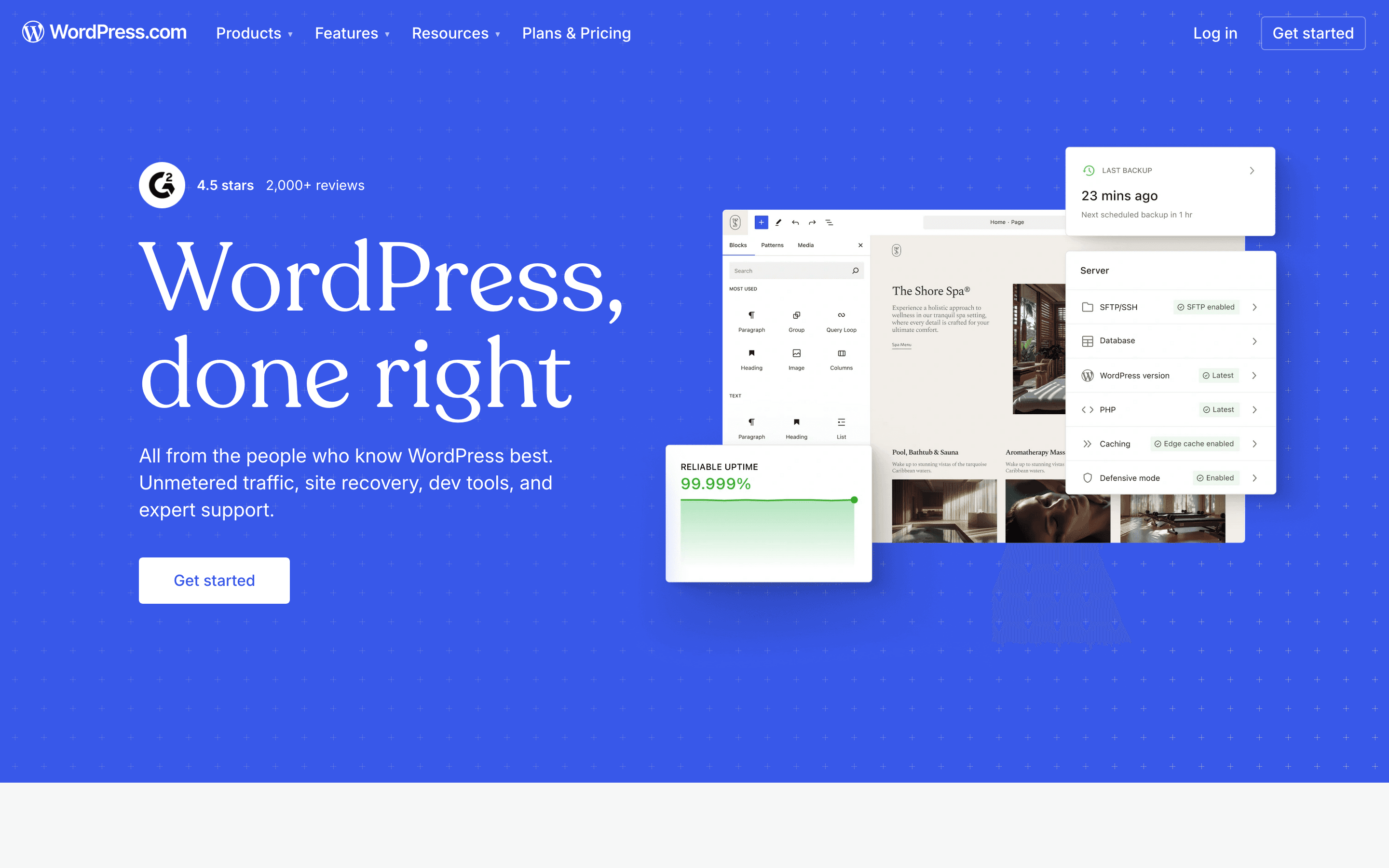
WordPress.com is the pick for teams whose real priority is content and a plugin ecosystem, not a visual design canvas. Personal starts at $9/month ($4 billed annually), undercutting every paid Webflow tier, and any paid plan unlocks the same 60,000-plus plugin marketplace, unlike Webflow where CMS access is gated to the pricier Premium tier. Business at $40/month (or $25 annual) adds SFTP/SSH, WP-CLI, GitHub deployments, and a staging site, closer to what a dev-adjacent Webflow team might want. What you give up is Webflow's visual, CSS-accurate editing; WordPress.com works through a block editor, a different mental model entirely. Storage also caps at 50 GB even on the top Commerce plan, and the platform's abrupt 2022 pricing change, which briefly cut the free plan to 500 MB, is still cited as a trust concern in reviews.
Pros
- + Free plan lets you launch and test a site with no credit card
- + Business and Commerce plans include real-time backups, SFTP/SSH, and Git deploys, which most website builders don't offer
- + Access to the full 60,000+ plugin marketplace on any paid plan, not just the top tier
Cons
- – Developer tools like SFTP/SSH, WP-CLI, GitHub deployments, staging sites, and real-time backups are locked out until you pay for Business at $40/month (or $25/month annual), a steep jump from Premium at $18
- – Storage tops out at 50 GB even on the $70/month Commerce plan; more space costs extra
Should your product be on this website builders list?
If you build a tool that belongs next to the ones above, submit it. A human reviews every submission. Approved products get their own page with pricing and screenshots, plus a place in the comparisons where they fit. It is free. You sign in with your work email so you can follow the decision, and there is no password to create.
Webflow alternatives: FAQ
What's the cheapest real alternative to Webflow?+
WordPress.com's Personal plan starts at $9/month ($4 billed annually), and Squarespace's Basic plan starts at $19/month annual. Both undercut the $25/month Premium plan Webflow requires for its own CMS.
Which alternative feels closest to Webflow's design experience?+
Framer. It's built around the same kind of free-form visual canvas rather than a form-based template editor, and it ships a CMS on paid plans.
Can I move my site to another host if I leave the alternative later?+
WordPress.com has a built-in migration path to self-hosted WordPress. Wix sites can't be exported to another host at all, so switching means rebuilding from scratch. Squarespace doesn't publish a comparable export path either, so check its current help docs before you commit if portability matters to you.
Which alternative drops ecommerce transaction fees like Webflow buyers hope for?+
Squarespace removes its commerce transaction fee entirely from the Core plan ($29/month annual) up, though digital product sales still carry a smaller fee that steps down at higher tiers.
Webflow alternatives: pricing compared
Entry price, billing model, and whether pricing is public. 5 of 5 publish pricing you can check without talking to sales.
| Tool | Starting price | Billing | Free option | Pricing disclosed |
|---|---|---|---|---|
| Webflow | $15/site/mo | tiered | Yes | Partly public |
| Framer | $10/site/mo | tiered | Yes | Partly public |
| Squarespace | $19/mo | tiered | Trial (14 days, no credit card required) | Public |
| Wix | $17/mo | tiered | Yes | Partly public |
| WordPress.com | $9/mo | tiered | Yes | Partly public |
How we made these picks. We compare tools on public pricing, features, and hands-on assessment, then verify every price against the vendor's own page. We never accept payment for rankings. Read the full methodology. Spotted an error? Report it.