Top Amplitude Alternatives in 2026
Here for Amplitude itself? See the full Amplitude profile, pricing & reviews →
Suggest a change- If you want Amplitude's full bundle (analytics, replay, flags, experiments) but with a cap on what a traffic spike can cost you, choose PostHog. every product has its own monthly free allowance and you can set a hard billing limit per product, plus a self-hosted option if you want event data off a vendor's servers.
- If your team mainly wants self-serve funnels, retention, and cohorts without Amplitude's usage-scaling Plus tier, choose Mixpanel. Growth bills a flat $0.28 per 1,000 events past the free 1M, which is easier to model than a price that rises automatically with volume.
- If you keep shipping features faster than you can update a tracking plan, choose Heap. auto-capture records every click and page view up front, so you can build a funnel on behavior you never explicitly instrumented.
- If you need analytics paired with in-app guides, walkthroughs, and NPS feedback under one vendor, choose Pendo. it bundles product adoption tools and feedback collection with analytics, which Amplitude does not offer on its own.
- If your real problem is finding the exact broken session, not reading an aggregate funnel, choose Fullstory. it indexes DOM elements, rage clicks, and errors as searchable data so you can query for a broken session instead of only watching a replay.
- If you're already running feature flags, experiments, and analytics together in Amplitude and the free or Plus tier still fits your budget, choose stay on Amplitude. migrating a working experimentation and analytics setup costs more in engineering time than the usage-based pricing currently costs you.
Amplitude bundles product analytics, session replay, feature flags, and experimentation into one platform, and its free plan covers a real 2M events a month with unlimited seats. Teams start looking elsewhere once they hit the usage-based pricing wall: the Plus plan's price climbs automatically with event volume, and the Growth and Enterprise tiers most growing teams need are quote-only with no published number to plan against.
The five tools below all do the same core job as Amplitude: turn your app's event stream into funnels, retention curves, and cohorts a product or growth team can act on without writing SQL for every question. Where they differ is how they price that, and how far they go into replay, experimentation, or in-app engagement on top of it.
Amplitude alternatives compared
| Tool | Best for | Starting price | Free option | Last update |
|---|---|---|---|---|
| PostHogBest for controlling cost at scale | Engineering-led product teams that want analytics, replay, flags, and experiments in one tool instead of stitching several together | Free tier + custom | Yes | June 2026 |
| MixpanelBest for simple self-serve funnels and retention | Product and growth teams that want self-serve funnels, retention, and cohort analysis without waiting on a data team | Usage-based | Yes | June 2026 |
| HeapBest if you don't have a tracking plan yet | Teams that want retroactive analytics without shipping a tracking plan first | Free tier + custom | Yes | April 2026 |
| PendoBest for analytics plus in-app engagement | Product teams that want analytics, in-app guides, and NPS feedback under one vendor instead of stitching together three tools | Free tier + custom | Yes | March 2026 |
| Fullstory | Product and growth teams that need to go from 'a metric moved' to 'here is the exact session where it broke' without switching tools | Free tier + custom | Yes | — |
Why teams switch from Amplitude
Pricing turns into a sales negotiation once you outgrow the free tier
Growth and Enterprise plans have no published price. Third-party deal data puts real contracts anywhere from about $40K to $250K+ a year, and the Plus plan itself scales automatically with event volume without a new conversation.
Experimentation and CDP features are billed as separate line items on top of Growth and Enterprise
Teams that assumed those capabilities were bundled with analytics can be surprised by the extra cost at renewal.
Even Amplitude's own leadership names pricing as the top objection
Amplitude's CEO has publicly acknowledged that price is the most cited reason prospects hesitate to adopt the product.
The best Amplitude alternatives, ranked
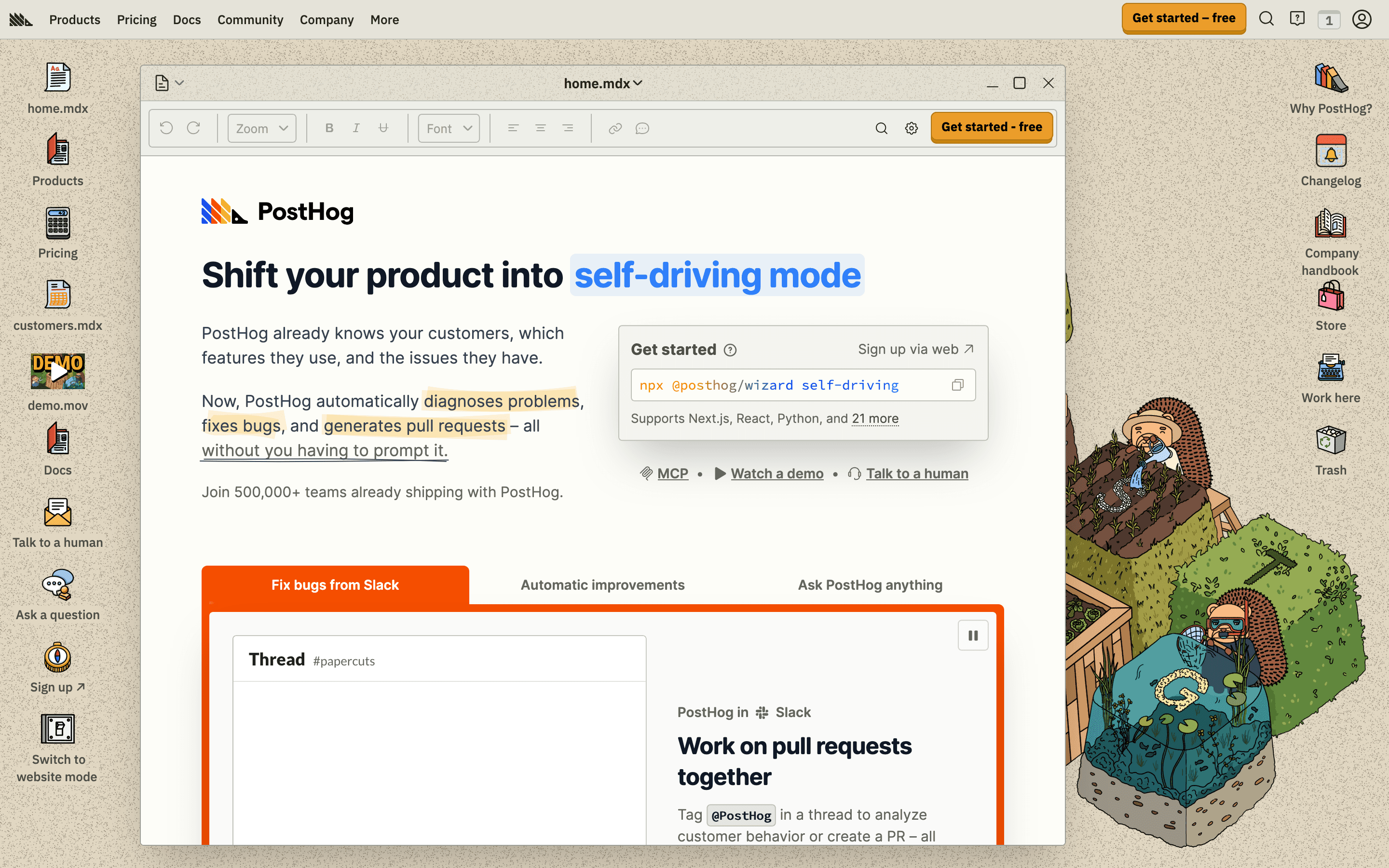
PostHog is the closest full-platform match for Amplitude: analytics, session replay, feature flags, experiments, surveys, and error tracking in one product, the same bundle Amplitude is built around. The difference is pricing and control. Instead of Amplitude's tiers that jump to a custom quote once you outgrow Plus, PostHog gives every product its own permanent monthly free allowance and lets you set a hard billing limit per product, so a traffic spike cannot blow the budget without warning. It is also open source with a self-hosted option, which matters if you want event data to stay off a vendor's servers. The tradeoff is that support beyond email requires a $250 or $750 monthly add-on, and usage-based billing across several products still takes setup discipline to keep predictable.
Pros
- + One tool covers analytics, session replay, flags, experiments, and error tracking, so you avoid stitching together separate vendors
- + Free tier resets every month and never expires, with 1M events and 5K recordings included at no cost
- + You can set a hard billing limit on each product separately, so a traffic spike can't blow past what you're willing to spend
Cons
- – Usage-based pricing means your bill moves with traffic, which makes it harder to budget than a flat per-seat plan
- – Without setting billing limits up front, a viral spike or misconfigured tracking call can generate a large bill fast
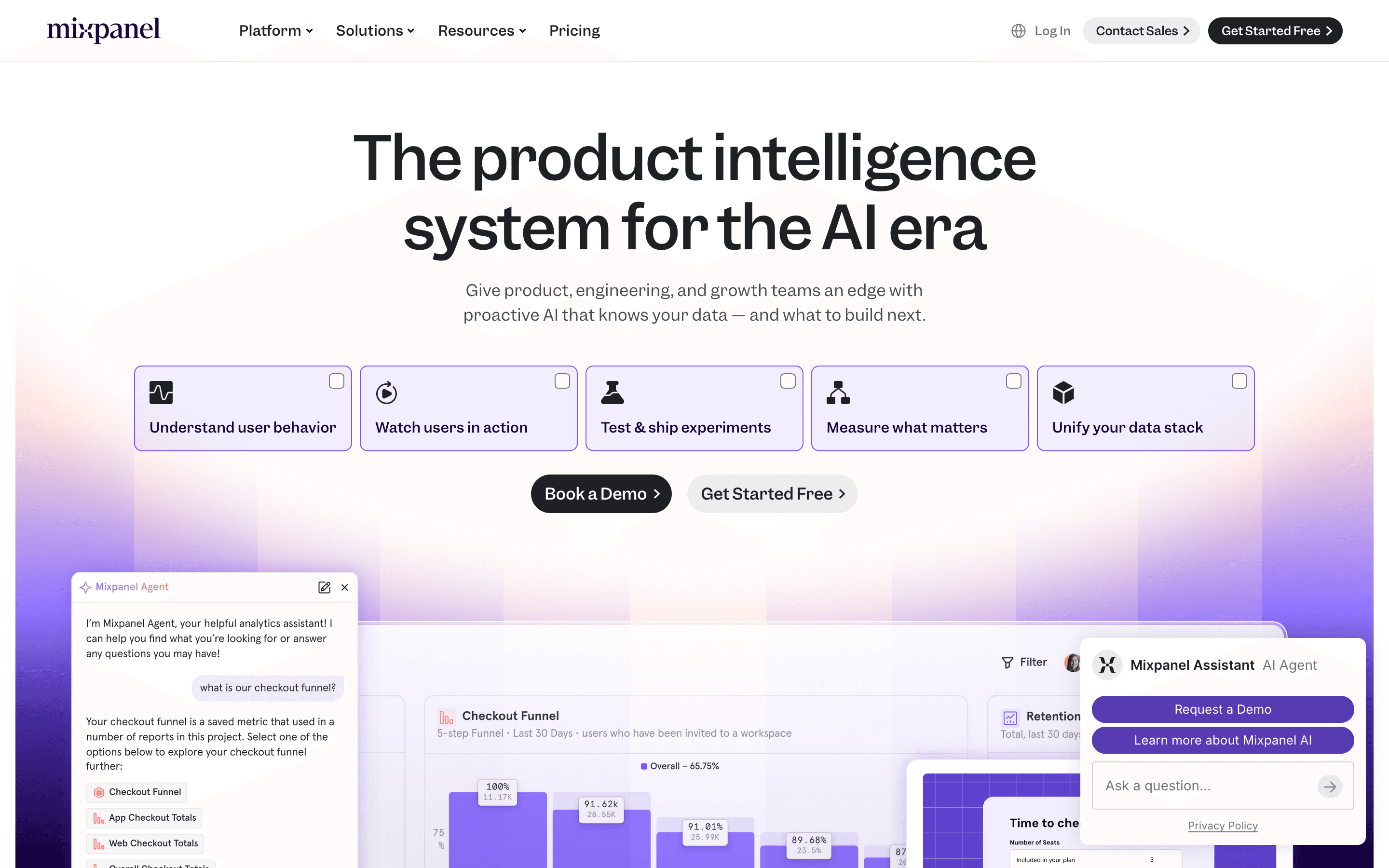
Mixpanel is the most direct swap for teams that picked Amplitude mainly for funnels, retention, and cohort analysis. Both are self-serve, event-based tools built for product and growth teams to answer behavior questions without a data team, and Mixpanel's free plan covers 1M events a month with unlimited seats, similar to Amplitude's free-forever pitch. Where it differs: pricing past the free tier is a flat $0.28 per 1,000 events rather than a custom-scaling seat-and-volume mix, which is easier to model, and Mixpanel Agent adds AI-driven root-cause analysis on metric shifts. Experimentation and feature flags exist but cost extra as an add-on, same as on Amplitude's higher tiers. Startups under 5 years old with under $8M raised can get a free first year, useful for teams still proving out product-market fit.
Pros
- + Free plan covers real usage (1M events/month, unlimited seats) rather than a token trial
- + Funnels, retention, and cohort tools are fast and don't require SQL
- + Feature flags and experimentation live next to the analytics, so you can tie a rollout directly to the metrics it moved, though it costs extra as an add-on
Cons
- – Event-based billing means cost is unpredictable if usage spikes; teams report bills scaling into tens of thousands a month at high event volumes
- – Enterprise pricing (unlimited events, SSO, HIPAA, 24/7 support) is quote-only, so you can't budget for it without talking to sales
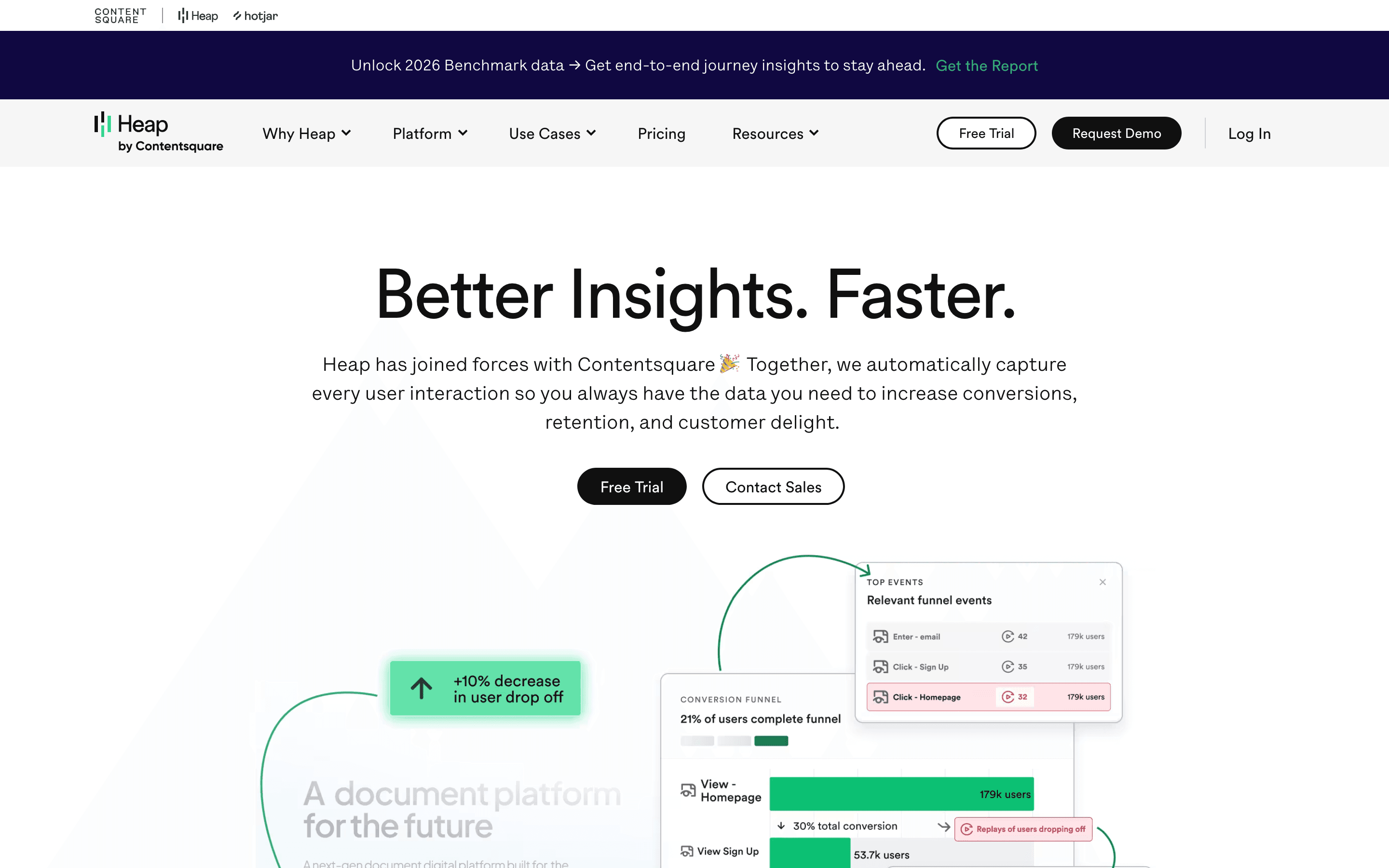
Heap fits teams frustrated that Amplitude requires defining every event before you can analyze it. Its auto-capture records every click, tap, and page view up front, so you can build a funnel on behavior you never explicitly instrumented, no redeploy required. Pricing is based on monthly sessions rather than events, which caps the damage from one power user's traffic but means normal growth can push you into a new tier faster than a per-event model would. Since Contentsquare's 2023 acquisition, new AI and session-replay investment is increasingly built for the combined Contentsquare platform rather than standalone Heap. Like Amplitude's Growth and Enterprise tiers, everything past the small free plan is a sales quote, with typical negotiated contracts landing near $41,000 a year.
Pros
- + Auto-capture means you can analyze old data for events you never explicitly instrumented
- + Free plan includes SSO and 6 months of history, unusual for a product analytics free tier
- + Session-based (not event-based) billing means a single user going wild doesn't blow up your bill
Cons
- – No public pricing past the Free plan; every paid tier requires a sales call and quote
- – Growth, Pro, and Premier contracts commonly carry 3-7% automatic price increases at renewal
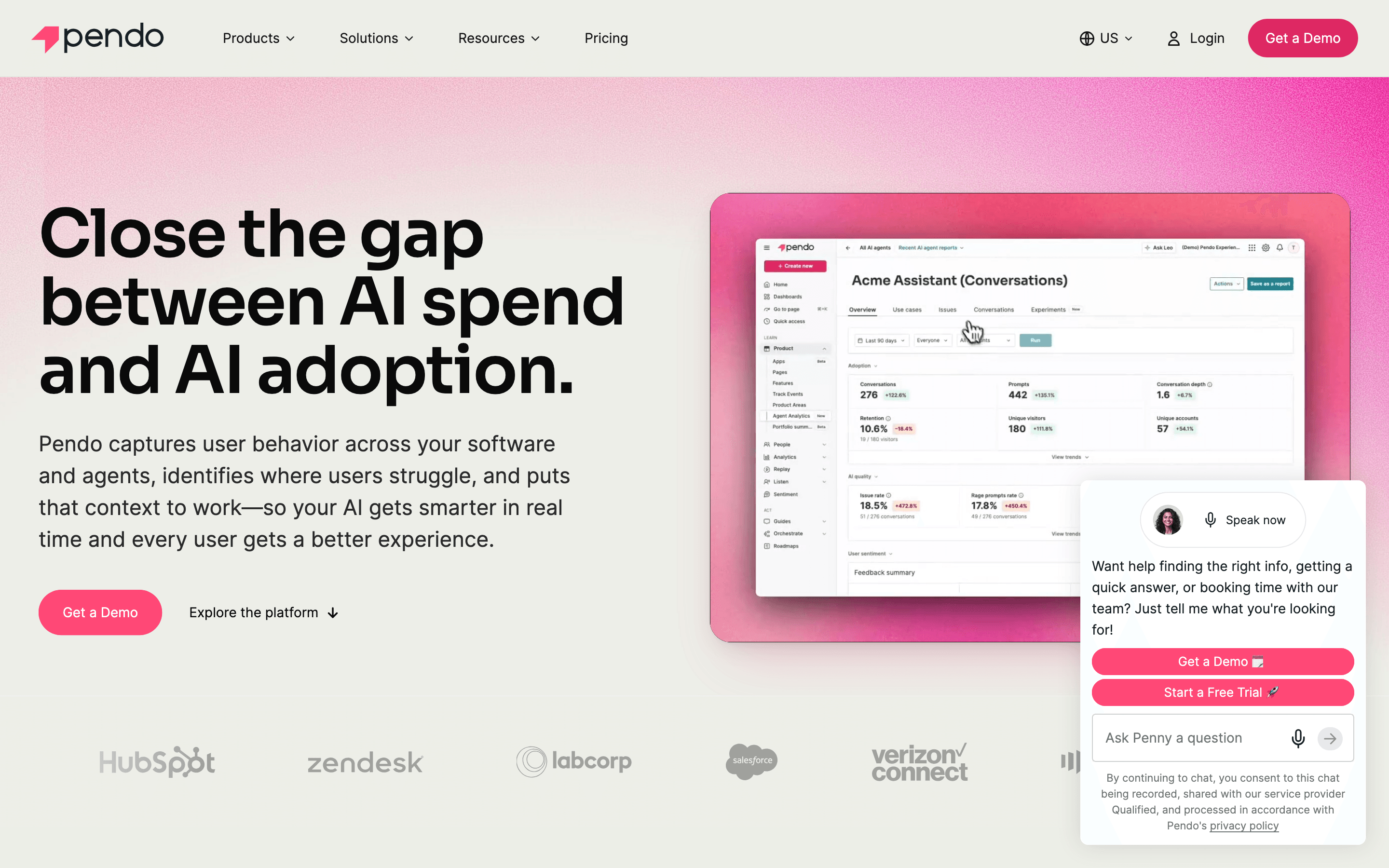
Pendo suits teams that want product analytics paired with in-app guides and NPS feedback under one contract, a broader bundle than Amplitude's analytics-plus-experimentation focus. Funnels, retention, and feature adoption sit alongside walkthroughs you can ship without engineering, plus roadmap and feedback collection, useful for PM-led teams managing adoption as much as measuring it. Pricing runs on monthly active users rather than events or seats, and every paid tier is a custom quote, so budgeting requires a sales conversation the way Amplitude's Growth and Enterprise tiers do. Session replay is included starting at the Core tier, but product discovery, sentiment surveys, and journey orchestration stay paid add-ons until the top Ultimate tier. Buyer data shows list prices rising about 16% a year for SMB buyers and about 9% for enterprise buyers, so treat renewal negotiation as part of the plan.
Pros
- + One platform covers analytics, in-app guides, and feedback collection, cutting down on tool sprawl
- + Free plan supports up to 500 MAUs with real product analytics and in-app guides, not just a trial
- + App Health and similar dashboards give product leaders a fast cross-app view without custom reporting
Cons
- – No published price for any paid tier. You go through a sales demo to find out what it costs
- – Your bill scales with product growth, not a fixed seat count. Vendr's buyer data shows moving from the roughly 500-2,000 MAU range (about $7,000-$15,000/year) into the 2,000-10,000 MAU range (about $20,000-$60,000/year) can multiply the bill 3-4x
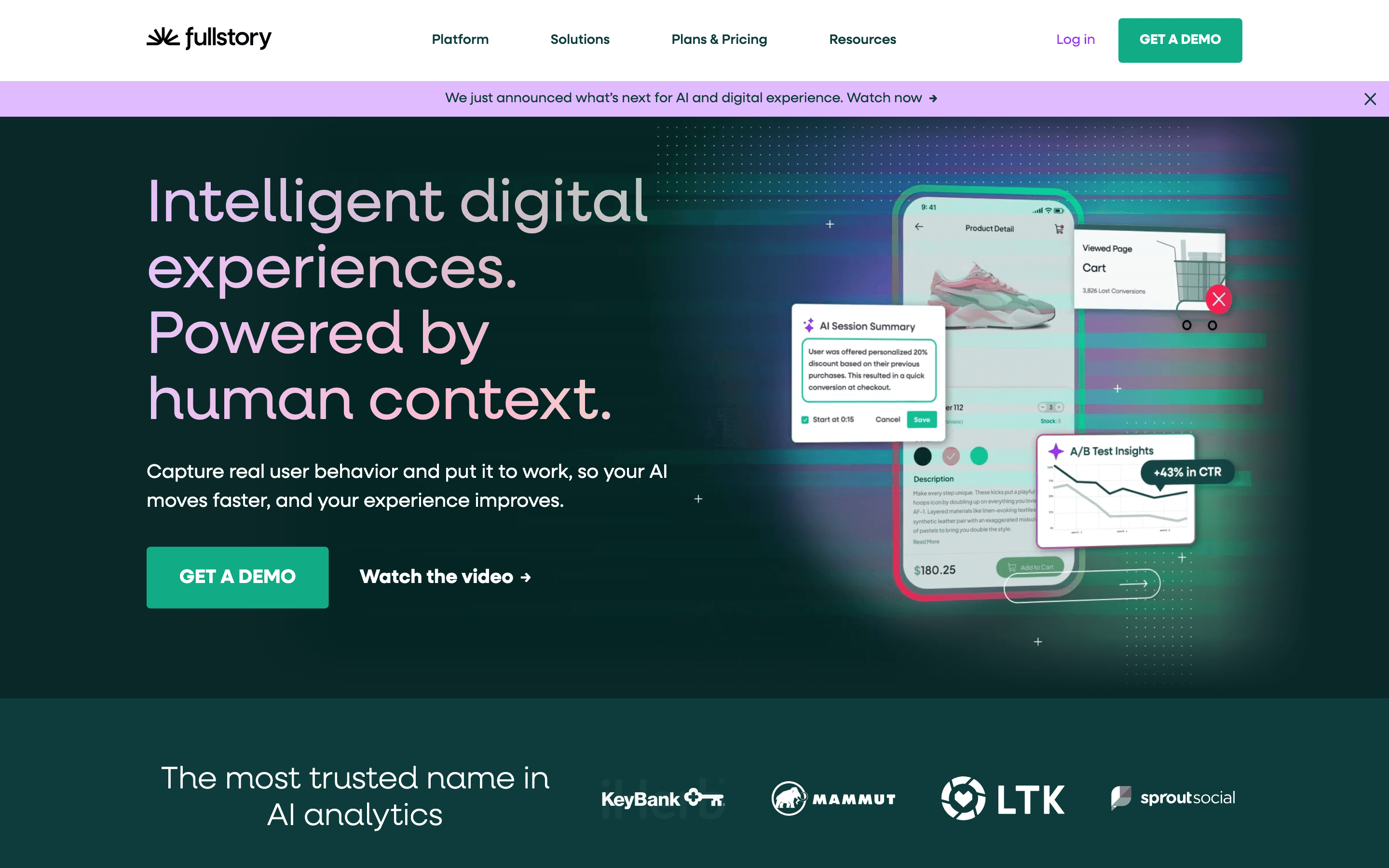
Fullstory is the pick when what actually matters is finding and watching the exact session where something broke, not just the aggregate funnel that shows a metric dropped. It indexes DOM elements, rage clicks, dead clicks, and errors as structured data, so you can query for broken sessions instead of scrubbing through video, then layers funnels, retention, and segmentation on top of that. That makes it a weaker like-for-like swap for teams that picked Amplitude mainly for cohort and event analytics rather than debugging. Its free plan covers 30,000 sessions a month for 10 users, generous for evaluation, but every paid tier is quote-only, and third-party contract data shows SMB renewal prices climbing roughly 30% a year, worth negotiating against up front.
Pros
- + Session replay is tied directly to structured event data, so you can search and segment sessions instead of scrubbing through video manually
- + Rage click, dead click, and error detection surface friction you would not think to look for
- + Generous free plan (30,000 sessions/month, 12 months retention, 10 users) for evaluating the product before committing to a paid contract
Cons
- – No public pricing above the free tier. Every paid plan (Business, Advanced, Enterprise) requires a sales call
- – Third-party contract data shows wide, unpredictable pricing (roughly $10K to $116K/year) driven by session volume, and SpendHound's benchmark data shows SMB renewal prices climbing about 30% year over year on average, versus about 11% for enterprise accounts
Should your product be on this product analytics list?
If you build a tool that belongs next to the ones above, submit it. A human reviews every submission. Approved products get their own page with pricing and screenshots, plus a place in the comparisons where they fit. It is free. You sign in with your work email so you can follow the decision, and there is no password to create.
Amplitude alternatives: FAQ
What is the best free Amplitude alternative?+
PostHog and Mixpanel both offer genuinely useful free tiers, 1M events a month for PostHog's analytics product and 1M events a month for Mixpanel, with unlimited seats on both. Heap's free plan caps at 10,000 sessions a month but throws in SSO, unusual for a free tier.
Which Amplitude alternative is cheapest at high volume?+
It depends on your usage pattern. PostHog lets you cap spend per product with a hard billing limit, and Mixpanel's flat $0.28 per 1,000 events is straightforward to model. Heap, Pendo, and Fullstory are all quote-only past their free plans, so you cannot budget for them without a sales call.
Does any Amplitude alternative match its feature flags and experimentation?+
PostHog bundles feature flags and experiments into the same product and pricing as its analytics. Mixpanel offers both too, but as a paid add-on on every plan rather than included.
Which Amplitude alternative works best without instrumenting events first?+
Heap auto-captures clicks, taps, and page views from day one, so you can build funnels retroactively instead of defining every event in advance the way Amplitude requires.
Amplitude alternatives: pricing compared
Entry price, billing model, and whether pricing is public. 3 of 6 publish pricing you can check without talking to sales.
| Tool | Starting price | Billing | Free option | Pricing disclosed |
|---|---|---|---|---|
| Amplitude | $49/mo | usage-based | Yes | Partly public |
| PostHog | Free tier + custom | usage-based | Yes | Partly public |
| Mixpanel | Usage-based | usage-based | Yes | Partly public |
| Heap | Free tier + custom | usage-based | Yes | Not disclosed |
| Pendo | Free tier + custom | quote-only | Yes | Not disclosed |
| Fullstory | Free tier + custom | quote-only | Yes | Not disclosed |
How we made these picks. We compare tools on public pricing, features, and hands-on assessment, then verify every price against the vendor's own page. We never accept payment for rankings. Read the full methodology. Spotted an error? Report it.