Data warehouse cost: the real 2026 numbers
Snowflake, Databricks, BigQuery, and Redshift bill by usage, not seats. Cost hinges on scans and idle compute, from hundreds to six figures a month.
Why data warehouse cost swings from hundreds to six figures
There's no single number. Snowflake, BigQuery, Databricks, and Redshift all charge for what you run, not for a seat or a flat plan, so a small data team's real data warehouse cost can land anywhere from a few hundred dollars a month to tens of thousands, depending on how much data you scan, how long compute sits idle, and how well you tune it. The rest of this guide translates each vendor's billing unit, credits, slots, DBUs, nodes, into what you'd feel on an invoice.
Snowflake credits: why there's no sticker price
Snowflake bills compute by the second in Snowflake credits, and storage separately by the TB per month on compressed data. The catch: Snowflake doesn't publish a dollar rate per credit anywhere on its pricing page. The rate depends on which edition you're on (Standard, Enterprise, Business Critical, or Virtual Private Snowflake), which cloud you picked (AWS, Azure, or GCP), and your region. You either run its calculator or talk to sales to find out what a credit costs you specifically.
That opacity is also the biggest source of Snowflake bill shock. A warehouse that isn't set to auto-suspend keeps burning credits every second it's up, whether or not anyone's querying it. New accounts get a 30-day trial with $400 in credits, which is enough to test real workloads but not enough to learn your steady-state cost.
BigQuery: pay per scan, or buy slots
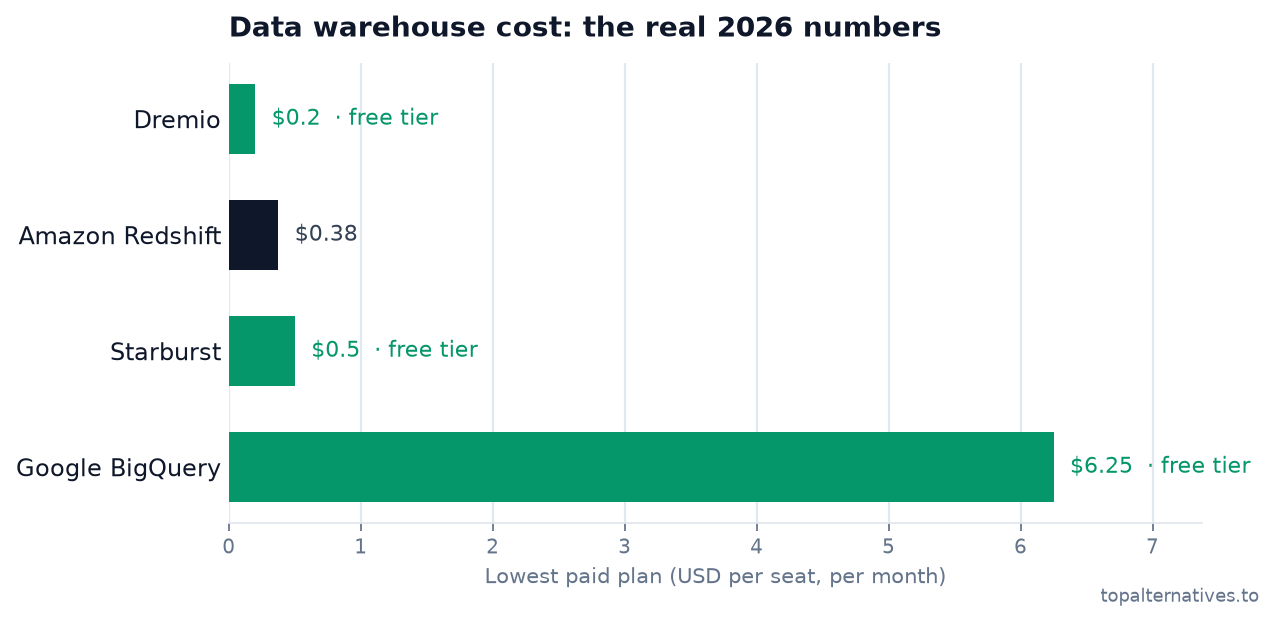
Google BigQuery is the one warehouse here with real published numbers. On-demand queries cost $6.25 per TiB of data scanned, and the first 1 TiB each month is free. Storage runs about $0.023 per GiB a month for data touched in the last 90 days, dropping to about $0.016 per GiB a month once it's untouched for 90+ days, and the first 10 GiB is free.
If your query volume gets steady and high, BigQuery Editions let you buy dedicated slot capacity instead of paying per scan: Standard starts at $0.04 per slot-hour, Enterprise at $0.06, and Enterprise Plus at $0.10, all in us-central1, with cheaper rates if you commit for one or three years. For a small team running occasional dashboards rather than constant pipelines, on-demand scanning is usually the cheaper starting point, right up until someone runs an unfiltered SELECT * over a multi-terabyte table.
Databricks DBUs, and why the median bill is $300,000
Databricks bills by the Databricks Unit (DBU), consumed per second, stacked on top of whatever AWS, Azure, or GCP charges you for the underlying compute and storage. Like Snowflake, there's no public DBU rate table. The exact rate depends on cloud, region, workload type (Jobs Compute, SQL Serverless, Model Serving, and others), and any commitment you sign.
What is public: third-party spend-benchmarking sites (Vendr and SpendHound) put the median Databricks buyer at roughly $300,000 a year, with SMB buyers averaging around $190,000 and enterprise buyers near $580,000. That's not a Databricks-specific problem so much as a sign of what happens when Spark clusters, ML training, and BI all run on the same usage-billed platform. If your team's job is mostly SQL dashboards and not Spark pipelines or model training, that bill buys you capability you may not need. Databricks Free Edition is free forever for learning, and there's a 14-day trial of the full platform, but neither tells you what production will cost.
Redshift: nodes, RPUs, and a real free-tier floor
Amazon Redshift splits into two paths. Provisioned clusters bill per node-hour, for example around $3.26/hour for an ra3.4xlarge or $3.04/hour for the newer rg.4xlarge in US East, plus managed storage at roughly $0.024/GB a month, separate from compute. Redshift Serverless bills per RPU-hour at $0.375, but there's a 4-RPU minimum, so an active workgroup runs about $1.50 an hour the moment it's on, even for a light query. It does drop to zero while genuinely idle. Querying data straight from S3 with Redshift Spectrum costs $5 per TB scanned, on top of whatever compute you're already paying for.
There's no standing free tier. First-time Serverless users get a $300 credit that expires after 90 days; where Serverless isn't available, provisioned clusters get a two-month trial capped at 750 hours a month.
Putting the four side by side
| Warehouse | Billing unit | Cheapest published rate | Storage billed separately? | Free tier / trial |
|---|---|---|---|---|
| Snowflake | Credits per second (compute) | Not published, quote or calculator only | Yes, per TB/month | No free tier; 30 days, $400 credits |
| Google BigQuery | TiB scanned or slot-hours | $6.25/TiB scanned; $0.04/slot-hour (Standard) | Yes, per GiB-hour | First 1 TiB scan + 10 GiB storage free/month; Sandbox with no card |
| Databricks | DBUs per second | Not published, quote or calculator only | Billed via cloud provider | Free Edition (learning only); 14-day trial |
| Amazon Redshift | RPU-hour (serverless) or node-hour (provisioned) | $0.375/RPU-hour (4 RPU minimum) | Yes, managed storage per GB-month | No standing free tier; $300 credit, 90 days |
Two things jump out. BigQuery and Redshift both publish real numbers you can plug into a spreadsheet today. Snowflake and Databricks don't, because their rate depends on commercial terms you only see after talking to sales or running their calculators. That's not a knock on either vendor's value, but it does mean "compare the sticker price" isn't possible for half this list.
Two narrower options: Dremio and Starburst
If your workload is really about querying data that already lives in Apache Iceberg tables, or federating queries across warehouses you already have, Dremio and Starburst price differently. Dremio Cloud bills $0.20 per Dremio Compute Unit, a time-based measure covering query execution and its Reflections caching layer, and its Community Edition is free forever if you're willing to self-host. Starburst Galaxy has a genuinely free tier for up to 3 clusters, then scales from $0.50 per credit on Pro to $1.00 on Mission Critical. Neither replaces a full warehouse migration for most teams, they sit on top of or beside one, but they're worth knowing if your actual cost problem is querying data you already have rather than storing new data somewhere.
How to estimate your bill
Vendor calculators and sales quotes are the only reliable way to size Snowflake or Databricks costs, since neither publishes rates. For BigQuery and Redshift, you can build a rough model from the public numbers above: estimate your monthly TB scanned or RPU-hours, multiply by the published rate, then add storage. For all four, the single biggest lever is idle compute. Warehouses without auto-suspend, serverless workgroups left running, and oversized clusters are the most common reason a data team's actual bill is multiples of what they expected. Whatever platform you land on, run a real workload through its calculator before you commit, and revisit the number after your first full billing cycle, not before.
If you're evaluating a move off Snowflake specifically, our Snowflake alternatives hub ranks the field with the same verified pricing data used here. If Databricks' DBU model and the $300,000 median bill are the problem, the Databricks alternatives hub covers the same ground for that platform.
Keep reading
FAQ
Why doesn't Snowflake or Databricks list a price per credit or DBU?+
Both bill compute by a usage unit, Snowflake credits per second and Databricks Units per second, and the rate for that unit depends on edition or workload type, cloud provider, region, and any committed spend. Neither publishes a flat dollar rate, so you need their pricing calculator or a sales quote to see your actual number.
How much does Databricks typically cost a team per year?+
Databricks doesn't publish a price list. Third-party spend-benchmarking sites, Vendr and SpendHound, put the median buyer at roughly $300,000 a year, with SMB buyers averaging around $190,000 and enterprise buyers near $580,000.
Which cloud data warehouse is cheapest for a small team with light, unpredictable usage?+
Google BigQuery's on-demand pricing charges $6.25 per TiB of data scanned, with the first 1 TiB free every month and no minimum warehouse or cluster kept running. That structure suits bursty or occasional workloads better than platforms with a compute floor, like Redshift Serverless, which has a 4-RPU minimum costing about $1.50 an hour while active.
Does any cloud data warehouse have a real free tier?+
BigQuery has a permanent free monthly allowance (1 TiB of query scanning and 10 GiB of storage) plus a no-credit-card Sandbox. Dremio's Community Edition and Starburst Galaxy's Free tier (up to 3 clusters) are also free with no time limit, though both are more limited than their paid tiers. Snowflake, Databricks production use, and Redshift have no standing free tier, only time-limited trial credits.
Sources
- https://www.snowflake.com/en/pricing-options/
- https://cloud.google.com/bigquery/pricing
- https://www.databricks.com/product/pricing
- https://aws.amazon.com/redshift/pricing/
- https://www.dremio.com/pricing/
- https://www.dremio.com/community-edition/
- https://www.starburst.io/pricing/
- https://www.vendr.com/buyer-guides/databricks
- https://www.spendhound.com/marketplace/databricks-pricing
Should your product be on this list?
If you build a tool that belongs next to the ones above, submit it. A human reviews every submission. Approved products get their own page with pricing and screenshots, plus a place in the comparisons where they fit. It is free. You sign in with your work email so you can follow the decision, and there is no password to create.
Spotted something wrong or out of date? Report it and we'll check it against the source.