Snowflake Review
A cloud data platform for warehousing, data engineering, AI, and app building, billed on actual usage
Is this your product? Claim this page · Request a change
Looking for a Snowflake alternative? See our ranked comparison.→What is Snowflake?
Snowflake is a cloud data platform that separates storage and compute, so teams can run data warehousing, data engineering, data lake, and AI/ML workloads on the same governed data without moving it between systems. It runs on AWS, Azure, or GCP and bills compute and storage separately based on actual use, not fixed server sizing.
The platform started as a SQL data warehouse and has since added Snowpark (Python, Java, and Scala workloads), Snowpark Container Services, Cortex (managed LLM and AI functions), Streamlit-based app hosting, and native support for Apache Iceberg tables. The editions (Standard, Enterprise, Business Critical, VPS) mainly gate security, governance, and isolation features, not raw compute capability. Compute is billed the same way no matter which workload type you run.
Snowflake screenshots
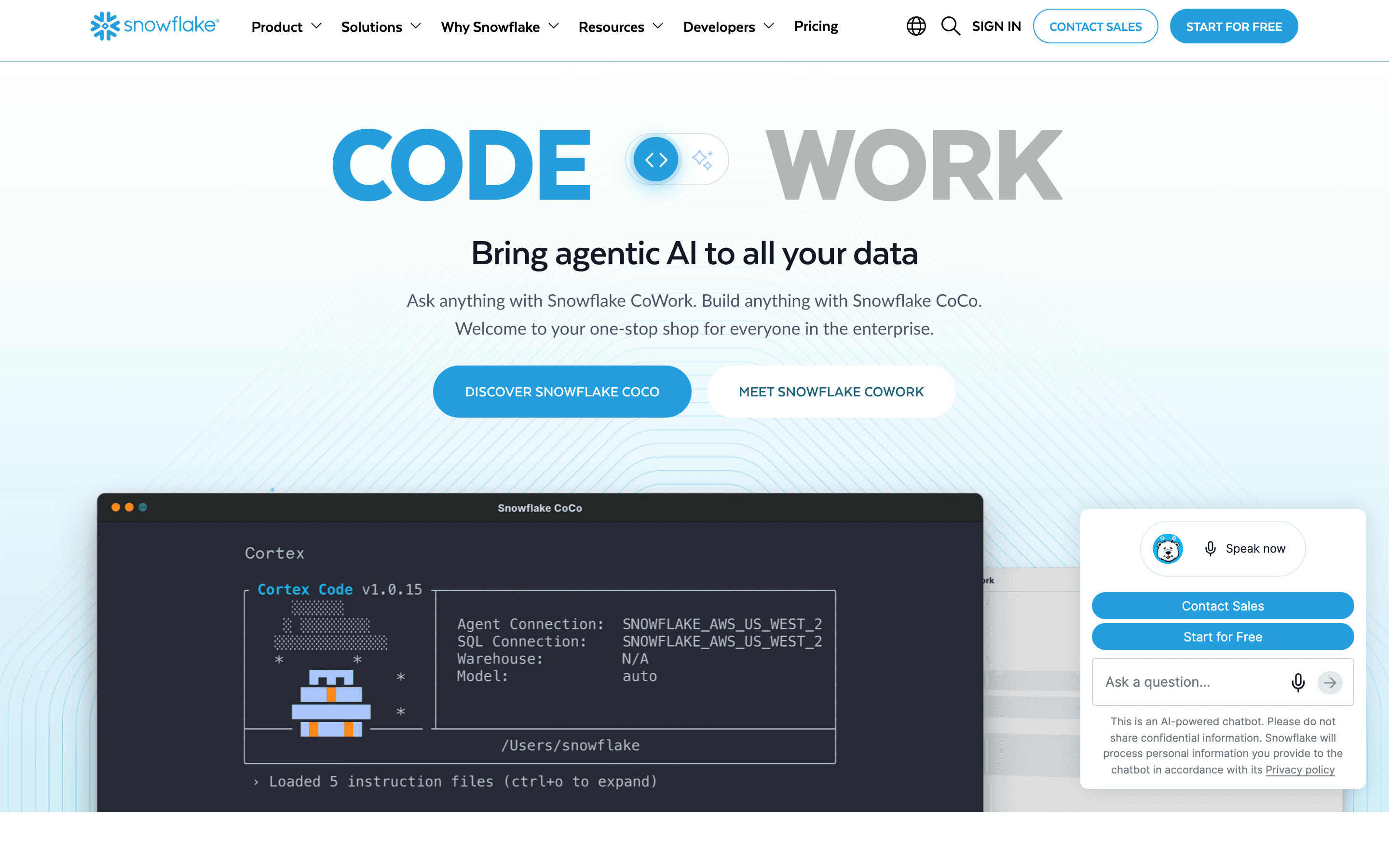
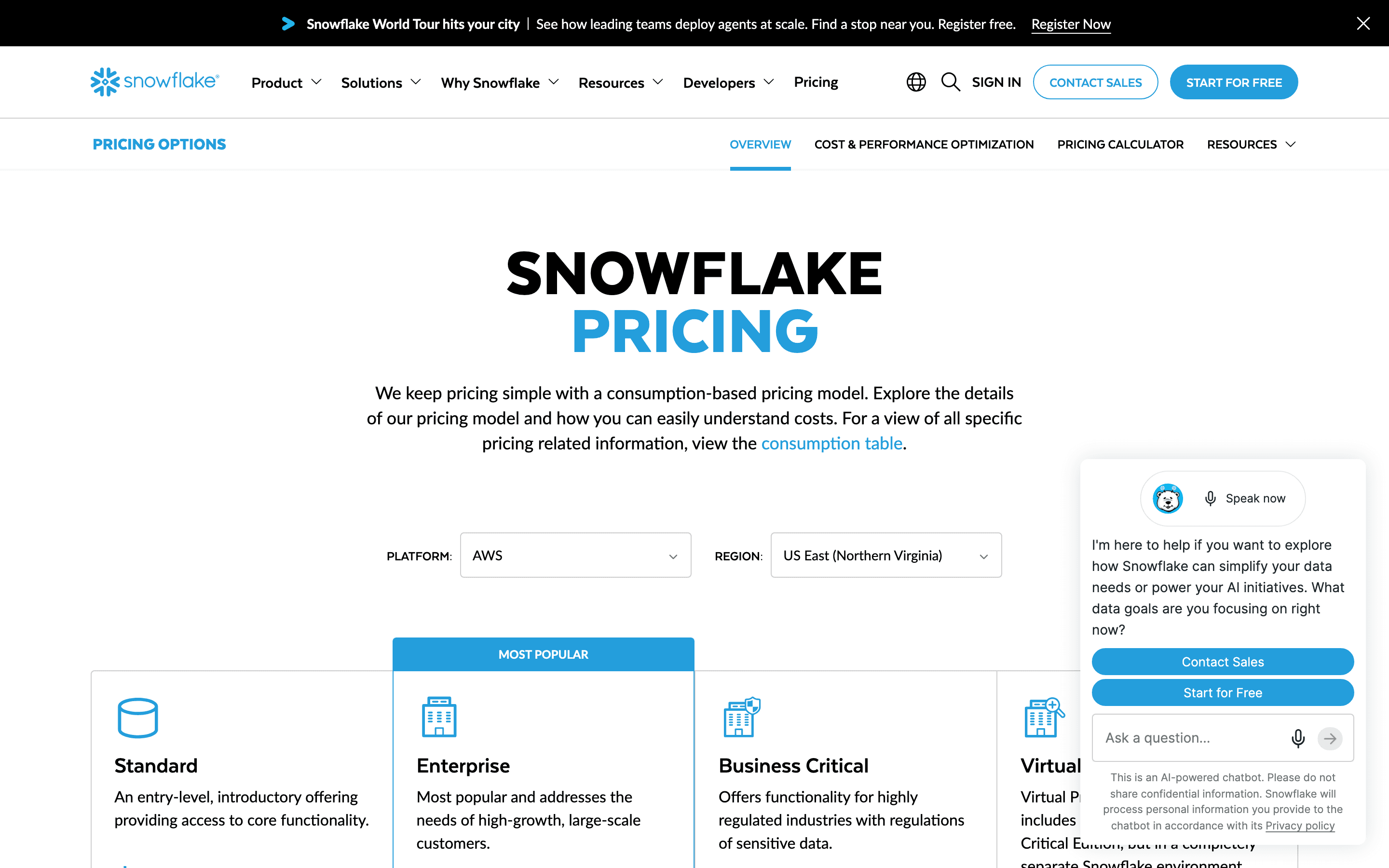
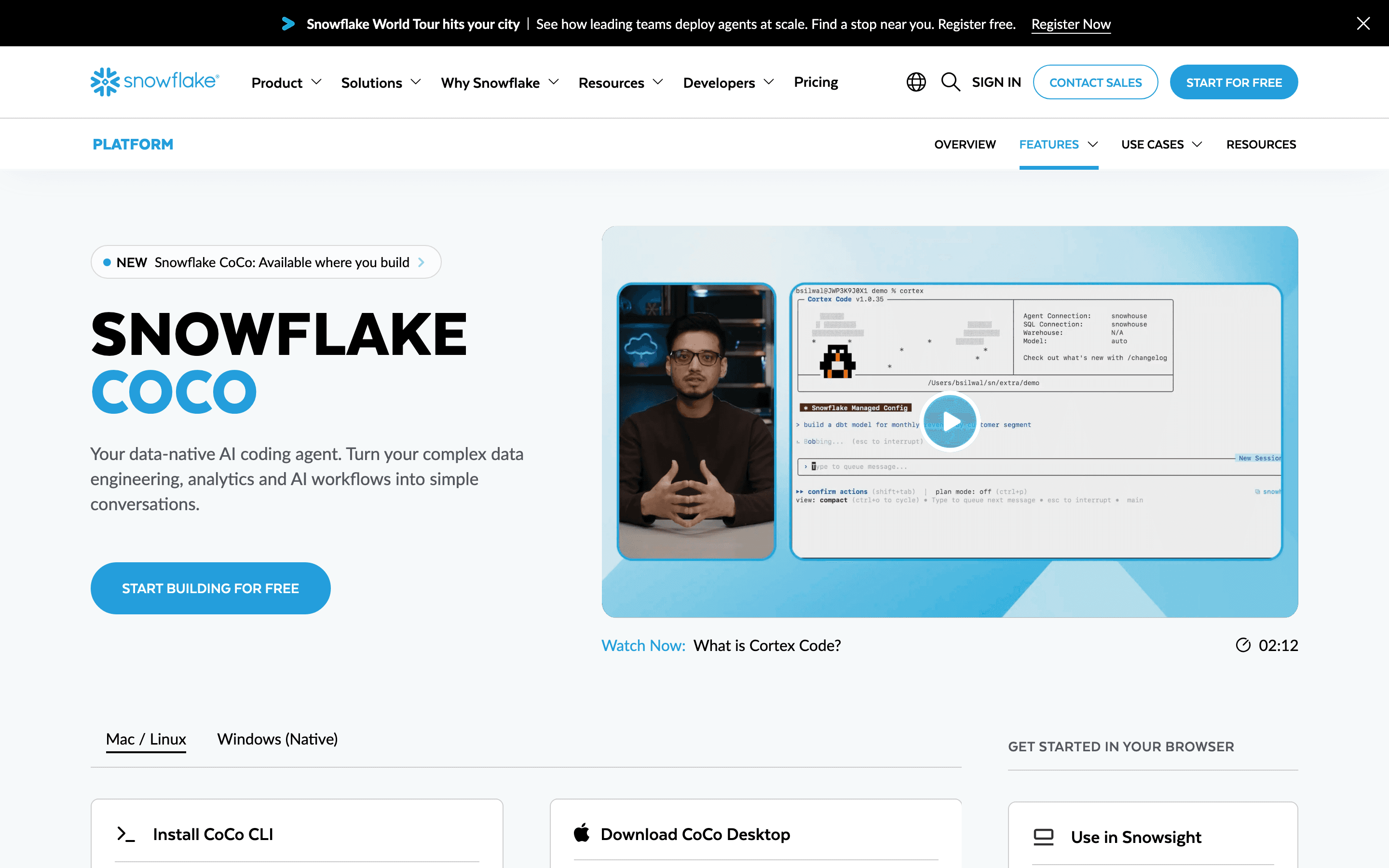

Who it's for
- ✓ Teams that need to run SQL analytics, data engineering, and AI workloads on one governed copy of data instead of stitching together separate systems
- ✓ Organizations that want to scale compute up or down, including to zero, without managing server infrastructure
- ✓ Companies already committed to AWS, Azure, or GCP that want a data platform that runs natively on their existing cloud
Who should look elsewhere
- ✗ Small teams or solo projects with tight, predictable budgets. Consumption billing can produce unpredictable monthly costs if warehouses are left running or queries aren't tuned
- ✗ Teams that want a simple flat-rate subscription instead of managing credit consumption, warehouse sizing, and auto-suspend settings
Pros
- + Compute and storage scale and bill independently, so idle warehouses can auto-suspend to stop charges
- + Native support for Apache Iceberg tables lets teams query open-format data without duplicating it into proprietary storage
- + Snowpark and Cortex let SQL, Python, and AI/LLM workloads run against the same data and governance model instead of separate platforms
- + Time Travel and zero-copy cloning make it easy to query past data states and clone databases without duplicating storage
Cons
- – No published flat price. You have to use the consumption calculator or get a sales quote to estimate real monthly cost
- – Per-credit compute rates differ by edition, cloud provider, and region, which makes it harder to compare quotes
- – Runaway costs are a common complaint when warehouses are oversized or not set to auto-suspend
- – Higher-security editions (Business Critical, VPS) require talking to sales, not a self-serve upgrade
Snowflake pricing
What you pay for
Snowflake bills usage, not seats. You pay for compute by the second in Snowflake credits, plus storage by the TB per month. There's no flat entry tier. The cheapest edition, Standard, covers core warehousing, Snowpark, data sharing, and encryption at the lowest per-credit rate, and every tier above it layers on governance and security features. There's no free tier, but new accounts get a 30-day trial with $400 in free credits. Snowflake doesn't publish per-credit dollar rates, so you need its pricing calculator or a sales quote to know your real cost.
You pay for what you consume rather than a per-seat fee, so cost scales with usage.
| Plan | Price | Highlights |
|---|---|---|
| Standard | Custom | Core warehousing, Snowpark, data sharing, automatic encryption · Lowest per-credit compute rate |
| Enterprise | Custom | Multi-cluster compute · Extended Time Travel (up to 90 days) · Column-level security and governance |
| Business Critical | Custom | Tri-Secret Secure encryption · HIPAA/PCI support · Private connectivity, database failover/failback |
| Virtual Private Snowflake (VPS) | Custom | Fully isolated environment · All Business Critical features · Requires a sales contact |
Snowflake bills compute and storage separately. Compute is Snowflake credits consumed per second by your warehouses. Storage is billed per TB per month on compressed data. Rates vary by edition, cloud provider (AWS, Azure, GCP), and region. The public pricing page does not list per-credit dollar rates. It points you to a consumption/rate table and a pricing calculator, or lets you request a custom quote. There is no single fixed entry price, so startingPrice is left null. New accounts get a 30-day trial with $400 in free credits, usable within 30 days of signup.
Pricing verified July 6, 2026 · source
How Snowflake's pricing compares
Snowflake next to its closest alternatives on entry price, billing, and whether pricing is public.
| Tool | Starting price | Billing | Free option | Pricing disclosed |
|---|---|---|---|---|
| Snowflake | Custom / quote | usage-based | Trial (30 days with $400 in free credits) | Not disclosed |
| Databricks | Free tier + custom | usage-based | Yes | Not disclosed |
| Google BigQuery | $6.25/TiB scanned | usage-based | Yes | Public |
| Amazon Redshift | $0.375/RPU-hour | usage-based | Trial ($300 credit (90-day expiration) for first-time Redshift Serverless users; in regions without Serverless, a two-month free trial for provisioned clusters (up to 750 hours/month)) | Partly public |
| Dremio | $0.2/DCU | usage-based | Yes | Partly public |
| Starburst | $0.5/credit | usage-based | Yes | Public |
Is Snowflake still actively developed?
Last significant update: June 2026. Dynamic Iceberg table replication is now generally available, per Snowflake's release notes.
Top Snowflake alternatives
Further reading
- Data warehouse for startups: picking BigQuery or Snowflake - For most small data teams, BigQuery is the best data warehouse for startups. It's serverless, with a free monthly allowance before usage billing starts.
- How to switch from Snowflake to Databricks - Both bill on usage, not seats, so the real question is workload fit. Here is the pricing difference, the migration steps, and when to stay on Snowflake.
- How to switch from Snowflake to BigQuery - Moving from Snowflake to BigQuery means trading credit-based compute for on-demand or slot pricing, plus a SQL dialect rewrite. Here's what the move takes.
- Data warehouse cost: the real 2026 numbers - Snowflake, Databricks, BigQuery, and Redshift bill by usage, not seats. Cost hinges on scans and idle compute, from hundreds to six figures a month.
Snowflake FAQ
Is Snowflake free to use?+
No. There is no permanent free tier. New accounts get a 30-day trial with $400 in usage credits, and after that you need a paid account to keep running workloads.
How is Snowflake priced?+
Snowflake charges separately for compute, billed per second in Snowflake credits based on warehouse size and edition, and for storage, billed per TB per month on compressed data. Rates vary by edition, cloud provider, and region, so Snowflake doesn't publish one fixed starting price. Instead it offers a pricing calculator and sales quotes.
What is the difference between Snowflake's editions?+
Standard covers core warehousing and Snowpark. Enterprise adds multi-cluster warehouses, extended Time Travel, and stronger governance. Business Critical adds Tri-Secret Secure encryption, HIPAA/PCI support, and private connectivity. Virtual Private Snowflake (VPS) adds a fully isolated environment, and you'll need to talk to sales to get it.
Can Snowflake query data stored outside of Snowflake?+
Yes. Snowflake can store and manage Apache Iceberg tables directly, or query Iceberg tables held in external object storage. Teams don't have to copy all their data into Snowflake's proprietary format.