Databricks Review
A cloud lakehouse for data engineering, analytics, and AI, built on Apache Spark and Delta Lake
Is this your product? Claim this page · Request a change
Looking for a Databricks alternative? See our ranked comparison.→What is Databricks?
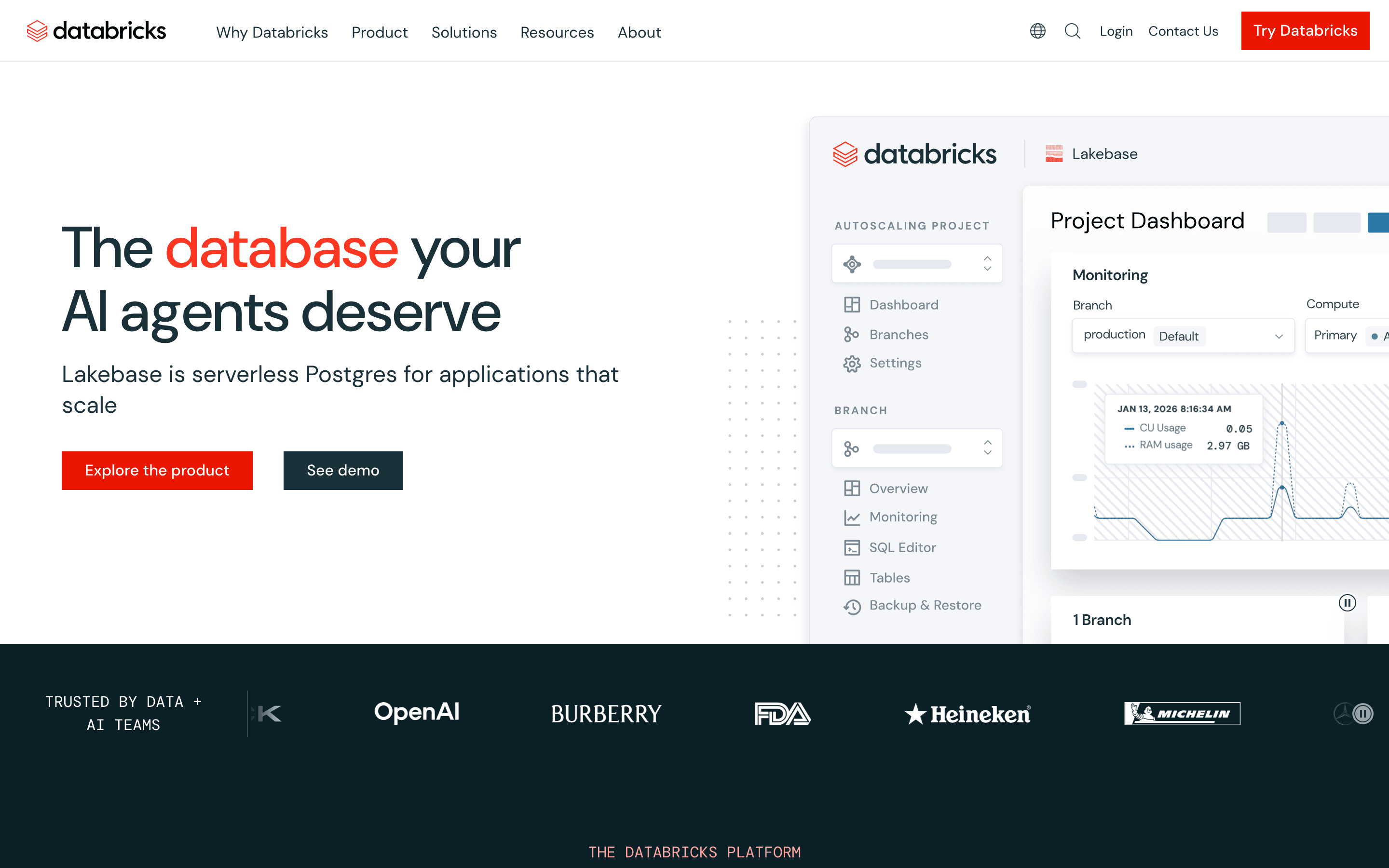
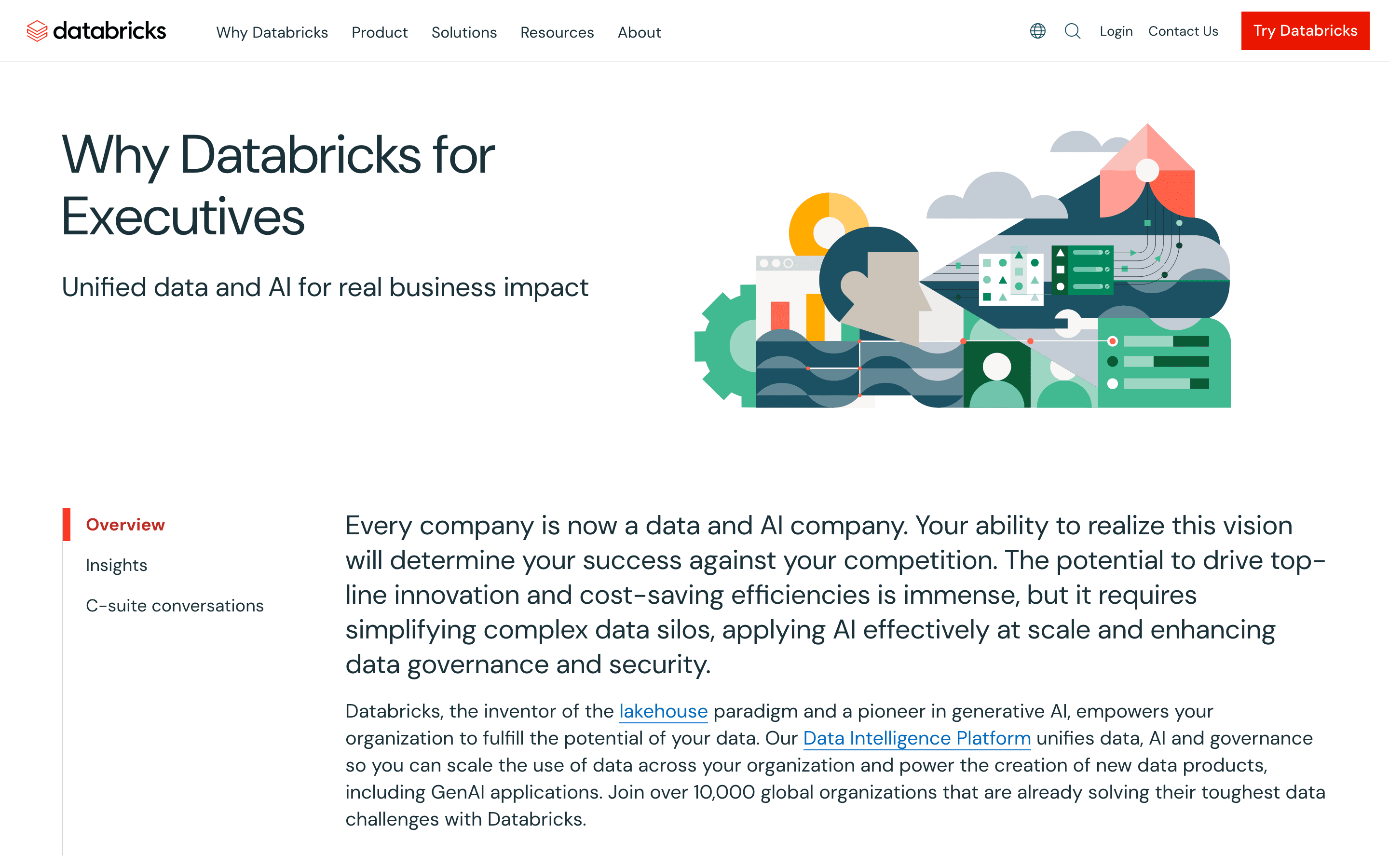
Databricks is a cloud platform built around the lakehouse idea. You store data once in open formats (Delta Lake) on cheap object storage, then run data engineering, SQL analytics, and machine learning against that same copy, instead of moving it into separate warehouses and ML environments. It runs on AWS, Azure, and GCP, and the team behind it built Apache Spark, Delta Lake, and MLflow.
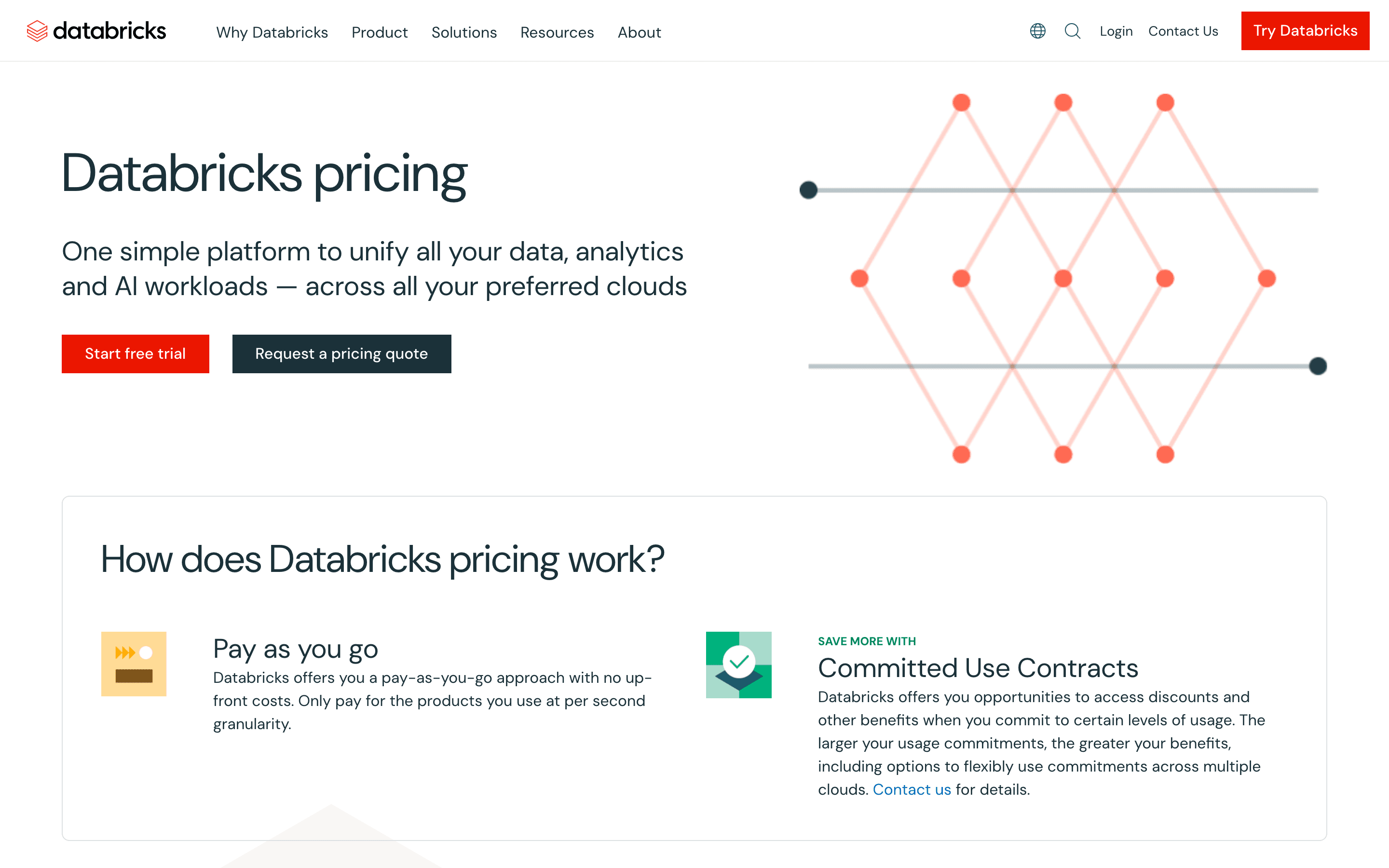
The platform bills by usage, not by seat. You provision compute clusters or serverless SQL and model-serving endpoints and pay per Databricks Unit (DBU) consumed per second, on top of the cloud provider's own compute and storage bill. This means costs scale with actual data and compute volume rather than headcount, but the effective price still depends a lot on workload design, cluster sizing, and cloud choice.
Databricks' current focus is generative AI and agents: Unity Catalog for governance, Mosaic AI and Foundation Model APIs for hosting and fine-tuning LLMs, and Lakeflow for ingestion and ETL pipelines, alongside its established Spark-based data engineering and MLflow-based ML tooling.
Databricks screenshots
Who it's for
- ✓ Data engineering and data science teams running large-scale Spark pipelines and ML training on the same data
- ✓ Organizations that want one governed copy of data, via Unity Catalog, shared across BI, ML, and AI workloads
- ✓ Teams building and hosting custom or fine-tuned LLMs alongside traditional analytics
Who should look elsewhere
- ✗ Small teams whose main need is straightforward SQL dashboards with no ML or engineering workload
- ✗ Organizations that want predictable flat monthly pricing instead of usage-based DBU billing
- ✗ Teams without in-house data engineering skills, since Databricks assumes comfort with Spark, notebooks, and cluster configuration
Pros
- + One platform for data engineering, SQL analytics, and ML/AI, so you avoid separate warehouse-plus-ML-platform sprawl
- + Open formats, Delta Lake and Unity Catalog, cut lock-in compared with proprietary warehouse storage formats
- + Runs natively on AWS, Azure, and GCP, which helps multi-cloud or cloud-migrating organizations
- + Serverless SQL and Model Serving cut the need to manually manage clusters for common workloads
- + Free Edition gives real hands-on access to the product for learning, not a stripped-down demo
Cons
- – No public price list. Total cost depends on DBU rates that vary by cloud, region, and workload, and you need a calculator or a sales call to estimate it
- – Usage-based DBU billing, plus separate cloud infrastructure cost, makes budgeting and cost governance harder than flat per-seat pricing
- – Steeper learning curve than SQL-only warehouses, since it assumes familiarity with Spark, notebooks, and cluster or compute configuration
- – Real-world annual spend is high even for mid-size teams. Third-party spend-benchmarking data puts the median Databricks buyer at roughly $300,000 a year, with SMB averages around $190,000 a year and enterprise averages near $580,000 a year
Databricks pricing
What you pay for
Databricks bills by usage, not by seat. You pay per Databricks Unit (DBU) consumed per second, plus the cloud provider's own compute and storage charges, and the rate depends on cloud, region, workload type, and any commitment level. There's no cheapest paid tier to point to since Databricks doesn't publish DBU rates. Databricks Free Edition is free forever for learning, and a 14-day free trial covers the full paid platform, but production pricing is quote-only through a calculator or a sales call.
You pay for what you consume rather than a per-seat fee, so cost scales with usage.
| Plan | Price | Highlights |
|---|---|---|
| Pricing is quote-only. Contact the vendor for a quote. | ||
Databricks bills by Databricks Units (DBUs) consumed per second, on top of the underlying cloud compute and storage costs from AWS, Azure, or GCP. There's no flat per-seat price and no published DBU rate table on the main pricing page. Exact DBU rates vary by cloud, region, workload type (Jobs Compute, SQL Serverless, Model Serving, and others), and commitment level, and Databricks shows them through an interactive pricing calculator rather than a static price list. Larger prepaid usage commitments come with discounts, but committed-use terms require contacting sales. Because of this, startingPrice is null, following the quote-only/usage-only pricing rule. Separately, Databricks Free Edition is a genuinely free-forever plan (notebooks, SQL, Genie BI, ML, and Lakeflow ETL) built for learning and experimentation rather than production workloads.
Pricing verified July 6, 2026 · source
How Databricks's pricing compares
Databricks next to its closest alternatives on entry price, billing, and whether pricing is public.
| Tool | Starting price | Billing | Free option | Pricing disclosed |
|---|---|---|---|---|
| Databricks | Free tier + custom | usage-based | Yes | Not disclosed |
| Snowflake | Custom / quote | usage-based | Trial (30 days with $400 in free credits) | Not disclosed |
| Google BigQuery | $6.25/TiB scanned | usage-based | Yes | Public |
| Amazon Redshift | $0.375/RPU-hour | usage-based | Trial ($300 credit (90-day expiration) for first-time Redshift Serverless users; in regions without Serverless, a two-month free trial for provisioned clusters (up to 750 hours/month)) | Partly public |
| Dremio | $0.2/DCU | usage-based | Yes | Partly public |
| Starburst | $0.5/credit | usage-based | Yes | Public |
Is Databricks still actively developed?
Last significant update: July 2026. Row filtering in Lakeflow Connect is now generally available. You can apply SQL WHERE-clause-style conditions so ingestion pipelines pull only the rows you need during initial and incremental loads.
Top Databricks alternatives
Further reading
- Data warehouse for startups: picking BigQuery or Snowflake - For most small data teams, BigQuery is the best data warehouse for startups. It's serverless, with a free monthly allowance before usage billing starts.
- How to switch from Snowflake to Databricks - Both bill on usage, not seats, so the real question is workload fit. Here is the pricing difference, the migration steps, and when to stay on Snowflake.
- Data warehouse cost: the real 2026 numbers - Snowflake, Databricks, BigQuery, and Redshift bill by usage, not seats. Cost hinges on scans and idle compute, from hundreds to six figures a month.
Databricks FAQ
Is Databricks free?+
Databricks Free Edition is free forever, for learning and experimentation (notebooks, SQL, Genie BI, ML, Lakeflow). There's also a 14-day free trial of the full paid platform. Production use is billed on usage, not free.
How much does Databricks cost?+
Databricks doesn't publish a fixed price list. It bills per Databricks Unit (DBU) consumed per second, on top of the cloud provider's own compute and storage charges, and the DBU rate varies by cloud, region, and workload type. To estimate cost, use Databricks' pricing calculator or contact sales for a committed-use quote.
How is Databricks different from Snowflake or BigQuery?+
Databricks is a lakehouse built on Apache Spark. It unifies data engineering, ML, and analytics over open Delta Lake tables. Snowflake and BigQuery are SQL-first data warehouses, typically simpler to run for pure BI work, but less suited to large-scale Spark data engineering and custom ML/AI pipelines.