Starburst Review
Managed Trino for querying data across lakes, warehouses, and databases without moving it
Is this your product? Claim this page · Request a change
Looking for a Starburst alternative? See our ranked comparison.→What is Starburst?
Starburst is a managed distribution of Trino, the open-source distributed SQL query engine. Justin Borgman founded the company in 2017. In 2020, the original creators of Presto, the Facebook-born project Trino forked from, joined Starburst's technical leadership team, including current CTO Martin Traverso. Starburst lets analysts and applications query data where it already lives, across S3, Snowflake, BigQuery, Redshift, Databricks, PostgreSQL, and other sources, through a single SQL layer instead of copying it into a new warehouse first.
It ships as two products. Starburst Galaxy is a fully managed cloud service on AWS, GCP, and Azure, billed by compute credits. Starburst Enterprise is a self-managed distribution for private cloud, hybrid, and on-premises deployments, sold on a custom quote. Galaxy also includes AIDA, a natural-language conversational analytics assistant that reached general availability on May 28, 2026.
Starburst builds around Apache Iceberg and the broader lakehouse pattern, which it calls the "Icehouse": keep data in open table formats in cheap object storage, then use Starburst as the query and governance layer on top instead of locking data into one proprietary warehouse.
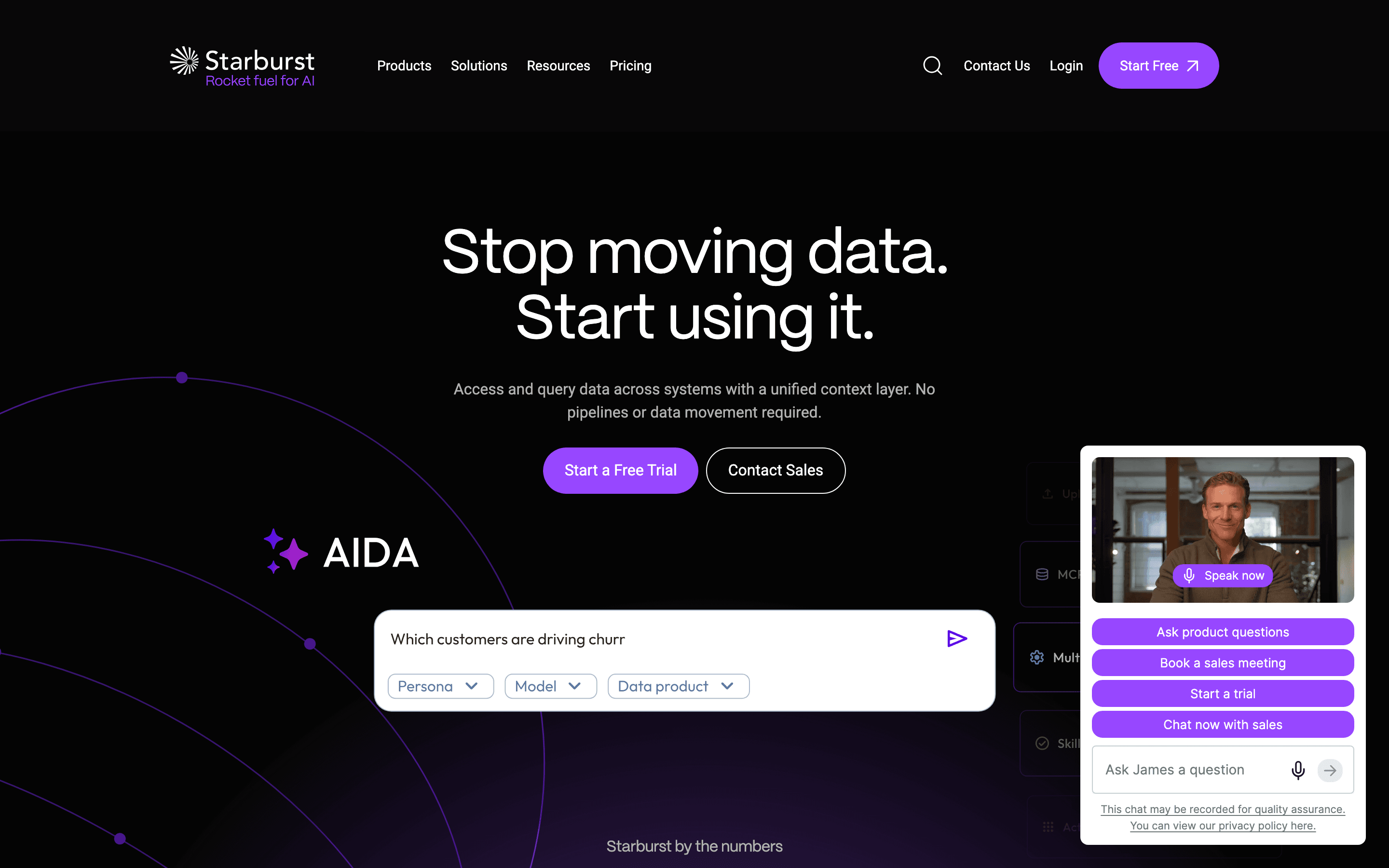
Starburst screenshots
Who it's for
- ✓ Teams that need to query data across multiple warehouses, lakes, and databases without building new ETL pipelines
- ✓ Organizations standardizing on Apache Iceberg and open table formats who want a managed Trino query layer on top
- ✓ Enterprises that need fine-grained data access controls, like ABAC and SCIM, across many connected data sources
Who should look elsewhere
- ✗ Small teams with a single, already-centralized data warehouse that don't need federated querying
- ✗ Teams that want flat, predictable per-seat pricing instead of usage-based compute billing
- ✗ Anyone who needs the self-managed Enterprise product but wants public list pricing instead of a sales quote
Pros
- + Queries data in place across S3, Snowflake, BigQuery, Redshift, Databricks, and other sources, no data movement required
- + Free forever tier for up to 3 clusters, good for evaluation or small workloads
- + Current CTO Martin Traverso and other original Presto/Trino creators sit on Starburst's technical leadership team, so the company stays close to the open-source engine
- + 50+ connectors covering cloud storage, warehouses, and SaaS applications
Cons
- – Usage-based credit pricing makes cost forecasting harder than flat per-seat plans, and the effective rate depends on your cloud provider and region
- – Starburst Enterprise pricing is quote-only with no public numbers
- – Advanced governance features like ABAC and SCIM sit behind the Enterprise tier and above
- – AIDA, the natural-language assistant, only reached general availability in May 2026, so it has a short track record
Starburst pricing
What you pay for
Starburst Galaxy charges by compute credits used, not by seat. The cheapest paid tier, Pro, starts at $0.50 per credit and adds flexible cluster execution, streaming ingest, and advanced cluster management. There is also a free forever tier for up to 3 clusters, plus a 30-day trial with $500 in compute credit and temporary access to Enterprise features. Galaxy pricing is public on the pricing page, but the self-managed Starburst Enterprise product and any annual commitment discounts are quote-only through sales.
You pay for what you consume rather than a per-seat fee, so cost scales with usage.
| Plan | Price | Highlights |
|---|---|---|
| Free | Free | Up to 3 clusters · Standard cluster execution mode · No cost, no time limit |
| Pro | $0.5/mo | Starting at $0.50 per credit · Flexible cluster execution modes · Streaming ingest · Advanced cluster management |
| Enterprise | $0.75/mo | Starting at $0.75 per credit · Advanced autoscaling · Fine-grained access control (ABAC, SCIM) · AWS PrivateLink · AIDA support |
| Mission Critical | $1/mo | Starting at $1.00 per credit · Elite support · Advanced governance integrations · Highest uptime guarantees · AIDA support |
Starburst Galaxy is billed by compute credits consumed, not per seat. The actual per-credit rate depends on your cloud provider and region, and annual commitment discounts need a sales conversation. Starburst Enterprise, the self-managed option, is quote-only and doesn't appear on the public pricing page. The figures above are the vendor's listed starting per-credit rates for Galaxy.
Pricing verified July 6, 2026 · source
How Starburst's pricing compares
Starburst next to its closest alternatives on entry price, billing, and whether pricing is public.
| Tool | Starting price | Billing | Free option | Pricing disclosed |
|---|---|---|---|---|
| Starburst | $0.5/credit | usage-based | Yes | Public |
| Databricks | Free tier + custom | usage-based | Yes | Not disclosed |
| Snowflake | Custom / quote | usage-based | Trial (30 days with $400 in free credits) | Not disclosed |
| Google BigQuery | $6.25/TiB scanned | usage-based | Yes | Public |
| Amazon Redshift | $0.375/RPU-hour | usage-based | Trial ($300 credit (90-day expiration) for first-time Redshift Serverless users; in regions without Serverless, a two-month free trial for provisioned clusters (up to 750 hours/month)) | Partly public |
| Dremio | $0.2/DCU | usage-based | Yes | Partly public |
Is Starburst still actively developed?
Last significant update: May 2026. AIDA, the Starburst AI Data Assistant, moved from public preview to general availability. Users can now query governed Galaxy data with natural language.
Top Starburst alternatives
Further reading
- Data warehouse cost: the real 2026 numbers - Snowflake, Databricks, BigQuery, and Redshift bill by usage, not seats. Cost hinges on scans and idle compute, from hundreds to six figures a month.
Starburst FAQ
Is Starburst free?+
Starburst Galaxy has a genuinely free forever tier, limited to 3 clusters with standard cluster execution mode. Paid tiers (Pro, Enterprise, Mission Critical) start at $0.50 per compute credit and add features like advanced autoscaling and fine-grained access control as you move up.
How is Starburst priced?+
Starburst Galaxy bills by compute credits consumed rather than per seat. Listed starting rates are $0.50 per credit for Pro, $0.75 for Enterprise, and $1.00 for Mission Critical. The exact rate depends on your cloud provider and region, and annual commitment discounts need a conversation with sales.
What is the difference between Starburst Galaxy and Starburst Enterprise?+
Galaxy is Starburst's fully managed cloud service on AWS, GCP, and Azure, billed by usage. Enterprise is a self-managed distribution for private cloud, hybrid, or on-premises deployment, and its pricing is quote-only, not published.
What is AIDA?+
AIDA is Starburst's AI Data Assistant, a conversational analytics tool that lets business users query governed data in plain language. It moved from public preview to general availability on May 28, 2026.