Top Codacy Alternatives in 2026
Here for Codacy itself? See the full Codacy profile, pricing & reviews →
Suggest a change- If your main complaint with Codacy is the volume of low-priority noise it flags before you tune it, choose CodeRabbit. its recent update adds source attribution that traces every review comment back to the specific guideline or rule that triggered it, which makes cutting false positives a lot more tractable than Codacy's less transparent flagging.
- If you need static analysis across many languages, including legacy ones, with hard quality gates for a regulated shop, choose SonarQube. it covers 30 to 40-plus languages including COBOL and ABAP with pass/fail merge gates, going deeper on language and compliance coverage than Codacy's AI-first competitors.
- If you want code review, SAST, and penetration testing under a single published-price contract, choose CodeAnt. its Premium plan adds automated blackbox, whitebox, and graybox pentesting plus a DORA metrics dashboard on top of the same review-and-security bundle Codacy sells, all at a posted seat price.
- If your codebase spans multiple related repos and breaking changes slip through diff-only review, choose Qodo. its multi-agent reviewer reads full codebase and cross-repo context (beta), so it can catch a change in one service that breaks a caller in another, something a rules-based scanner like Codacy isn't built to do.
- If you want the reviewer to actually generate and run tests against a PR, not just leave comments, choose Greptile. TREX, in public beta, writes and runs its own tests in a sandbox against a pull request, built on the same full-codebase graph index Greptile uses for cross-file review, something none of the other diff-focused reviewers here do.
- If you rely on Codacy's AI Guardrails to police what coding agents like Claude Code or Cursor can commit, choose stay on Codacy. none of these alternatives extend policy checks into the coding agent's own commit path the way Codacy's AI Guardrails and AI Risk Hub do, so switching would mean losing that layer entirely.
Codacy bundles static analysis, security scanning, and AI-powered pull request review into one per-developer subscription, with a free tier for individual use and open source. Teams start looking elsewhere mostly over noise: reviewers report it takes real tuning to cut the volume of low-priority findings it surfaces out of the box, and email support can be slow to respond.
The five tools below all compete for the same job, automated review and quality gating on pull requests, but split into two camps. SonarQube and CodeAnt match Codacy's breadth of static analysis, security scanning, and compliance reporting. CodeRabbit, Qodo, and Greptile lean harder into AI-driven PR review itself, trading some of that scanning depth for sharper comments, whole-codebase context, or a lower price.
Codacy alternatives compared
| Tool | Best for | Starting price | Free option | Last update |
|---|---|---|---|---|
| CodeRabbitBest for cutting review noise | Teams that want PR reviews to happen automatically without changing their GitHub or GitLab workflow | $24/seat/mo | Yes | July 2026 |
| SonarQubeBest for deep static analysis and compliance | Teams that already gate merges on a quality standard and want that enforced automatically across many repos and languages | $34/mo | Yes | June 2026 |
| CodeAnt | Engineering leads who want code review, SAST, secrets scanning, and pentesting under one contract instead of stitching together four vendors | $24/seat/mo | Trial (14 days, no credit card required, unlimited seats and 100 PR reviews included) | July 2026 |
| QodoBest for cross-repo context | Engineering teams that want PR review to understand the full codebase, not just the diff | $30/seat/mo | Trial (14 days, unlimited usage, no credit card required) | June 2026 |
| GreptileBest for automated test generation | Teams that want review comments grounded in the full codebase, not just the diff | $30/seat/mo | Yes | June 2026 |
Why teams switch from Codacy
Codacy needs real tuning to cut down on low-priority noise
Buyer reviews report Codacy flags a lot of low-priority issues out of the box and takes significant manual tuning to bring the signal-to-noise ratio down to something a team can act on.
Email support is reported as slow
Buyer reviews describe support response times over 24 hours on email, with questions sometimes missed on the first reply.
Team plan caps out at 30 developers with no on-prem option
Codacy's Team plan is capped at 30 developers, larger teams must move to quote-only Business pricing, and Codacy only scans repos on GitHub Cloud, Bitbucket Cloud, and GitLab Cloud, with no support for on-premise Git deployments.
The best Codacy alternatives, ranked
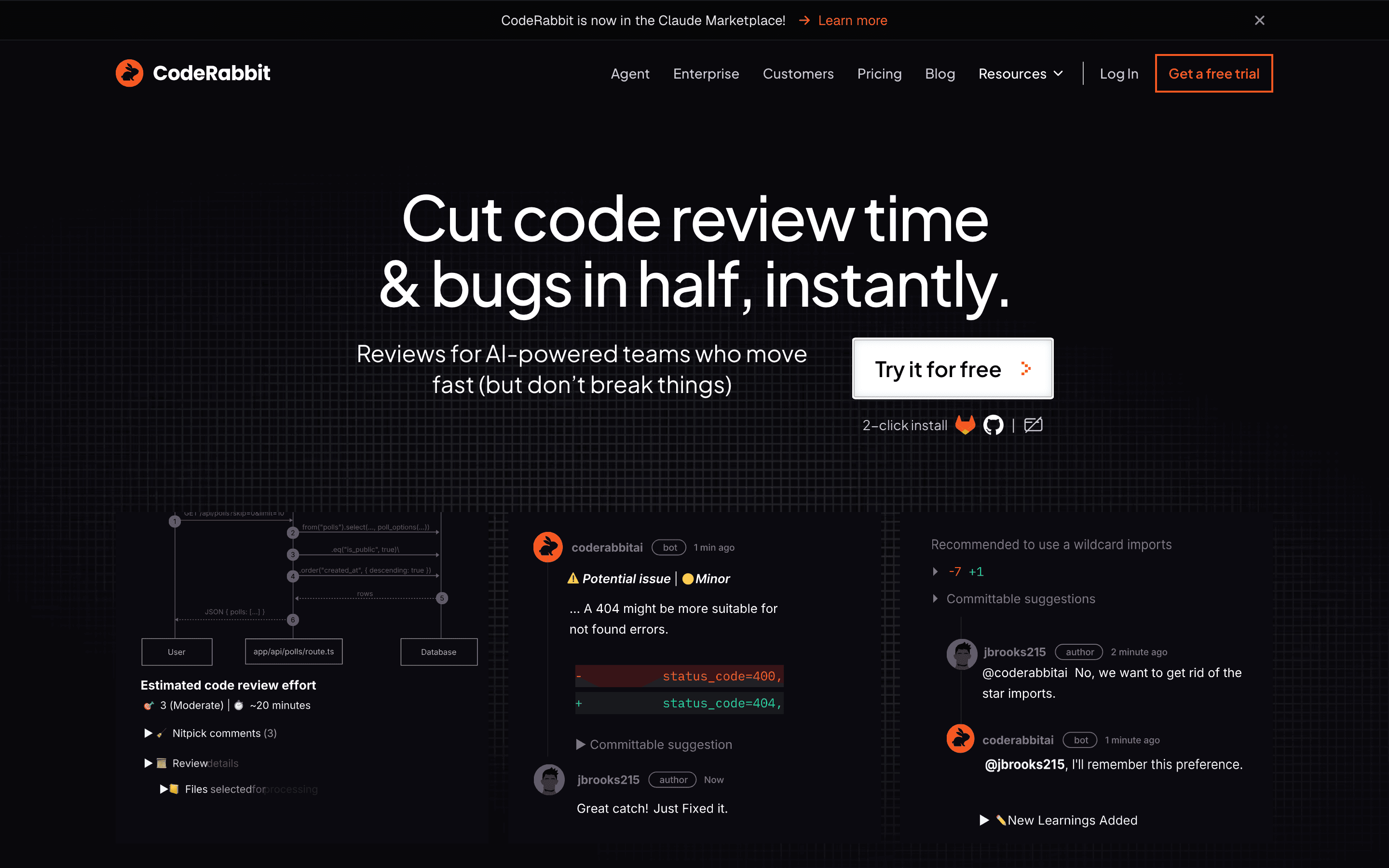
CodeRabbit is the AI-first pull request reviewer most engineering leads test first when Codacy's out-of-the-box noise gets to be too much. It runs as an app on GitHub, GitLab, Azure DevOps, or Bitbucket, plus an IDE extension and CLI, so review happens before a PR even opens. Its July 2026 update added source attribution, tracing each comment back to the specific guideline that triggered it, which makes tuning false positives far more tractable than Codacy's more opaque flagging. Pricing only counts developers who open pull requests, not every repo collaborator, and the Free tier is unlimited on public repos. The catch is the hourly review-rate cap, 1 an hour free, 5 on Pro, 10 on Pro Plus, so teams shipping fast with AI coding agents can hit the ceiling and need the usage-based add-on. Its Pro tier's "Linter and SAST support" is still more limited than Codacy's dedicated scanning: it doesn't match Codacy's SCA dependency scanning, IaC scanning, or compliance-gate reporting.
Pros
- + Free forever on public repositories, no seat limit
- + Charges only for developers who open pull requests, not the whole team
- + Recent update adds source attribution so you can see which guideline triggered a comment
Cons
- – Each plan caps reviews per developer per hour; teams that exceed it need the usage-based add-on or a higher tier
- – Review quality is diff-focused, so it can miss bugs that only show up when you look at the whole codebase
SonarQube is the closest match to Codacy's breadth: both scan for bugs, vulnerabilities, secrets, and code smells and gate merges on a quality standard rather than just leaving advisory comments. SonarQube goes deeper on language coverage, 30 to 40-plus languages including COBOL and ABAP, which matters for regulated or legacy-heavy shops Codacy doesn't reach. Pricing works differently: SonarQube Cloud bills by lines of code analyzed rather than per seat, starting at $34 a month for up to 100k LOC, and the self-managed SonarQube Server is licensed per instance per year from around $750. There's a genuinely free Community Build and a free Cloud tier up to 50k LOC. The tradeoff is a reportedly dated, cluttered web UI that gets slow to navigate on large codebases, and Enterprise editions are quote-only, just like Codacy's Business tier.
Pros
- + Covers 30-40+ languages including older enterprise languages like COBOL and ABAP that most AI review tools skip
- + Quality gates give you a hard pass/fail merge check, not just advisory comments
- + Free tier and open-source Community Build let you start without paying anything
Cons
- – Pricing is based on lines of code analyzed, so cost climbs as your codebase grows regardless of how active your team is
- – Enterprise and Data Center editions are quote-only, so you can't see the real cost until you talk to sales
CodeAnt
CodeAnt sells the same pitch as Codacy, one platform instead of stitching together review, SAST, secrets, and IaC scanning, and adds automated penetration testing (blackbox, whitebox, and graybox) that Codacy doesn't offer. Premium is $24 per seat per month, posted on the site rather than gated behind a sales call, though that's higher than Codacy's $18 Team price. The 14-day trial unlocks the full product with unlimited seats and no card, useful for a real pilot before signing anything. It also reports DORA metrics, deployment frequency, lead time, change failure rate, and time to restore, alongside review data, which Codacy doesn't surface. The catch: Premium's static analysis and SAST only run on pull requests, not full-repo scans, so teams that need repo-wide security scanning like Codacy provides have to move to CodeAnt's quote-only Enterprise tier.
Pros
- + One price covers code review, SAST, secrets detection, IaC scanning, and DORA metrics instead of separate line items
- + Trial unlocks the full product with unlimited seats and no card, so a team can pilot it before committing
- + Publishes its per-seat price instead of forcing every buyer through a sales call
Cons
- – Static analysis and SAST on the Premium plan only run on pull requests, not full repo scans, unless you go Enterprise
- – Enterprise pricing (SSO, on-prem, dedicated success manager) is quote-only, so total cost for larger teams isn't visible upfront
Qodo trades Codacy's rules-based scanning for an agentic reviewer that reads the whole codebase, and since its June 2026 release, related repos too (beta), so it can catch a change in one service that breaks a caller in another. Its rules system learns your team's standards from past merged PRs instead of requiring you to write every check by hand, and it reviews changes locally before a developer even opens a PR. Pro Team is $30 per seat per month for up to 30 users, but that's only the base fee: actual usage draws from a shared credit pool of 2,500, 5,000, or 20,000 credits, so cost is harder to predict than Codacy's flat per-developer price. There's no lasting free plan, just a 14-day unlimited trial. Reviewers also report accuracy drops and slow generation on large or unusual codebases.
Pros
- + Reviews use full codebase context, including cross-repo relationships, not just the PR diff
- + Rules system learns from your team's past PRs and merged code instead of requiring you to write every standard by hand
- + Local, pre-commit review lets developers catch issues before opening a PR
Cons
- – Pricing is credit-based on top of a per-seat fee, so cost is hard to predict for teams with heavy usage or premium-model reviews
- – No lasting free plan, only a 14-day trial
Greptile builds a graph index of the entire codebase before reviewing a pull request, so it flags cross-file breakages a diff-only tool would miss, and TREX, in public beta, goes further by writing and running its own tests in a sandbox. The free Starter plan has no repo limit for one developer, a genuine option next to Codacy's free Developer tier. Pro is $30 per seat a month for 50 review credits, then $1 per extra credit, a change from its old flat pricing made in March 2026 that drew real criticism: Greptile's own stated average of 1.2 reviews per PR means the 50-credit cap covers only about 42 PRs a month, and one developer reportedly saw a bill jump from $30 to over $500 after 571 PRs in a month. It self-hosts on Enterprise, unlike Codacy, which is cloud-only.
Pros
- + Codebase-wide context catches cross-file bugs that diff-only reviewers miss
- + Free Starter plan has no repo limit, just a 50-review cap for one developer
- + TREX writes and runs its own tests against a PR, not just comments
Cons
- – Pro plan switched to metered billing in March 2026: $30 covers 50 reviews, then $1 each after that
- – Heavy PR volume can get expensive fast: critics point to one developer's bill reportedly jumping from $30 to over $500 after 571 PRs in a month
Should your product be on this ai code review list?
If you build a tool that belongs next to the ones above, submit it. A human reviews every submission. Approved products get their own page with pricing and screenshots, plus a place in the comparisons where they fit. It is free. You sign in with your work email so you can follow the decision, and there is no password to create.
Codacy alternatives: FAQ
What is the best Codacy alternative overall?+
CodeRabbit is the closest general-purpose swap for teams whose main complaint with Codacy is review noise, since its source-attributed comments make tuning easier. Teams that need Codacy's full breadth of static analysis and compliance coverage should look at SonarQube instead.
Is there a cheaper alternative to Codacy?+
CodeRabbit is free forever on public repos and bills only for developers who open pull requests; on private repos its Pro plan is $24 per seat per month billed annually. That's a lower entry point than Codacy for teams whose review need is mostly PR comments, though it doesn't include Codacy's SAST, secrets, or IaC scanning.
Which Codacy alternative supports self-hosted or on-premise deployment?+
SonarQube Server is licensed per instance per year for self-managed deployment, and CodeRabbit, CodeAnt, and Greptile all offer self-hosting or on-prem/VPC deployment on their quote-only Enterprise tiers. Qodo's Enterprise tier also offers single-tenant or on-prem deployment if self-hosting is a hard requirement, though the vendor doesn't publish deployment details beyond that one line item. Codacy itself only scans GitHub Cloud, Bitbucket Cloud, and GitLab Cloud repos and does not support on-premise Git deployments.
Which alternative comes closest to Codacy's AI Guardrails for coding agents?+
None of them match it directly. Qodo's rules system enforces team standards automatically and CodeAnt runs SAST inside CI/CD pipelines, but neither extends policy checks into a coding agent's own commit path the way Codacy's AI Guardrails and AI Risk Hub are built to do.
Codacy alternatives: pricing compared
Entry price, billing model, and whether pricing is public. 6 of 6 publish pricing you can check without talking to sales.
| Tool | Starting price | Billing | Free option | Pricing disclosed |
|---|---|---|---|---|
| Codacy | $18/seat/mo | per-seat | Yes | Partly public |
| CodeRabbit | $24/seat/mo | per-seat | Yes | Partly public |
| SonarQube | $34/mo | usage-based | Yes | Partly public |
| CodeAnt | $24/seat/mo | per-seat | Trial (14 days, no credit card required, unlimited seats and 100 PR reviews included) | Partly public |
| Qodo | $30/seat/mo | usage-based | Trial (14 days, unlimited usage, no credit card required) | Partly public |
| Greptile | $30/seat/mo | tiered | Yes | Partly public |
How we made these picks. We compare tools on public pricing, features, and hands-on assessment, then verify every price against the vendor's own page. We never accept payment for rankings. Read the full methodology. Spotted an error? Report it.