Qodo Review
Agentic AI code review that reads your whole codebase, not just the diff
Is this your product? Claim this page · Request a change
Looking for a Qodo alternative? See our ranked comparison.→What is Qodo?
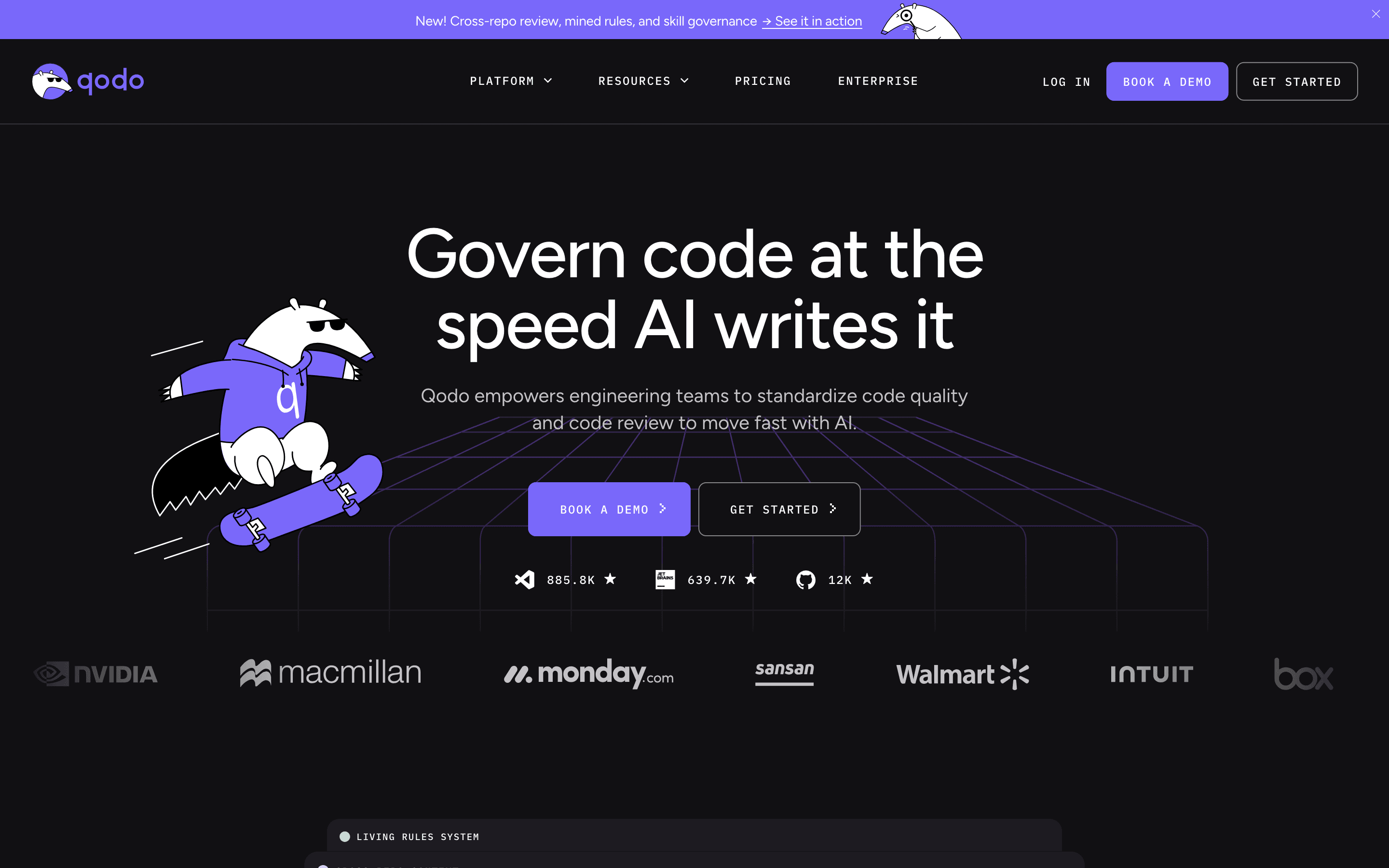
Qodo is an AI code review platform built around a multi-agent reviewer that reads pull requests with context from the rest of your codebase, not just the changed lines. It runs in your Git provider (GitHub, GitLab, Bitbucket, Azure DevOps) and in the IDE, and it can review local changes before you even open a PR.
Beyond flagging issues, Qodo maintains a living rules system that learns your team's standards from past PRs and enforces them automatically. Recent releases have pushed it toward cross-repository review, so it can catch a change in one service that breaks a caller in another.
Qodo was founded in 2022 as CodiumAI, originally known for AI test generation, and rebranded to Qodo in 2024. Since early 2026 the company has leaned further into positioning itself as a dedicated code review and governance platform rather than a general code-generation tool, though it still ships a separate code-generation product, Qodo Gen.
Qodo screenshots
Who it's for
- ✓ Engineering teams that want PR review to understand the full codebase, not just the diff
- ✓ Organizations with multiple related repos who need cross-repo breaking-change detection
- ✓ Teams that want review standards enforced automatically instead of written down and ignored
Who should look elsewhere
- ✗ Small teams that want a flat, predictable per-seat bill instead of a credit meter
- ✗ Teams that want every AI comment to go out unreviewed with zero setup
Pros
- + Reviews use full codebase context, including cross-repo relationships, not just the PR diff
- + Rules system learns from your team's past PRs and merged code instead of requiring you to write every standard by hand
- + Local, pre-commit review lets developers catch issues before opening a PR
- + Works across GitHub, GitLab, Bitbucket, and Azure DevOps plus major IDEs
Cons
- – Pricing is credit-based on top of a per-seat fee, so cost is hard to predict for teams with heavy usage or premium-model reviews
- – No lasting free plan, only a 14-day trial
- – Reviewers report accuracy drops on large or unusual codebases, including a tracked GitHub issue where the suggestion tool recommended code that already existed
- – Pro Team's $30/seat/month is only the base fee; actual cost also depends on a shared credit pool (2,500/5,000/20,000-credit packs) that scales with usage, unlike flat per-tier competitors such as CodeRabbit
Qodo pricing
What you pay for
You pay per user for the Pro Team plan, but what you actually use is credits drawn from a shared team pool, and heavier AI models burn through credits faster than lighter ones. Enterprise pricing is quote-only and negotiated per contract. There's no lasting free plan, only a 14-day full-access trial.
At about $30/month to start, it sits mid-pack on price in AI Code Review.
| Plan | Price | Highlights |
|---|---|---|
| Trial | Free | 14 days · Unlimited reviews and credits · No credit card required |
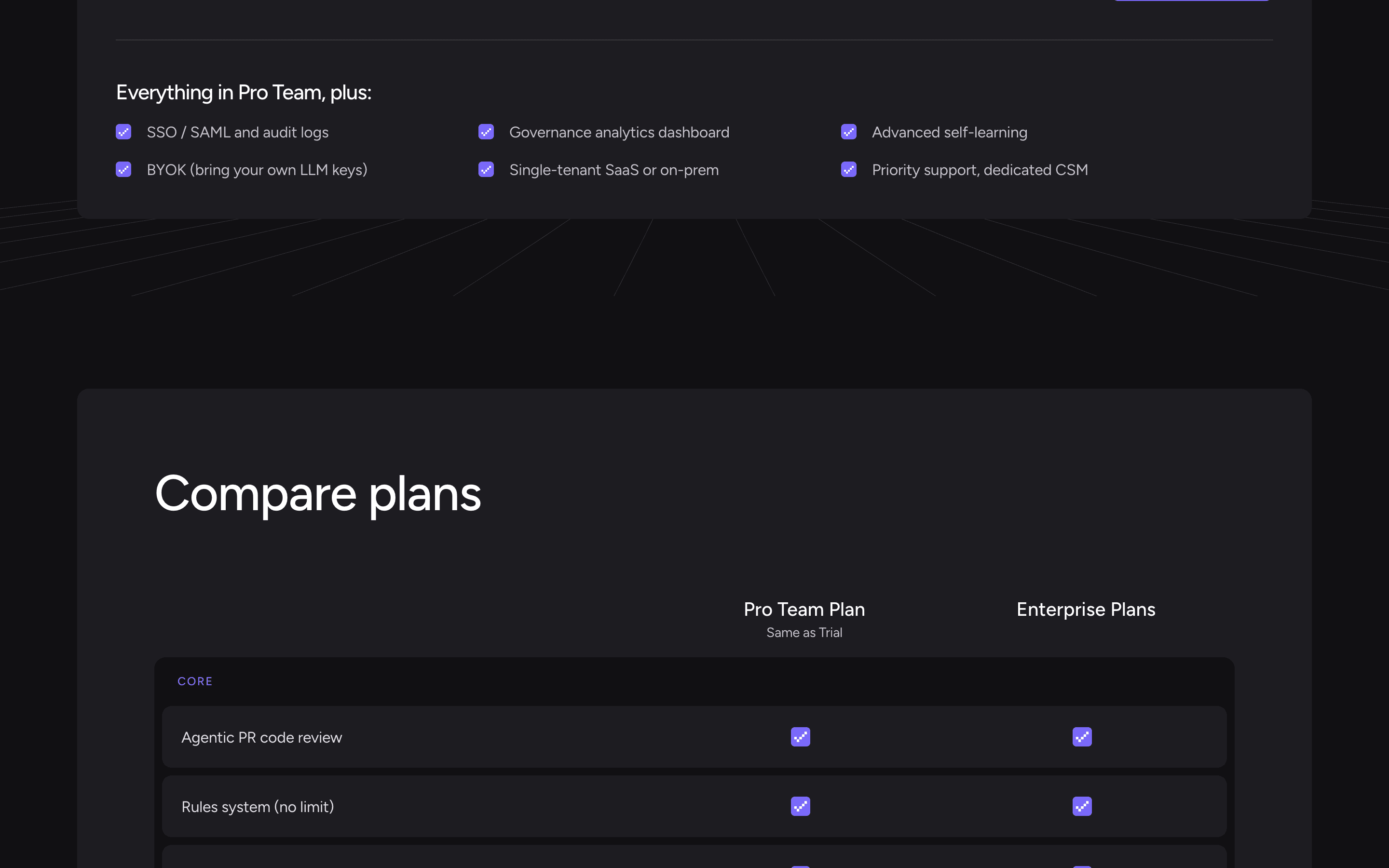
| Pro Team | $30/seat/mo | Up to 30 users · Shared pool of credits (2,500 / 5,000 / 20,000 packs) · Agentic PR review, unlimited rules, Git + IDE integrations · No annual commitment |
| Enterprise | Custom | 30+ users · SSO/SAML, audit logs, BYOK · Single-tenant or on-prem deployment · Priority support with dedicated CSM |
Qodo runs on team-wide credits, not a flat per-seat license. Pro Team is $30/user/month with no annual discount published; credits are pooled across the workspace and cost about $0.012 each, with overage billed at the same rate. Qodo says there is no permanent free plan (open source projects can apply for a free grant). Enterprise is quote-only, negotiated on annual contracts.
Pricing verified July 7, 2026 · source
How Qodo's pricing compares
Qodo next to its closest alternatives on entry price, billing, and whether pricing is public.
| Tool | Starting price | Billing | Free option | Pricing disclosed |
|---|---|---|---|---|
| Qodo | $30/seat/mo | usage-based | Trial (14 days, unlimited usage, no credit card required) | Partly public |
| CodeRabbit | $24/seat/mo | per-seat | Yes | Partly public |
| Codacy | $18/seat/mo | per-seat | Yes | Partly public |
| CodeAnt | $24/seat/mo | per-seat | Trial (14 days, no credit card required, unlimited seats and 100 PR reviews included) | Partly public |
| Greptile | $30/seat/mo | tiered | Yes | Partly public |
| SonarQube | $34/mo | usage-based | Yes | Partly public |
Is Qodo still actively developed?
Last significant update: June 2026. Qodo 2.5 added automatic cross-repository discovery (beta), letting it detect relationships between repos and review breaking changes across repo boundaries without manual dependency mapping.
Top Qodo alternatives
Qodo FAQ
Does Qodo have a free plan?+
No. Qodo offers a 14-day trial with full, unlimited access and no credit card required, but the vendor is explicit that there's no permanent free tier after that. Qualified open source projects can apply separately for free access.
How does Qodo's credit system work?+
Credits are pooled at the workspace level and consumed based on what you use, with smaller PRs costing fewer credits than large or complex ones. Pro Team starts with a 2,500-credit pack and you can move up to 5,000 or 20,000. Overage is billed at the same per-credit rate rather than a penalty rate.
How much does Qodo cost for a team?+
Pro Team is $30 per user per month with no annual discount published, supporting up to 30 users. Above that, or for SSO, audit logs, and on-prem deployment, you need Enterprise, which is quote-only.