SonarQube Review
Static analysis and code review that gates code quality and security before it merges
Is this your product? Claim this page · Request a change
Looking for a SonarQube alternative? See our ranked comparison.→What is SonarQube?
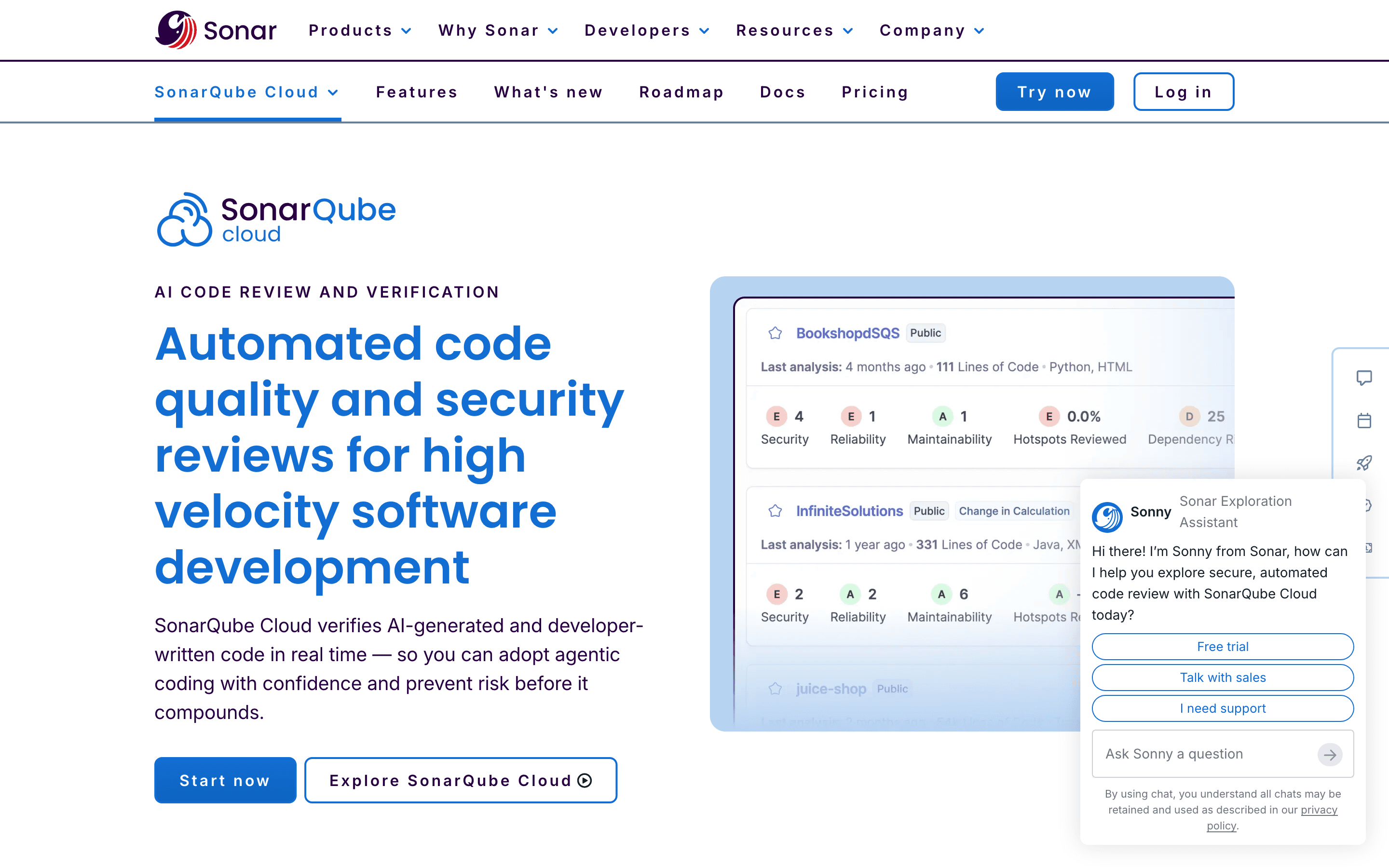
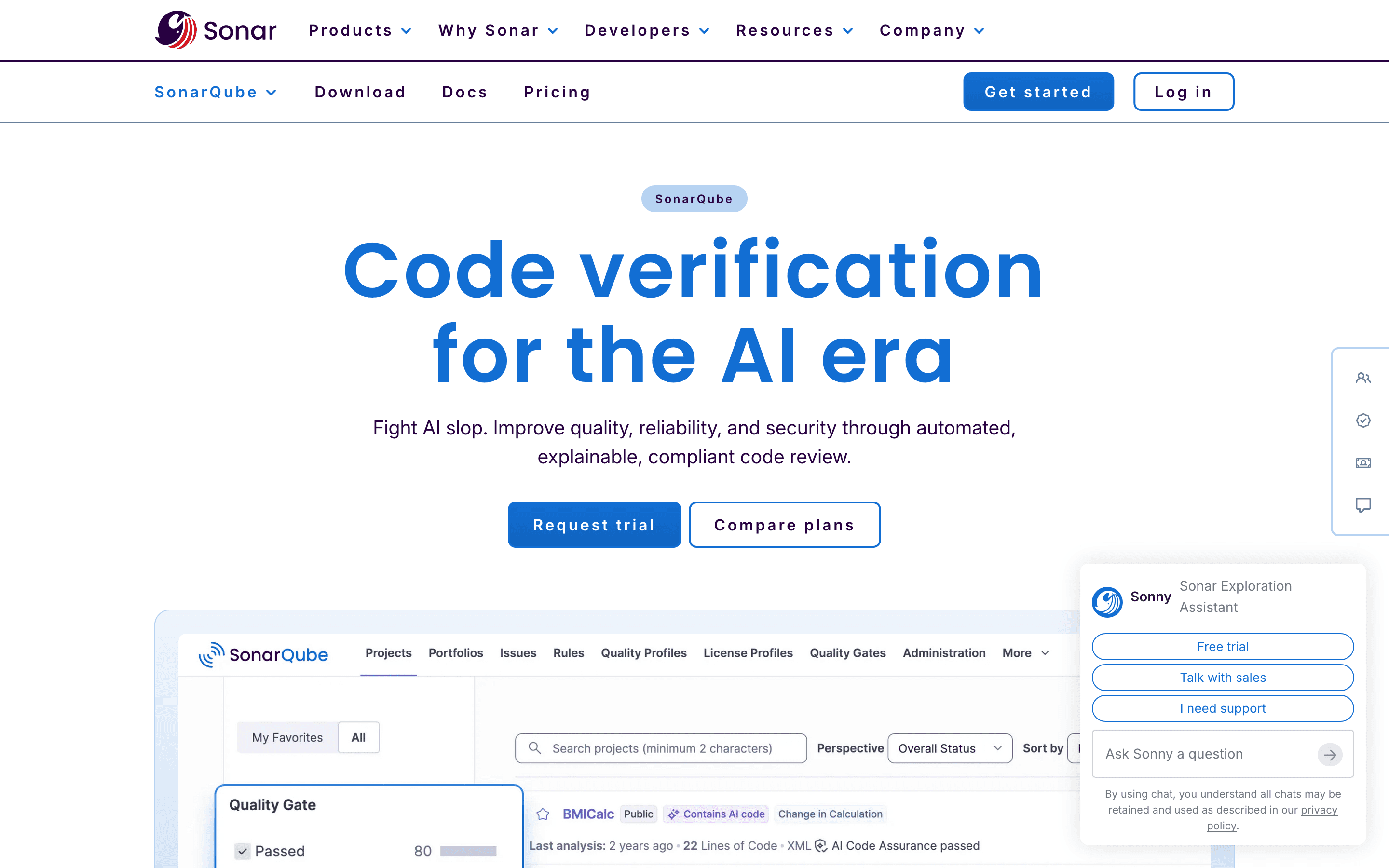
SonarQube is static analysis for code quality and security. It scans your codebase on every commit or pull request, flags bugs, vulnerabilities, code smells, and duplicated code, and can block a merge if the new code doesn't meet a quality gate you set.
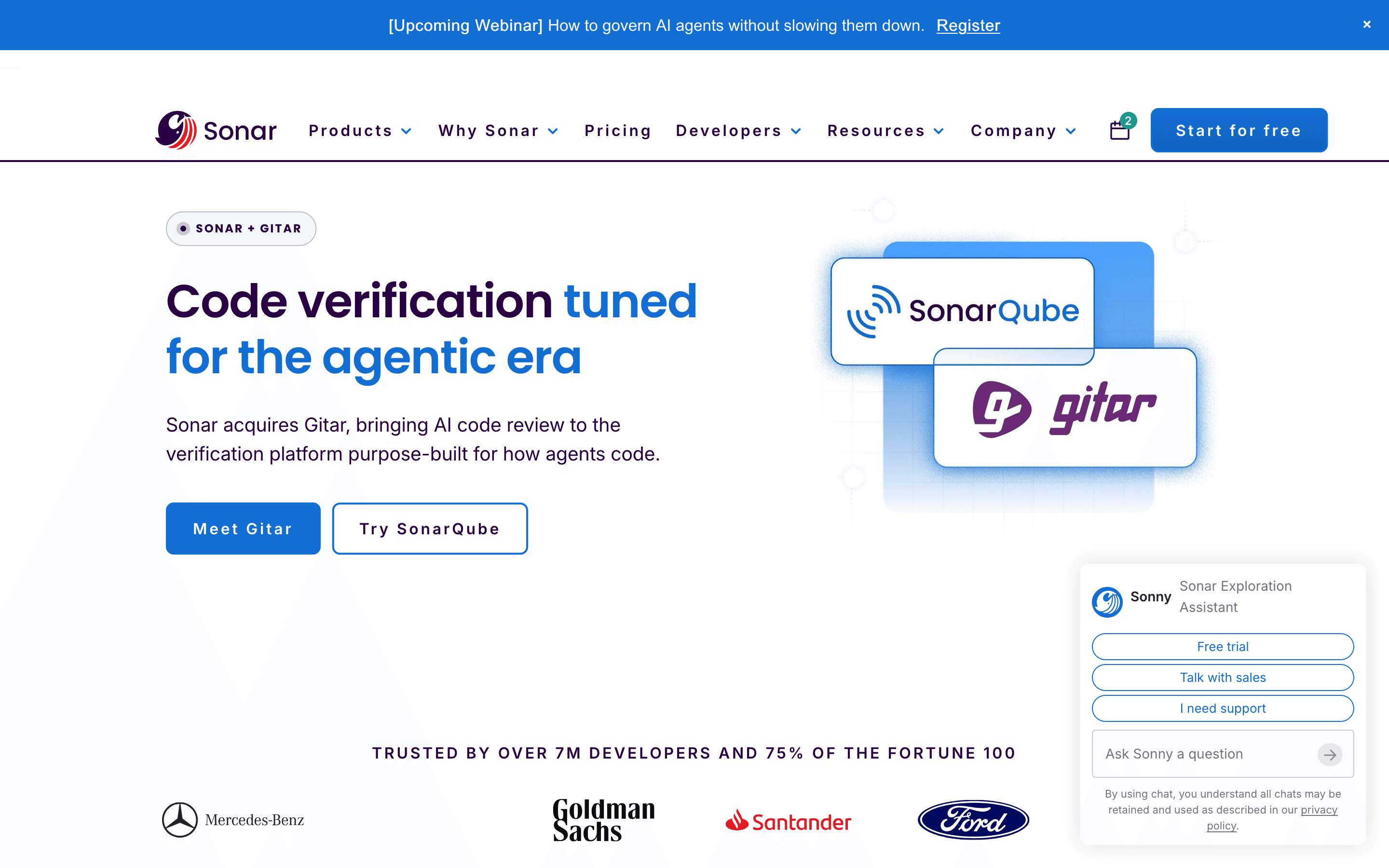
It ships as SonarQube Cloud, a hosted product billed by lines of code analyzed, or SonarQube Server, a self-managed product you run on your own infrastructure and license per instance per year. Sonar has been pushing further into AI over the past year, adding AI-generated fix suggestions, a remediation agent that fixes issues it finds on its own, and Sonar Vortex, which feeds architectural context to coding agents like Cursor and Claude Code as they write.
SonarQube screenshots
Who it's for
- ✓ Teams that already gate merges on a quality standard and want that enforced automatically across many repos and languages
- ✓ Regulated or compliance-heavy shops that need MISRA, OWASP, or PCI DSS coverage baked into the scan
Who should look elsewhere
- ✗ Small teams or solo developers who just want quick AI comments on a pull request without managing a quality gate or LOC-based bill
- ✗ Teams that mainly want an AI reviewer that reads intent and leaves natural-language comments rather than a rules-based static analyzer
Pros
- + Covers 30-40+ languages including older enterprise languages like COBOL and ABAP that most AI review tools skip
- + Quality gates give you a hard pass/fail merge check, not just advisory comments
- + Free tier and open-source Community Build let you start without paying anything
- + Now shipping real AI additions (Remediation Agent, Sonar Vortex) instead of just static rules
Cons
- – Pricing is based on lines of code analyzed, so cost climbs as your codebase grows regardless of how active your team is
- – Enterprise and Data Center editions are quote-only, so you can't see the real cost until you talk to sales
- – Reviewers commonly describe the web UI as dated and cluttered, and say navigating the issues view gets slow on large codebases
- – Self-managed setup and upkeep (Server editions) take real ops time compared with a hosted, seat-priced competitor
SonarQube pricing
At about $34/month to start, it sits at the higher end of AI Code Review pricing.
| Plan | Price | Highlights |
|---|---|---|
| Free | Free | Up to 50k lines of code on private projects · Unlimited public projects · 30+ languages |
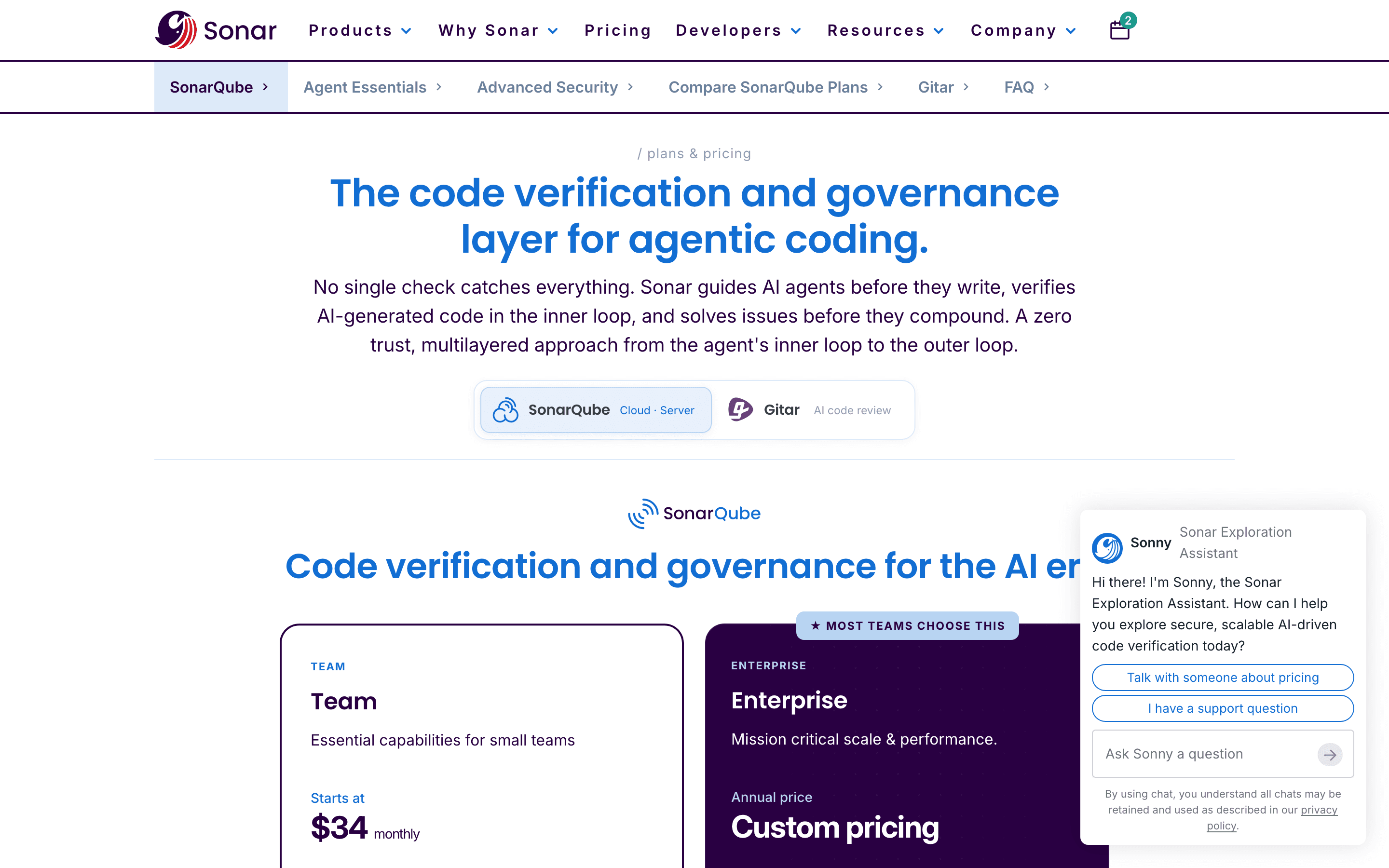
| Team (Cloud) | $34/mo | Starts at 100k LOC, scales up to 1.9M LOC · Bug, vulnerability, and secrets detection · Pull request analysis · AI-generated fix suggestions |
| Enterprise (Cloud) | Custom | Unlimited users and projects · 40+ languages including COBOL and Apex · SSO/SCIM, audit logs, IP allowlisting · GitHub Advanced Security integration |
SonarQube Cloud (the hosted product) bills monthly per maximum lines of code analyzed, not per seat: Team starts at $34/month for up to 100k LOC and climbs in LOC increments to 1.9M LOC. The self-managed SonarQube Server product is priced per instance per year, also by LOC: Developer Edition starts around $750/year (100k+ LOC), and Enterprise and Data Center editions are quote-only. Community Build (self-managed) is free and open source but has no commercial support or advanced security rules.
Pricing verified July 7, 2026 · source
How SonarQube's pricing compares
SonarQube next to its closest alternatives on entry price, billing, and whether pricing is public.
| Tool | Starting price | Billing | Free option | Pricing disclosed |
|---|---|---|---|---|
| SonarQube | $34/mo | usage-based | Yes | Partly public |
| CodeRabbit | $24/seat/mo | per-seat | Yes | Partly public |
| Codacy | $18/seat/mo | per-seat | Yes | Partly public |
| CodeAnt | $24/seat/mo | per-seat | Trial (14 days, no credit card required, unlimited seats and 100 PR reviews included) | Partly public |
| Qodo | $30/seat/mo | usage-based | Trial (14 days, unlimited usage, no credit card required) | Partly public |
| Greptile | $30/seat/mo | tiered | Yes | Partly public |
Is SonarQube still actively developed?
Last significant update: June 2026. Sonar launched Sonar Vortex, which sits inside an AI coding agent's loop to give it architectural context before it writes code, plus the SonarQube Remediation Agent, now generally available, which autonomously fixes reliability, security, and maintainability issues and dependency vulnerabilities it finds.
Top SonarQube alternatives
SonarQube FAQ
Is SonarQube free?+
Yes, in two ways. SonarQube Cloud has a free tier for private projects up to 50k lines of code, plus unlimited free use on public projects. Separately, SonarQube Server has a free, open-source Community Build, though it lacks commercial support and the advanced security and AI features of the paid editions.
How does SonarQube pricing scale?+
By lines of code analyzed, not by seat. SonarQube Cloud's Team plan starts at $34/month for up to 100k LOC and rises in LOC increments up to 1.9M LOC. SonarQube Server (self-managed) is licensed per instance per year on the same LOC basis, starting around $750/year for Developer Edition.
What's the difference between SonarQube Cloud and SonarQube Server?+
Cloud is the hosted, SaaS version billed monthly. Server is the self-managed version you install and run yourself, licensed annually per instance. Both use the same LOC-based pricing logic and the same core analysis engine.