Top CodeRabbit Alternatives in 2026
Here for CodeRabbit itself? See the full CodeRabbit profile, pricing & reviews →
Suggest a change- If you need review comments that catch a change breaking a caller in another repository entirely, choose Qodo. Qodo's 2.5 release added beta cross-repository discovery that detects relationships between repos and reviews breaking changes across repo boundaries, which none of the other tools here do yet.
- If you're a solo developer who wants a codebase-aware reviewer with a genuinely free option, choose Greptile. Greptile's Starter plan is free forever for 1 active developer, with unlimited repositories and 50 review credits a month, without the 1-review-per-hour ceiling on CodeRabbit's own free tier. Small open-source projects with more than one maintainer don't fit Starter's seat limit; they'd need to apply separately for Greptile's free-access grant for MIT- or Apache-licensed OSS projects, which isn't guaranteed the way Starter is.
- If you want code review, static analysis, secret scanning, and pentesting under one contract instead of separate vendors, choose CodeAnt. CodeAnt bundles SAST, secrets detection, IaC scanning, and automated penetration testing into the same per-seat price as its PR review. Its $24/month is billed monthly with no annual discount, undercutting CodeRabbit's $30/month Pro price for PR review alone, and only matching CodeRabbit's $24/seat rate if you commit to annual billing.
- If you want the cheapest all-in-one bundle and don't mind spending time tuning out noise, choose Codacy. Codacy's Team plan runs $18 to $21 per seat a month, undercutting CodeAnt's $24 flat rate for a similar review-plus-security bundle. Reviewers say Codacy takes manual tuning to cut false-positive findings, so budget time to configure the rules.
- If you need merge-blocking quality gates, and you'll pay for a custom Enterprise quote if you need COBOL or Apex coverage, choose SonarQube. SonarQube's quality gates can block a merge outright when code fails a standard, across 30+ languages on the Free and Team tiers. The 40+ language count that includes COBOL and Apex is an Enterprise-only highlight, priced by custom quote, not the $34/month Team plan.
- If your team rarely hits the hourly review-rate cap and already has CodeRabbit wired into Jira, Linear, or Discord, choose stay on CodeRabbit. No alternative here matches CodeRabbit's combination of a free-forever public-repo tier, per-PR-author billing, and native Jira and Linear integrations without adding a security bundle or credit meter you don't need.
CodeRabbit is the default pick for teams that want an AI bot commenting on every pull request, priced per developer who actually opens PRs. Most teams that look elsewhere are running into the hourly review-rate cap, or they want a reviewer that understands the whole codebase instead of just the diff.
The tools below split into two groups: reviewers that go deeper into the codebase (Greptile, Qodo), and platforms that bundle review with security scanning or merge-blocking quality gates (CodeAnt, Codacy, SonarQube).
CodeRabbit alternatives compared
| Tool | Best for | Starting price | Free option | Last update |
|---|---|---|---|---|
| GreptileBest free tier | Teams that want review comments grounded in the full codebase, not just the diff | $30/seat/mo | Yes | June 2026 |
| Qodo | Engineering teams that want PR review to understand the full codebase, not just the diff | $30/seat/mo | Trial (14 days, unlimited usage, no credit card required) | June 2026 |
| CodeAntBest all-in-one security bundle | Engineering leads who want code review, SAST, secrets scanning, and pentesting under one contract instead of stitching together four vendors | $24/seat/mo | Trial (14 days, no credit card required, unlimited seats and 100 PR reviews included) | July 2026 |
| CodacyCheapest all-in-one bundle | Engineering leads who want one tool covering code quality, security scanning, and AI PR review instead of stitching several together | $18/seat/mo | Yes | July 2026 |
| SonarQubeBest for compliance and quality gates | Teams that already gate merges on a quality standard and want that enforced automatically across many repos and languages | $34/mo | Yes | June 2026 |
Why teams switch from CodeRabbit
Hourly review-rate caps push growing teams onto a usage-based add-on
G2 reviewers say CodeRabbit's per-developer hourly review limits, and the unclear pricing of the usage-based top-up needed to exceed them, make the product feel expensive to scale.
Support is slow and often unhelpful
Reviewers report a support chatbot that only pre-fills an email rather than resolving the issue directly.
The best CodeRabbit alternatives, ranked
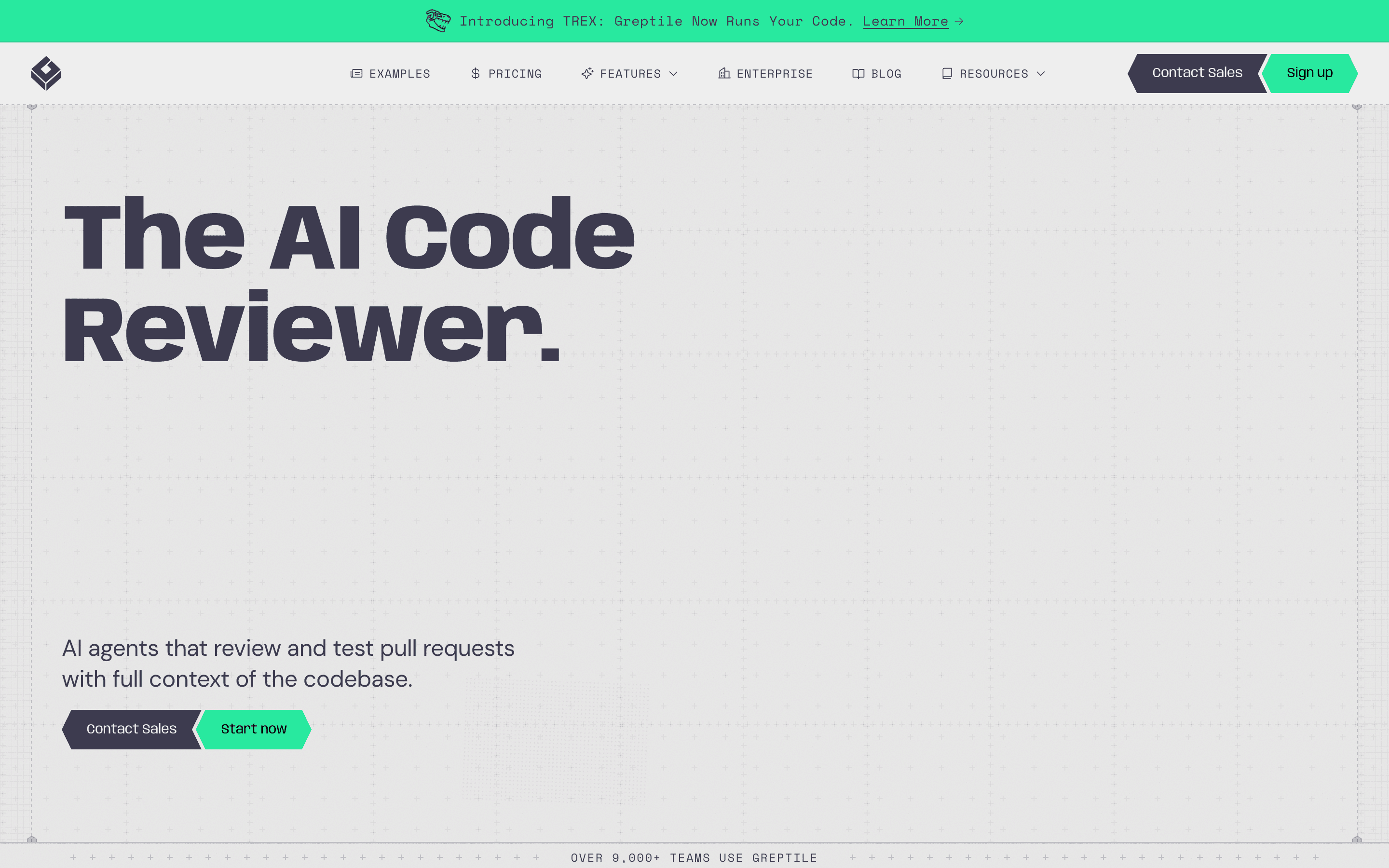
Greptile is the closest match to what CodeRabbit does: an AI bot that comments on pull requests in GitHub or GitLab. But it builds a graph index of the whole codebase first, so it can flag a change that breaks a caller three files away, something a diff-only reviewer can miss. It runs from the PR, the CLI, or its MCP server in Claude Code and Cursor. The catch is pricing. In March 2026 Greptile moved from a flat per-seat fee to $30 per seat plus $1 per credit past the included 50, and some users report significant overage costs under the new model, especially teams whose AI coding agents generate a high volume of small PRs. If your team ships a small, steady number of PRs per developer, that's a fair tradeoff for codebase-wide context. If you use AI coding agents that generate lots of small PRs, run the numbers on Greptile's pricing page before switching.
Pros
- + Codebase-wide context catches cross-file bugs that diff-only reviewers miss
- + Free Starter plan has no repo limit, just a 50-review cap for one developer
- + TREX writes and runs its own tests against a PR, not just comments
Cons
- – Pro plan switched to metered billing in March 2026: $30 covers 50 reviews, then $1 each after that
- – Heavy PR volume can get expensive fast: critics point to one developer's bill reportedly jumping from $30 to over $500 after 571 PRs in a month
Qodo
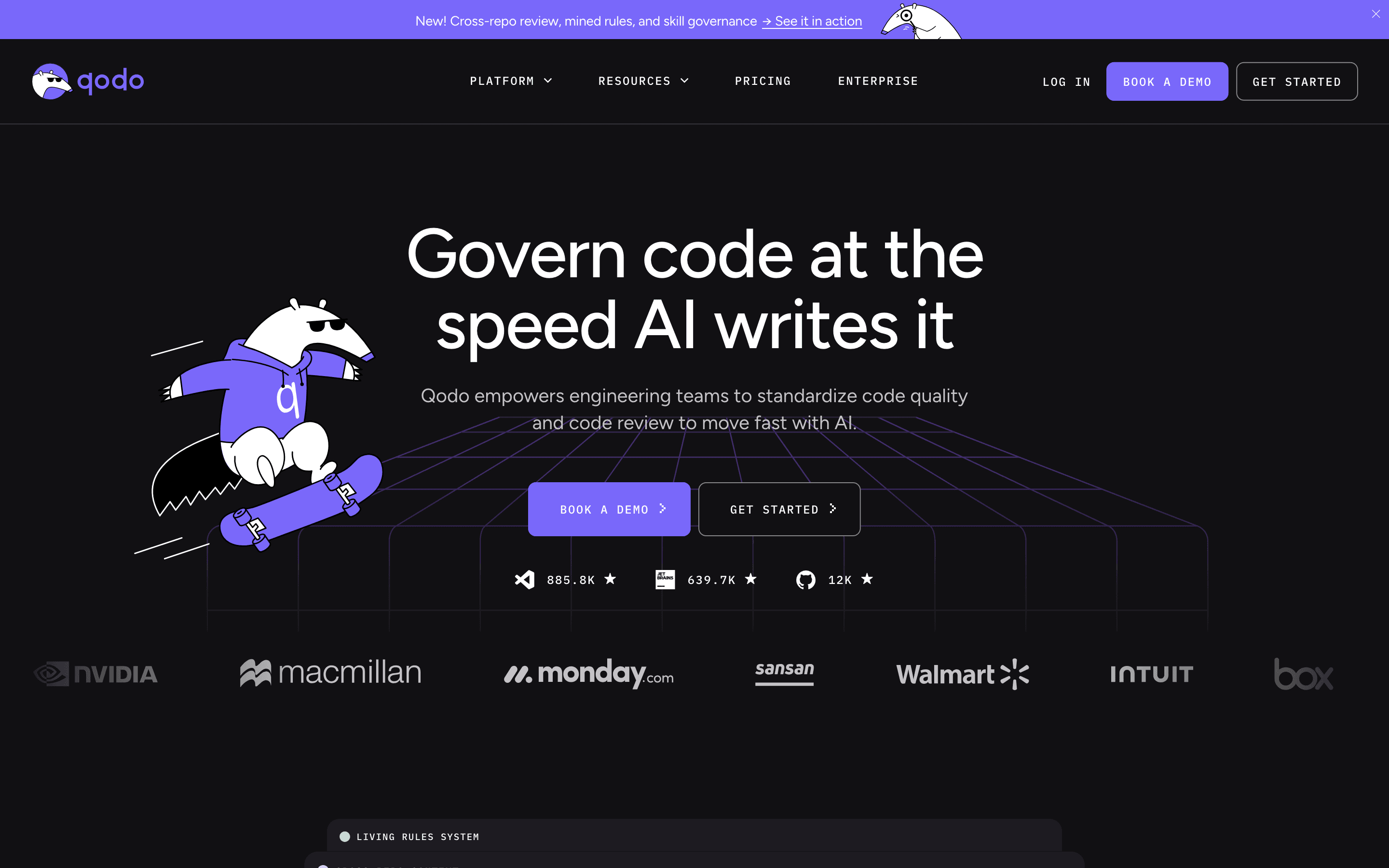
Qodo goes further than CodeRabbit's diff-based review with a multi-agent reviewer that reads full codebase context, and its 2.5 release added beta cross-repository discovery, catching a change in one service that breaks a caller in another repo entirely. It also maintains a rules system that learns your team's standards from merged PRs instead of requiring you to write every rule by hand. The cost structure differs from CodeRabbit's flat tiers: Pro Team is $30 per seat a month, but that only buys a base allotment from a shared team credit pool, so heavy usage or premium-model reviews cost more on top. There's no permanent free plan, just a 14-day unlimited trial. Qodo fits teams with multiple interdependent repos who've outgrown single-repo diff review, not teams that want a flat, predictable bill.
Pros
- + Reviews use full codebase context, including cross-repo relationships, not just the PR diff
- + Rules system learns from your team's past PRs and merged code instead of requiring you to write every standard by hand
- + Local, pre-commit review lets developers catch issues before opening a PR
Cons
- – Pricing is credit-based on top of a per-seat fee, so cost is hard to predict for teams with heavy usage or premium-model reviews
- – No lasting free plan, only a 14-day trial
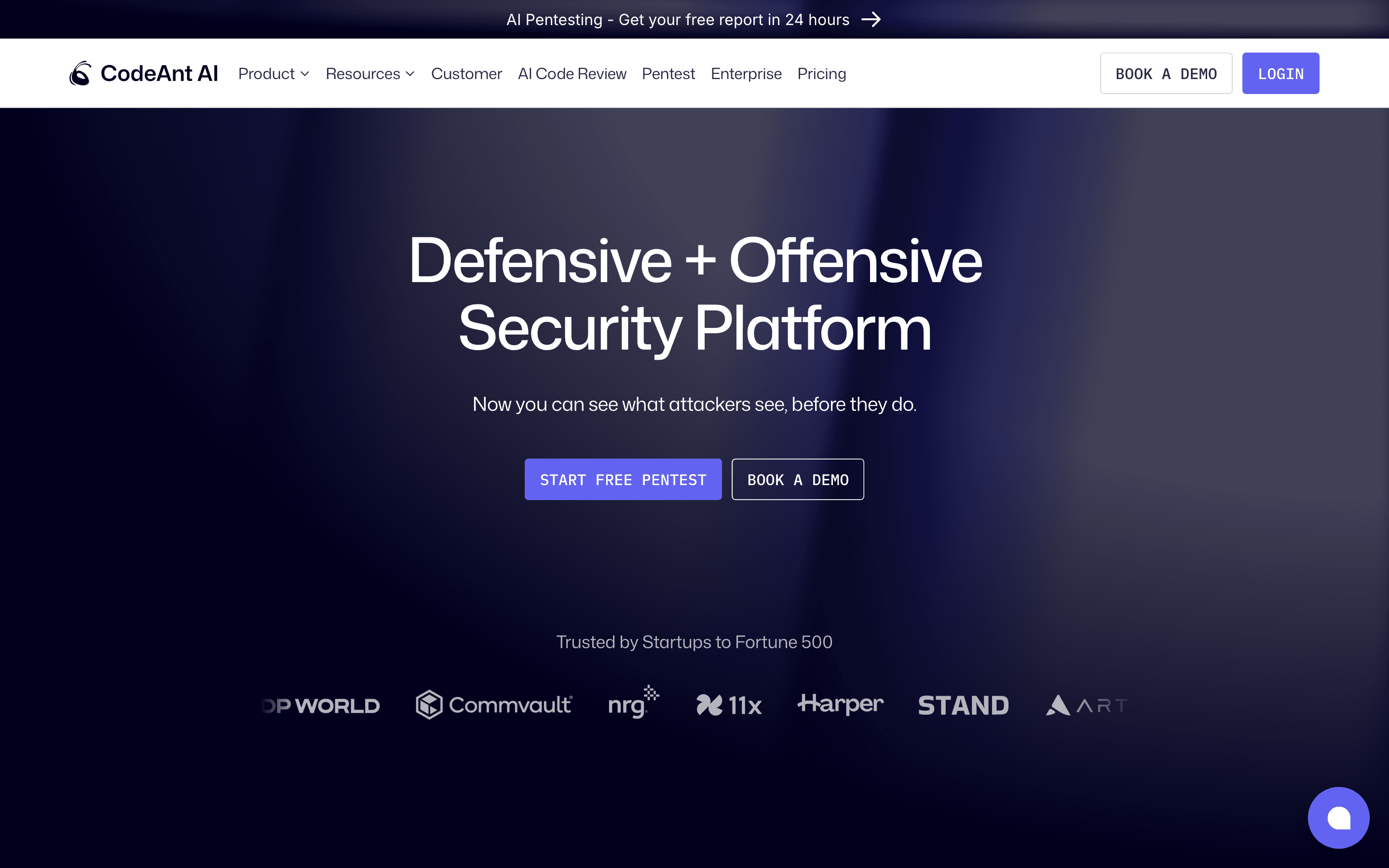
CodeAnt covers the same PR-comment workflow as CodeRabbit, then adds static analysis, secret scanning, infrastructure-as-code checks, and automated penetration testing, all for $24 per seat a month billed monthly, with no annual discount posted. CodeRabbit's own $24/seat price only applies if you commit to annual billing; paying CodeRabbit month to month costs $30/seat for PR review alone, so CodeAnt's bundle actually undercuts CodeRabbit's monthly rate by $6/seat while adding SAST, secrets, IaC, and pentesting. For a team paying for CodeRabbit plus a separate SAST or pentesting tool, that's one bill instead of several. The 14-day trial unlocks unlimited seats and 100 PR reviews with no card required, so a team can pilot the full bundle before committing. The limits: static analysis and SAST on the Premium plan only run on pull requests, not full-repo scans, and getting SSO, on-prem deployment, or a dedicated success manager means an Enterprise quote with no posted price. CodeAnt suits engineering leads who want to consolidate review, security scanning, and compliance reporting under one vendor rather than teams that just want the sharpest PR comments.
Pros
- + One price covers code review, SAST, secrets detection, IaC scanning, and DORA metrics instead of separate line items
- + Trial unlocks the full product with unlimited seats and no card, so a team can pilot it before committing
- + Publishes its per-seat price instead of forcing every buyer through a sales call
Cons
- – Static analysis and SAST on the Premium plan only run on pull requests, not full repo scans, unless you go Enterprise
- – Enterprise pricing (SSO, on-prem, dedicated success manager) is quote-only, so total cost for larger teams isn't visible upfront
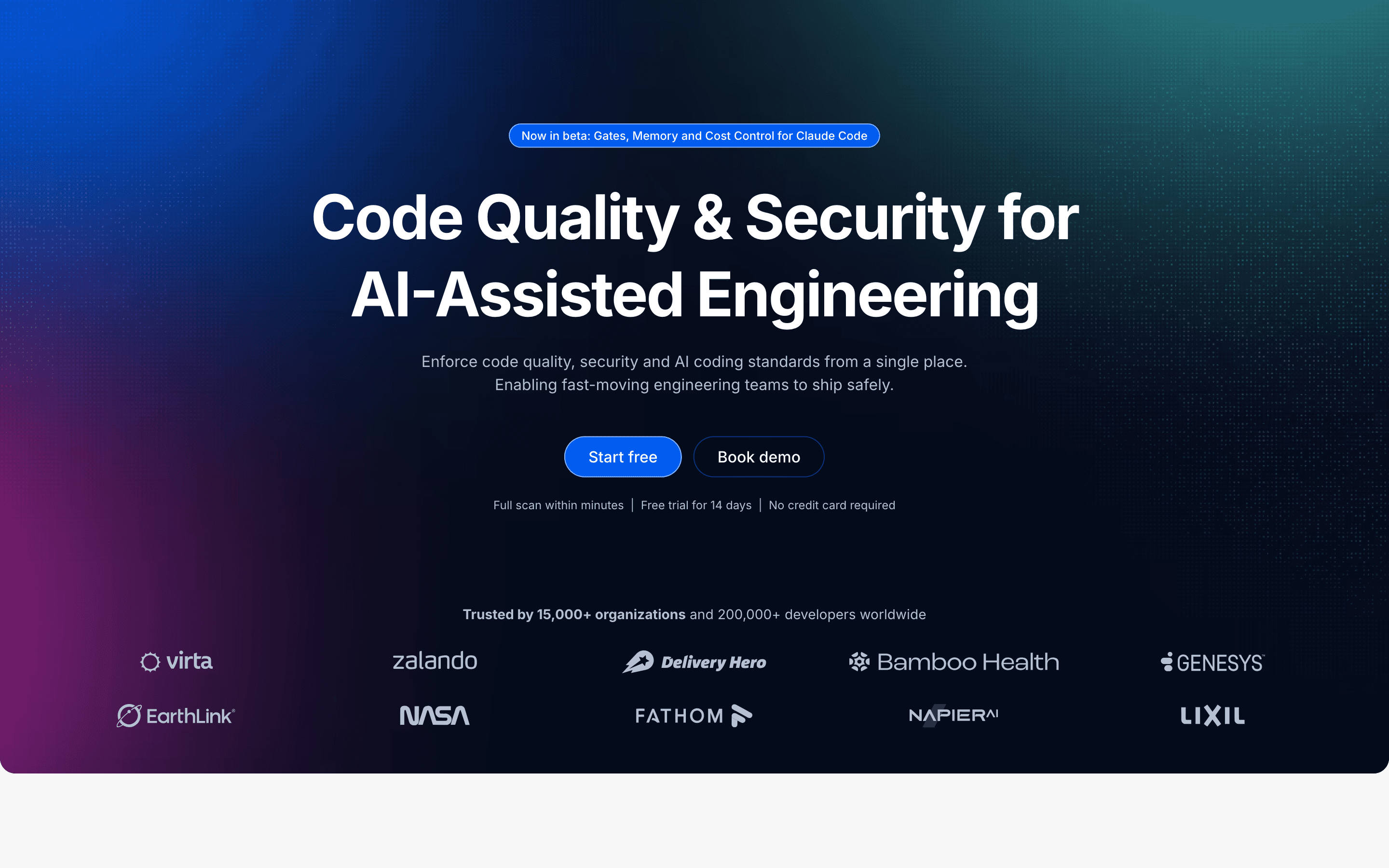
Codacy has a different center of gravity than CodeRabbit. It started as a code-quality and security scanner in 2012 and added an AI Reviewer and AI Guardrails on top, rather than starting as a PR-comment bot. That history shows up as breadth: static analysis, secret detection, software composition analysis, and IaC scanning sit alongside the AI review, all on one platform for $18 to $21 per developer a month on the Team plan, cheaper than CodeRabbit's Pro. AI Guardrails also extend policy checks into coding agents like Claude Code and Cursor themselves, not just PR checks, which CodeRabbit doesn't do. The catch is noise: reviewers report real tuning work is needed to cut the volume of low-priority findings out of the box, and Team is capped at 30 developers before you need a custom Business quote.
Pros
- + Free Developer plan and free usage for open-source projects with no time limit
- + One platform for code quality, SAST, secrets, SCA, and AI PR review instead of separate tools
- + AI Guardrails extend policy checks into coding agents themselves, not just PR checks
Cons
- – Reviewers report real tuning work is needed to get the signal-to-noise ratio down; out of the box it flags a lot of low-priority issues
- – Business (enterprise) tier is quote-only, so you can't compare cost against competitors without a sales call
SonarQube is the odd one out on this list. Instead of an AI bot leaving natural-language PR comments like CodeRabbit, it's a static analyzer that sets a quality gate and can block a merge outright if new code fails it. Free and Team both cover 30+ languages; the 40+ language count that adds older enterprise languages like COBOL and Apex, which AI review tools skip entirely, is called out specifically on the Enterprise tier, which is quote-only. So if COBOL or Apex coverage is the reason you're looking at SonarQube, budget for an Enterprise conversation, not the posted $34/month Team price. Pricing is by lines of code analyzed rather than by seat: the Team cloud plan starts at $34 a month for 100k LOC and climbs from there, and there's a genuinely free tier and open-source Community Build to start with no cost. The tradeoff is a dated, cluttered web UI that reviewers say slows down on large codebases, and a cost that grows with codebase size rather than team size or activity.
Pros
- + Covers 30-40+ languages including older enterprise languages like COBOL and ABAP that most AI review tools skip
- + Quality gates give you a hard pass/fail merge check, not just advisory comments
- + Free tier and open-source Community Build let you start without paying anything
Cons
- – Pricing is based on lines of code analyzed, so cost climbs as your codebase grows regardless of how active your team is
- – Enterprise and Data Center editions are quote-only, so you can't see the real cost until you talk to sales
Should your product be on this ai code review list?
If you build a tool that belongs next to the ones above, submit it. A human reviews every submission. Approved products get their own page with pricing and screenshots, plus a place in the comparisons where they fit. It is free. You sign in with your work email so you can follow the decision, and there is no password to create.
CodeRabbit alternatives: FAQ
What's the best CodeRabbit alternative for teams hitting the hourly review-rate limit?+
The alternatives here meter review volume differently than CodeRabbit's per-hour cap. Greptile and Qodo draw reviews from a monthly credit pool rather than an hourly limit, so heavy-PR teams should size the credits to their volume, and SonarQube prices by lines of code analyzed with no per-review cap at all. Run your monthly PR count against each pricing page before switching.
Is there a free CodeRabbit alternative?+
Greptile's Starter plan is free forever for one developer, with unlimited repositories and 50 review credits a month. CodeRabbit's Free tier is also free forever but caps reviews at 1 per developer per hour.
Which CodeRabbit alternative bundles security scanning with code review?+
CodeAnt and Codacy both combine AI PR review with SAST, secret scanning, and IaC checks in one platform. CodeAnt is $24 per seat a month; Codacy's Team plan is cheaper at $18 to $21 per seat a month, but reviewers say Codacy takes more manual tuning to cut false-positive noise.
Which alternative understands the whole codebase, not just the diff?+
Greptile and Qodo both build full-codebase context before reviewing. Qodo goes further with beta cross-repository breaking-change detection across related repos.
CodeRabbit alternatives: pricing compared
Entry price, billing model, and whether pricing is public. 6 of 6 publish pricing you can check without talking to sales.
| Tool | Starting price | Billing | Free option | Pricing disclosed |
|---|---|---|---|---|
| CodeRabbit | $24/seat/mo | per-seat | Yes | Partly public |
| Greptile | $30/seat/mo | tiered | Yes | Partly public |
| Qodo | $30/seat/mo | usage-based | Trial (14 days, unlimited usage, no credit card required) | Partly public |
| CodeAnt | $24/seat/mo | per-seat | Trial (14 days, no credit card required, unlimited seats and 100 PR reviews included) | Partly public |
| Codacy | $18/seat/mo | per-seat | Yes | Partly public |
| SonarQube | $34/mo | usage-based | Yes | Partly public |
How we made these picks. We compare tools on public pricing, features, and hands-on assessment, then verify every price against the vendor's own page. We never accept payment for rankings. Read the full methodology. Spotted an error? Report it.