Top LogRocket Alternatives in 2026
Here for LogRocket itself? See the full LogRocket profile, pricing & reviews →
Suggest a change- If you want error tracking and analytics bundled with replay but need a lower-cost self-serve entry point, choose PostHog. its free tier covers 1M analytics events and 5K session recordings a month with no credit card, and usage-based pricing lets you set a billing cap instead of committing to LogRocket's session-volume Core plan before you know your real traffic.
- If you're already spending five figures a year on behavioral analytics and want the deepest session-level data with an AI layer like LogRocket's, choose Fullstory. it indexes every session as searchable, structured data and its StoryAI summaries cover the same ground as Galileo's issue detection, though pricing above the free tier still needs a sales call, same as LogRocket's Pro plan.
- If budget is the deciding factor and you can live without error tracking or product analytics, choose Microsoft Clarity. it's free with no session cap, no seat limit, and no credit card required, though it has no A/B testing, surveys, or coding-agent handoff for the bugs it finds.
- If you already route flagged bugs to Cursor, Claude Code, or Codex and want a pull request opened automatically, choose stay on LogRocket. Galileo AI's auto-dispatch from a flagged bug to a coding agent isn't matched by PostHog's AI assistant or Fullstory's StoryAI, which summarize issues but stop short of opening a pull request for you.
LogRocket bundles session replay, error tracking, and product analytics, and now routes flagged bugs straight to coding agents through Galileo AI. Teams leave it mostly over cost: pricing tracks session volume, there's no free-forever plan, and reviewers say the bill climbs fast once traffic grows past the entry tier.
The alternatives below split into two camps. PostHog and Fullstory try to match LogRocket's full job, replay plus error tracking plus analytics, for engineering-led and enterprise teams. Microsoft Clarity trades that depth for a free published price, and fits UX-focused debugging like rage clicks and heatmaps better than stack traces.
LogRocket alternatives compared
| Tool | Best for | Starting price | Free option | Last update |
|---|---|---|---|---|
| PostHogBest for engineering-led debugging | Engineering-led product teams that want analytics, replay, flags, and experiments in one tool instead of stitching several together | Free tier + custom | Yes | June 2026 |
| FullstoryBest enterprise-grade replacement | Product and growth teams that need to go from 'a metric moved' to 'here is the exact session where it broke' without switching tools | Free tier + custom | Yes | — |
| Microsoft ClarityBest free alternative | Teams that want unlimited session recordings and heatmaps without a per-session or per-visit bill | Free tier + custom | Yes | June 2026 |
Why teams switch from LogRocket
Costs climb fast once you outgrow the entry-level session tier
High-traffic teams report the bill rising quickly past the entry-level session tier on Core.
The jump from the free trial to a paid plan feels steep for smaller teams
Reviewers say moving from the 14-day trial to a paid plan is a bigger price jump than they expected for a small team.
There's no free-forever plan
LogRocket only offers a 14-day trial with no credit card required, so teams have to commit to a paid plan before they've fully evaluated it against their real traffic.
The best LogRocket alternatives, ranked
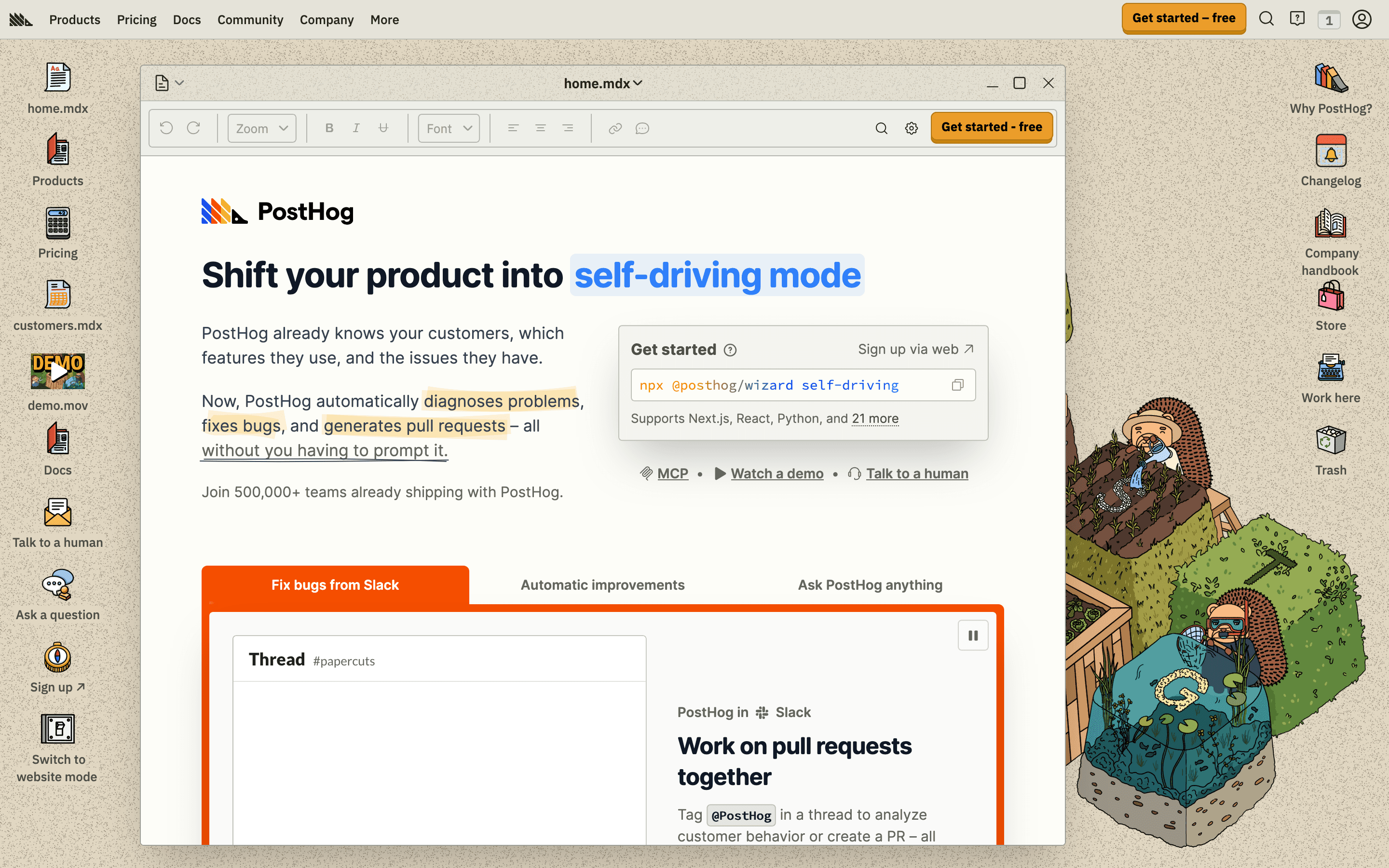
PostHog is the closest match to LogRocket's actual job: watching sessions, tracking errors, and reading analytics in one place, for the same audience of engineering-led product teams. Where LogRocket bills you for captured sessions, PostHog splits pricing by product, so you pay separately for analytics events, recordings, and feature flags, each with its own free monthly allowance (1M events and 5K recordings, no credit card required). You can set a hard billing limit per product, which caps the kind of runaway bill LogRocket reviewers complain about on high-traffic sites. PostHog also throws in feature flags and A/B experiments, which LogRocket doesn't have, so teams already testing rollouts get one bill instead of two. The tradeoff is that you're watching several usage meters instead of one session count, and support beyond email needs the $250/month Boost add-on.
Pros
- + One tool covers analytics, session replay, flags, experiments, and error tracking, so you avoid stitching together separate vendors
- + Free tier resets every month and never expires, with 1M events and 5K recordings included at no cost
- + You can set a hard billing limit on each product separately, so a traffic spike can't blow past what you're willing to spend
Cons
- – Usage-based pricing means your bill moves with traffic, which makes it harder to budget than a flat per-seat plan
- – Without setting billing limits up front, a viral spike or misconfigured tracking call can generate a large bill fast
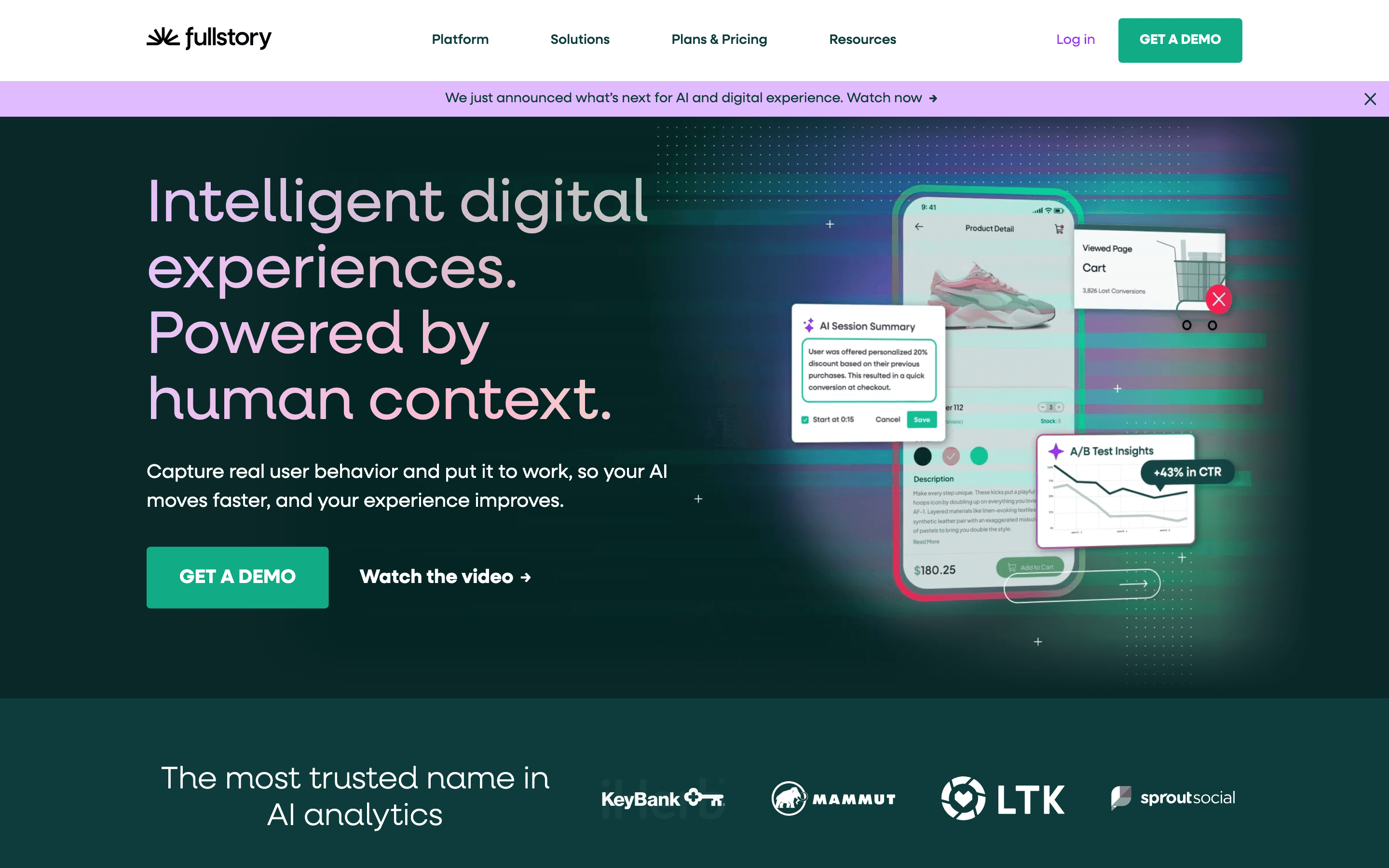
Fullstory is the enterprise-grade rival to LogRocket. Both index every session as searchable, structured data rather than plain video, both flag rage clicks and JS errors automatically, and both now ship an AI layer, StoryAI versus Galileo, that summarizes what went wrong. Fullstory's free plan is more generous on paper: 30,000 sessions a month with 12 months of retention against LogRocket's 14-day trial and no free tier at all. But once you outgrow free, Fullstory's Business, Advanced, and Enterprise plans are all quote-only, and third-party contract data puts typical annual spend between $10,000 and $116,000, with SMB renewals climbing about 30% a year. That makes budgeting harder than LogRocket's published Core price, even though LogRocket's own Pro tier is quote-only too. Pick Fullstory if you want the deepest session search and can commit to a sales-negotiated contract.
Pros
- + Session replay is tied directly to structured event data, so you can search and segment sessions instead of scrubbing through video manually
- + Rage click, dead click, and error detection surface friction you would not think to look for
- + Generous free plan (30,000 sessions/month, 12 months retention, 10 users) for evaluating the product before committing to a paid contract
Cons
- – No public pricing above the free tier. Every paid plan (Business, Advanced, Enterprise) requires a sales call
- – Third-party contract data shows wide, unpredictable pricing (roughly $10K to $116K/year) driven by session volume, and SpendHound's benchmark data shows SMB renewal prices climbing about 30% year over year on average, versus about 11% for enterprise accounts
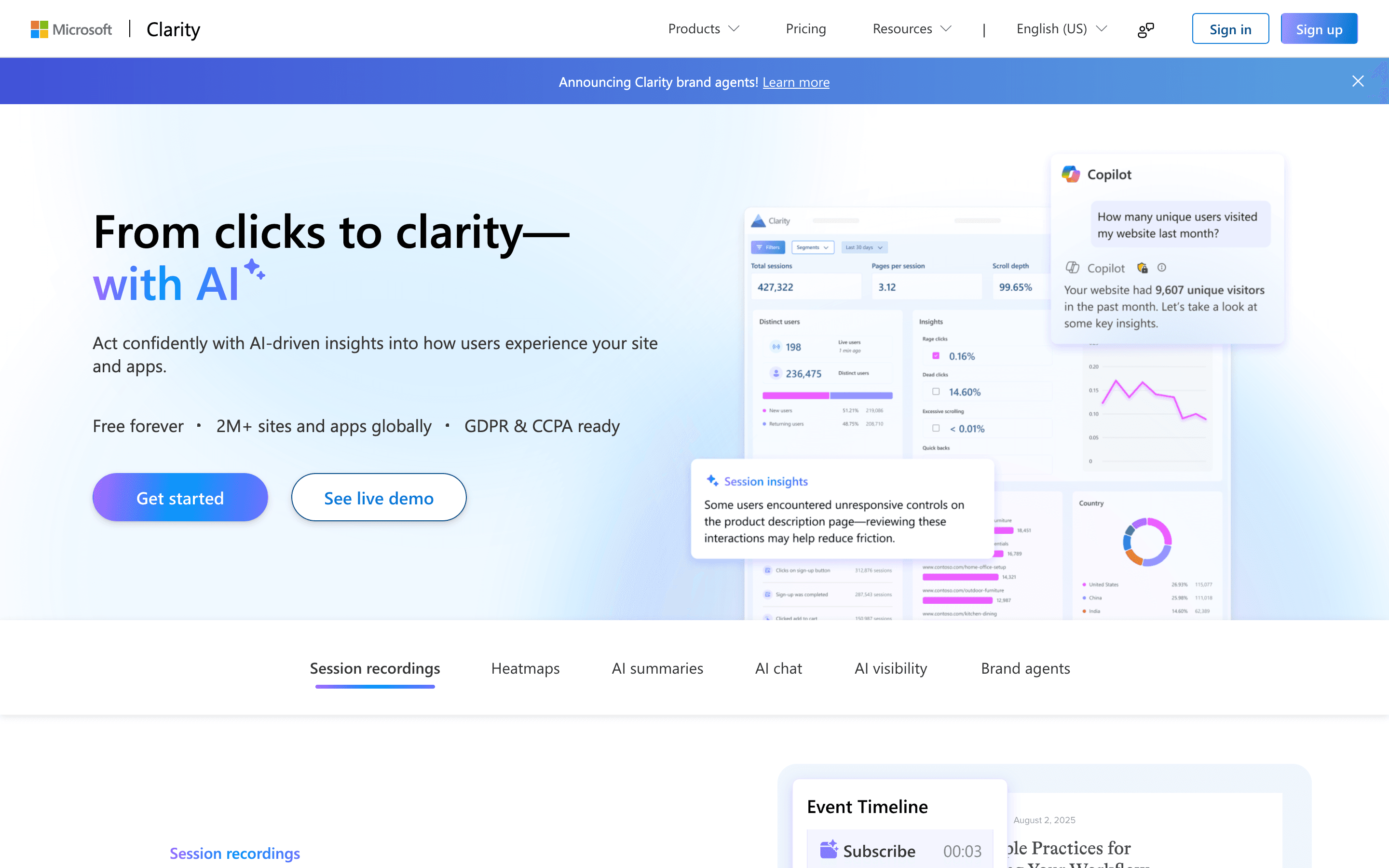
Microsoft Clarity is the free swap for LogRocket's replay and heatmap features, with no session cap, no seat limit, and no credit card, ever. You get rage click, dead click, and quick-back detection plus AI-generated summaries of what happened in a recording, which covers a good chunk of what teams actually open LogRocket for. What it drops entirely is error tracking, console and network logs, and any kind of coding-agent handoff like Galileo, so if you're debugging a stack trace rather than a UX dead end, Clarity won't get you there. Recordings also expire after 30 days unless you favorite them, and a single heatmap tops out at 100,000 page views, both real limits on a high-traffic site. Choose Clarity when budget is the deciding factor and your debugging is mostly visual, not code-level.
Pros
- + Genuinely free with no session caps, no seat limits, and no upgrade prompts
- + Unlimited team members and unlimited projects per account
- + AI-generated summaries of recordings and a chat interface for querying session data without watching every clip
Cons
- – No A/B testing, on-page surveys, or form analytics, so you can't test fixes for the friction you find
- – Recordings are deleted after 30 days unless you favorite them or they land in Clarity's sampled set
Should your product be on this session replay & heatmaps list?
If you build a tool that belongs next to the ones above, submit it. A human reviews every submission. Approved products get their own page with pricing and screenshots, plus a place in the comparisons where they fit. It is free. You sign in with your work email so you can follow the decision, and there is no password to create.
LogRocket alternatives: FAQ
What's the best free alternative to LogRocket?+
Microsoft Clarity. It's free with no session cap, no seat limit, and no credit card required, and it covers session recordings, heatmaps, and rage/dead click detection. It doesn't do error tracking or product analytics, which is the tradeoff for the free price.
Is there a cheaper alternative to LogRocket that still has error tracking?+
PostHog. Error tracking is one of its bundled products, and pricing is usage-based with a free monthly allowance, so small teams can run analytics, replay, and error tracking together without hitting LogRocket's session-volume Core price.
Which LogRocket alternative has published pricing instead of a sales call?+
Microsoft Clarity is fully published because it's simply free, and PostHog lists its usage-based rates publicly too.
Does any LogRocket alternative match Galileo AI's bug-to-pull-request workflow?+
Not exactly. PostHog's AI assistant and Fullstory's StoryAI both summarize issues and surface spikes automatically, but neither dispatches a flagged bug to a coding agent and opens a pull request the way LogRocket's Galileo AI does.
LogRocket alternatives: pricing compared
Entry price, billing model, and whether pricing is public. 2 of 4 publish pricing you can check without talking to sales.
| Tool | Starting price | Billing | Free option | Pricing disclosed |
|---|---|---|---|---|
| LogRocket | $176/mo | usage-based | Trial (14 days, no credit card required) | Partly public |
| PostHog | Free tier + custom | usage-based | Yes | Partly public |
| Fullstory | Free tier + custom | quote-only | Yes | Not disclosed |
| Microsoft Clarity | Free tier + custom | free | Yes | Not disclosed |
How we made these picks. We compare tools on public pricing, features, and hands-on assessment, then verify every price against the vendor's own page. We never accept payment for rankings. Read the full methodology. Spotted an error? Report it.