Top Modal Alternatives in 2026
Here for Modal itself? See the full Modal profile, pricing & reviews →
Suggest a change- If you're deploying a custom or fine-tuned model and want autoscaling without paying for idle time, choose Baseten. Baseten's dedicated deployments bill only for minutes of active use, and the Basic plan carries no platform fee the way Modal's Team tier does.
- If you want the closest match to Modal's build-and-deploy workflow plus a huge catalog of ready-to-call models, choose Replicate. Replicate's Cog tool packages a model into a hosted API much like Modal's decorators wrap a Python function, and it adds thousands of public models you can call without building anything.
- If you mainly need the cheapest possible GPU-hour and are fine managing pods yourself, choose RunPod. RunPod's per-second Pod pricing starts at $0.27/hr for an RTX A5000 with no platform fee, undercutting Modal for teams that don't need its higher-level Python API.
- If you're mainly calling or fine-tuning open-weight LLMs and want reserved GPU pricing that drops with commitment length, choose Together AI. Together AI covers serverless inference, dedicated GPU rental, and fine-tuning for open models on one account, with reserved cluster rates as low as $3.09/hr for longer commitments and a single bill for training and serving.
- If you're running high-volume batch jobs or repeated prompts against open models and want a discount for it, choose Fireworks AI. Fireworks prices cached input tokens and batch inference at half the standard rate, a discount Modal doesn't offer since it bills raw compute rather than tokens.
- If you need general-purpose serverless Python compute for batch jobs, scheduled functions, and agent sandboxes in one platform, choose stay on Modal. none of the alternatives package sandboxes, scheduled functions, and arbitrary autoscaling Python compute into a single decorator-based API the way Modal does.
Modal is a serverless platform for running Python functions and GPUs by the second, popular for batch inference, fine-tuning jobs, and agent sandboxes that don't want to run on idle infrastructure. Teams start looking elsewhere for a few concrete reasons: the Team plan tacks a $250/month platform fee on top of usage, GPU per-second rates run higher than raw cloud rental, and reviews on Trustpilot describe spend-limit alerts firing at low usage and support being hard to reach when trying to close an account.
The right alternative depends on what you're actually doing on Modal. If you're deploying a custom or fine-tuned model to production, Baseten and Replicate are the closest match. If your workload is mostly calling or fine-tuning open-weight LLMs, Together AI and Fireworks AI fit better. If you just want the cheapest raw GPU-hour and don't mind managing more of the stack yourself, RunPod is the pick.
Modal alternatives compared
| Tool | Best for | Starting price | Free option | Last update |
|---|---|---|---|---|
| BasetenBest for custom or fine-tuned model deployment | Teams deploying custom or fine-tuned models that need dedicated GPU capacity with autoscaling | Custom / quote | No | July 2026 |
| ReplicateBest match for Modal's build-and-deploy workflow | Teams that want to call a huge catalog of open and third-party models through one API without standing up their own GPU fleet | $0.000025/second | No | April 2026 |
| RunPodBest raw GPU value | Teams that want raw GPU access by the hour without committing to AWS/GCP reserved capacity | Usage-based | No | July 2026 |
| Together AIBest for open-weight LLM serving at volume | Teams already committed to open-weight models (Llama, DeepSeek, Qwen, GLM, Kimi) who want one API instead of standing up their own serving stack | Usage-based | No | July 2026 |
| Fireworks AI | Teams running open-weight models (Llama, Qwen, DeepSeek, Kimi, GLM) in production who don't want to manage GPUs themselves | Usage-based | Trial ($1 in free credits for new accounts to test serverless inference) | June 2026 |
Why teams switch from Modal
Spend-limit alerts trip even at low usage
Reviews on Trustpilot describe spend-limit alerts firing despite minimal usage, with support hard to reach beyond automated replies.
Closing an account can get stuck on a disputed balance
Reviews on Trustpilot describe being charged after wanting to close an account, with support citing an outstanding balance as the reason the account couldn't be deleted.
The Team plan adds a flat platform fee on top of usage
Moving past the free Starter tier means paying $250/month just for the Team plan, on top of per-second compute charges, a real jump for teams that outgrow the free tier's limits.
The best Modal alternatives, ranked
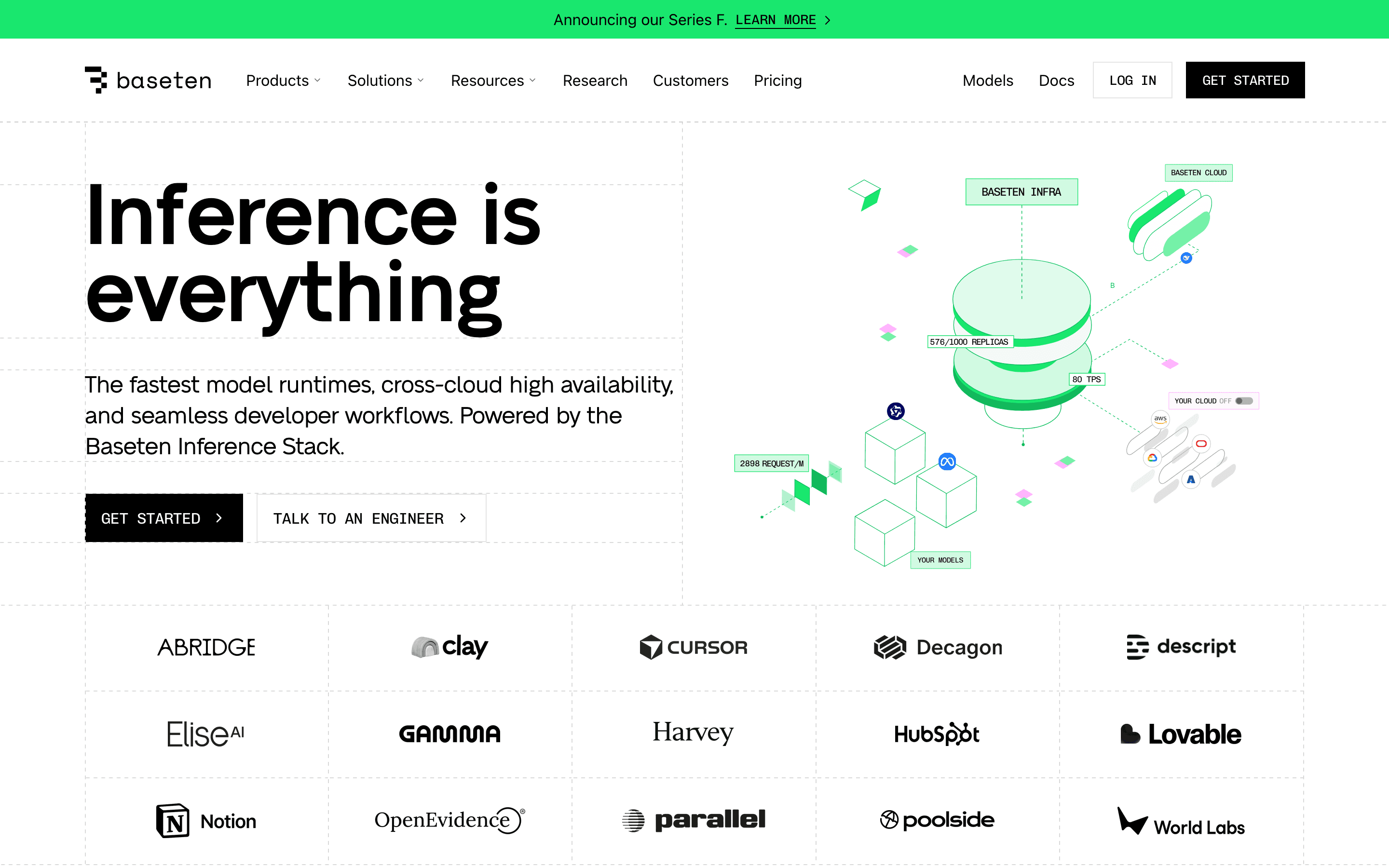
Baseten is the tightest match for teams deploying a custom or fine-tuned model to production, which is one of Modal's core use cases. Dedicated GPU deployments bill per minute of active use only, so idle time between requests costs nothing, similar to Modal's per-second scale-to-zero model. There's no platform fee sitting on top of usage the way Modal's $250/month Team tier does. The Basic plan is pay-as-you-go with signup credits to start. Baseten also ships a CLI and an MCP server for deploying and tuning autoscalers straight from an agent, which fits teams already building with coding agents. The tradeoff is predictability: autoscaling reacts to traffic automatically, so bursty workloads can produce bursty bills, and Pro and Enterprise pricing is quote-only rather than published like Modal's per-second GPU rates.
Pros
- + No idle-time billing on dedicated deployments, only pay for active compute minutes
- + Per-minute GPU rates and per-token Model API rates are published on the site, not hidden behind a demo request
- + Recent releases (CLI, MCP server, event overlays on metrics) show active platform investment
Cons
- – Traffic spikes translate directly into cost spikes since autoscaling adds GPU instances automatically, making budgets hard to forecast for bursty workloads
- – Pro and Enterprise pricing is quote-only with no published starting price
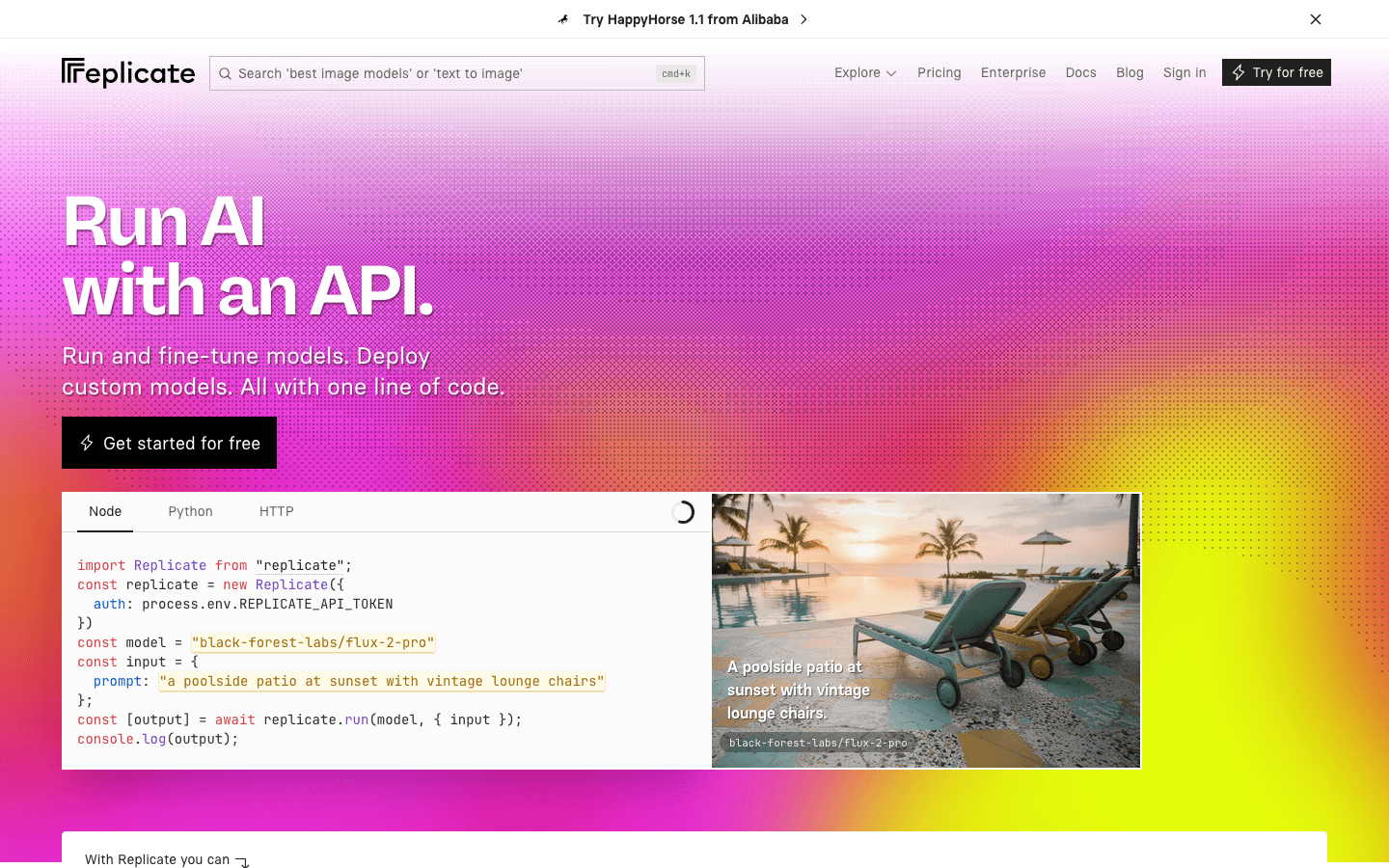
Replicate is the closest match to Modal's actual developer workflow. Its Cog tool packages a model into a container much the way Modal's decorators wrap a Python function, and private deployments support autoscaling and scale-to-zero with per-second billing, not a plan or seat. Replicate adds a huge public catalog of thousands of community models you can call immediately, something Modal doesn't offer since Modal is build-your-own rather than call-an-existing-model. Recent agent skills and MCP auto-discovery mirror Modal's own push into agent sandboxes. The downside is cost at sustained scale: Replicate lists H100 at $5.49/hr against Modal's roughly $3.95/hr for the same chip, and Replicate dropped monthly spend limits in mid-2025, leaving only prepaid credit as a hard cap. There's also no free tier, only a limited, undisclosed set of free-to-try models.
Pros
- + Pricing is transparent and published down to the per-second hardware rate, with no plan tiers or seats to negotiate
- + Huge, actively growing catalog of public models you can call with no setup
- + Cog packaging makes it straightforward to move a model from a repo into a hosted API
Cons
- – Per-second GPU rates run noticeably higher than some competitors for sustained workloads; an H100 on Replicate lists at $5.49/hr versus $3.95/hr on Modal and $3.99/hr list price ($1.89/hr at the low end) on Fal.ai for comparable hardware
- – Private deployments bill for the full instance lifecycle, so cold starts and idle warm instances add real cost beyond actual inference time
RunPod is the option for teams that mainly want cheap GPU-hours rather than a managed deployment layer. Pods start at $0.27/hr for an RTX A5000 and run up to $7.39/hr for a B300, all billed per second with no seat fee or platform charge, undercutting Modal's rates for teams that don't need Modal's higher-level Python API. Its Serverless product covers the autoscaling, scale-to-zero use case Modal is known for, and Instant Clusters add multi-node training that Modal doesn't offer directly. The catch is you sit closer to raw infrastructure: you SSH into Pods and manage more of the stack yourself, storage keeps billing at double the running rate once a pod is stopped, and several cluster and high-end GPU rates are quote-only. New accounts also start with a hard $80/hour spend cap that needs a support request to lift.
Pros
- + Per-second billing on both compute and storage, no monthly minimum or seat fee
- + One of the widest GPU catalogs of any GPU cloud, from budget RTX cards to B300
- + No charge for ingress or egress data transfer
Cons
- – Pricing page doesn't show Secure Cloud vs Community Cloud rates side by side, you find the real split only at deploy time
- – Stopped volume storage bills at $0.20/GB/month, double the running rate, which surprises people who expect stopping a pod to stop the meter
Together AI fits teams whose Modal usage is mostly running or fine-tuning open-weight LLMs rather than arbitrary Python jobs. Serverless calls are billed per million tokens with every model's rate published, dedicated GPU rental covers H100 through B200 by the hour, and fine-tuning runs on the same account, so a team can go from training to serving without switching vendors. Reserved GPU cluster pricing drops as low as $3.09/hr for long commitments, well under Modal's on-demand rates. The tradeoff is onboarding friction: there's no free trial, and the docs require a $5 credit purchase before the API answers any call, unlike Modal's free Starter tier with $30 in monthly credits. Rate limits are also dynamic and unpublished rather than the fixed concurrency limits Modal states upfront.
Pros
- + Every price is on the public pricing page, model by model, with no tiers or sales calls required
- + Covers serverless inference, dedicated GPUs, fine-tuning, and image/video/audio generation under one account and one bill
- + Reserved GPU cluster pricing drops noticeably below on-demand (H100 cluster on-demand $3.99/hr vs. reserved down to $3.29/hr for 91-180 days)
Cons
- – No free trial. The docs require a minimum $5 credit purchase before the API will respond to any call
- – Serverless rate limits are dynamic and unpublished; the docs tell you to read response headers instead of a fixed number, which makes capacity planning harder
Fireworks AI is built for teams running open-model inference at production volume rather than general Python compute. Every serverless rate is published by model size or by named flagship model, and cached input tokens plus batch inference both run at half the standard rate, a discount Modal doesn't offer since it bills raw compute rather than tokens. On-demand GPU rental and fine-tuning sit on the same bill, so a team can move from training to serving without leaving the platform. Compared with Modal's free Starter tier and $30 in monthly credits, Fireworks gives new accounts only $1 in starter credit, and its rate limits are a hard 6,000 RPM ceiling per account even after adding a payment method. Teams needing more throughput have to go through sales.
Pros
- + Published per-token rates for every model tier, not hidden behind a sales call
- + Cached input tokens and batch inference are both 50% cheaper than standard rates
- + Covers the full lifecycle: serverless inference, on-demand GPU rental, and fine-tuning on one platform
Cons
- – No free tier, only $1 of starter credit, so cost tracking starts almost immediately
- – Rate limits are capped at a fixed 6,000 RPM even after adding a payment method; going higher means contacting sales
Should your product be on this ai inference & gpu infrastructure list?
If you build a tool that belongs next to the ones above, submit it. A human reviews every submission. Approved products get their own page with pricing and screenshots, plus a place in the comparisons where they fit. It is free. You sign in with your work email so you can follow the decision, and there is no password to create.
Modal alternatives: FAQ
What's the main difference between Modal and Baseten?+
Modal is a general-purpose serverless Python platform billed per second across CPU, GPU, and memory, used for batch jobs, fine-tuning, and agent sandboxes as well as inference. Baseten is focused specifically on deploying custom and fine-tuned models to production, with dedicated GPU deployments billed per minute of active use and no platform fee.
Is there a cheaper alternative to Modal for raw GPU compute?+
RunPod tends to be cheaper for raw GPU-hours: Pods start at $0.27/hr for an RTX A5000, with no seat fee or platform charge on top. The tradeoff is you manage more of the deployment yourself compared with Modal's Python decorator API.
Which Modal alternative is best for calling open-source LLMs?+
Together AI and Fireworks AI are both built around serving open-weight models by the token, with published per-model rates and fine-tuning on the same platform. Fireworks adds 50% discounts on cached tokens and batch inference; Together AI adds reserved GPU cluster pricing down to $3.09/hr.
Do any Modal alternatives have a free tier?+
Not a forever-free tier in most cases. Baseten, Replicate, Together AI, Fireworks AI, and RunPod all require payment or a starter credit before real usage, unlike Modal's free Starter plan with $30 a month in compute credits.
Modal alternatives: pricing compared
Entry price, billing model, and whether pricing is public. 5 of 6 publish pricing you can check without talking to sales.
| Tool | Starting price | Billing | Free option | Pricing disclosed |
|---|---|---|---|---|
| Modal | $0.0000131/core-second | usage-based | Yes | Partly public |
| Baseten | Custom / quote | usage-based | No | Not disclosed |
| Replicate | $0.000025/second | usage-based | No | Public |
| RunPod | Usage-based | usage-based | No | Public |
| Together AI | Usage-based | usage-based | No | Public |
| Fireworks AI | Usage-based | usage-based | Trial ($1 in free credits for new accounts to test serverless inference) | Partly public |
How we made these picks. We compare tools on public pricing, features, and hands-on assessment, then verify every price against the vendor's own page. We never accept payment for rankings. Read the full methodology. Spotted an error? Report it.