RunPod Review
Pay-by-the-second GPU cloud for training, inference, and serverless endpoints
Is this your product? Claim this page · Request a change
Looking for a RunPod alternative? See our ranked comparison.→What is RunPod?
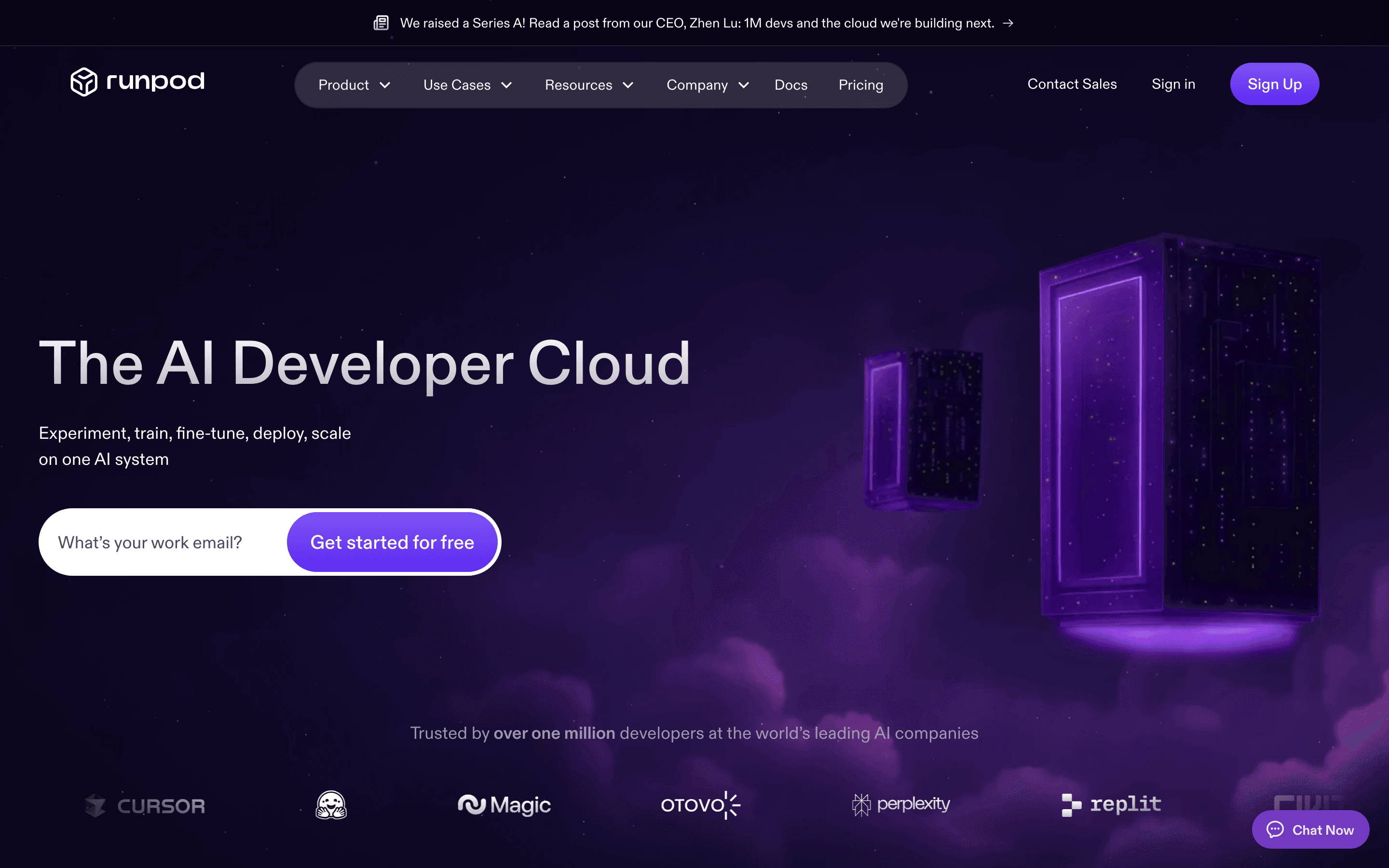
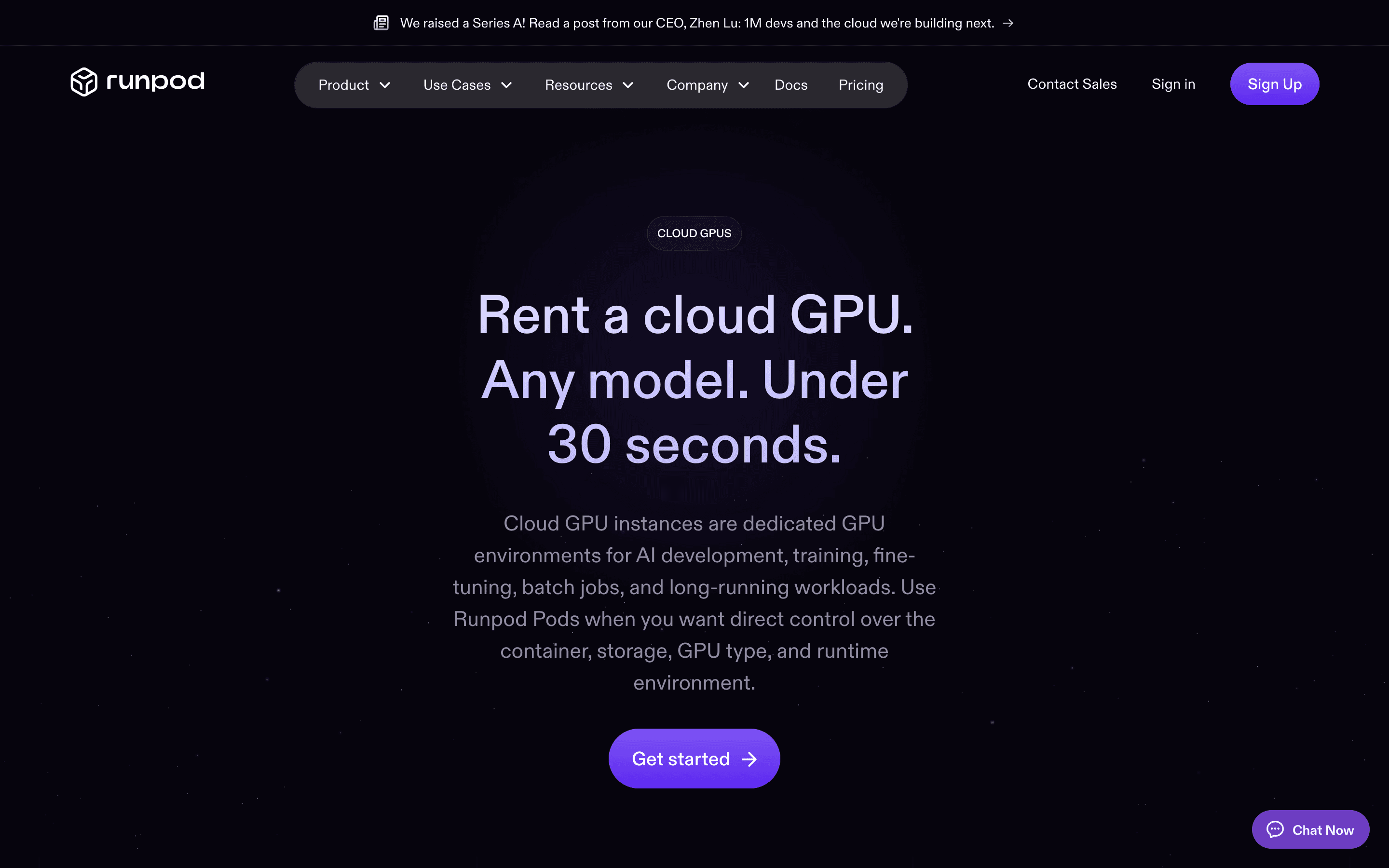
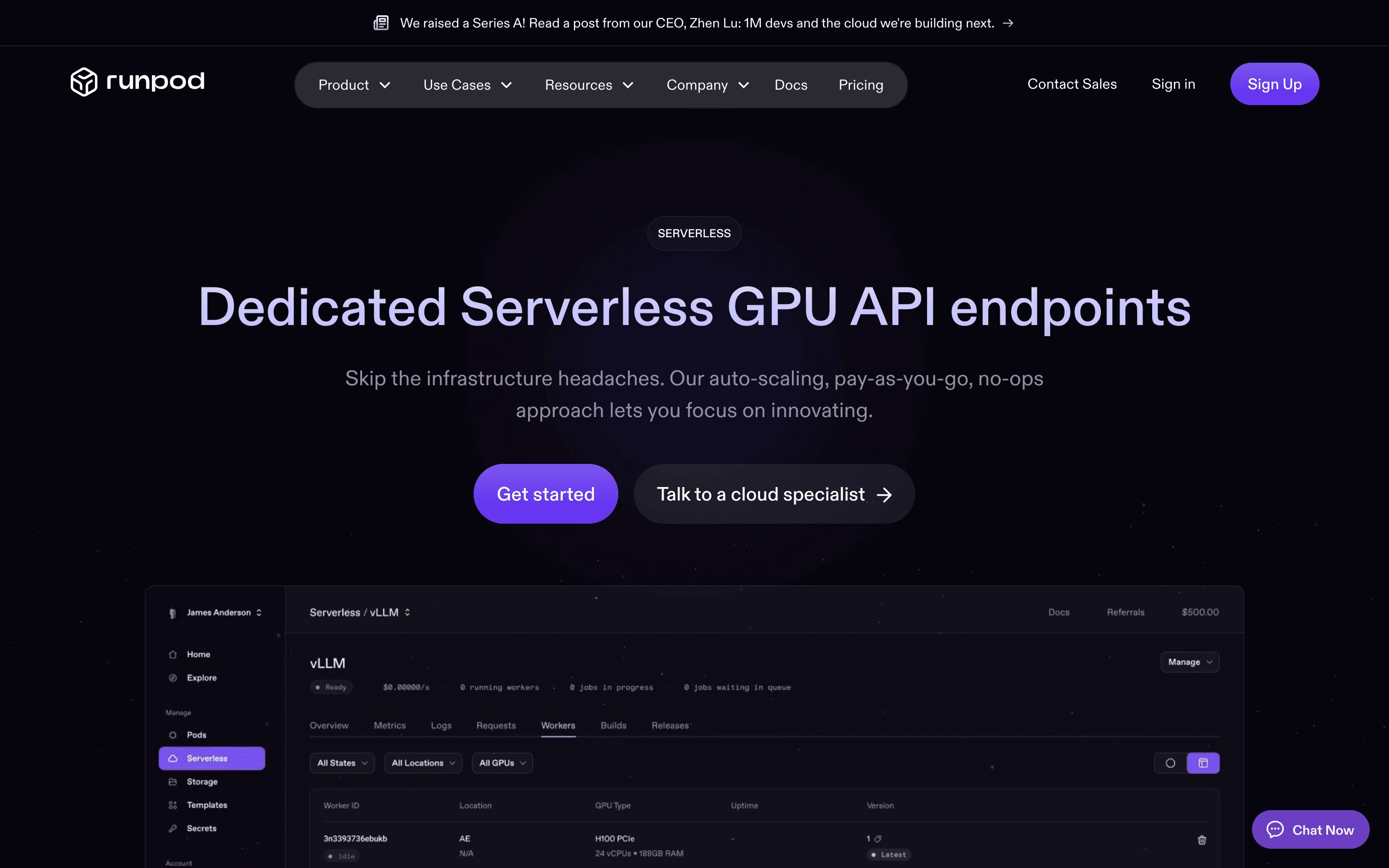
RunPod is a GPU cloud built for ML workloads: Pods for dedicated instances you spin up and SSH into, Serverless for autoscaling inference endpoints that scale to zero, and Instant Clusters for multi-node training jobs. Everything is billed per second, down to a wide catalog of GPUs from RTX A5000 up to B300.
You pick a GPU, a Community Cloud (cheaper, less redundant, third-party host hardware) or Secure Cloud (higher SLA, Tier 3/4 certified data centers) tier, and pay only for the seconds the instance runs. There's no seat pricing and no platform subscription, but storage, network volumes, and idle pods keep billing even when you're not actively computing.
RunPod screenshots
Who it's for
- ✓ Teams that want raw GPU access by the hour without committing to AWS/GCP reserved capacity
- ✓ Solo ML engineers and small teams running training jobs or self-hosted inference that need a wide, cheap GPU catalog
- ✓ Projects using RunPod Serverless to wrap a custom model in an autoscaling endpoint
Who should look elsewhere
- ✗ Teams that want a managed inference API with per-token pricing and no infra to babysit
- ✗ Anyone who needs a hard, predictable monthly bill instead of usage-based GPU-hour billing
- ✗ Enterprises that need Secure Cloud SLAs spelled out with a fixed price, since several high-end GPU and cluster rates are quote-only
Pros
- + Per-second billing on both compute and storage, no monthly minimum or seat fee
- + One of the widest GPU catalogs of any GPU cloud, from budget RTX cards to B300
- + No charge for ingress or egress data transfer
- + Serverless flex workers scale to zero, so idle endpoints don't burn GPU-hours
Cons
- – Pricing page doesn't show Secure Cloud vs Community Cloud rates side by side, you find the real split only at deploy time
- – Stopped volume storage bills at $0.20/GB/month, double the running rate, which surprises people who expect stopping a pod to stop the meter
- – Default $80/hour spend cap requires a support request to raise
- – Spot/Community pricing and availability have shifted with little notice, users have reported sudden rate changes and features moved behind API access
RunPod pricing
You pay for what you consume rather than a per-seat fee, so cost scales with usage.
| Plan | Price | Highlights |
|---|---|---|
| Pods | $0.27/mo | Dedicated GPU instances billed per second · RTX A5000 24GB from $0.27/hr up to B300 288GB at $7.39/hr · Secure Cloud carries a premium over Community Cloud, RunPod does not publish the exact split on the pricing page |
| Serverless | $0.69/mo | Autoscaling inference endpoints · L4 24GB from $0.69/hr, H100 80GB around $4.55/hr · Flex workers scale to zero and bill per second, Active (always-on) workers get volume discounts through sales |
| Instant Clusters | $1.79/mo | Multi-node jobs · A100 SXM from $1.79/hr, H200 SXM around $4.31/hr · Most other cluster GPUs are quote-only |
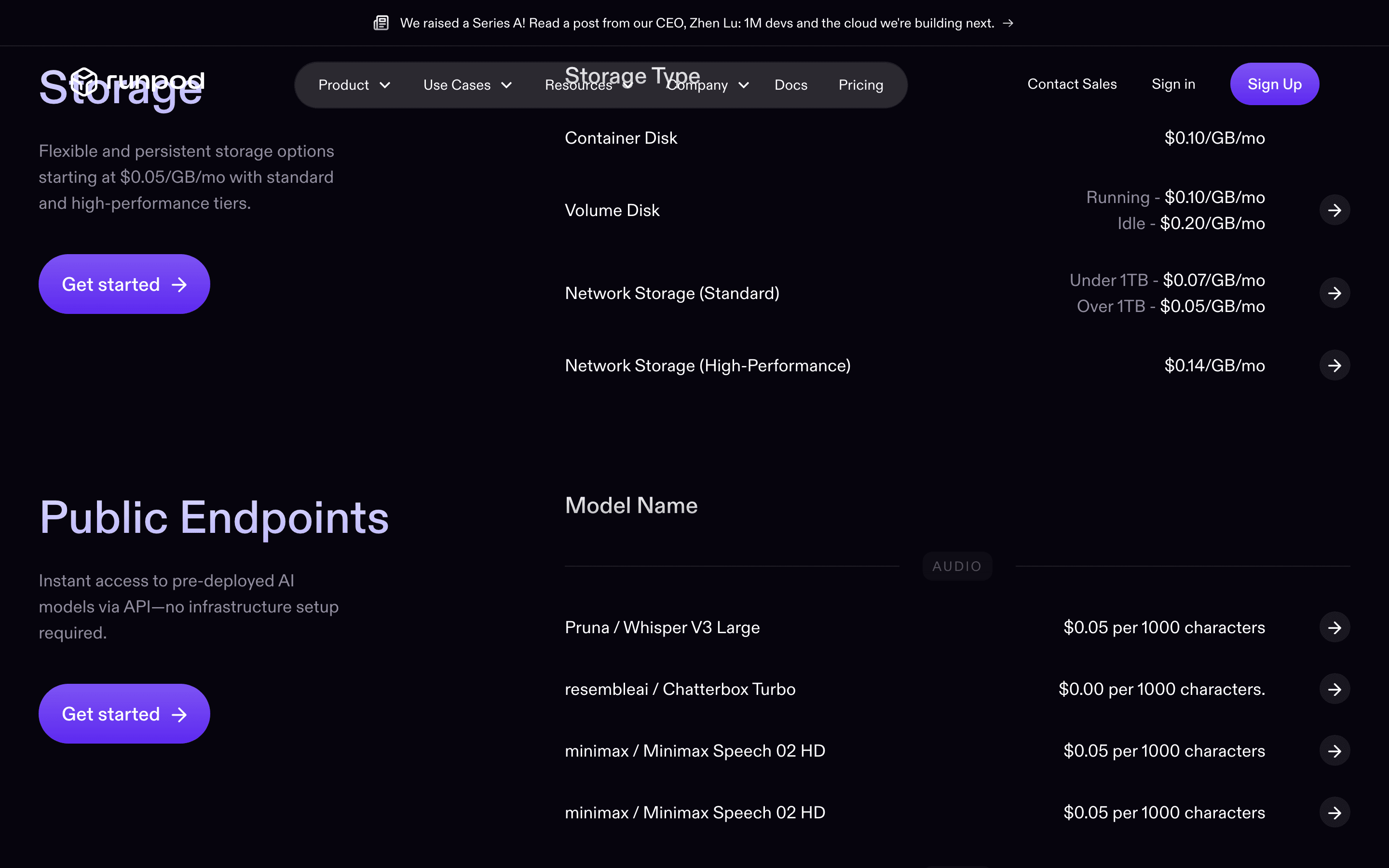
All prices are per GPU-hour, billed per second, from the live RunPod pricing page. There is no monthly subscription or per-seat fee. Storage is billed separately: container and running volume disk at $0.10/GB/month, stopped volume disk at $0.20/GB/month, network volume storage at $0.07/GB/month under 1TB and $0.05/GB/month above that (a faster high-performance network volume tier runs $0.14/GB/month). New accounts default to an $80/hour spend cap across all resources, raised only by contacting support. Instant Cluster and some high-end GPU rates require a sales quote.
Pricing verified July 7, 2026 · source
How RunPod's pricing compares
RunPod next to its closest alternatives on entry price, billing, and whether pricing is public.
| Tool | Starting price | Billing | Free option | Pricing disclosed |
|---|---|---|---|---|
| RunPod | Usage-based | usage-based | No | Public |
| Baseten | Custom / quote | usage-based | No | Not disclosed |
| Modal | $0.0000131/core-second | usage-based | Yes | Partly public |
| Replicate | $0.000025/second | usage-based | No | Public |
| Together AI | Usage-based | usage-based | No | Public |
| Fireworks AI | Usage-based | usage-based | Trial ($1 in free credits for new accounts to test serverless inference) | Partly public |
Is RunPod still actively developed?
Last significant update: July 2026. Serverless endpoint creation expanded to six deployment paths (Hello World, Hugging Face LLM, Docker, GitHub, Flash, Hub), and a new beta tutorial covers deploying Pods with private AWS ECR images via cross-account IAM.
Top RunPod alternatives
RunPod FAQ
Does RunPod have a free tier?+
No. RunPod has no free forever plan. New accounts get a default $80/hour spend cap across all resources rather than free usage, and any promotional credits come from the referral program ($5-$500 in credit once a referral spends $10) or the startup program (from $1,000 up to $75,000 in credits for venture-backed companies), not a standing free tier.
What's the difference between Secure Cloud and Community Cloud?+
Secure Cloud runs in Tier 3/Tier 4 certified data centers for higher reliability, Community Cloud connects individual and third-party compute providers through a vetted peer-to-peer network at a lower price. RunPod's public pricing page shows column headers for both but only one rate per GPU, so you see the real split when you go to deploy.
How is storage billed if I stop a Pod?+
Container disk and running volume disk cost $0.10/GB/month, but a stopped Pod's volume disk bills at $0.20/GB/month, twice the running rate. Network volume storage is billed separately at $0.07/GB/month under 1TB and $0.05/GB/month above that.
Is Serverless pricing different from Pods pricing?+
Yes. Serverless has its own per-GPU hourly rates, generally higher than the equivalent Pod rate, and splits workers into Flex (scales to zero, standard per-second rate) and Active (always-on, discounted through a sales conversation).