Fireworks AI Review
Pay-per-token inference platform for open and custom models, built for low-latency production traffic
Is this your product? Claim this page · Request a change
Looking for a Fireworks AI alternative? See our ranked comparison.→What is Fireworks AI?
Fireworks AI is an inference platform for running open-weight and custom models in production. You call its API the same way you'd call OpenAI's, but point it at models like Kimi, DeepSeek, GLM, or Qwen, and it handles the GPU orchestration, batching, and scaling behind the scenes.
Beyond serverless endpoints, Fireworks rents on-demand GPUs (H100, H200, B200, B300) for custom deployments, runs supervised and preference fine-tuning jobs, and offers reinforcement fine-tuning billed by GPU-hour. Pricing is entirely usage-based: no seats, no flat monthly fee, just tokens and compute-hours.
The company has been raising its profile as an infrastructure layer for teams that don't want to manage their own GPU fleet but still want more control and lower latency than a single closed-model API gives them.
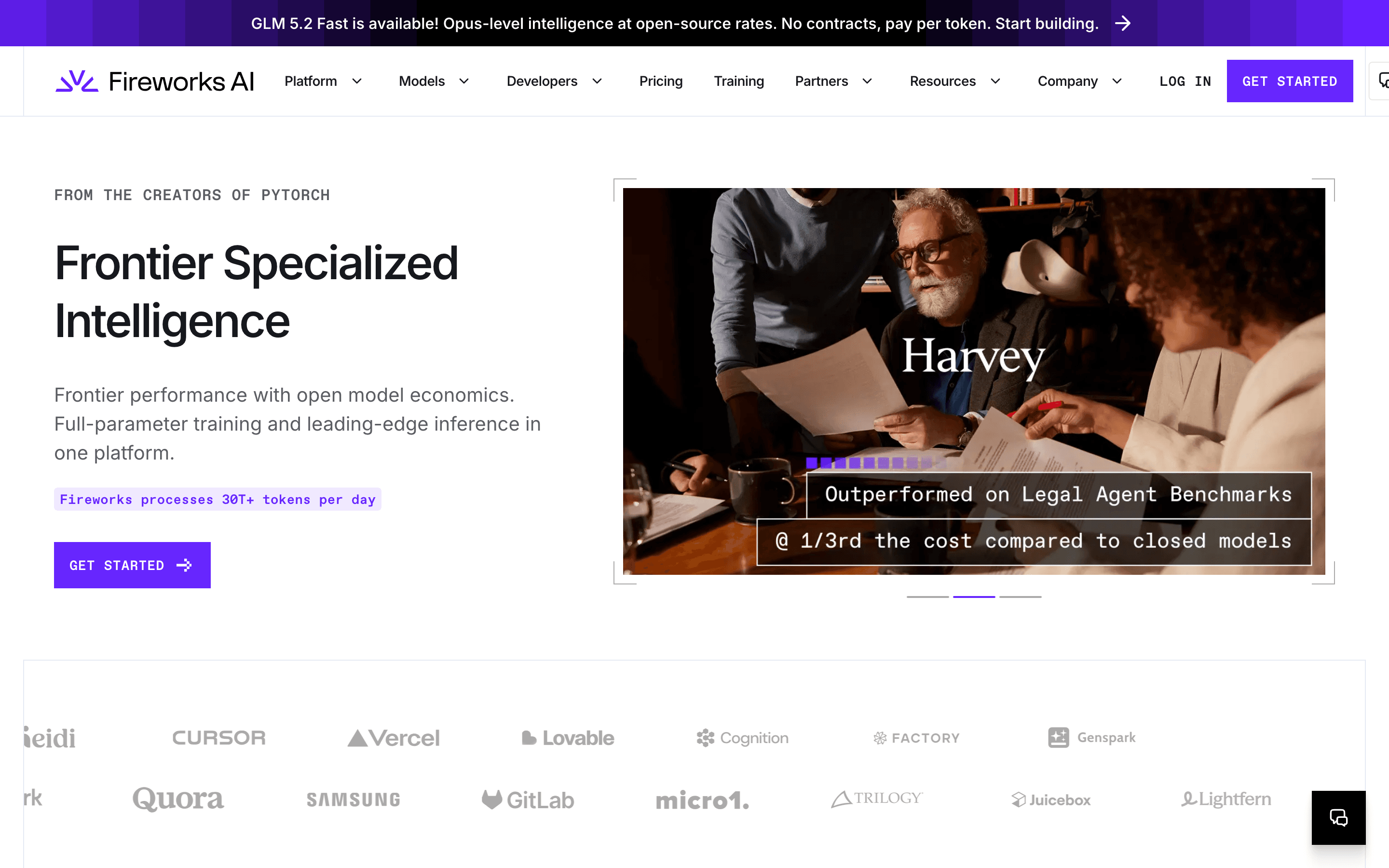
Fireworks AI screenshots
Who it's for
- ✓ Teams running open-weight models (Llama, Qwen, DeepSeek, Kimi, GLM) in production who don't want to manage GPUs themselves
- ✓ Workloads with spiky or high-volume token traffic where per-token pricing beats a fixed GPU rental
- ✓ Teams that need to fine-tune a model and then serve it from the same platform
Who should look elsewhere
- ✗ Teams that want a flat, predictable monthly bill instead of usage-based billing
- ✗ Low-volume side projects, since there's no forever-free tier, only a small starter credit
- ✗ Teams that need more than 6,000 requests per minute without going through a sales conversation
Pros
- + Published per-token rates for every model tier, not hidden behind a sales call
- + Cached input tokens and batch inference are both 50% cheaper than standard rates
- + Covers the full lifecycle: serverless inference, on-demand GPU rental, and fine-tuning on one platform
- + Named flagship models (DeepSeek, Kimi, GLM, Qwen) are kept current with frequent version updates
Cons
- – No free tier, only $1 of starter credit, so cost tracking starts almost immediately
- – Rate limits are capped at a fixed 6,000 RPM even after adding a payment method; going higher means contacting sales
- – Usage-based billing across tokens, GPU-hours, and training tokens takes real effort to monitor and forecast
- – Free-tier accounts without a payment method are capped at just 10 requests per minute
Fireworks AI pricing
What you pay for
You pay per token for inference, per GPU-hour if you rent dedicated capacity, and per training token if you fine-tune. All core rates are published, not quote-only, though enterprise volume discounts and higher rate limits require talking to sales.
You pay for what you consume rather than a per-seat fee, so cost scales with usage.
| Plan | Price | Highlights |
|---|---|---|
| Serverless (<4B params) | $0.1/mo | $0.10 per 1M tokens · Shared capacity, no dedicated GPUs |
| Serverless (4B-16B params) | $0.2/mo | $0.20 per 1M tokens |
| Serverless (16B+ dense params) | $0.9/mo | $0.90 per 1M tokens |
| Serverless MoE (up to 56B active) | $0.5/mo | $0.50 per 1M tokens |
| Serverless MoE (56.1B-176B active) | $1.2/mo | $1.20 per 1M tokens |
| On-demand GPU (H100/H200) | $7/mo | $7.00 per GPU-hour, billed per second · For custom deployments and fine-tuned models |
| On-demand GPU (B200) | $10/mo | $10.00 per GPU-hour |
| On-demand GPU (B300) | $12/mo | $12.00 per GPU-hour |
| Enterprise | Custom | Lower per-token cost at volume · Higher rate limits · Faster inference |
No flat subscription. You pay per token for serverless inference (rates vary by model size, or by named flagship model like DeepSeek V4 Pro, GLM 5.2, Kimi K2.7 Code, or Qwen 3.7 Plus, each with its own published input/cached/output rate), per GPU-hour for on-demand deployments, and per training token for fine-tuning (LoRA and full-parameter jobs are priced by parameter-count band, from $0.50 to $40 per 1M training tokens depending on method and model size). Cached input tokens are 50% off, and batch inference is 50% off standard serverless rates on both input and output. There is no forever-free plan, only $1 of starter credit. Named flagship models are priced individually rather than by the generic size tiers, and their rates don't map cleanly onto them: some run higher, some lower, depending on the token type.
Pricing verified July 7, 2026 · source
How Fireworks AI's pricing compares
Fireworks AI next to its closest alternatives on entry price, billing, and whether pricing is public.
| Tool | Starting price | Billing | Free option | Pricing disclosed |
|---|---|---|---|---|
| Fireworks AI | Usage-based | usage-based | Trial ($1 in free credits for new accounts to test serverless inference) | Partly public |
| Baseten | Custom / quote | usage-based | No | Not disclosed |
| Modal | $0.0000131/core-second | usage-based | Yes | Partly public |
| Replicate | $0.000025/second | usage-based | No | Public |
| Together AI | Usage-based | usage-based | No | Public |
| RunPod | Usage-based | usage-based | No | Public |
Is Fireworks AI still actively developed?
Last significant update: June 2026. Kimi K2.5 and Qwen 3.6 Plus were deprecated from serverless inference, with Fireworks pushing customers to migrate to the newer Kimi K2.6 and Qwen 3.7 Plus.
Top Fireworks AI alternatives
Fireworks AI FAQ
Does Fireworks AI have a free plan?+
No. New accounts get $1 in free credits to test serverless inference, but there's no ongoing free tier.
How is Fireworks AI priced?+
You pay per million tokens for serverless inference, with rates set by model size or by named model for flagship options like DeepSeek V4 Pro and GLM 5.2. On-demand GPU rentals are billed per GPU-hour, and fine-tuning is billed per training token.
What's the rate limit on Fireworks AI?+
Accounts without a payment method are capped at 10 requests per minute. Adding a payment method raises that to a fixed 6,000 RPM ceiling account-wide. Going beyond that requires contacting sales.
Can I fine-tune models on Fireworks AI?+
Yes. It supports LoRA and full-parameter supervised fine-tuning, preference fine-tuning (DPO), and reinforcement fine-tuning, all billed per training token or GPU-hour depending on the method.