Top PagerDuty Alternatives in 2026
Here for PagerDuty itself? See the full PagerDuty profile, pricing & reviews →
Suggest a change- If you want to run the whole incident lifecycle in Slack or Teams and get built-in tooling to migrate off PagerDuty, choose incident.io. it bundles incident response, on-call, and status pages in one chat-native product and ships PagerDuty migration tooling specifically for teams making this switch.
- If you want an AI scribe sitting in on every incident call and are fine paying separately for on-call, choose Rootly. its AI chat panel, scribe, and similar-incident matching cut real time off writing timelines and retros, at the cost of Incident Response and On-Call being billed as two separate $20 products.
- If you'd rather pay one vendor for uptime monitoring, logs, and on-call instead of PagerDuty plus a separate observability stack, choose Better Stack. its Responder seat bundles scheduling and escalations with the telemetry tools many teams already buy elsewhere, and every add-on price is published instead of gated behind a sales call.
- If you run deep ServiceNow ITSM sync, need enterprise admin controls, or lean on PagerDuty's 750+ integration library, choose stay on PagerDuty. none of the smaller challengers publish the same integration breadth or ITSM depth yet, even though their entry pricing looks better on paper.
PagerDuty is the default on-call platform for a lot of engineering orgs, and for good reason: mature escalation policies, 750+ integrations, and ITSM depth few challengers match yet. But per-seat cost climbs fast once you need custom incident types, more AI Actions, or higher status page limits, and reviewers regularly flag steep renewal increases.
The tools below do the same job PagerDuty does: alert the right on-call engineer, run the incident, and write up what happened after. incident.io and Rootly both compete directly with PagerDuty on incident response and on-call, usually at a lower entry price, though on-call add-on costs aren't always published either. Better Stack takes a different angle, bundling on-call into a broader observability platform. Opsgenie isn't on this list. Atlassian closed it to new customers in 2025, so it isn't something a PagerDuty buyer can actually adopt today.
PagerDuty alternatives compared
| Tool | Best for | Starting price | Free option | Last update |
|---|---|---|---|---|
| incident.ioBest overall replacement | Engineering teams already living in Slack or Teams who want incident channels, paging, and status pages in one tool | $15/seat/mo | Yes | June 2026 |
| RootlyBest for AI-assisted postmortems | Teams that already run incident response inside Slack and want less manual timeline and retro writing | $20/seat/mo | Trial (About 2 weeks) | July 2026 |
| Better StackBest for consolidating with observability | Small to mid-size engineering teams that want uptime monitoring, logs, and on-call in one tool instead of stitching together three vendors | $29/seat/mo | Yes | November 2025 |
Why teams switch from PagerDuty
Renewal prices can jump hard
One team on a multi-year contract said PagerDuty quoted a renewal price more than 5x their prior rate once their on-call API usage grew, prompting a switch to Opsgenie.
Entry-level seats cost more than budget competitors
Engineers comparing sticker prices note PagerDuty's cheapest paid seat runs meaningfully higher than cheaper on-call tools' usable tier.
Real features are split across tiers and paid add-ons
Custom fields, more incident types, and higher AI Action limits sit behind higher tiers, and Enterprise pricing isn't published at all, so the sticker price undersells what a team actually pays.
The best PagerDuty alternatives, ranked
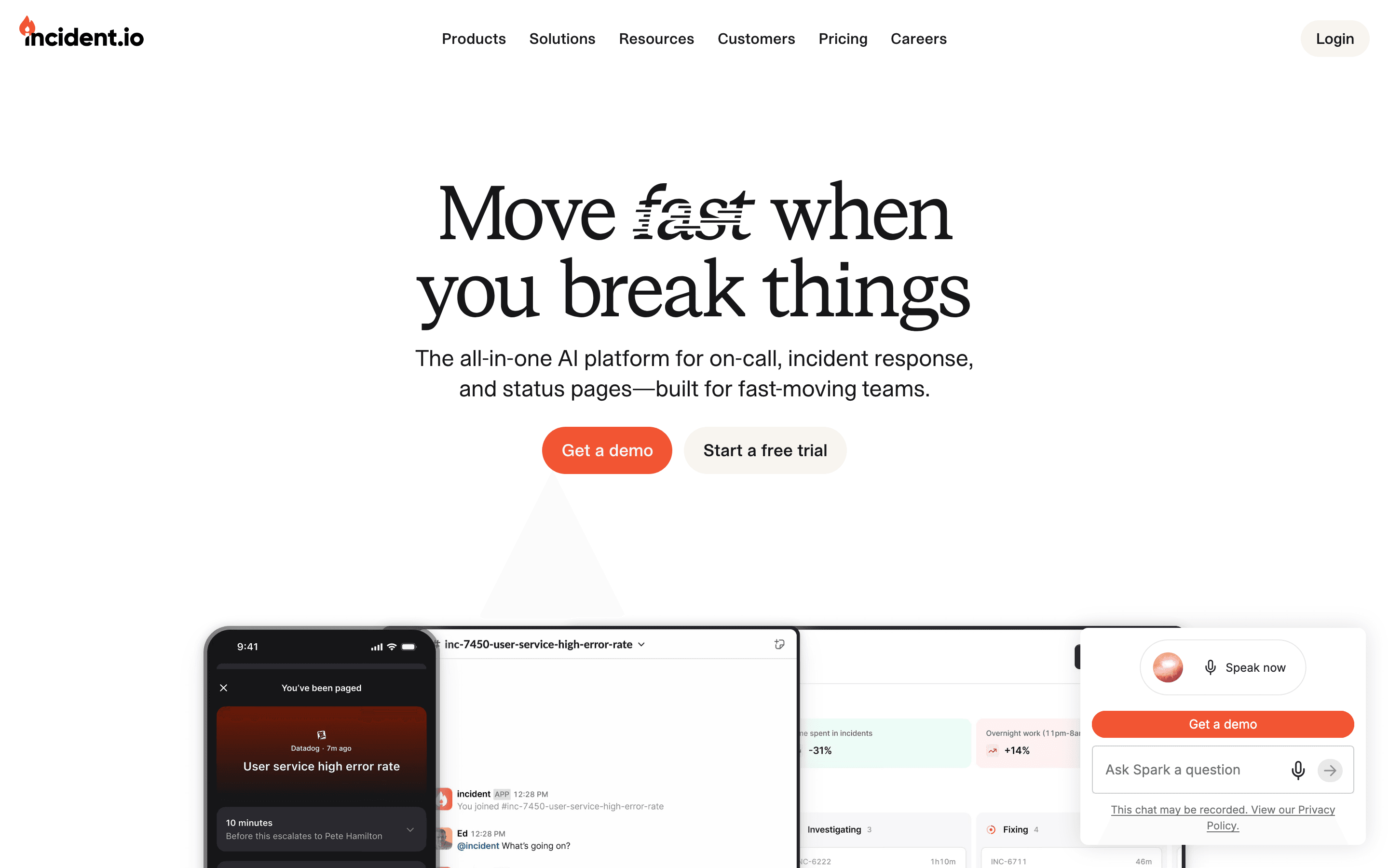
incident.io is the closest one-to-one swap for teams that live in Slack or Microsoft Teams and want to keep it that way. It runs the whole loop: declare an incident in chat, page the on-call engineer, post to a public status page, and let its AI draft the postmortem afterward. It even ships PagerDuty migration tooling, so switching over isn't a cold start. The catch is the pricing structure. The advertised $19/seat Team price covers incident response only; on-call is a separate $10 to $20 per user add-on, so a team running real rotations should budget closer to $30-45 a seat. Status pages are also capped on the lower tiers, with unlimited pages reserved for Enterprise. For a team that wants modern, fast-moving software over PagerDuty's older interface, this is the strongest match.
Pros
- + Slack and Teams integration feels native, not bolted on
- + AI-written post-mortem drafts save real time after an incident
- + Status pages, on-call, and incident response are one product instead of three separate bills
Cons
- – The advertised per-seat price doesn't include on-call, which is a separate charge on top
- – Status pages are limited on lower tiers: Team gets one public page, Pro adds one internal page, unlimited pages only on Enterprise
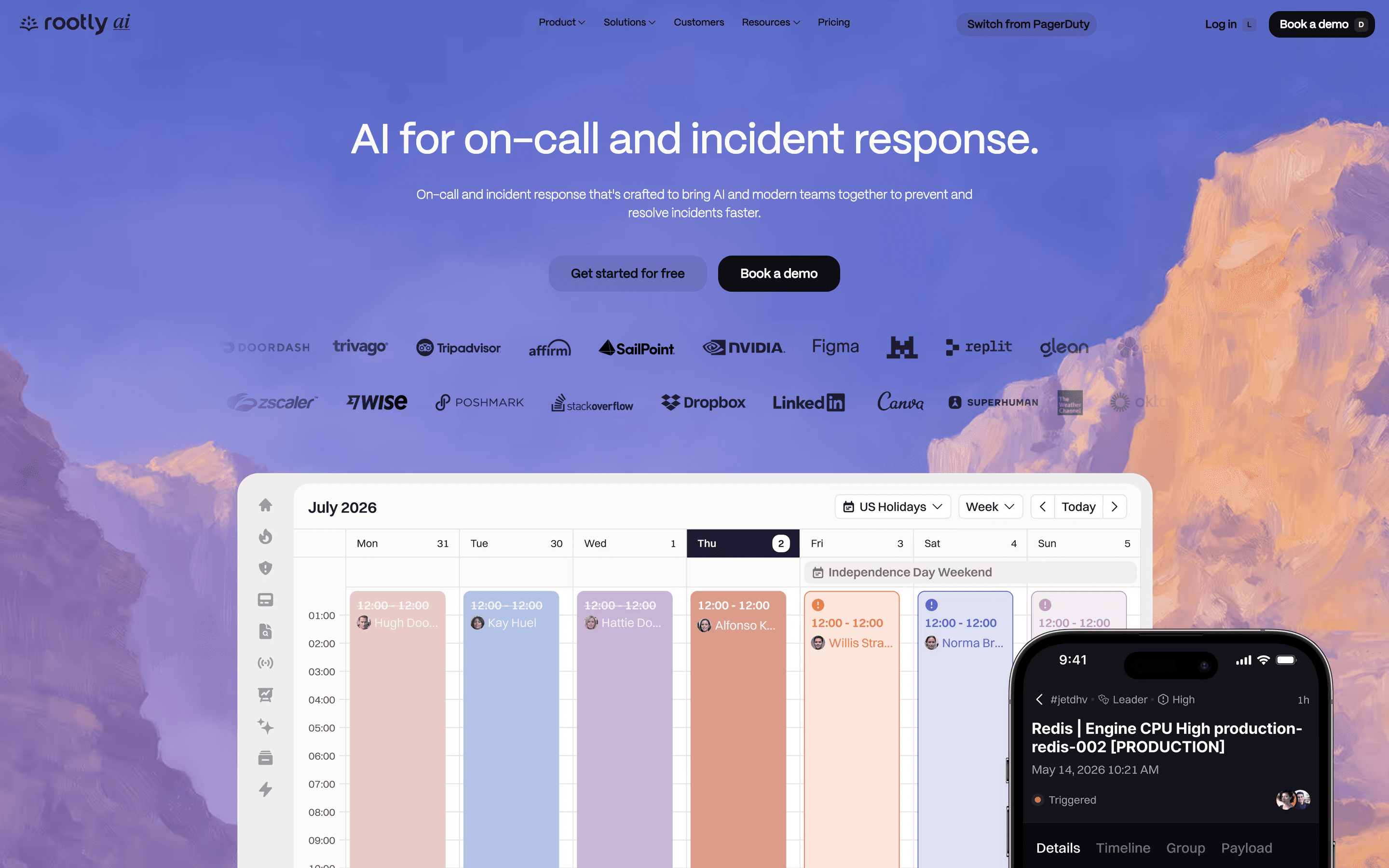
Rootly leans hardest into AI of the group. An AI scribe sits in on incident calls and writes the notes, a chat panel answers questions about an active incident, and similar-incident matching surfaces past fires with the same symptoms. It runs on Slack or Teams the way PagerDuty runs on its own dashboard, which suits teams that want to manage incidents where they already talk. The catch is structure: Incident Response and On-Call are sold as two separate $20-a-seat products, so a team that wants both pays close to $40 per seat, not $20, before any Enterprise features. There's no free tier, only a two-week trial, though a real startup discount program, including pay-what-you-can under 25 employees, softens that for smaller teams.
Pros
- + Deep Slack-native workflow so responders don't have to switch tools mid-incident
- + AI scribe and AI chat cut down on manual timeline and retro writing
- + Startup program gives real discounts, including pay-what-you-can under 25 employees
Cons
- – Incident Response and On-Call are two separate $20/seat products, so a team using both is paying close to $40/seat, not $20
- – Enterprise pricing, SCIM, and unlimited schedules are all quote-only, with no published numbers
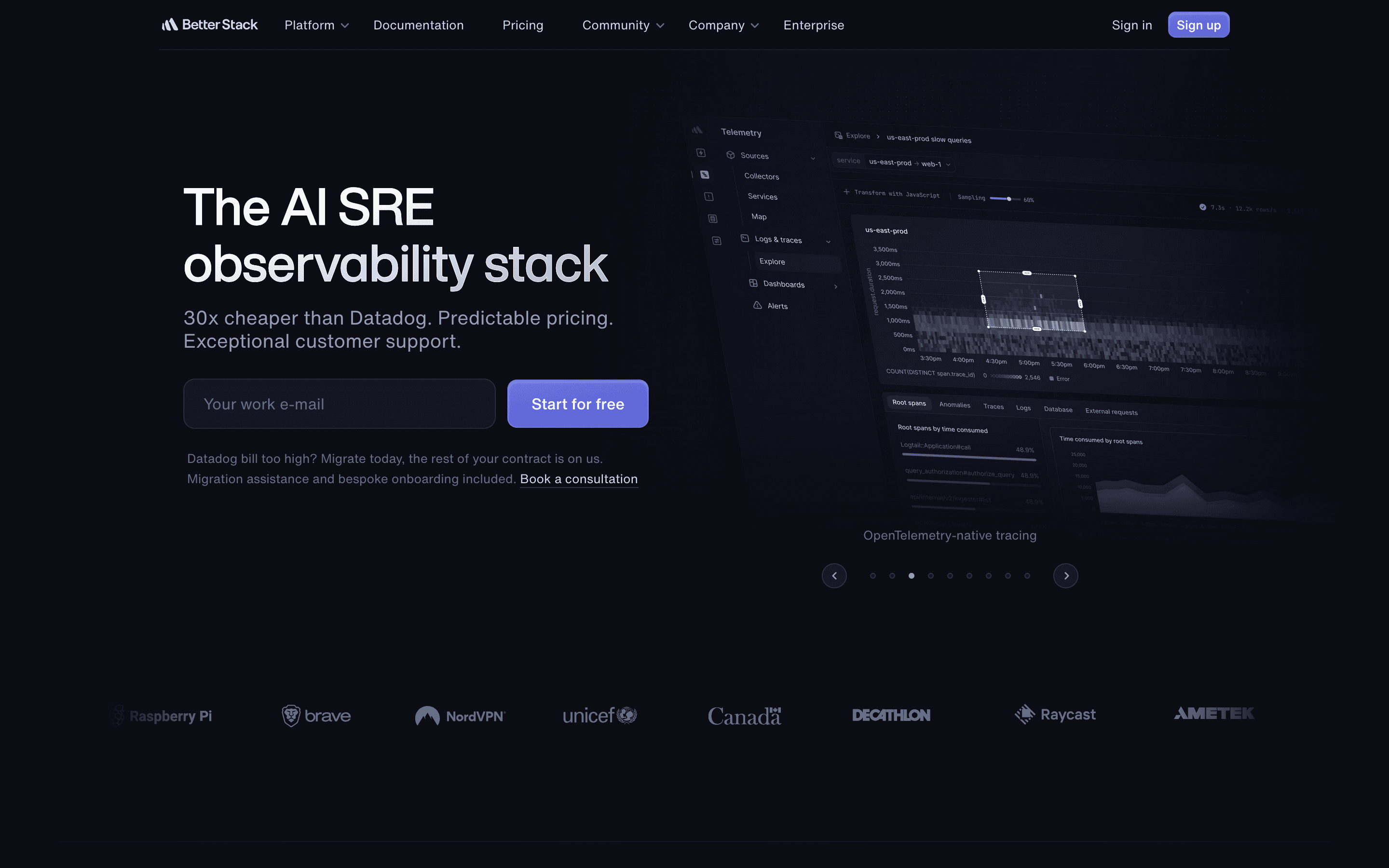
Better Stack is the pick for a team that wants on-call paging bundled with the uptime monitoring, logs, and error tracking it's probably already paying another vendor for. The Responder seat, $29-34/month, includes scheduling, escalations, and unlimited phone or SMS alerts, and every price, down to the add-ons, is published on the pricing page instead of gated behind a sales call. That transparency comes with real complexity: status pages, Slack/Teams workflows, call routing, and SSO are all separate line items, so the real bill takes work to model. It's also newer to incident management specifically than PagerDuty, so its escalation and postmortem tooling has less track record. It's a good fit for budget-conscious teams willing to consolidate tools, and a weaker fit for orgs that want one flat enterprise price with everything included.
Pros
- + Responder pricing ($29-34/seat/month) is public and itemized down to the dollar for every add-on, unlike vendors that gate on-call pricing behind a sales call
- + Free tier is genuinely usable: 10 monitors, 100k exceptions, and 5k session replays a month at $0
- + On-call, uptime checks, and telemetry live in one product, so incidents and the logs that explain them sit in the same timeline
Cons
- – Real monthly cost is hard to predict because status pages, call routing, Slack/Teams workflows, SSO, and audit logs are all separate paid add-ons
- – Phone/live support is reserved for higher-spend accounts, so smaller teams are on email and chat
Should your product be on this incident management & on-call list?
If you build a tool that belongs next to the ones above, submit it. A human reviews every submission. Approved products get their own page with pricing and screenshots, plus a place in the comparisons where they fit. It is free. You sign in with your work email so you can follow the decision, and there is no password to create.
PagerDuty alternatives: FAQ
What's the best PagerDuty alternative overall?+
incident.io is the closest match: full incident response, on-call, and status pages in one Slack or Teams-native product, plus built-in PagerDuty migration tooling.
Is there a cheaper alternative to PagerDuty?+
Yes. incident.io's advertised $19/seat undercuts PagerDuty's $41/seat Business tier on incident management, though on-call paging is billed separately on top. Rootly starts at $20/seat for incident response, with on-call sold as a second $20/seat product. Both come in under PagerDuty on the base incident-management price, so check whether the separate on-call charges still leave you ahead before switching.
Is Opsgenie a good alternative to PagerDuty?+
No, not anymore. Atlassian closed Opsgenie to new customers on June 4, 2025 and plans to shut it down entirely on April 5, 2027, so it isn't something a new PagerDuty buyer can adopt.
Which alternative has the most generous free plan?+
For actual on-call paging, PagerDuty's own free tier is the one to beat: it includes 1 on-call schedule, 1 escalation policy, and 100 phone/SMS notifications, so it can page someone for free. incident.io's free Basic plan adds one on-call schedule and one status page. Rootly has no free tier at all.
PagerDuty alternatives: pricing compared
Entry price, billing model, and whether pricing is public. 4 of 4 publish pricing you can check without talking to sales.
| Tool | Starting price | Billing | Free option | Pricing disclosed |
|---|---|---|---|---|
| PagerDuty | $21/seat/mo | per-seat | Yes | Partly public |
| incident.io | $15/seat/mo | per-seat | Yes | Partly public |
| Rootly | $20/seat/mo | per-seat | Trial (About 2 weeks) | Partly public |
| Better Stack | $29/seat/mo | per-seat | Yes | Partly public |
How we made these picks. We compare tools on public pricing, features, and hands-on assessment, then verify every price against the vendor's own page. We never accept payment for rankings. Read the full methodology. Spotted an error? Report it.