Top Procurify Alternatives in 2026
Here for Procurify itself? See the full Procurify profile, pricing & reviews →
Suggest a change- If you're already running SAP S/4HANA or ECC and need formal sourcing events plus supplier risk management, choose SAP Ariba. It runs natively on the SAP stack and connects to the Ariba Business Network, so supplier onboarding often means linking an existing account instead of building a new integration.
- If you need enterprise-grade sourcing and contract management but you're not standardized on SAP, choose Coupa. Coupa covers sourcing, contracts, procurement, invoicing, and supply chain in one platform and integrates with SAP, Oracle, NetSuite, and Workday rather than requiring SAP.
- If you want AI to handle transaction coding and expense review, plus NetSuite or Sage Intacct sync, without a lot of manual bookkeeping, choose Ramp. The Free plan already covers unlimited cards and invoice capture at no seat cost, and Plus adds AI-driven approvals and NetSuite/Sage Intacct sync for $15 per user per month.
- If you want a free tier that already covers multi-entity support (up to two entities) and travel booking, not just cards and invoice capture, choose Brex. Essentials is free at $0 per seat and covers up to two entities (one global) at no cost; full US and international multi-entity support needs the $12-per-seat Premium tier, still cheaper than Ramp's $15 Plus plan.
- If you want Procurify's all-in-one purchasing-plus-cards approach but you're based in Europe or have European entities, choose Spendesk. It puts cards, expenses, and procurement in one system with native Sage 100, Datev, and Pennylane integrations that a North America-first alternative won't match.
- If you already have a clean ERP-integrated purchasing and approval workflow that your team likes, choose stay on Procurify. Procurify's purchase request and approval flow is rated easy to use, and its native NetSuite, Sage Intacct, and Dynamics 365 integrations already do the job you'd be paying to rebuild elsewhere.
Procurify is a mid-market procure-to-pay platform for purchase requests, approvals, and vendor management, with accounts payable, contracts, and expense cards sold as separate add-ons. It doesn't publish pricing anywhere, has no free trial, and charges an undisclosed one-time implementation fee on top of whatever you're quoted for the platform itself.
The five alternatives below split into two groups. Coupa and SAP Ariba go up-market into full enterprise source-to-pay, sourcing, and supplier risk management. Ramp, Brex, and Spendesk come at spend management from the card and payments side, with purchasing and approvals built on top rather than as the core product. Ramp and Brex publish at least a starting price and both have genuinely free tiers. Spendesk, like Coupa, SAP Ariba, and Procurify, publishes no pricing at all and requires a sales quote to get any number. None of them copy Procurify's purchasing workflow exactly, so the right pick depends on whether you're outgrowing Procurify upward or want something simpler and cheaper.
Procurify alternatives compared
| Tool | Best for | Starting price | Free option | Last update |
|---|---|---|---|---|
| Coupa | Large enterprises consolidating procurement, invoicing, expenses, and supply chain planning into one platform | Custom / quote | No | May 2026 |
| SAP AribaBest for global enterprise procurement | Large enterprises, especially existing SAP ERP or S/4HANA customers, that need a full source-to-pay suite with deep supplier network reach | Custom / quote | No | March 2026 |
| RampBest for AI-driven expense automation | US-based companies that want corporate cards, expense management, and bill pay in one system instead of stitching together separate tools | $15/seat/mo | Yes | June 2026 |
| BrexBest free option | Venture-backed startups that want a card, expense management, and bill pay from one vendor | Free | Yes | — |
| SpendeskBest for European mid-market teams | European mid-market finance teams (roughly 50-250 employees) that want cards, expenses, invoices, and procurement in one platform | Custom / quote | No | June 2026 |
Why teams switch from Procurify
No published pricing anywhere
Every plan and add-on module requires a sales quote, plus a separate one-time implementation fee that Procurify also doesn't disclose.
No free trial
You can't test the product yourself. Evaluating Procurify means booking a vendor-led demo first.
Editing an already-submitted purchase request is hard
Reviewers report you often can't add or change line items on a request once it's submitted, and have to start a new one instead.
Expense categorization is limited
Reviewers say categorization gaps make spend reporting harder than expected once you add the Expense & Card module on top of the base platform.
The best Procurify alternatives, ranked
Coupa
Coupa is built for large enterprises running a full source-to-pay operation: sourcing, contracts, procurement, invoicing, expenses, and supply chain design under one vendor. Thoma Bravo took it private in 2023, and Coupa has since pushed hard into agentic AI with Coupa Compose, a no-code agent builder for procurement and finance workflows. That depth comes at a real cost. There's no pricing page at all, just a demo request, and third-party estimates put real contracts anywhere from $50,000 a year for a small deployment to $500,000 or more for a multi-module enterprise rollout. Implementations typically run several months with a systems integrator. If you're moving off Procurify because you've outgrown mid-market purchasing and need sourcing events, supplier risk, and supply chain planning at scale, Coupa is a strong fit. If you just want purchase requests and approvals, it's overkill.
Pros
- + Covers sourcing, procurement, invoicing, expenses, and supply chain in one connected platform instead of several point tools
- + Strong built-in approval workflows and spend controls suited to complex, multi-entity organizations
- + Investing heavily in agentic AI, including Coupa Compose and Navi Agent Studio, to automate sourcing, invoice matching, and risk workflows instead of adding generic chat features
Cons
- – No published pricing anywhere. Every buyer has to go through a sales cycle and RFP process to learn the cost
- – Third-party buyer estimates put annual contracts in the tens to hundreds of thousands of dollars, out of reach for small and mid-size companies
SAP Ariba is the deepest option here, built on the Ariba Business Network that SAP says connects millions of buyer and supplier accounts. That network is the real differentiator: onboarding a supplier can mean linking to an account that already exists rather than building a new integration. Pricing is per named user per year, quoted individually for each module (Sourcing, Contracts, Buying, Supplier Risk), under a 1-5 year contract with auto-renewal. SAP is rebuilding the product in 2026 as Next-Gen SAP Ariba, adding Joule AI agents and a single intake point for spend requests, but reviewers still describe the interface as complex and dated, and full rollouts commonly stretch past a year. This is the pick if you're already running SAP S/4HANA or ECC and need formal sourcing events and supplier risk management. Outside the SAP ecosystem, that integration advantage disappears and the complexity doesn't.
Pros
- + Ariba Network gives buyers access to a very large existing pool of onboarded suppliers, which can shortcut supplier setup compared with building integrations from scratch
- + Covers the full source-to-pay cycle (sourcing, contracts, procurement, invoicing, supplier risk) as one connected suite instead of separate point tools
- + Tight native integration with SAP ERP/S/4HANA for organizations already standardized on SAP
Cons
- – No published pricing. Every deployment needs a custom, negotiated quote per module, per user, and per contract term
- – Reviewers consistently describe the interface as complex, dated, and not very intuitive, with a steep learning curve for new users
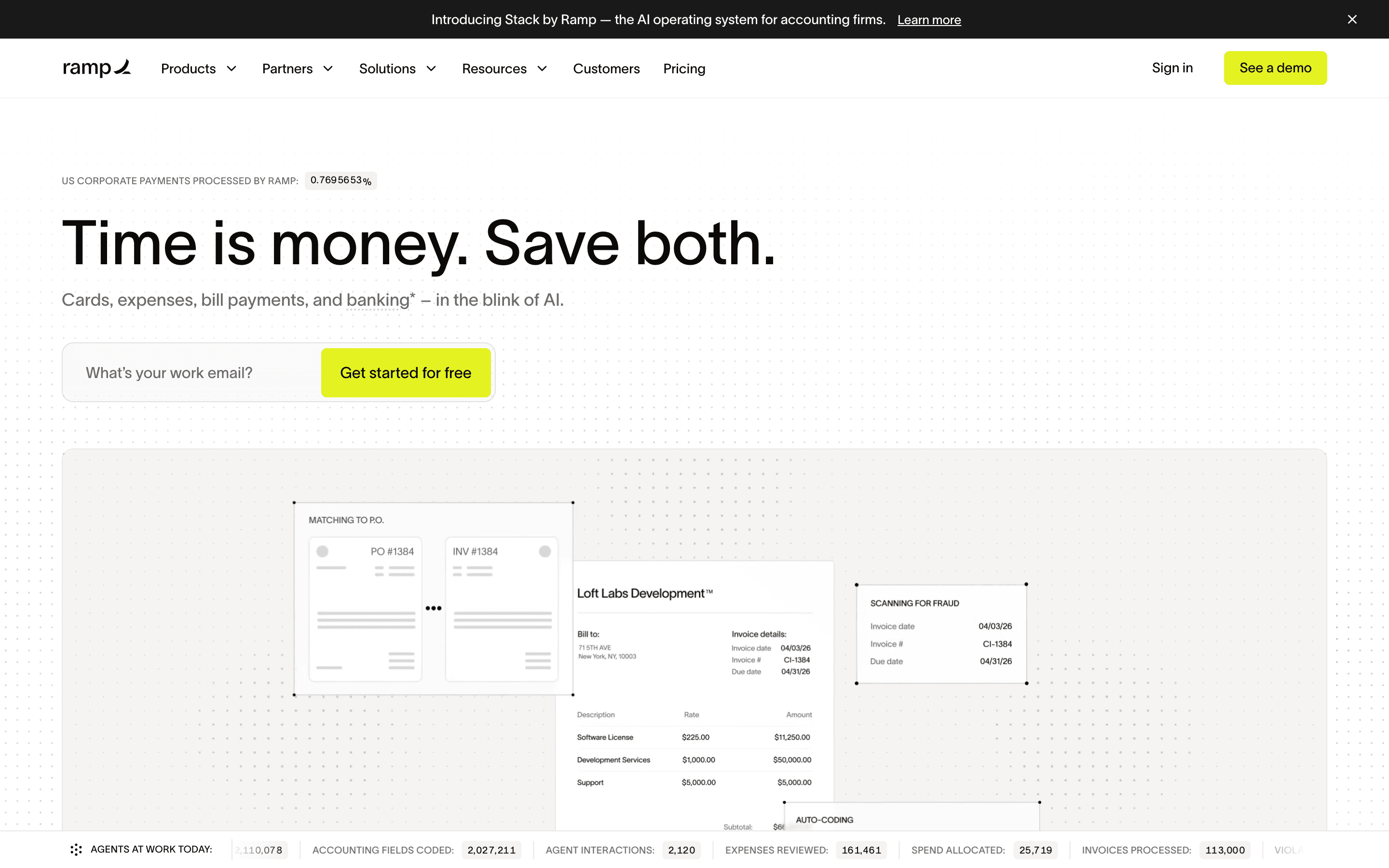
Ramp bundles corporate cards, expense management, bill pay, and basic procurement, with AI doing the transaction coding and expense review that would otherwise eat a finance team's month. The Free plan has no seat fee and includes unlimited cards, invoice capture, and accounting automation. Plus adds AI-driven approvals and NetSuite/Sage Intacct sync for $15 per user per month, plus an unpublished platform fee that scales with headcount and only shows up once you talk to sales. Enterprise pricing is fully custom. Ramp's procurement and PO tools exist but sit closer to a card-company add-on than the purpose-built purchasing workflows Procurify runs. It's a good swap if what you actually want is fewer point tools around spend and faster books, not a dedicated procure-to-pay system.
Pros
- + The Free plan includes unlimited cards and basic accounting automation with no seat fee
- + AI auto-coding and expense review cut down manual bookkeeping compared with older expense tools
- + Bill pay, procurement, and travel are native, not bolted-on integrations
Cons
- – The Plus plan's platform fee isn't published, so the real cost per company only shows up during a sales conversation
- – Enterprise pricing is fully custom and annual-only, so there's no self-serve path for larger organizations
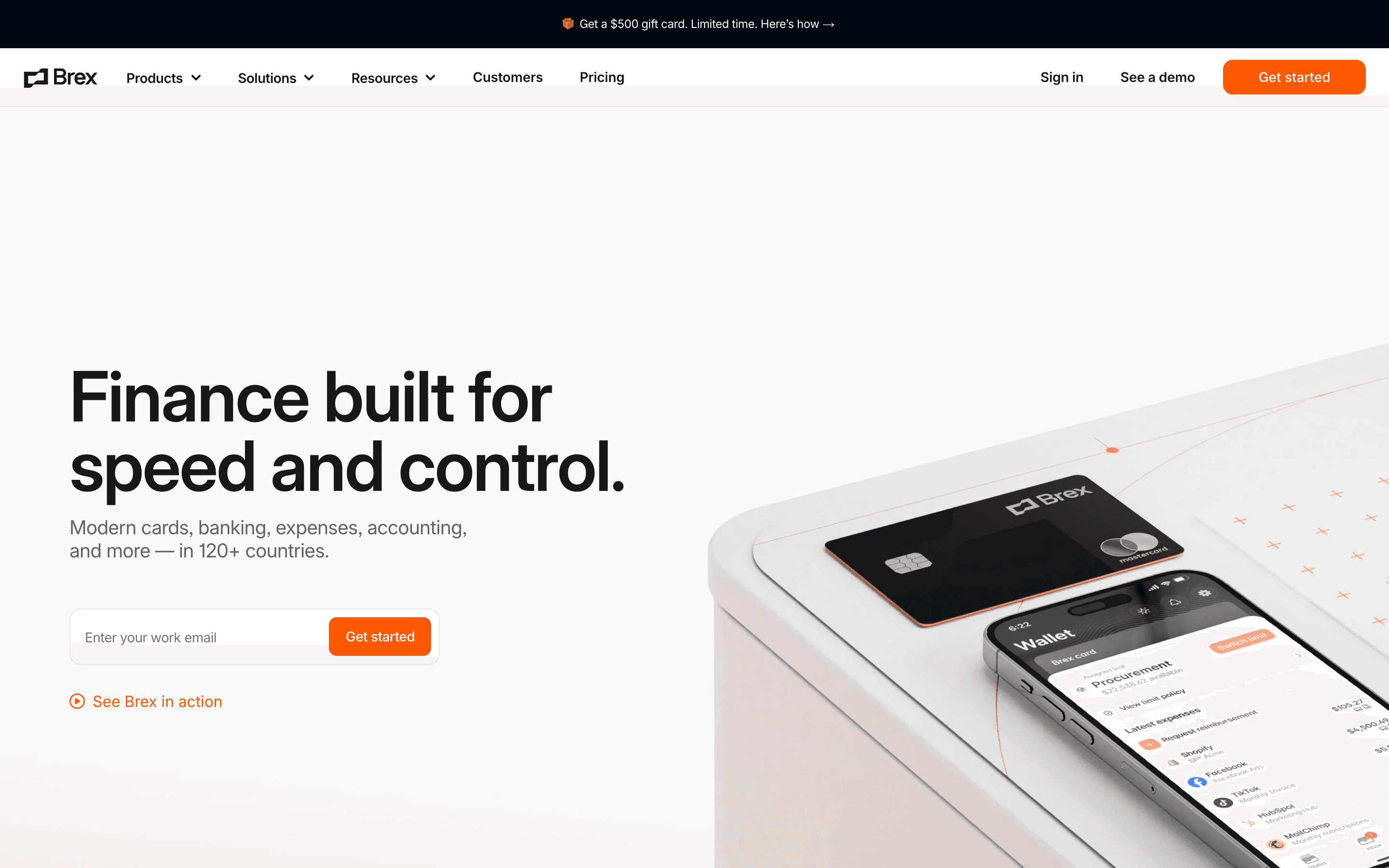
Brex covers the same ground as Ramp: cards, expenses, bill pay, travel, but undercuts it on price. Essentials is free at $0 per seat and already includes travel booking and support for up to two entities (one global); full US and international multi-entity support requires the $12-per-seat Premium tier, still cheaper than Ramp's $15. Capital One completed its acquisition of Brex in April 2026, so it's now a bank-owned product rather than an independent fintech, which matters if that's a concern for you. Underwriting is based on company cash rather than personal credit, which favors well-funded startups over cash-light ones. Brex's procurement tools, the Smart Card plan, are quote-only and thinner than a real procure-to-pay system like Procurify's. Pick Brex if you want the cheapest path to cards and expense automation, with basic multi-entity support free and full multi-entity support a cheap upgrade away. Skip it if procurement workflow depth matters more than card pricing.
Pros
- + Free Essentials plan includes unlimited global corporate cards, accounting integrations, travel booking, and bill pay at $0/user/month
- + Premium tier at $12/user/month adds customizable expense policies, multi-entity support, and live budgets
- + AI-native Accounting API pushes rule enforcement to the point of transaction instead of month-end reconciliation
Cons
- – Enterprise and Smart Card (procurement) plans are quote-only, so total cost for larger deployments isn't transparent
- – Now owned by Capital One as of April 2026, so it's a bank-owned product, not an independent fintech
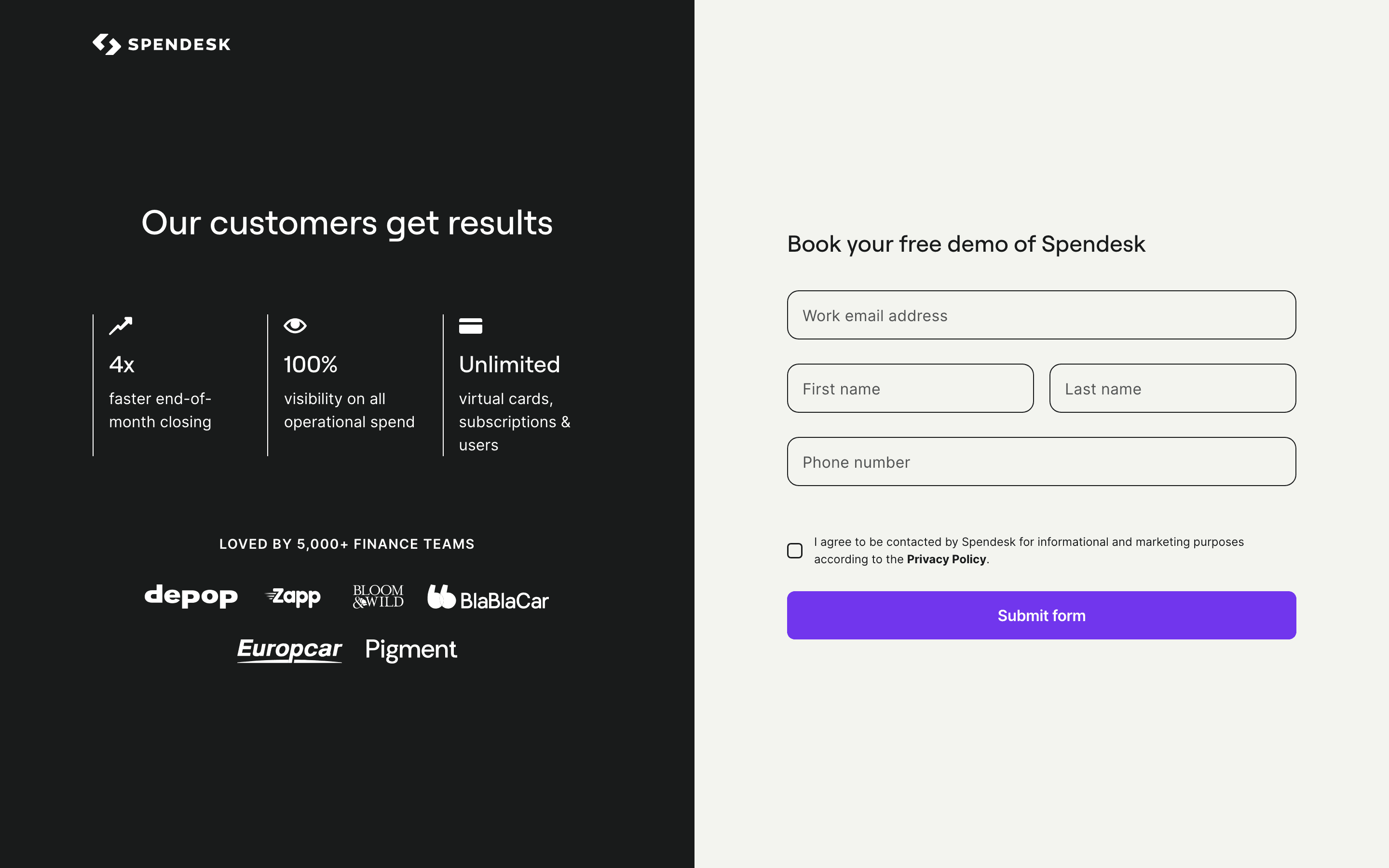
Spendesk is the closest match to Procurify's all-in-one pitch, just built for European mid-market finance teams instead of North American ones, and it's just as opaque on price. It puts cards and expense claims in one system with unlimited users on a fixed monthly platform fee, plus transaction-based charges on card purchases, invoice payments, and expense claims. Procurement (Procure to Pay), accounts payable, multi-entity management, and advanced workflows are separately priced add-ons on top of that base fee, similar to how Procurify sells AP and Expense & Card as add-ons to its base platform. There's no published price, no free tier, and no trial, so you'll go through a sales quote either way, the same as Coupa, SAP Ariba, and Procurify itself. Some users report slow support and a drawn-out offboarding process. If your company is based in Europe or has European entities, Spendesk's native Sage 100, Datev, and Pennylane integrations make it a more natural fit than a North America-first alternative.
Pros
- + Combines cards, expense claims, invoice payments, and procurement approvals in one interface, so you are not reconciling separate tools
- + The base subscription includes unlimited users and cards, so adding headcount does not add per-seat card fees
- + Mobile receipt capture and AI-assisted field pre-fill (cost centers, categories) cut manual data entry on expense claims and invoices
Cons
- – No public pricing. Every prospect has to go through a sales quote, so it is hard to compare cost against competitors upfront
- – Multiple reviewers report slow, unresponsive customer support and drawn-out offboarding when closing an account
Should your product be on this spend & procurement list?
If you build a tool that belongs next to the ones above, submit it. A human reviews every submission. Approved products get their own page with pricing and screenshots, plus a place in the comparisons where they fit. It is free. You sign in with your work email so you can follow the decision, and there is no password to create.
Procurify alternatives: FAQ
What's the biggest difference between Procurify and Coupa or SAP Ariba?+
Coupa and SAP Ariba are built for large enterprises and go much deeper into sourcing events, contract lifecycle management, and supplier risk. Procurify targets mid-market purchasing and doesn't go that deep, but it's also far simpler to deploy and doesn't require a multi-month, multi-module enterprise contract.
Is there a free alternative to Procurify?+
Yes. Ramp and Brex both have genuinely free tiers at $0 per seat covering corporate cards, expense management, and bill pay. Neither replaces a full procure-to-pay purchasing workflow the way Procurify does, so they fit better if cards and expenses are your main need.
Which Procurify alternative is easiest to get pricing for?+
Ramp and Brex both publish an entry-level price: $15 per seat and $12 per seat. Coupa, SAP Ariba, Spendesk, and Procurify itself require a sales quote for every plan.
Which alternative fits a company already using NetSuite or Sage Intacct?+
Procurify, Ramp, and Brex all integrate natively with NetSuite and Sage Intacct, so switching doesn't necessarily mean rebuilding your ERP connection from scratch. Spendesk integrates with NetSuite too, but its Sage integration is Sage 100, not Sage Intacct.
Procurify alternatives: pricing compared
Entry price, billing model, and whether pricing is public. 2 of 6 publish pricing you can check without talking to sales.
| Tool | Starting price | Billing | Free option | Pricing disclosed |
|---|---|---|---|---|
| Procurify | Custom / quote | quote-only | No | Not disclosed |
| Coupa | Custom / quote | quote-only | No | Not disclosed |
| SAP Ariba | Custom / quote | quote-only | No | Not disclosed |
| Ramp | $15/seat/mo | per-seat | Yes | Partly public |
| Brex | Free | per-seat | Yes | Partly public |
| Spendesk | Custom / quote | quote-only | No | Not disclosed |
How we made these picks. We compare tools on public pricing, features, and hands-on assessment, then verify every price against the vendor's own page. We never accept payment for rankings. Read the full methodology. Spotted an error? Report it.