Top RunPod Alternatives in 2026
Here for RunPod itself? See the full RunPod profile, pricing & reviews →
Suggest a change- If you want a Python-native serverless workflow instead of managing Docker images or SSH-ing into a box, choose Modal. Modal's decorator-based deploys bill CPU, GPU, and memory per second like RunPod does, but skip building and pushing a Docker image and SSH-ing in to manage the box yourself. You still choose a GPU type, Modal just provisions and scales it for you.
- If you want a GPU cloud with the same dedicated-rental-plus-cluster structure as RunPod but published reserved-rate discounts on its clusters, choose Together AI. Together's on-demand H100 clusters run $3.99/hr and drop to $3.29/hr on a 91-180 day commitment, a published discount RunPod doesn't offer since several of its own cluster GPUs are quote-only. Dedicated single-tenant endpoint reserved pricing is quote-only on both platforms.
- If you're deploying a custom or fine-tuned model and want a hosted catalog of popular open models too, not just a place to run your own container, choose Baseten. Baseten bills dedicated deployments per minute of active compute with nothing charged while scaled to zero, which matches what RunPod Serverless flex workers already do. The difference is Baseten also runs a separate catalog of hosted Model APIs billed per token for open models like GPT OSS 120B and DeepSeek V4, so you're not stuck deploying everything yourself.
- If your real job is serving open-weight LLMs at high token volume rather than renting raw GPUs, choose Fireworks AI. Fireworks prices serverless inference per token with 50% off cached input and batch requests, which fits production token traffic better than paying for a general-purpose GPU rental by the hour.
- If you rely on RunPod's GPU catalog breadth (budget RTX cards through B300) and its zero data-transfer fees, choose stay on RunPod. none of the alternatives match RunPod's combination of a wide, cheap hardware catalog and per-second billing with no ingress or egress charges.
RunPod is a pay-by-the-second GPU cloud: Pods for dedicated instances, Serverless for autoscaling inference endpoints, and Instant Clusters for multi-node training. It's a common first stop for teams that want raw GPU access without committing to AWS or GCP reserved capacity.
Teams leave RunPod for a few real reasons. Some want less infrastructure to manage and move to a platform that handles deployment and scaling for them. Others get burned by billing details RunPod doesn't surface up front, like stopped Pods still billing for storage at double the running rate, or spot pricing that has changed with little warning. The alternatives below do the same job, GPU compute for training and inference, at different points on the build-it-yourself-to-fully-managed spectrum.
RunPod alternatives compared
| Tool | Best for | Starting price | Free option | Last update |
|---|---|---|---|---|
| ModalBest for serverless Python workflows | Teams running bursty or batch GPU workloads (fine-tuning, batch inference, data pipelines) who don't want to manage idle capacity | $0.0000131/core-second | Yes | June 2026 |
| Together AIBest match for RunPod's own structure | Teams already committed to open-weight models (Llama, DeepSeek, Qwen, GLM, Kimi) who want one API instead of standing up their own serving stack | Usage-based | No | July 2026 |
| BasetenBest for managed custom model deployment | Teams deploying custom or fine-tuned models that need dedicated GPU capacity with autoscaling | Custom / quote | No | July 2026 |
| Fireworks AIBest for high-volume token inference | Teams running open-weight models (Llama, Qwen, DeepSeek, Kimi, GLM) in production who don't want to manage GPUs themselves | Usage-based | Trial ($1 in free credits for new accounts to test serverless inference) | June 2026 |
| Replicate | Teams that want to call a huge catalog of open and third-party models through one API without standing up their own GPU fleet | $0.000025/second | No | April 2026 |
Why teams switch from RunPod
RunPod's spot and Community Cloud pricing has changed with little warning
Users report RunPod raising Community Cloud spot prices roughly 25%, briefly removing spot pricing, then reintroducing it gated behind API access instead of the web UI.
Stopping a Pod doesn't stop the meter
Stopped volume storage bills at $0.20/GB/month, double the $0.10/GB/month running rate, which surprises teams that expect a stopped instance to stop costing money.
Raising your spend cap requires a support ticket
New accounts default to an $80/hour spend cap across all resources, and the only way past it is a request to RunPod support rather than a self-serve setting.
The best RunPod alternatives, ranked
Modal is the closest match to RunPod's per-second billing model, but built around writing Python functions instead of managing Docker images or SSH-ing into a box. You decorate a function, Modal builds the container, and it runs on CPU or GPU with billing down to the second, including memory and storage. The free Starter plan includes $30 a month in compute credits and up to 10 concurrent GPUs, which beats RunPod's lack of any free tier. The catch is the Team plan's $250 a month platform fee sits on top of usage once you outgrow Starter, and per-second GPU rates run higher than renting the same card directly. For teams that want serverless Python instead of infrastructure to babysit, Modal is the strongest swap.
Pros
- + Per-second billing across CPU, GPU, and memory with no charge for idle time
- + Fast cold starts and container reuse, which matters for bursty inference and agent workloads
- + Straightforward Python decorator API instead of managing Docker/Kubernetes directly
Cons
- – Team plan adds a $250/month platform fee on top of compute usage, which is a real jump from the free Starter tier
- – GPU per-second rates are higher than renting the same GPU directly from a bare-metal cloud
Together AI mirrors RunPod's own structure more closely than any other alternative: dedicated single-tenant GPU endpoints, rentable GPU clusters, and serverless inference, all under one account. Cluster pricing is where it separates itself. On-demand H100 clusters run $3.99/hr but drop to $3.29/hr with a 91-180 day commitment, a published reserved-rate discount RunPod's Instant Clusters pricing doesn't offer, since several of RunPod's own cluster GPUs are quote-only. That transparency stops at the cluster line, though: on Together's dedicated single-tenant endpoints, H200 pricing and any reserved rate are quote-only, the same as RunPod. Serverless inference covers 200+ open models billed per million tokens, and fine-tuning runs on the same platform as serving. The catch is there's no free trial. The docs require a minimum $5 credit purchase before the API answers any call, and serverless rate limits are dynamic and unpublished rather than a fixed number you can plan against.
Pros
- + Every price is on the public pricing page, model by model, with no tiers or sales calls required
- + Covers serverless inference, dedicated GPUs, fine-tuning, and image/video/audio generation under one account and one bill
- + Reserved GPU cluster pricing drops noticeably below on-demand (H100 cluster on-demand $3.99/hr vs. reserved down to $3.29/hr for 91-180 days)
Cons
- – No free trial. The docs require a minimum $5 credit purchase before the API will respond to any call
- – Serverless rate limits are dynamic and unpublished; the docs tell you to read response headers instead of a fixed number, which makes capacity planning harder
Baseten fits teams deploying a custom or fine-tuned model that also want a hosted catalog of popular open models on the same platform. Dedicated deployments bill per minute of active compute only, from $0.01052/min on a T4 up to $0.16633/min on a B200, with nothing charged while scaled to zero, the same zero-idle-cost promise RunPod's own Serverless flex workers already make. Where Baseten pulls ahead is the separate catalog of hosted Model APIs billed per token for open models like GPT OSS 120B and DeepSeek V4, so you're not stuck deploying everything yourself. Recent releases, a CLI, an MCP server, and event overlays on metrics, show active investment in the deploy-and-operate workflow. The tradeoff is that Pro and Enterprise pricing is quote-only, and traffic spikes translate directly into cost spikes since autoscaling adds instances automatically.
Pros
- + No idle-time billing on dedicated deployments, only pay for active compute minutes
- + Per-minute GPU rates and per-token Model API rates are published on the site, not hidden behind a demo request
- + Recent releases (CLI, MCP server, event overlays on metrics) show active platform investment
Cons
- – Traffic spikes translate directly into cost spikes since autoscaling adds GPU instances automatically, making budgets hard to forecast for bursty workloads
- – Pro and Enterprise pricing is quote-only with no published starting price
Fireworks AI is the pick when the real job is serving open-weight models at high token volume, not renting raw GPUs to run your own code. Serverless inference is billed per million tokens by model size or by named flagship model, such as DeepSeek V4 Pro, GLM 5.2, or Kimi K2.7 Code, with cached input and batch inference both 50% off standard rates. It also rents on-demand GPUs, H100 through B300, for custom deployments and runs fine-tuning on the same platform. The rough edge is a fixed 6,000 RPM ceiling on every paid account no matter your usage, so teams that outgrow it have to talk to sales. There's also no free tier, just $1 of starter credit to test with.
Pros
- + Published per-token rates for every model tier, not hidden behind a sales call
- + Cached input tokens and batch inference are both 50% cheaper than standard rates
- + Covers the full lifecycle: serverless inference, on-demand GPU rental, and fine-tuning on one platform
Cons
- – No free tier, only $1 of starter credit, so cost tracking starts almost immediately
- – Rate limits are capped at a fixed 6,000 RPM even after adding a payment method; going higher means contacting sales
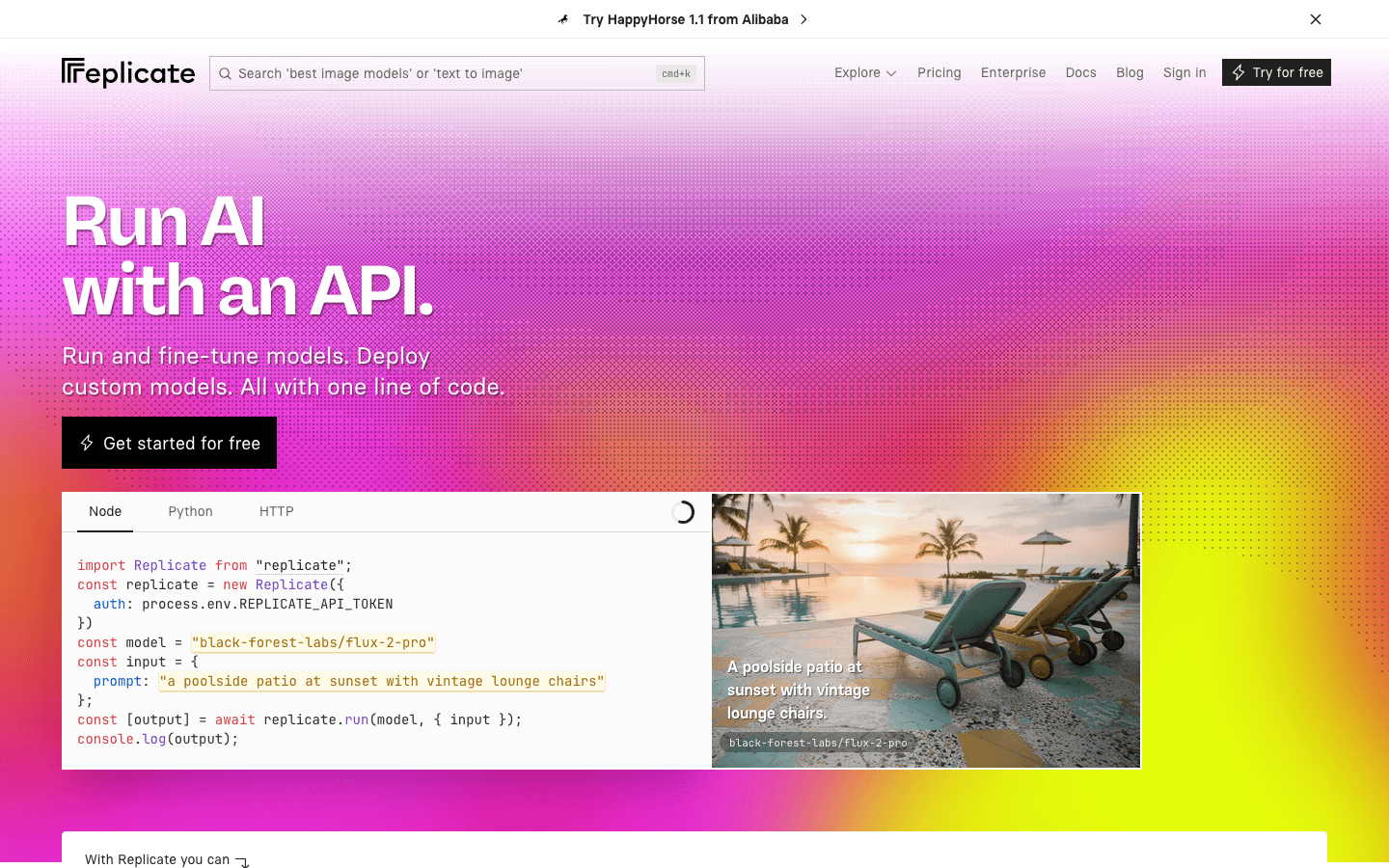
Replicate is the fastest path from an existing open-source model to a working API, without spinning up a RunPod Pod and managing it yourself. Its catalog runs to thousands of community models you call with one request, and Cog packaging lets you push your own model and get an endpoint back. Billing is per second of compute for most models, or per token or per output unit for newer ones like Claude or Flux 1.1 Pro. Two things pull it down the list: sustained GPU workloads cost more here than on Modal or RunPod, an H100 lists at $5.49/hr, and Cloudflare's pending acquisition, announced November 2025, adds uncertainty about where pricing and the product head next.
Pros
- + Pricing is transparent and published down to the per-second hardware rate, with no plan tiers or seats to negotiate
- + Huge, actively growing catalog of public models you can call with no setup
- + Cog packaging makes it straightforward to move a model from a repo into a hosted API
Cons
- – Per-second GPU rates run noticeably higher than some competitors for sustained workloads; an H100 on Replicate lists at $5.49/hr versus $3.95/hr on Modal and $3.99/hr list price ($1.89/hr at the low end) on Fal.ai for comparable hardware
- – Private deployments bill for the full instance lifecycle, so cold starts and idle warm instances add real cost beyond actual inference time
Should your product be on this ai inference & gpu infrastructure list?
If you build a tool that belongs next to the ones above, submit it. A human reviews every submission. Approved products get their own page with pricing and screenshots, plus a place in the comparisons where they fit. It is free. You sign in with your work email so you can follow the decision, and there is no password to create.
RunPod alternatives: FAQ
What's the best RunPod alternative for serverless GPU compute?+
Modal is the closest match. It bills CPU, GPU, and memory per second like RunPod, but you deploy a decorated Python function instead of managing containers or SSH-ing into a Pod.
Is there a RunPod alternative that doesn't bill for idle time?+
Baseten's dedicated deployments bill per minute of active compute only, with nothing charged while a deployment is idle or scaled to zero. RunPod's own Serverless flex workers already do this too; Baseten's edge is a hosted Model APIs catalog for open models on top of the same zero-idle billing.
Which RunPod alternative is cheapest for sustained GPU workloads?+
Together AI publishes reserved-rate discounts on its GPU clusters. An on-demand H100 cluster runs $3.99/hr and drops to $3.29/hr with a 91-180 day commitment, a discount structure RunPod doesn't publish for Instant Clusters.
Do any RunPod alternatives have a free tier?+
Modal's Starter plan is free and includes $30 a month in compute credits and up to 10 concurrent GPUs. RunPod, Baseten, Replicate, and Fireworks AI have no forever-free tier, only starter or referral credits. Together AI offers no credit at all: it requires a minimum $5 purchase before its API will respond to any call.
RunPod alternatives: pricing compared
Entry price, billing model, and whether pricing is public. 5 of 6 publish pricing you can check without talking to sales.
| Tool | Starting price | Billing | Free option | Pricing disclosed |
|---|---|---|---|---|
| RunPod | Usage-based | usage-based | No | Public |
| Modal | $0.0000131/core-second | usage-based | Yes | Partly public |
| Together AI | Usage-based | usage-based | No | Public |
| Baseten | Custom / quote | usage-based | No | Not disclosed |
| Fireworks AI | Usage-based | usage-based | Trial ($1 in free credits for new accounts to test serverless inference) | Partly public |
| Replicate | $0.000025/second | usage-based | No | Public |
How we made these picks. We compare tools on public pricing, features, and hands-on assessment, then verify every price against the vendor's own page. We never accept payment for rankings. Read the full methodology. Spotted an error? Report it.