Top Squarespace Alternatives in 2026
Here for Squarespace itself? See the full Squarespace profile, pricing & reviews →
Suggest a change- If you want to test the whole site for free, then add ecommerce on the same platform later without switching tools, choose Wix. Wix's free plan lets you build and preview a full site before paying, though it carries Wix branding and ads and gives you a Wix subdomain, not a custom domain, so what you're testing is the layout, not the final look. When you're ready to sell, ecommerce is bundled into the Core plan at $29 a month rather than a bolt-on plugin.
- If you keep hitting Squarespace's template limits and need real design control with a proper CMS, choose Webflow. Webflow's canvas outputs real CSS instead of a proprietary rendering layer, and its CMS collections handle blogs and directories that Squarespace's content blocks can't.
- If you want a Figma-like design canvas and AI help getting a marketing site live fast, choose Framer. Framer's free plan and $10-a-month Basic tier undercut Squarespace's $19 floor, and its AI page generator gets a usable first draft up quickly.
- If you want the largest plugin and theme ecosystem at a lower starting price, choose WordPress.com. every paid WordPress.com tier, not just the top one, unlocks all 60,000-plus plugins, and its entry plan costs less than half of Squarespace's.
- If all you actually need is one page, like a landing page or a link-in-bio, choose Carrd. Carrd's $9-a-year Pro Lite plan covers that single job, but it has no custom domain. Matching Squarespace's included domain takes Carrd's $19-a-year Pro Standard tier, still far cheaper than Squarespace's $19-a-month plan built for a multi-page site.
- If you run a real multi-page store and want ecommerce and hosting bundled into one predictable bill, choose stay on Squarespace. none of these alternatives match that same all-in-one package at a similar price without adding complexity, per-seat costs, or extra transaction fees. Support is chat and email only, and reviewers rate it poorly, but it's still there around the clock if you need it.
Squarespace is still one of the easiest ways to get a professional-looking site live this week, no developer required. But its 14-day-only trial with no free plan, fees on the Basic tier, and a 1.2-star Trustpilot rating for support have real teams looking elsewhere once they hit a wall on design, cost, or content needs.
This guide ranks the tools that compete for Squarespace's job: a founder or marketer who needs a working site live, not a coding project. Wix is the closest all-in-one match. Webflow and Framer trade some of Squarespace's simplicity for more design control. WordPress.com and Carrd sit at the cheaper, more DIY end. Pick based on what you need to launch, not the name you've heard of.
Squarespace alternatives compared
| Tool | Best for | Starting price | Free option | Last update |
|---|---|---|---|---|
| Wix | Founders and small teams who need a working site or store live this week without hiring a developer | $17/mo | Yes | June 2026 |
| WebflowBest for full design control | Marketers and designers who want pixel-level control without writing code | $15/site/mo | Yes | July 2026 |
| FramerBest free plan to test before committing | Founders and designers who want a marketing site that looks custom-built, not templated, and can be live in days | $10/site/mo | Yes | July 2026 |
| WordPress.comBest plugin ecosystem | Founders and marketers who want a working site live today without touching code or a server | $9/mo | Yes | July 2026 |
| CarrdBest value for a single page | Founders who need a landing page or waitlist live within a day, without hiring a developer | $9/yr | Yes | June 2026 |
Why teams switch from Squarespace
Squarespace's support quality frustrates users
Trustpilot shows a 1.2-out-of-5 rating for Squarespace, with recurring complaints about slow or unhelpful responses on account and access issues.
Prices keep climbing, including a June 2026 restructure
Squarespace raised Basic, Core, and Plus prices again in 2026, and reviewers note costs escalate quickly once you need features beyond the entry-level plan.
There is no free plan to fall back on
Squarespace offers only a 14-day trial with no genuinely free tier, and the cheapest Basic plan still carries a 2% commerce fee and a 7% fee on digital products.
The best Squarespace alternatives, ranked
Wix

Wix is the closest match to Squarespace in how it actually works: pick a template or let its AI draft one from a prompt, then edit everything visually with no code. Its free plan is a real edge over Squarespace, which only offers a 14-day trial with no free tier, letting you build and preview a full site before paying. But that free plan puts Wix branding and ads on the site and gives you a Wix subdomain instead of a custom domain, so it's good for testing layout and content, not for seeing what the site will look like once it's live. Ecommerce, bookings, and a blog all live in the same editor, so a small store or service business runs everything from one login. The catch is that Wix Payments charges 2.9% plus $0.30 per transaction on every ecommerce-capable plan, the same rate on Core and on Business Elite, and Wix sites cannot be exported if you ever want to leave. For a founder who wants Squarespace's ease at a similar price with a free way to test first, Wix is the safer first stop.
Pros
- + Free plan lets you build and preview a full site before paying anything
- + Ecommerce, bookings, blog, and marketing tools all live in the same editor, so you don't stitch together separate apps
- + AI site generator gets a usable draft up in minutes from a text prompt
Cons
- – You cannot export or migrate a Wix site to another host, so switching later means rebuilding from scratch
- – Wix Payments charges 2.9% + $0.30 per transaction (3.7% + $0.30 for Amex) on Core, Business, and Business Elite alike, on top of the subscription price
Webflow trades some of Squarespace's simplicity for real design control. Instead of being boxed into a template, you build on a canvas that mirrors actual CSS, and CMS collections handle blogs or directories properly instead of stitching together repeating content blocks. That makes it the pick for teams that keep hitting Squarespace's layout ceiling or need a content model Squarespace cannot support. The tradeoff is a genuine learning curve: this is not a same-day builder for someone who has never worked with layout tools. Pricing is also less predictable than Squarespace's flat tiers. Basic at $15 a month has no CMS at all, Premium at $25 a month is capped at 50 GB of bandwidth with overages billed separately, and Webflow's May 2026 repricing pushed some customers' bills up sharply, especially anyone paying monthly. Choose Webflow only if the design and CMS upgrade is worth a more complex bill.
Pros
- + Design control close to hand-written CSS, no proprietary rendering quirks
- + A real CMS with collections, not just editable blocks
- + Clean code export if you ever need to hand the site to developers
Cons
- – Steep learning curve compared to drag-and-drop builders like Squarespace or Wix
- – May 2026 pricing overhaul raised costs for many existing customers, especially monthly billers and high-bandwidth sites
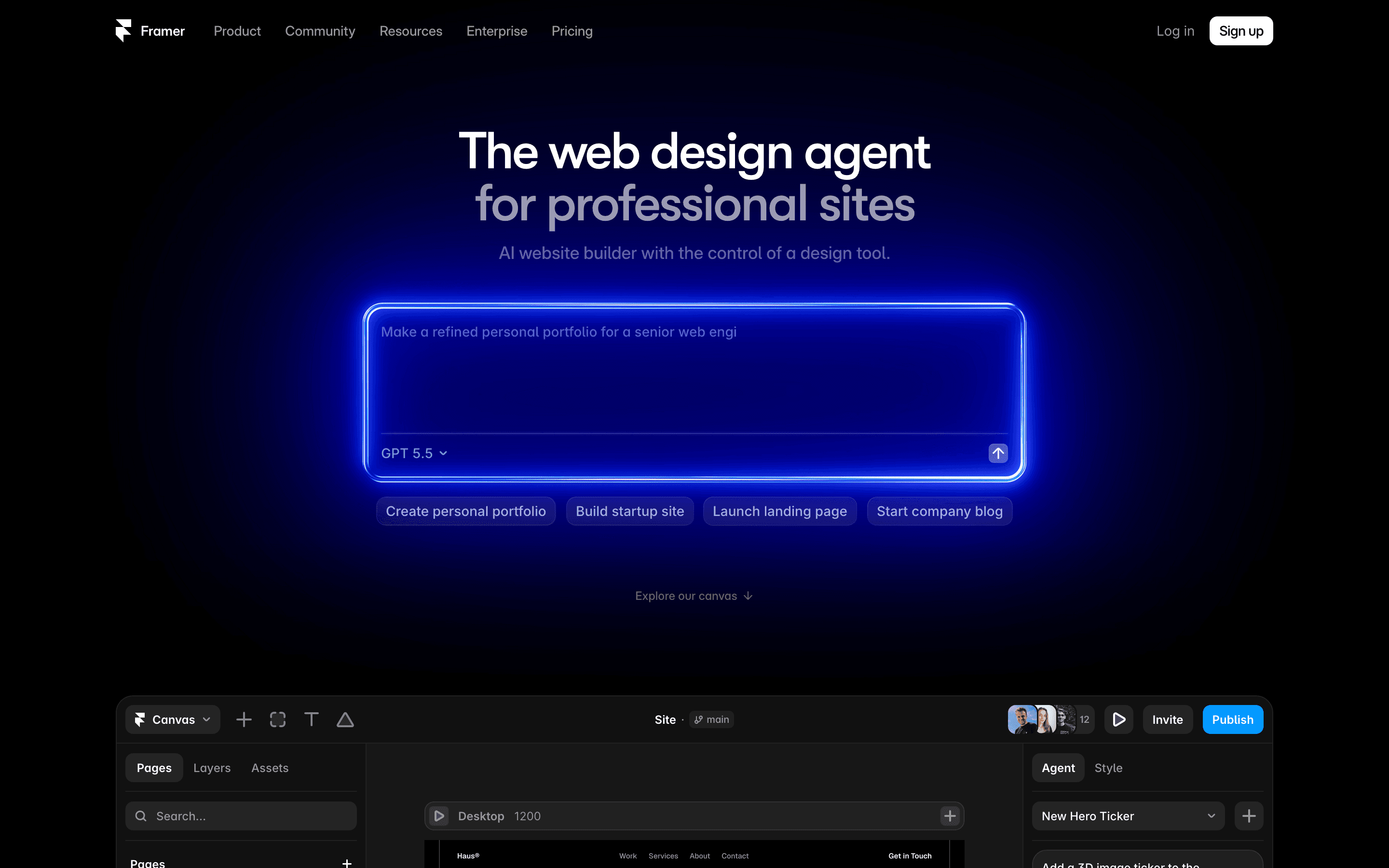
Framer fits a founder who thinks in Figma and wants that same freeform control on the web, plus AI help getting a first draft up fast. Its free plan is usable for testing a real site, and the $10-a-month Basic plan already includes a custom domain and SEO basics, cheaper than Squarespace's $19 entry point. The catch shows up once more than one person needs to edit: every extra editor costs $20 a month on top of the plan price, and bandwidth, CMS items, and pages are all separate paid add-ons past the plan default. Framer also leans harder into AI than Squarespace, recently adding Sonnet 5 and Fable 5 as selectable models in its page generator. It has no dedicated ecommerce story to match Squarespace's built-in store, so it suits a marketing site or portfolio better than a shop.
Pros
- + Real visual design control, closer to Figma than to a typical drag-and-drop builder
- + CMS, hosting, staging, and AI page generation are all in one product with no plugins to wire together
- + Free plan is usable for testing a real site, not just a stripped-down demo
Cons
- – Extra editor seats cost $20/month each on every paid plan, so team pricing climbs fast past the headline number
- – Bandwidth, CMS collections, and page limits are all separate paid add-ons once you exceed the plan default
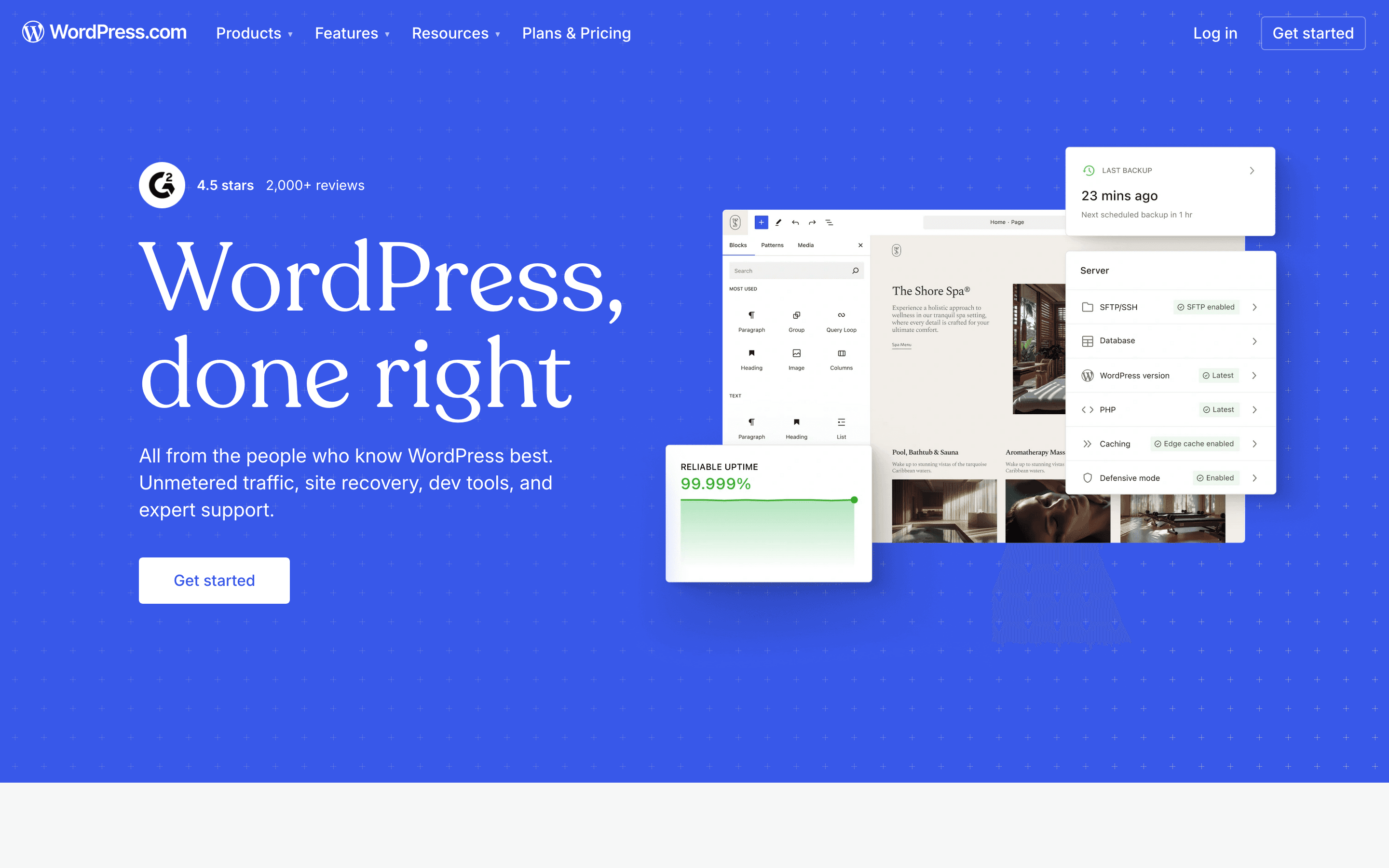
WordPress.com suits anyone who wants Squarespace-style managed hosting but access to WordPress's plugin ecosystem instead of a closed template system. The free plan and $9-a-month Personal tier already beat Squarespace's $19 floor, and every paid tier, not only the top one, unlocks all 60,000-plus plugins. The Commerce plan at $70 a month (or $45 billed annually) adds WooCommerce if you need an actual store. Where it falls short of Squarespace is out-of-the-box polish: you are working with WordPress's block editor, not a design-first template experience, and developer tools like SFTP, WP-CLI, and GitHub deploys sit behind the $40-a-month Business plan, a steep jump from Premium at $18. WordPress.com also has a history of abrupt pricing changes, including a 2022 rollout that briefly cut the free plan's storage to 500 MB before public backlash reversed it. Good for teams comfortable with WordPress, less good for a fast, no-decisions launch.
Pros
- + Free plan lets you launch and test a site with no credit card
- + Business and Commerce plans include real-time backups, SFTP/SSH, and Git deploys, which most website builders don't offer
- + Access to the full 60,000+ plugin marketplace on any paid plan, not just the top tier
Cons
- – Developer tools like SFTP/SSH, WP-CLI, GitHub deployments, staging sites, and real-time backups are locked out until you pay for Business at $40/month (or $25/month annual), a steep jump from Premium at $18
- – Storage tops out at 50 GB even on the $70/month Commerce plan; more space costs extra
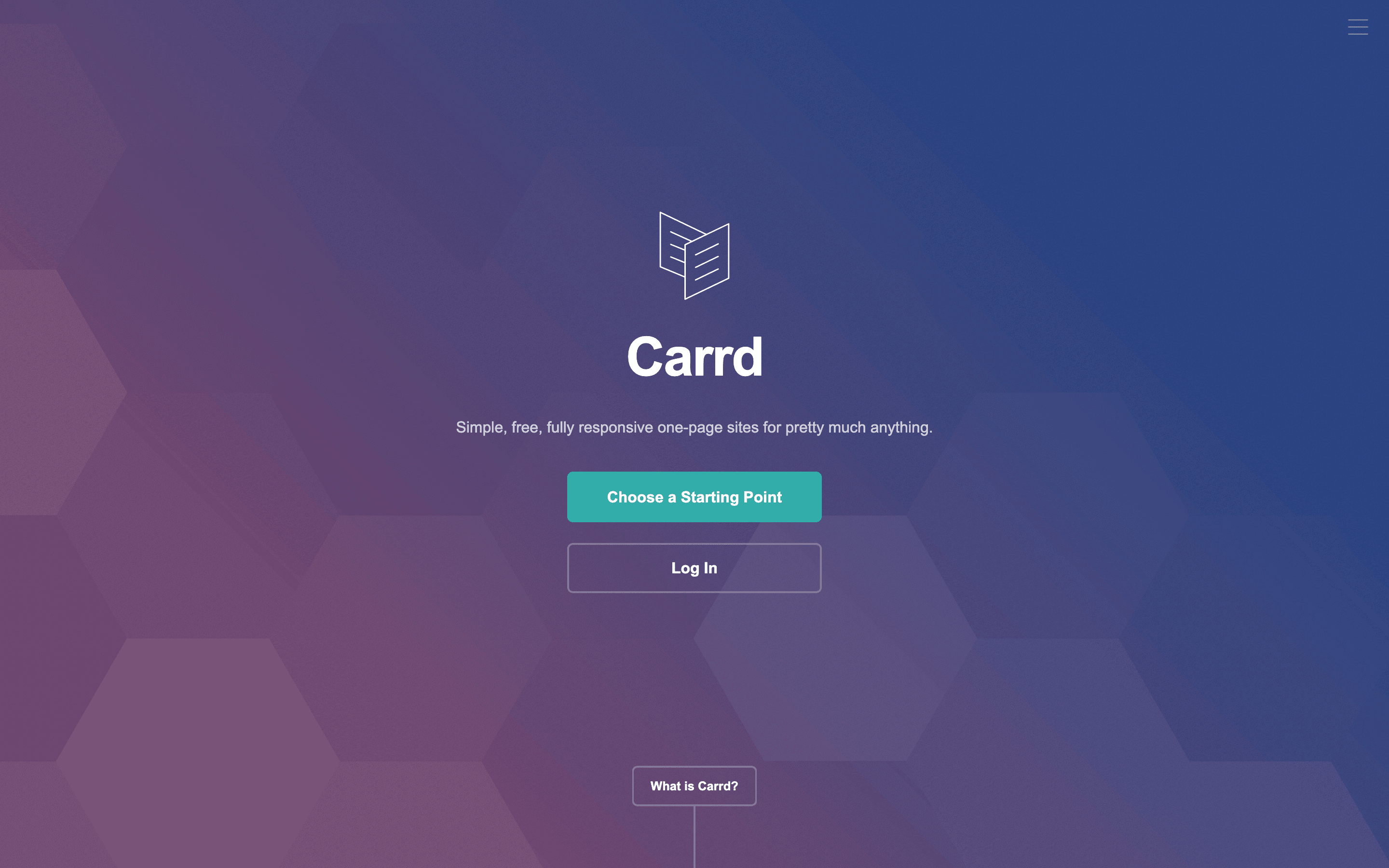
Carrd fits a narrower job than Squarespace: a single scrolling page, not a full site or store. If what you need is a landing page, a link-in-bio page, or an event page, Carrd gets it live for a fraction of the cost, starting at $9 a year instead of $19 a month, with no monthly billing to track. The free plan is usable for a real project, not a stripped-down demo. What you give up is everything Squarespace is built for beyond one page: no blog, no CMS, no built-in checkout, and custom domains and forms are locked behind the $19-a-year Standard tier rather than included from the start. Pick Carrd only when your Squarespace site would have been one page anyway; it is not a replacement for a multi-page marketing site or a store. (Typedream covers similar ground, but its public development has gone quiet since beehiiv acquired it in 2024, so it only makes sense if you already use beehiiv's newsletter platform.)
Pros
- + Cheapest way to get a real site live, starting at $9/year for a paid plan
- + No monthly billing complexity, one annual fee per slot tier
- + Fast to build in because there's only one page to design
Cons
- – Single page only, so it can't grow into a multi-page marketing site without a rebuild elsewhere
- – No blog or CMS, so any new content means manually editing the page again
Should your product be on this website builders list?
If you build a tool that belongs next to the ones above, submit it. A human reviews every submission. Approved products get their own page with pricing and screenshots, plus a place in the comparisons where they fit. It is free. You sign in with your work email so you can follow the decision, and there is no password to create.
Squarespace alternatives: FAQ
What is the best Squarespace alternative overall?+
Wix is the closest overall match. It follows the same template-plus-ecommerce model as Squarespace, but adds a genuinely free plan for testing before you pay.
Is there a free alternative to Squarespace?+
Yes. Wix, Webflow, Framer, and WordPress.com all have real free tiers with limits on storage, bandwidth, or pages. Squarespace itself offers only a 14-day trial, no free plan.
What is the cheapest way to replace a simple Squarespace site?+
If you only need one page, Carrd's Pro Lite plan starts at $9 a year, but that tier has no custom domain. Get one with Carrd's Pro Standard tier at $19 a year, still far cheaper than Squarespace. For a full multi-page site, WordPress.com's Personal plan is $9 a month, or $4 a month billed annually.
Which alternative is closest to Squarespace's built-in ecommerce?+
Wix's Core plan, at $29 a month billed annually, is the closest price match and bundles ecommerce natively. WordPress.com's Commerce plan adds full WooCommerce but costs more, at $70 a month.
Squarespace alternatives: pricing compared
Entry price, billing model, and whether pricing is public. 6 of 6 publish pricing you can check without talking to sales.
| Tool | Starting price | Billing | Free option | Pricing disclosed |
|---|---|---|---|---|
| Squarespace | $19/mo | tiered | Trial (14 days, no credit card required) | Public |
| Wix | $17/mo | tiered | Yes | Partly public |
| Webflow | $15/site/mo | tiered | Yes | Partly public |
| Framer | $10/site/mo | tiered | Yes | Partly public |
| WordPress.com | $9/mo | tiered | Yes | Partly public |
| Carrd | $9/yr | tiered | Yes | Public |
How we made these picks. We compare tools on public pricing, features, and hands-on assessment, then verify every price against the vendor's own page. We never accept payment for rankings. Read the full methodology. Spotted an error? Report it.