Paddle Review
Merchant of record that runs your checkout, billing, and global sales tax as one bill
Is this your product? Claim this page · Request a change
Looking for a Paddle alternative? See our ranked comparison.→What is Paddle?
Paddle is a merchant of record. Instead of you setting up a payment processor and then bolting on separate tools for sales tax, VAT, invoicing, and chargeback handling, Paddle sits between you and your customers, collects the money, remits the tax itself, and pays you out net of its fee. You integrate one checkout and one billing system instead of stitching several together.
The tradeoff for that convenience is that Paddle owns the customer relationship on paper. Customers see charges from Paddle, not your brand, refund and chargeback decisions run through Paddle's process, and payouts follow Paddle's schedule rather than landing same-day the way they would with a processor you run directly.
Paddle is built for software and subscription businesses selling digital products globally, particularly ones that don't want an in-house team registering for tax in dozens of countries.
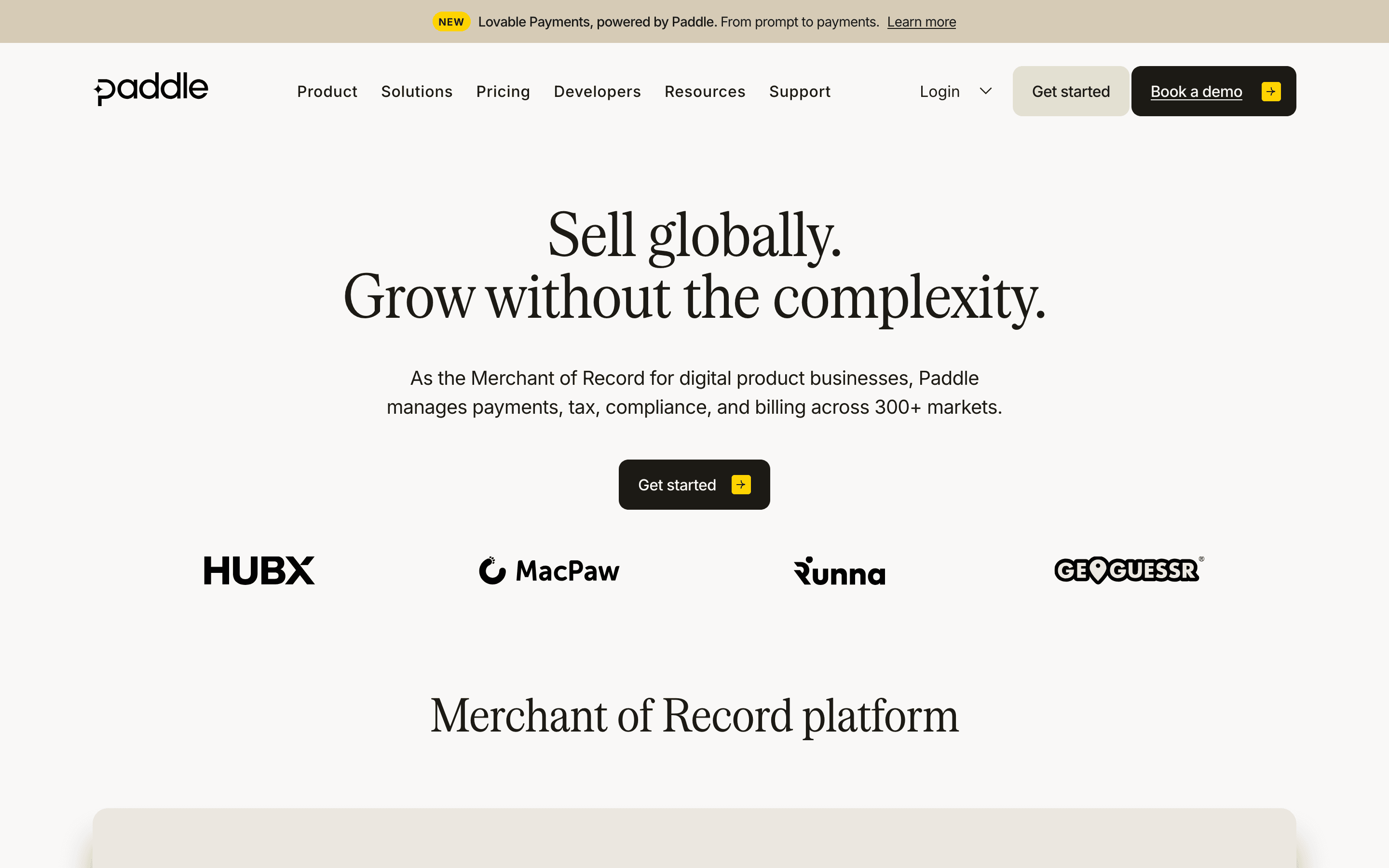
Paddle screenshots
Who it's for
- ✓ Solo founders and small teams selling software or digital products who don't want to register for VAT and sales tax in every country themselves
- ✓ Companies selling globally where tax compliance across many jurisdictions would otherwise need a dedicated finance hire
Who should look elsewhere
- ✗ Businesses selling physical goods or running marketplaces
- ✗ Teams that want to keep a direct payment processor relationship and control their own funds flow and risk decisions
- ✗ High-volume, high-ARPU companies where a flat 5% take rate costs more than a payment processor plus a billing tool bought separately
Pros
- + One fee covers payment processing, global tax and VAT compliance, billing, fraud protection, and support, so you don't buy and manage separate tools
- + No monthly platform fee. You only pay when you get paid, and there's no lock-in contract
- + Handles tax registration and remittance in over 200 countries, which is the main reason most teams pick a merchant of record over a plain processor
- + Built-in subscription billing, dunning, trials, and revenue reporting instead of needing a separate billing platform
Cons
- – 5% + $0.50 per transaction is expensive at scale. A business processing $500,000 a month pays roughly $25,000 in fees on that volume alone
- – Multiple reviewers describe payouts held for 90 to 180+ days after an account closure or risk flag, with support slow to respond during that period
- – As merchant of record, Paddle's risk team can close an account with little warning, even after years of processing history, and the decision process is opaque
- – Customer support response times can stretch to several days on the standard plan, a real problem when a live payment issue is blocking revenue
- – Charges show up on customer statements as Paddle, not your brand name, which generates support tickets and refund disputes you don't control directly
- – Cross-currency payouts carry a conversion margin of up to 1.5% on top of the headline rate, and international wire transfers add a flat $15/€15/£15 fee
Paddle pricing
What you pay for
Paddle charges one all-in fee per transaction instead of billing you separately for a payment processor, a tax tool, and a billing platform. The standard rate is disclosed on the pricing page: 5% + $0.50 per successful checkout, with no monthly fee. Larger sellers, and anyone selling items under $10, get routed to a custom negotiated rate instead of the published number, so the real price for high-volume or unusual businesses isn't public.
You pay for what you consume rather than a per-seat fee, so cost scales with usage.
| Plan | Price | Highlights |
|---|---|---|
| Pay-as-you-go | Custom | 5% + $0.50 per successful checkout, no monthly fee · Covers payment processing, checkout, global sales tax and VAT, fraud and chargeback handling, and support · No contract, cancel anytime |
| Custom / Tailored | Custom | For rapidly scaling or established large-scale businesses · Negotiated rate, can include premium support and a dedicated success manager · Products priced under $10, or that need manual invoicing, are also routed here |
Paddle is a merchant of record, so its fee replaces a payment processor fee, not a seat license. The published rate is 5% of the transaction plus a flat $0.50 per successful checkout, with no monthly fee and no lock-in period. Products priced under $10 are routed to a custom pricing conversation, as are large or fast-scaling businesses (Tailored pricing). The one real add-on cost is on the payout side: cross-border wire transfers can incur a $15/€15/£15 fee, and if you take payouts in a currency different from your account's balance currency, Paddle adds a conversion margin of up to 1.5%.
Pricing verified July 22, 2026 · source
How Paddle's pricing compares
Paddle next to its closest alternatives on entry price, billing, and whether pricing is public.
Is Paddle still actively developed?
Last significant update: July 2026. Paddle added scheduled API key rotation through AWS Secrets Manager, so keys can rotate automatically without manual intervention or downtime. Recent weeks also added OAuth support for third-party apps, a checkouts conversion report, UPI for India, and paid trials that charge a reduced amount before full-price renewal.
Top Paddle alternatives
Paddle FAQ
How much does Paddle actually cost?+
The standard rate is 5% of the transaction plus $0.50 per successful checkout, with no monthly fee and no lock-in contract. Larger businesses, and anyone selling items under $10, get a custom negotiated rate instead. The one added cost outside the headline rate is on payouts: cross-currency payouts carry a conversion margin of up to 1.5%, and international wires add a flat fee.
Is there a free plan?+
No. There's no monthly subscription fee, but every transaction is charged the 5% + $0.50 rate, so there's no genuinely free tier.
Why does a charge on my card say Paddle instead of the app I bought?+
Because Paddle is the merchant of record, it appears as the seller on your statement rather than the software company you actually bought from. Paddle explains this directly to confused customers on its own site.
Why do people say Paddle held their money?+
Because Paddle is the merchant of record, it can hold funds in reserve or freeze a payout if its risk team flags an account, and several sellers report waiting 90 days or longer to get paid after a closure. Read the reserve and payout terms before you rely on Paddle for cash flow.