Top Airtable Alternatives in 2026
Here for Airtable itself? See the full Airtable profile, pricing & reviews →
Suggest a change- If you want to keep Airtable's flexible, build-your-own data model but get dedicated CRM features on top, choose Attio. Attio lets you define your own objects instead of a fixed contact/company/deal structure, and its Free plan covers 3 seats and 50,000 records, far past Airtable's 1,000-record free cap.
- If your CRM is really a shared, enriched contact list built from LinkedIn and email outreach, choose folk. folk's folkX extension pulls people straight off LinkedIn and Sales Navigator and syncs your inbox automatically, so the CRM populates itself instead of you rebuilding an Airtable base by hand.
- If you want a CRM that's genuinely free while your team is small, not just a trial, choose HubSpot. HubSpot's Free CRM has no expiration date and covers contact and deal management, tasks, and email tracking for up to 2 users at no cost.
- If you want the fastest, cheapest way to get a sales team working a visual pipeline, choose Pipedrive. Pipedrive's Lite plan starts at $14/seat/month, the cheapest plan built for a real team, and ships a ready-made kanban pipeline with no base-building required. (Close's Solo plan is cheaper per seat at $9/seat/month, but it caps at 1 user, so it isn't a team option.)
- If your team already lives in Gmail and Google Calendar all day, choose Copper. Copper auto-logs email and calendar activity straight from Gmail into contact records, cutting the manual data entry an Airtable-based CRM needs from you.
- If your Airtable base was really tracking high-volume outbound calling and email, choose Close. Close bundles calling, SMS, and email sequencing into every plan, and adds a power dialer on Growth ($99/seat/month) and a predictive dialer on Scale ($139/seat/month), so outbound teams get calling infrastructure Airtable never had.
- If you use Airtable for more than sales, like a project tracker or an ops database, and don't need built-in sequencing or call logging yet, choose stay on Airtable. no dedicated CRM matches Airtable's ability to reshape the same data into a pipeline, a calendar, and a report, and switching would mean rebuilding those other workflows elsewhere too.
Airtable is where a lot of founders and RevOps teams build their first CRM: a contacts table, a pipeline view, an automation that pings Slack when a deal moves stage. It works, until the record caps, the doubled Team-plan price, or the lack of built-in sequencing and call logging start costing more time than they save.
The tools below are the ones an Airtable-as-CRM buyer actually cross-shops: CRMs with a genuinely lightweight setup, a real free or cheap entry tier, and enough flexibility that you're not trading Airtable's DIY freedom for a rigid template. We left out heavier enterprise platforms like Salesforce, since almost no one leaving Airtable for a lightweight CRM is choosing between the two.
Airtable alternatives compared
| Tool | Best for | Starting price | Free option | Last update |
|---|---|---|---|---|
| AttioBest free alternative | Startups and small sales teams that want a CRM shaped around their own process instead of a rigid template | $29/seat/mo | Yes | June 2026 |
| folkBest for LinkedIn-sourced prospecting | Small teams and agencies whose CRM is really a shared, enriched contact list built from LinkedIn and email | $24/seat/mo | Trial (2 weeks, no credit card required) | April 2026 |
| HubSpot | Growing companies that want marketing, sales, and support data in one system instead of stitching together separate point tools | $7/seat/mo | Yes | June 2026 |
| PipedriveCheapest paid entry for a team | Small and mid-sized B2B sales teams that want a fast, visual pipeline without a heavy admin setup | $14/seat/mo | Trial (14 days, full access to the selected plan, no credit card required) | June 2026 |
| CopperBest for Gmail-native teams | Small teams already living in Gmail and Google Calendar who want a CRM that feels native to that workflow | $23/seat/mo | Trial (14 days, no credit card required) | June 2026 |
| Close | Small and midsize teams doing high-volume outbound calling and email who want calling, SMS, and email built into the CRM | $9/seat/mo | Trial (14 days, no credit card required) | May 2026 |
Why teams switch from Airtable
Airtable's per-base record caps mean fast-growing teams keep needing to upgrade plans, from Team's 50,000 records to Business's 125,000, and eventually to a quote-only Enterprise Scale contract, just to keep adding records.
One team described needing to leave because there was no scale plan that made financial sense at their size.
Airtable roughly doubled its entry-tier price in Q3 2025, replacing the $10/seat Plus plan with the $20/seat Team plan.
That price jump pushed some cost-conscious teams to look at cheaper alternatives.
Airtable has no built-in email sequencing, call logging, or deal scoring, so it takes real setup work before it functions as a working CRM.
Teams that need those features working on day one usually pair Airtable with a dedicated CRM or switch to one instead.
The best Airtable alternatives, ranked
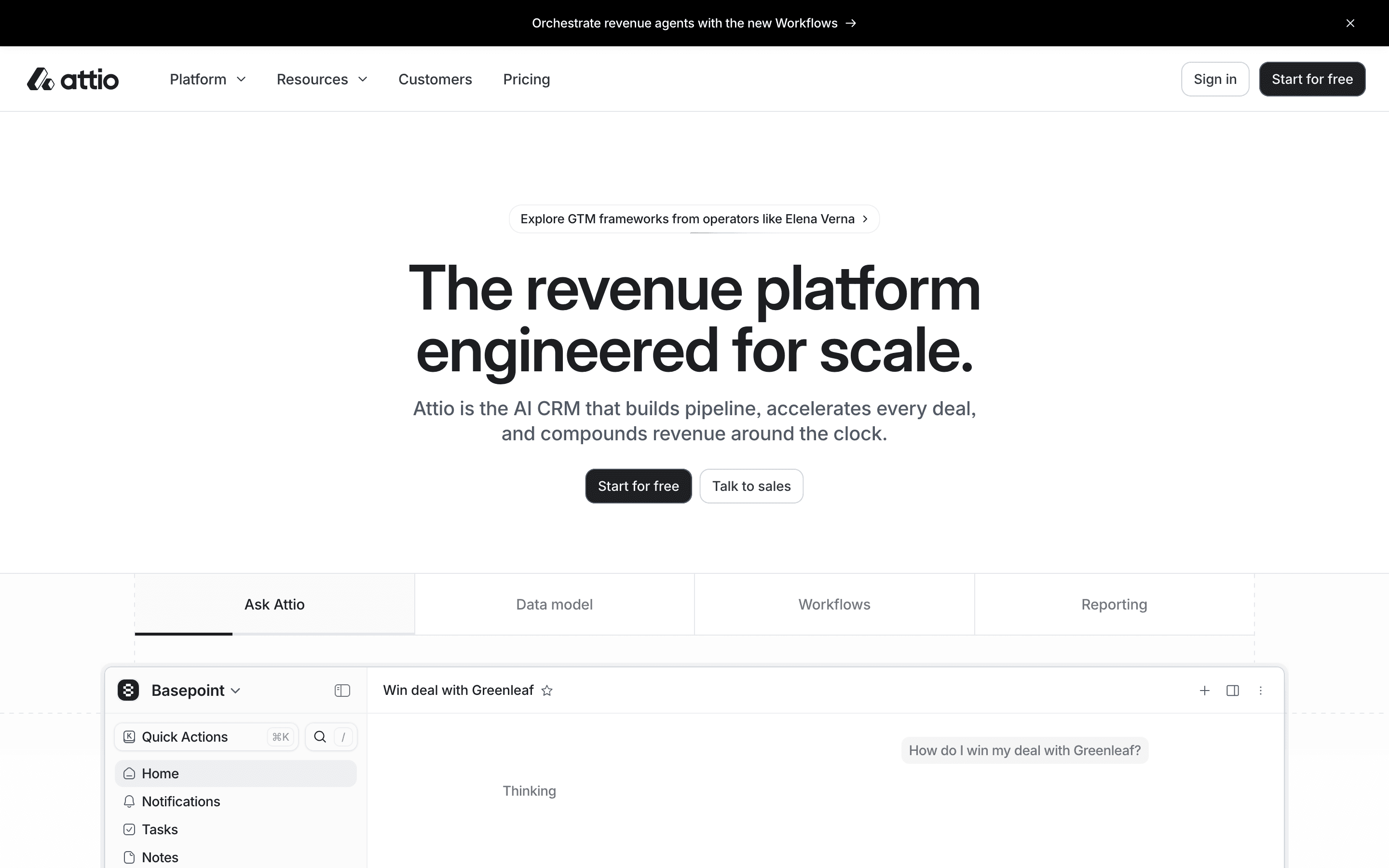
Attio is the closest thing to Airtable's own philosophy applied to a dedicated CRM. Instead of a fixed contact/company/deal template, you define custom objects that match how your business actually works, whether that's an investor tracking deals or a SaaS company tracking accounts and usage. Its Free plan covers 3 seats and 50,000 records, well past Airtable's 1,000-record free cap, and paid Plus starts at $29/seat/month. The tradeoff is a credit system layered on top of seats: AI search, enrichment, and record creation draw down monthly seat and workspace credits, so heavy use can push real cost above the sticker price. Call intelligence and sequences also sit behind the $69/seat Pro tier. For a team that liked Airtable's flexibility but wants a real CRM data model and built-in enrichment, Attio is the strongest match.
Pros
- + Custom objects and a flexible data model instead of a fixed contact/company/deal structure
- + Connects to your inbox and calendar with built-in enrichment to keep records current
- + Free plan covers up to 3 seats with 50,000 records, enough to actually run a small team on
Cons
- – Call intelligence, sequences, and advanced permissions are locked behind the Pro tier, a 138% jump in per-seat price over Plus ($69 vs $29/seat/month billed annually)
- – The credit system means actual monthly cost can exceed the per-seat sticker price once AI and enrichment features are used heavily
folk is built for teams whose CRM is really a shared, enriched contact list, which is exactly how a lot of small teams end up using Airtable. The folkX browser extension pulls people directly off LinkedIn and Sales Navigator, and folk syncs Gmail, Outlook, and WhatsApp so contact history builds itself instead of you populating a base by hand. Standard runs $24/seat/month with 500 shared enrichment credits a month, but deal pipelines, sequences, dashboards, and API access all require Premium at double the price, $48/seat/month. There's no free-forever plan, only a 2-week trial. folk fits founders and agencies who want an AI-assisted address book more than a heavyweight pipeline tool, and who are fine paying from day one since Airtable's own free tier isn't an option here.
Pros
- + folkX makes it fast to pull leads and their context off LinkedIn, including Sales Navigator, straight into the CRM
- + AI assistants (Recap, Research, Follow-up, Workflow) cut down on manual note-taking and prospect research
- + Setup is quick since most of the CRM populates itself from synced email, calendar, and LinkedIn activity
Cons
- – No free-forever plan, only a 2-week trial
- – Deal tracking, sequences, dashboards, and API access are locked behind Premium, which is double the Standard price per seat
HubSpot
HubSpot is the pick for teams that want a genuinely free CRM, not just a trial, while they figure out their process. The Free CRM has no expiration date and covers contact and deal management, tasks, live chat, and basic email tracking for up to 2 users, no credit card required. That's more generous long-term than Airtable's 1,000-record free base, though HubSpot's free tier caps at 2 users, so it stops working the moment a third person needs a login. The next step up, the Starter Customer Platform, lists at $20/seat/month standard, and Sales Hub Professional jumps to $90/seat/month plus a $1,500 onboarding fee. HubSpot makes sense if you want room to add marketing and service tools on the same contact database later, not just a sales pipeline today.
Pros
- + One contact record shared across marketing, sales, and service cuts down on duplicate data entry
- + The free CRM plan has no time limit and needs no credit card to start
- + A large ecosystem of native integrations and a marketplace of third-party apps
Cons
- – Marketing Hub pricing tracks marketing contact volume, so costs can rise as your list grows even without adding seats
- – Professional and Enterprise tiers on Sales and Marketing Hub carry separate one-time onboarding fees, from $1,500 to $7,000 depending on hub and tier
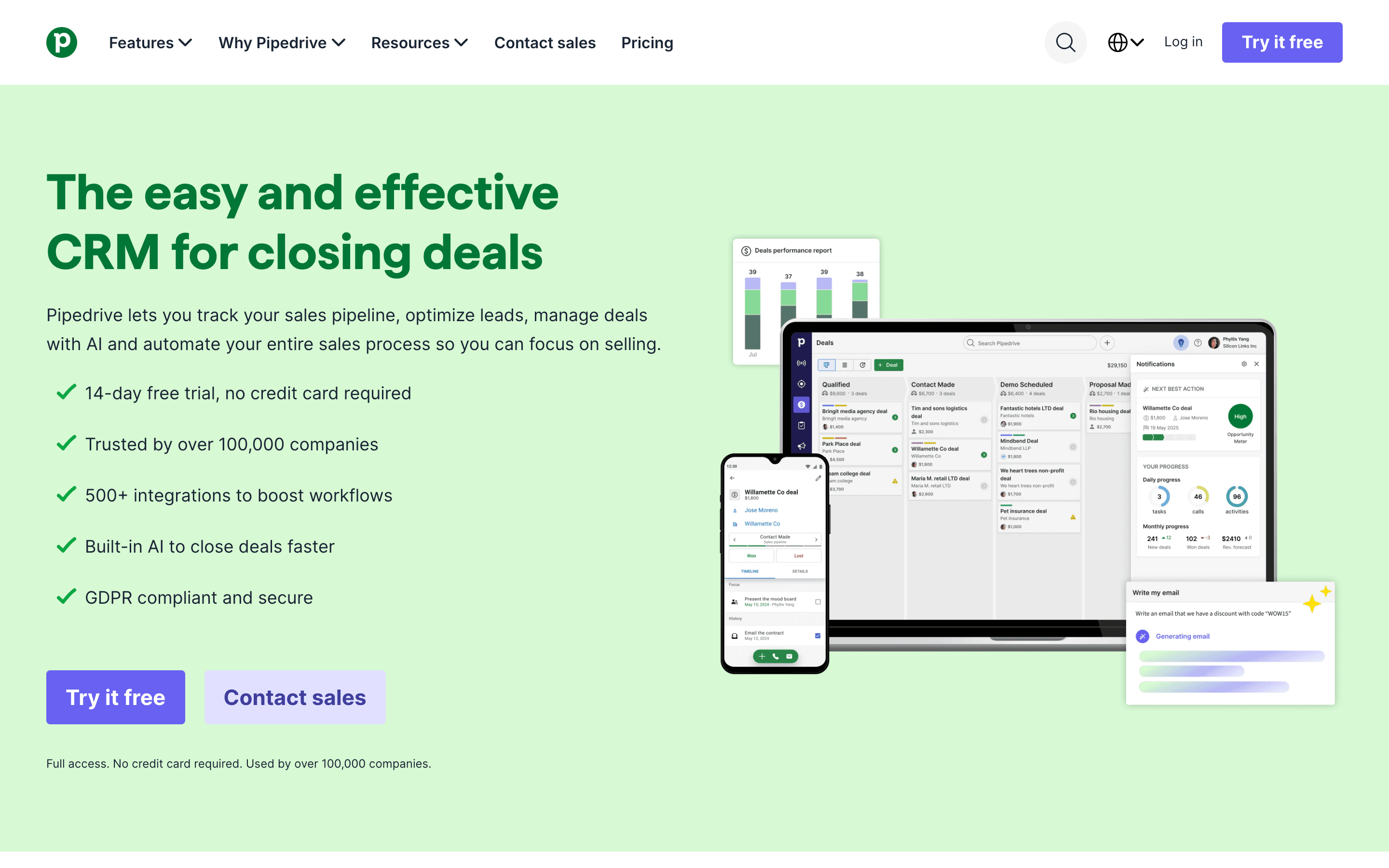
Pipedrive is the cheapest way to hand an actual sales team a real pipeline without building one in Airtable first. Lite starts at $14/seat/month, the cheapest plan here built for more than one user (Close's Solo plan is cheaper per seat at $9/seat/month, but it caps at 1 user, so it doesn't scale to a team), and gives you drag-and-drop deal stages, an AI Sales Assistant, and 500+ marketplace integrations out of the box. There's no permanent free plan, only a 14-day full-access trial. The catch is that two-way email sync, workflow automation, and forecasting don't show up until Growth at $39/seat/month, and lead generation tools like LeadBooster cost extra unless you're on Premium or Ultimate. For a sales-led team that just wants deal-stage tracking and activity reminders working on day one, without Airtable's setup time, Pipedrive is the straightforward swap.
Pros
- + The pipeline UI is fast to set up and easy for reps to learn with little training
- + AI Sales Assistant and AI-generated reports are included on the entry plans too, not held back for the top tier
- + 500+ marketplace integrations, plus a native MCP server added in June 2026 for connecting CRM data to ChatGPT and Claude
Cons
- – No permanent free plan, unlike some CRM competitors
- – Core revenue-generating features like LeadBooster's chatbot, live chat, and prospecting tools, plus Smart Docs and Campaigns, cost extra unless you're on Premium or Ultimate
Copper is built for teams that live in Gmail and Google Workspace and want the CRM to feel native to that inbox instead of a separate app to switch into. It auto-logs email threads and calendar activity into contact records, which cuts down on the manual entry an Airtable-based CRM demands. Basic starts at $23/seat/month and includes pipeline and project management, but formal sales opportunities and workflow automation are reserved for Professional at $59/seat/month, so teams that want deal-level tracking, not just a basic pipeline, end up needing that tier. Native reporting has real gaps, and reviewers describe a rigid cancellation and auto-renewal process. Copper suits small teams and agencies already running their day on Google who want simple pipeline tracking with less setup than Airtable, not teams that need deep reporting or opportunity tracking on the cheapest plan.
Pros
- + Auto-logs email and calendar activity so reps spend less time on data entry
- + Clean, simple interface that's fast to learn for non-technical sales teams
- + Pricing is published up front, no sales call required to see what it costs
Cons
- – Basic plan includes basic pipelines but not Sales Opportunities, the deal record with a revenue rollup, so most teams end up needing Professional
- – Native reporting has real gaps (reviewers note not every field can be included in a report); Copper ships official Looker Studio and Google Sheets export connectors as the standard workaround for deeper analysis
Close
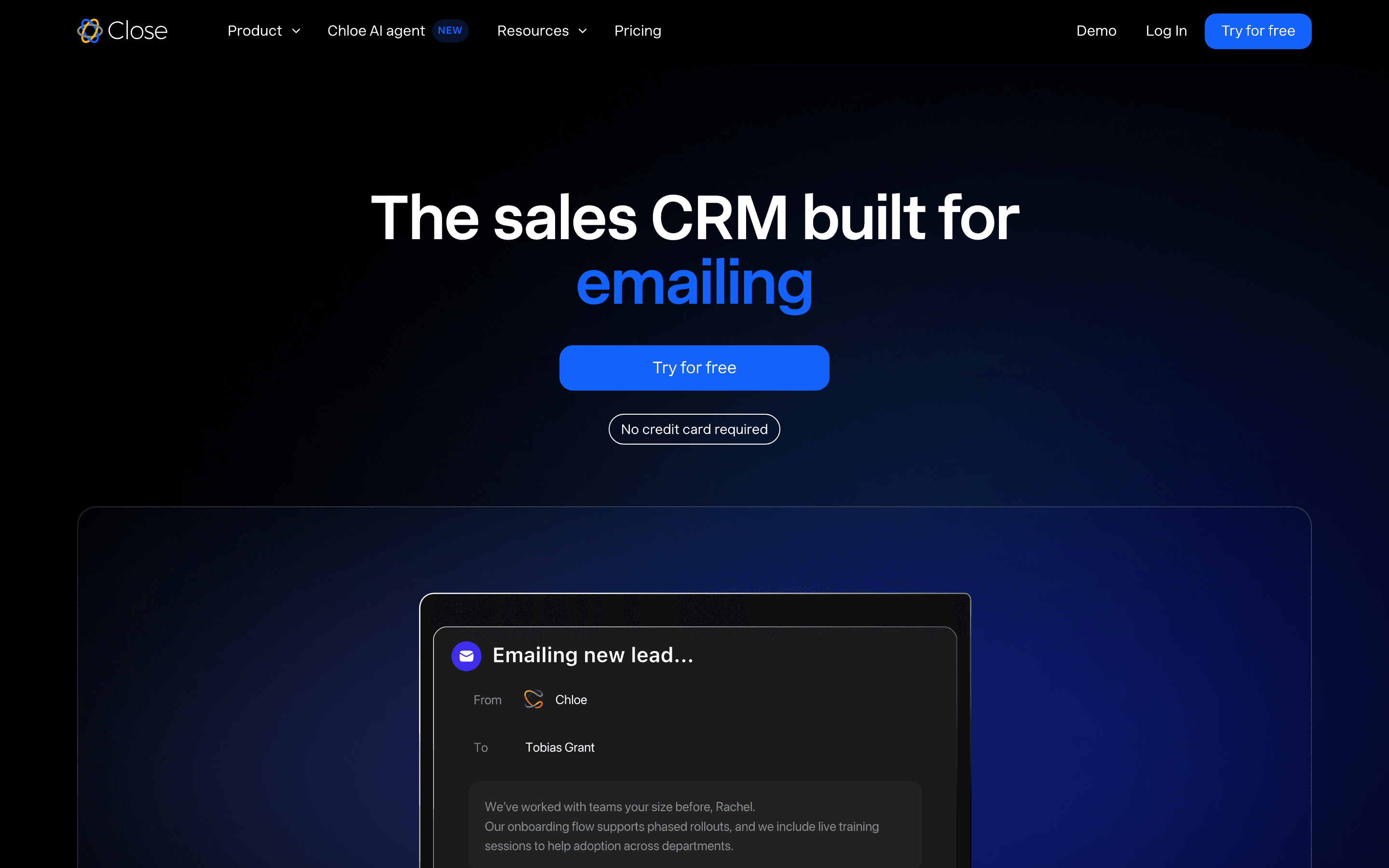
Close is the pick for teams whose Airtable-as-CRM was really tracking high-volume outbound calling and email. Every plan includes calling, SMS, and email, but the power dialer is reserved for Growth at $99/seat/month, and the predictive dialer for Scale at $139/seat/month. Solo starts at $9/seat/month but caps at 1 user and 10,000 leads, so any real team jumps to Essentials at $35/seat/month, which still doesn't include a power dialer. Calling minutes and phone numbers bill separately on usage on top of the seat price. Chloe, Close's built-in AI voice agent, calls and qualifies leads and updates records on its own, using a monthly credit allowance included with every plan. Close is a narrower fit than the others here: it's the strongest choice specifically for outbound-heavy sales teams willing to pay up for Growth or Scale to get the dialer, less so for teams that just want lightweight contact and deal tracking.
Pros
- + Calling, SMS, and email are built into the product, not bolted on, so call and message activity logs straight to the lead record
- + The power dialer speeds up high-volume outbound calling, and the predictive dialer on the Scale plan speeds it up further
- + Workflow automation, multi-step email, call, and SMS sequences with branching, comes starting on the Growth plan instead of a separate add-on product
Cons
- – There's no free-forever tier, only a 14-day trial, so teams can't run it long-term at zero cost the way they can with HubSpot's free CRM
- – The Solo plan caps out at 1 user and 10,000 leads, so almost any real team has to jump straight to the $35-a-seat Essentials tier
Should your product be on this crm & marketing list?
If you build a tool that belongs next to the ones above, submit it. A human reviews every submission. Approved products get their own page with pricing and screenshots, plus a place in the comparisons where they fit. It is free. You sign in with your work email so you can follow the decision, and there is no password to create.
Airtable alternatives: FAQ
What's the best free Airtable alternative for a CRM?+
Attio's Free plan covers 3 seats and 50,000 records, more generous than Airtable's own 1,000-record free cap. HubSpot's Free CRM never expires either, but it caps at 2 users, so it stops working once a third person needs a login.
Which Airtable alternative is cheapest?+
For a real team, Pipedrive's Lite plan starts at $14/seat/month billed annually, less than Airtable's own $20/seat Team plan, though it's a 14-day trial only, with no permanent free tier. Close's Solo plan is technically cheaper at $9/seat/month, but it caps at 1 user, so it isn't a team plan.
Can I keep Airtable's flexible, custom data model in a dedicated CRM?+
Attio is the closest match. It lets you define your own objects instead of forcing a fixed contact/company/deal structure, similar in spirit to how Airtable lets you reshape linked tables into whatever view you need.
What's the best Airtable alternative for outbound sales calling?+
Close is built for outbound calling: every plan bundles calling, SMS, and email sequencing directly into the CRM. The power dialer needs Close's Growth plan at $99/seat/month, and the predictive dialer needs Scale at $139/seat/month, so budget for one of those tiers if the dialer is the reason you're buying it.
Airtable alternatives: pricing compared
Entry price, billing model, and whether pricing is public. 7 of 7 publish pricing you can check without talking to sales.
| Tool | Starting price | Billing | Free option | Pricing disclosed |
|---|---|---|---|---|
| Airtable | $20/seat/mo | per-seat | Yes | Partly public |
| Attio | $29/seat/mo | per-seat | Yes | Partly public |
| folk | $24/seat/mo | per-seat | Trial (2 weeks, no credit card required) | Partly public |
| HubSpot | $7/seat/mo | tiered | Yes | Public |
| Pipedrive | $14/seat/mo | per-seat | Trial (14 days, full access to the selected plan, no credit card required) | Public |
| Copper | $23/seat/mo | per-seat | Trial (14 days, no credit card required) | Public |
| Close | $9/seat/mo | per-seat | Trial (14 days, no credit card required) | Public |
How we made these picks. We compare tools on public pricing, features, and hands-on assessment, then verify every price against the vendor's own page. We never accept payment for rankings. Read the full methodology. Spotted an error? Report it.