Ad agency software pricing: per-seat, spend, or client
Ad agency software pricing runs three ways: per seat, a cut of ad spend, or per client. Here's what each costs and which wins as you add clients.
How ad agency software pricing actually breaks down
Ad agency software pricing splits three ways: a flat fee per ad account or seat, a fee tied to how much ad spend runs through the platform, and a fee per client the agency manages. Each model rewards a different kind of agency and punishes another. A team of five running twenty small accounts pays a very different bill on each one, so the right pick depends on your headcount and your client roster, not just the sticker price.
Disclosure: this site is built by the team behind Adside.
The three models, side by side
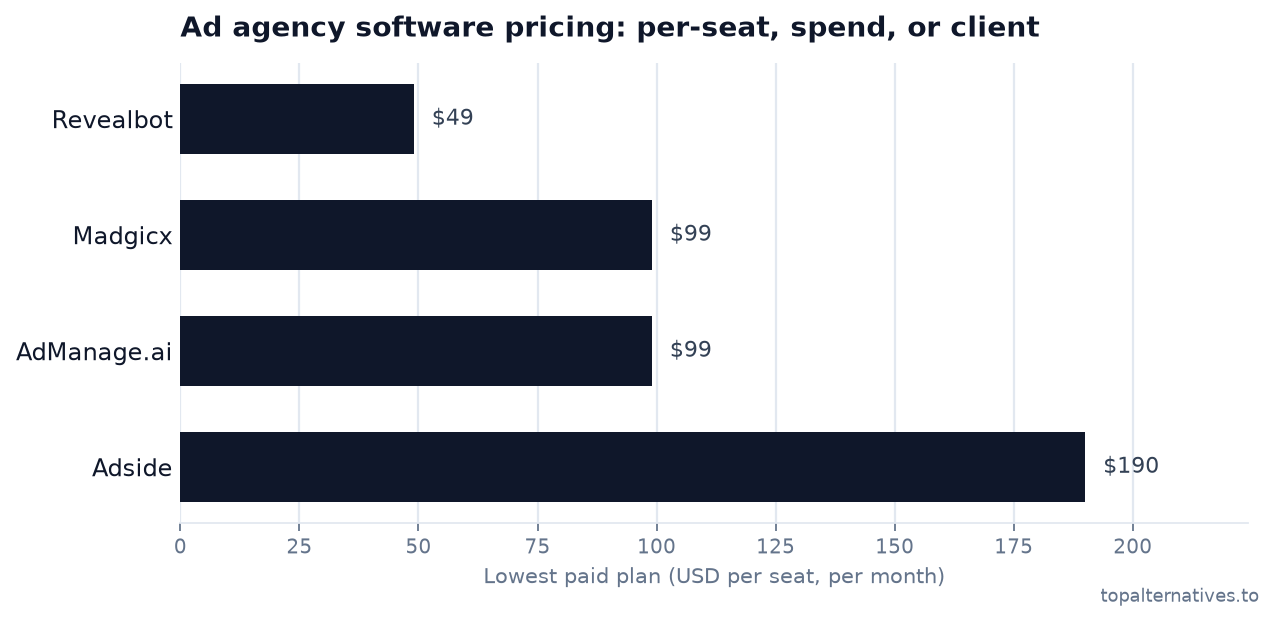
| Tool | Pricing model | Starting price | What drives the bill |
|---|---|---|---|
| Adside | Per client | $190/client/month billed annually, $290 monthly | Number of clients, not seats or spend |
| Madgicx | Percentage of ad spend | $99/month under $2,500/month Meta spend | Monthly ad spend bracket |
| Revealbot | Percentage of ad spend | $49/month up to a $10K/month spend cap | Combined connected ad spend |
| AdManage.ai | Per account tier | £99/month, 1 account, 1 channel | Number of ad accounts, flat by tier |
All four prices above come from each vendor's own pricing page, checked July 7, 2026. Confirm your own quote before you buy; Enterprise tiers on all four are negotiated.
Per-seat and per-account pricing
AdManage.ai is the clearest per-account model here: Essential runs £99 a month for one ad account and one channel (Taboola), In-House jumps to £499 a month for five accounts across all nine supported channels, and Agency runs £999 a month for ten accounts. The price is public and fixed by tier, so you know the cost before a sales call. The catch for a growing agency is that the account count is the ceiling. Land an eleventh client and you need Enterprise, which is quote-only. And within a tier, adding people to your team costs nothing extra, but adding accounts does, which is the opposite of what a per-client tool does. The other thing to watch on this model is the channel count, since the Essential tier's single channel is Taboola rather than Meta, meaning a Meta-first agency is really shopping the In-House tier and up from the start. It is the wrong shape for a shop with a long tail of dormant or seasonal accounts, because a client who spends nothing this month still occupies a slot you are paying for.
Where Ryze fits, and what the entry tiers stop covering
Ryze sits at the cheap end of the per-account model, starting at $43 an account a month, checked against its own payment page on July 7, 2026. That price point makes per-account billing workable at a scale where AdManage.ai's £99 entry tier is hard to justify, because each small account can carry its own line item instead of pushing you into a higher tier you only half use. The trade is the one every per-account tool makes: the bill is a straight multiple of your roster, so a roster twice the size costs twice as much unless the vendor grants a volume break.
Entry tiers across all of these vendors stop covering roughly the same three things, and it is worth knowing which wall you will hit first. Spend-based entry plans stop at a cap, which is why Revealbot's $49 and $99 tiers both end at $10,000 in combined monthly spend and why crossing it on monthly billing triggers an overage fee. Per-account entry plans stop at a slot count and, in AdManage.ai's case, at a single channel. And where a vendor offers a trial rather than a free tier, the trial usually runs on one live account, which tells you whether the tool works but tells you nothing about how it behaves when a dozen clients and their approval chains are inside it at once. Adside has no free trial or free tier listed at all, so the evaluation there is a paid one from day one.
Percentage-of-spend pricing
Madgicx and Revealbot both price against the ad spend flowing through the accounts you connect, not the number of clients or seats. Madgicx starts at $99 a month for accounts spending under $2,500 a month on Meta and climbs as that spend bracket rises; its own pricing page won't show the exact number until you pick a bracket or start the trial. Revealbot (sold under the Bïrch brand) is more transparent about the ladder: Essential starts at $49 a month and Pro at $99 a month, both capped at $10,000 in combined monthly ad spend, stepping up to $1,299 a month on Pro once connected spend hits $300,000. Both plans charge an overage fee if you cross the spend cap on monthly billing; annual billing avoids that fee.
This model is a good deal for a single account or a small handful of accounts spending in the tens of thousands a month, since the price tracks the size of the budget you're optimizing rather than your team size. It gets expensive fast for an agency with a long roster of smaller clients, because spend adds up across every account on the same bill regardless of how much staff time each client needs. It also makes your software bill seasonal in a way the others are not: a Q4 push where every client doubles budget can move you up a bracket in the same month your team is busiest, and a January lull does not always move you back down if you are on annual billing. If you quote clients a fixed retainer, that variability lands entirely on your margin rather than theirs.
Per-client pricing
Adside's per-client plan charges $290 a client a month, or $190 a client a month billed annually, with unlimited team members included at no extra cost. There's one plan (Standard), with Enterprise reserved for teams that need SSO, dedicated infrastructure, custom SLAs, or that run more than 100 clients; agencies with 25 or more clients also get volume pricing on request. The trade a per-client model makes is the mirror image of per-seat: hiring a fourth or fifth account manager doesn't move the bill, but each new client does, at a fixed rate regardless of how much that client spends on ads. That predictability is the main draw, since the cost of a new logo is a known number you can price into the retainer before you sign it. It is the wrong model if your roster is mostly micro-budget accounts, because a client spending a few hundred dollars a month costs the same as one spending six figures.
Which model actually wins as you add clients
Run the same rough scenario, a five-person agency with ten client accounts averaging $8,000 a month in ad spend, across each model. On Revealbot's Pro plan, ten accounts at $8,000 each is $80,000 in combined spend, which clears the $75,000 spend cap, so that roster needs the $799-a-month bracket, not a cheaper one. On AdManage.ai, ten accounts land you in the Agency tier at £999 a month, but only if you need all nine channels; if you're Meta-only, the account cap is what matters, not the channel count. On Adside, ten clients at $190 a month billed annually is $1,900 a month, full stop, regardless of how many of those five staffers touch the accounts or how much each client spends.
The lines cross depending on your averages. A per-client tool costs less than spend-based pricing once average client spend rises high enough that a spend-based bill would exceed the flat per-client rate. It costs more than spend-based pricing for a roster of very small accounts, under a few hundred dollars a month each, where Madgicx or Revealbot's entry tier might undercut $190 a client. And it beats per-account tools like AdManage.ai the moment your team wants to add people without hitting a wall, since headcount is free under per-client billing but accounts are what gate an AdManage.ai tier.
What changes between five seats and twenty-five
None of these four billing models charges you for the extra twenty people, so going from five seats to twenty-five leaves the invoice untouched; what changes is which ceiling you hit first and how much of your bill you can predict a quarter out. At five seats the roster is usually small enough that a per-account or entry spend tier still fits, and any of the models can be made to work. At twenty-five seats you are almost certainly past the ten-account Agency tier on AdManage.ai and into a quote-only Enterprise conversation, past the $10,000 entry cap on Revealbot and climbing its brackets, and into the range where Adside's volume pricing for agencies with 25 or more clients becomes the number that matters rather than the $190 list rate.
The second thing that changes is who touches the tools. A five-person team can run a spend-based plan with everyone in one shared login and absorb a surprise overage out of one month's margin. A twenty-five-person team needs permissions, approval steps and someone accountable for the bill, and an unlimited-seats model stops the awkward internal habit of sharing credentials to avoid buying another seat. If you are growing headcount faster than your client list, per-client and spend-based billing both age well and per-account billing does not; if the client list is what is growing, the reverse is true.
Who each model actually fits
A solo advertiser or in-house team running one Meta account fits percentage-of-spend pricing best. Madgicx's or Revealbot's entry tier is cheap at low spend and the tools do real optimization work on that one account. A media-buying team launching the same creative across many channels and accounts, where the pain is deployment speed rather than research or reporting, fits AdManage.ai's flat per-account tiers. An agency running Meta ads for many clients, where the bottleneck is staff time and the roster keeps growing, fits per-client pricing, because the bill doesn't change when you hire and doesn't change per client regardless of that client's spend.
Adside is built for that last group specifically. It's not a fit for teams that need deep Google or LinkedIn ad management, since its research, creative, and automation are built around Meta, and it's not a fit for a solo advertiser running a single brand account, since the pricing and feature set assume multiple clients. There's also no free trial or free tier listed, so you commit to the $290 (or $190 annual) plan before testing it on a live account. If your agency's real bottleneck is exact per-channel bulk launching rather than research and creative, our Revealbot alternatives ranking covers that ground and where each of these tools actually wins. For the full field around Adside itself, see our Adside alternatives ranking.
If per-client pricing fits your agency's shape, Adside's pricing and plan details are on adside.ai.
Keep reading
FAQ
Is ad agency software usually priced per seat?+
Not always. Ad management tools split between per-seat/per-account tiers (AdManage.ai), a percentage tied to ad spend (Madgicx, Revealbot), and per-client pricing that doesn't charge for extra team members (Adside).
When is percentage-of-spend pricing cheaper than per-client pricing?+
When you run a small number of accounts with low individual ad spend. Revealbot's Essential tier starts at $49/month for up to $10,000 in combined monthly spend, which can undercut a per-client rate like Adside's $190/client/month if your average client spends little.
Does adding staff change the bill under per-client pricing?+
No. Adside charges per client account, not per user, so an agency can add account managers or strategists without the software bill moving.
Does Adside have a free trial?+
No. Adside's pricing page lists no free trial or free tier; you start on the paid Standard plan, at $290/client/month monthly or $190/client/month billed annually.
Sources
Should your product be on this list?
If you build a tool that belongs next to the ones above, submit it. A human reviews every submission. Approved products get their own page with pricing and screenshots, plus a place in the comparisons where they fit. It is free. You sign in with your work email so you can follow the decision, and there is no password to create.
Spotted something wrong or out of date? Report it and we'll check it against the source.