Top Workday Alternatives in 2026
Here for Workday itself? See the full Workday profile, pricing & reviews →
Suggest a change- If you want the HR-plus-finance breadth Workday offers, plus IT device and app provisioning tied to HR events that Workday doesn't do, with faster setup and modular pricing, choose Rippling. Rippling is built on the same single-employee-record idea, but modules turn on individually and buyers commonly report going live faster than a multi-month partner-led Workday rollout, though Rippling publishes no timeline itself.
- If you're an SMB (roughly 25-500 employees) that wants transparent per-seat pricing and a simple HR and hiring system, not a full ERP, choose BambooHR. BambooHR publishes its three tiers at $10-$25/employee/month, so you can see a price without a sales call, unlike Workday's fully custom quotes.
- If your HR team cares as much about employee experience and adoption as about back-office configurability, choose HiBob. HiBob's social feed, shoutouts, and real-time people analytics drive adoption that heavier enterprise systems rarely achieve, even though it's still quote-only.
- If you're hiring or paying employees and contractors across dozens of countries without local legal entities, choose Deel. Deel publishes EOR coverage in 110+ countries and contractor payouts in 120+ currencies as priced services, which Workday doesn't offer at all.
- If you're a small, US-only business whose main pain point is running payroll and tax filing correctly and cheaply, choose Gusto. Every Gusto plan includes unlimited payroll runs and automatic tax filing starting at $49/mo + $6/employee, a fraction of a Workday-scale deployment.
- If you're already running SAP ERP/S4HANA and need HR data natively tied to that finance backbone, choose SAP SuccessFactors. SAP SuccessFactors integrates with your existing SAP stack in a way Workday can't, even though it shares Workday's quote-only pricing and multi-hundred-thousand-dollar implementation costs.
- If you're a large, multi-country enterprise already running Workday's combined HR and financial-management stack, or actively using its new agentic AI tooling, choose stay on Workday. No alternative here matches Workday's unified HR-plus-finance data model or pace of agentic AI investment, and switching costs from a live implementation are high.
Workday combines HR, payroll, financial management, and workforce planning in one broad platform, but it comes with two costs that push buyers to look elsewhere. Nobody outside a sales call knows what it costs, and nobody outside a partner-led implementation project knows how long it will take to go live. There's no public pricing page for HCM or Payroll, buyer research suggests implementation can rival or exceed the first year of subscription fees, and configuration work like business processes, security groups, and reports needs trained administrators, not casual HR staff.
The right alternative depends on what actually hurts. Companies that only need HR and payroll for a few hundred people are usually paying for ERP-scale complexity they'll never use. Companies hiring across dozens of countries need EOR and contractor tooling Workday doesn't offer at all. And companies deep into a live Workday rollout tied to their finance stack often shouldn't switch at all. Below are six real alternatives, ranked and assessed on what's verifiable from each vendor's own pricing pages, not marketing claims.
Workday alternatives compared
| Tool | Best for | Starting price | Free option | Last update |
|---|---|---|---|---|
| RipplingBest all-in-one alternative | Companies that want HR, payroll, IT device/app provisioning, and spend management on one employee record instead of stitched-together point tools | Custom / quote | Trial (14 days for Rippling IT only; core HR/payroll requires a sales demo, no self-serve trial) | January 2026 |
| BambooHRBest value | Small and mid-sized companies (roughly 25 to 500 employees) that want one system for HR records, time off, and hiring without building a custom HR stack | $10/seat/mo | No | June 2026 |
| HiBobBest employee experience | Mid-sized, often globally distributed companies (roughly 75-5,000 employees) that want a single HRIS with strong reporting and an employee experience people actually use | Custom / quote | No | November 2025 |
| DeelBest for global hiring | Companies hiring employees or contractors in countries where they have no legal entity, and need someone else to hold the local employment risk | $5/seat/mo | No | June 2026 |
| Gusto | US-based small businesses running single- or multi-state payroll who want tax filing handled for them | $49/seat/mo | Trial (No free trial on core plans; sign-up is free until you run payroll) | April 2026 |
| SAP SuccessFactors | Large, multi-country enterprises already running SAP ERP/S4HANA that want HR data tied into finance and operations | Custom / quote | No | May 2026 |
Why teams switch from Workday
No public pricing and a slow, custom-quote sales process
There is no general pricing page for Workday's core HCM or Payroll products. Every prospect goes through a sales contact form and a negotiated, per-module, per-headcount quote.
Implementation cost and time can rival the software itself
Rollouts are typically multi-month, partner-led projects, and buyer research cited alongside Workday's own pricing notes puts implementation costs as high as or higher than the first year of subscription fees.
Overkill for teams that only need HR and payroll
Workday bundles HCM with financial management, spend management, and workforce planning as one system of record, so teams that just want HR and payroll end up configuring and paying for a broader ERP-style platform than they need.
Administration requires trained specialists, not casual HR admins
Business processes, security groups, and custom reports are built for administrators with dedicated Workday training or certified implementation partners, which raises the ongoing cost of ownership beyond the subscription itself.
The best Workday alternatives, ranked
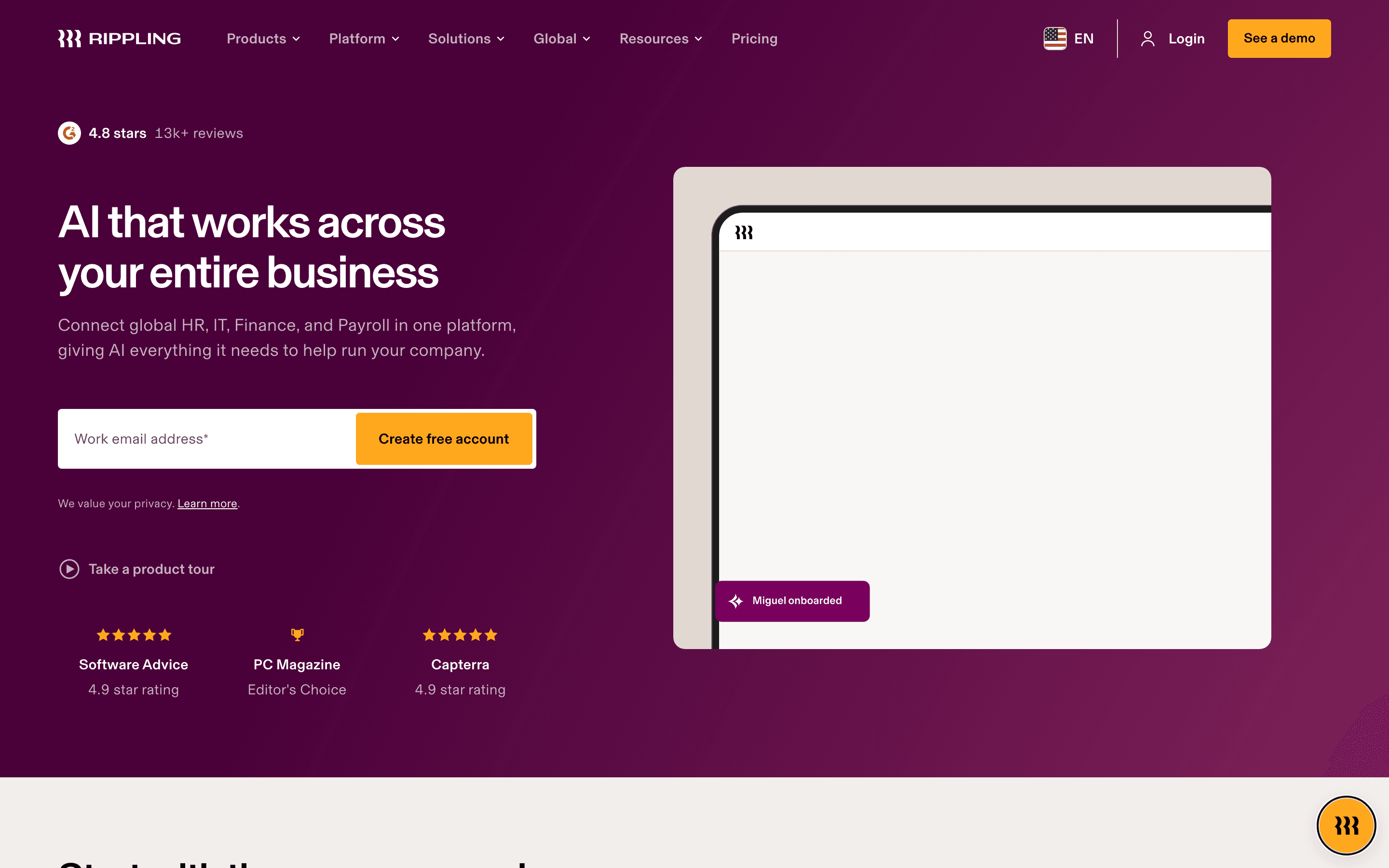
Rippling is the alternative that most resembles Workday's own pitch: one employee record that fans out to payroll, benefits, device management, and even spend management, so a hire or termination doesn't need re-entering in three systems. Where it diverges is speed and packaging. Modules are turned on individually per company rather than sold as one enterprise-wide suite, and third-party buyer data reports typical blended costs in the $15-50 per employee per month range once a few modules are active, though Rippling itself publishes no prices and routes every deal through a sales demo. Its IT layer stands out among HR platforms: device management (MDM) and automated app provisioning and deprovisioning tied directly to HR events like hires, terminations, and role changes is unusually deep. The tradeoffs echo Workday's in miniature. There's no comparison-shopping without a call, multi-year contracts are common, and Rippling publishes no starting price at all, only third-party contract data suggesting $15-50/employee/month once a few modules are active.
Pros
- + One employee record drives HR, payroll, IT provisioning, and spend management, cutting duplicate data entry across systems
- + Device and SaaS app management (MDM plus automated provisioning/deprovisioning) runs deeper than most HR platforms offer
- + Global payroll and EOR options let one company run payroll for both US and international employees from the same system
Cons
- – No published pricing anywhere on the site. Every price requires a sales demo and custom quote, which makes it hard to comparison-shop
- – Modular, per-module PEPM pricing means the advertised low starting price rarely reflects what a company with payroll, benefits, and IT modules will actually pay
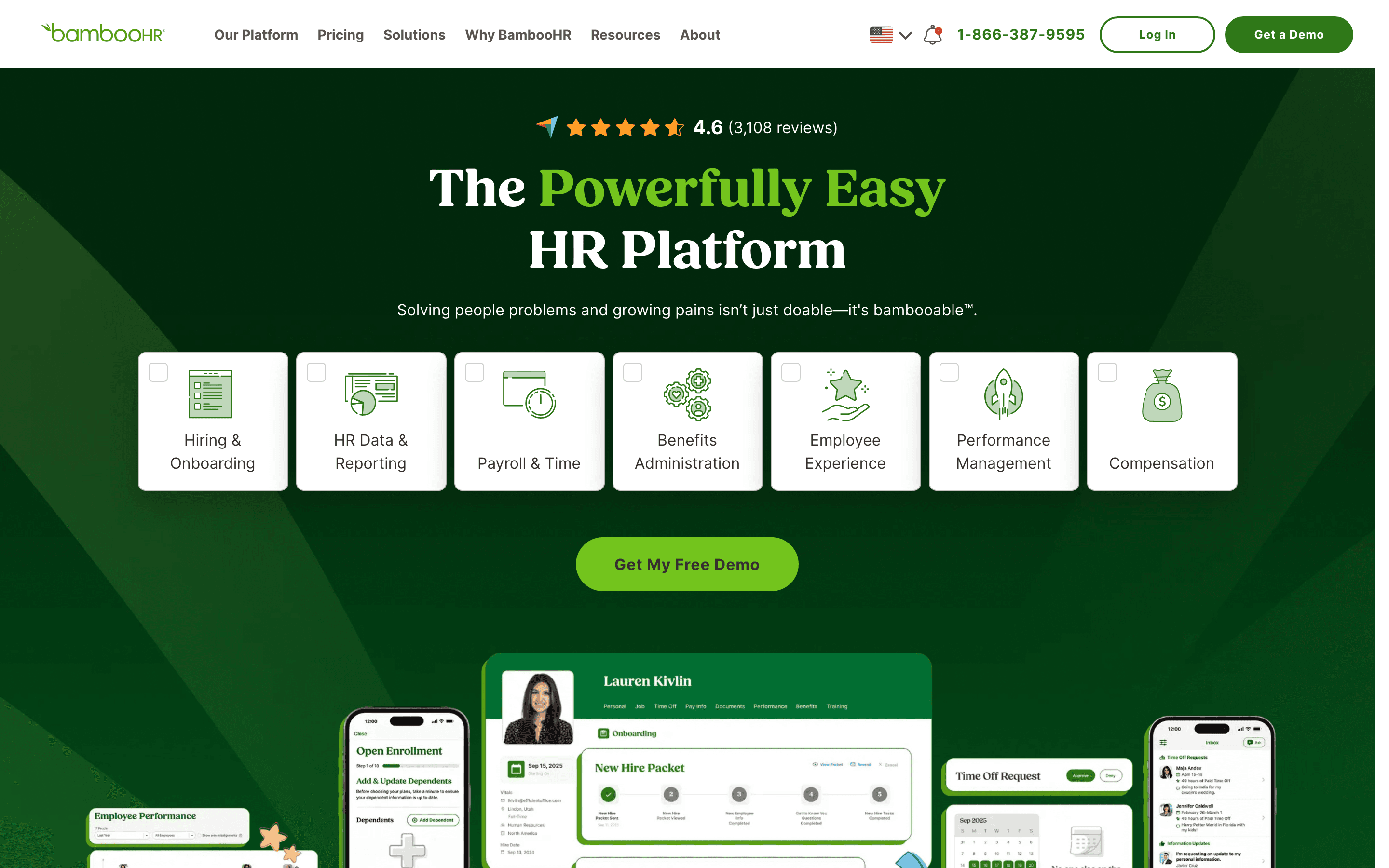
BambooHR targets the company Workday was never built for: roughly 25-500 employees that want one place for HR records, hiring, onboarding, and time off without an ERP-scale rollout. It's one of the few HCM competitors that puts real numbers on its pricing page: $10, $17, and $25 per employee per month for Core, Pro, and Elite. Buyers still submit a 'Get Quote' form rather than checking out online, and companies under 25 employees pay a flat $250/month minimum instead of the per-seat rate. Its June 2026 Contractor Management launch, powered by Remote, lets US customers pay international contractors from the same dashboard, narrowing one gap versus Workday's global reach. The catch: BambooHR's own payroll is US-only, compensation management and custom dashboards are locked behind the top Elite tier, and add-on pricing for payroll, benefits, and time and attendance isn't published. Companies that chose Workday to unify HR and finance in one system won't find that here.
Pros
- + One system of record for HR data, onboarding, time off, and performance reviews, with an easy-to-use interface people like
- + Modular add-ons (payroll, benefits admin, contractor management via Remote, on-demand pay via Clair) let customers add capability without switching platforms
- + Strong applicant tracking and onboarding workflows are a common reason SMBs pick BambooHR over spreadsheets
Cons
- – No self-serve checkout. Even though tier prices are public, every buyer still has to submit a 'Get Quote' request to sign up
- – Payroll and benefits administration are limited to US companies
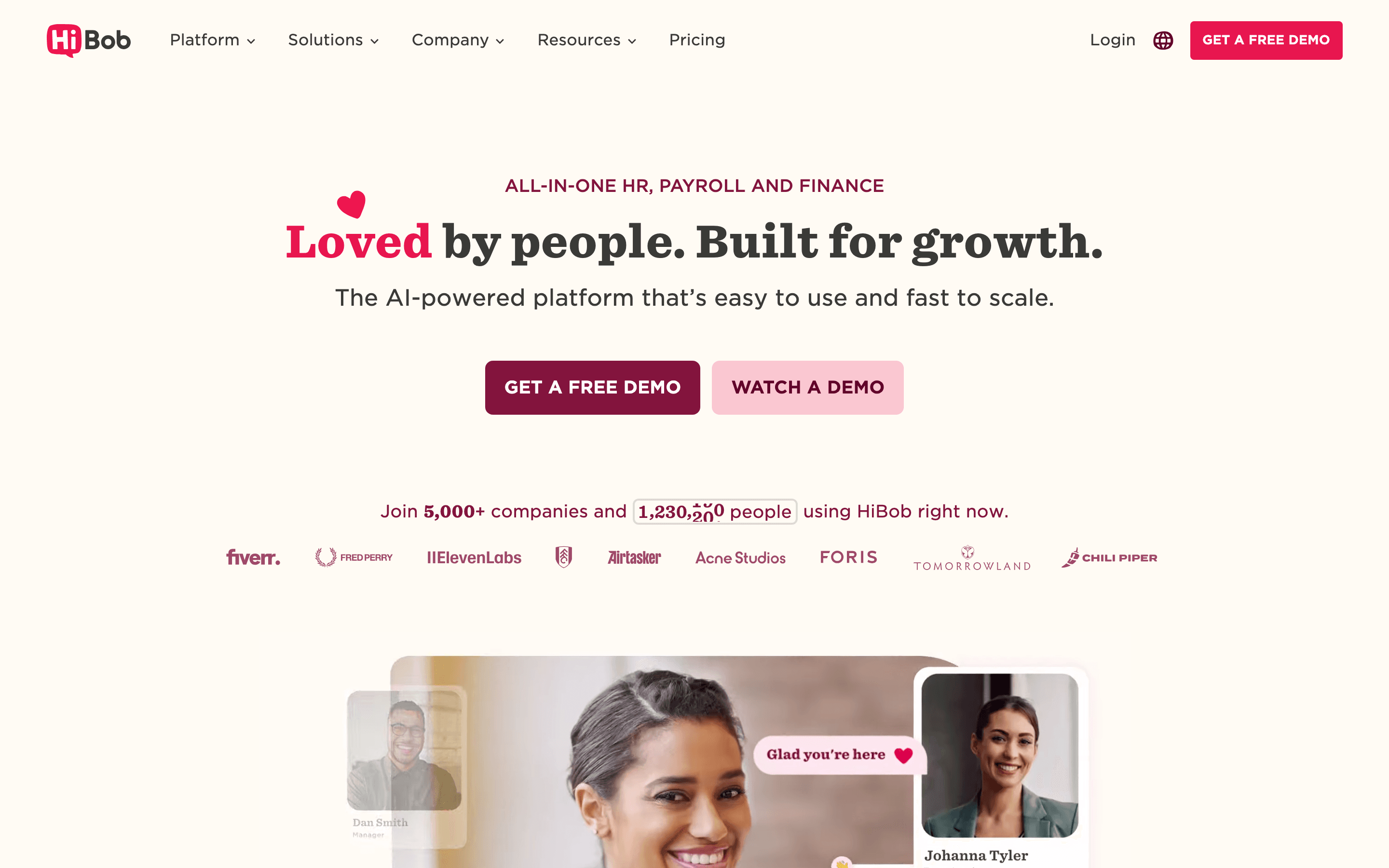
HiBob's pitch to Workday shoppers is less about matching enterprise depth and more about winning the parts of HR that Workday tends to treat as an afterthought: adoption and employee experience. A social home feed, shoutouts, and engagement surveys sit alongside a genuinely modular platform (Core HR, Talent, Payroll, Workforce Planning, and a newer Bob Finance module launched in November 2025) that a company can expand into over time, plus dozens of real-time analytics dashboards without needing a separate BI tool. Like Workday, HiBob publishes no pricing. Every deal is a custom quote based on headcount and modules, with a commonly reported implementation fee of 10-20% of first-year contract value on top. Recruiting and performance-management workflows are reported by users as thinner than dedicated best-of-breed tools, and the mobile app doesn't always mirror desktop functionality. It fits mid-sized, often distributed companies of roughly 75-5,000 employees that want one well-loved HRIS rather than Workday's combined HR-and-finance ambitions.
Pros
- + Widely praised, modern interface that reviewers repeatedly single out as one of the best in HR software, which drives higher employee adoption than older HR systems
- + Strong built-in analytics: dozens of real-time dashboards covering headcount, turnover, and engagement without needing a separate BI tool
- + Built for distributed, global teams with multi-currency and localized policy support baked into the core product
Cons
- – No public pricing: every deal requires a sales quote, which makes it hard to budget or compare vendors up front
- – Implementation fee commonly reported at 10-20% of first-year contract value on top of the per-employee subscription
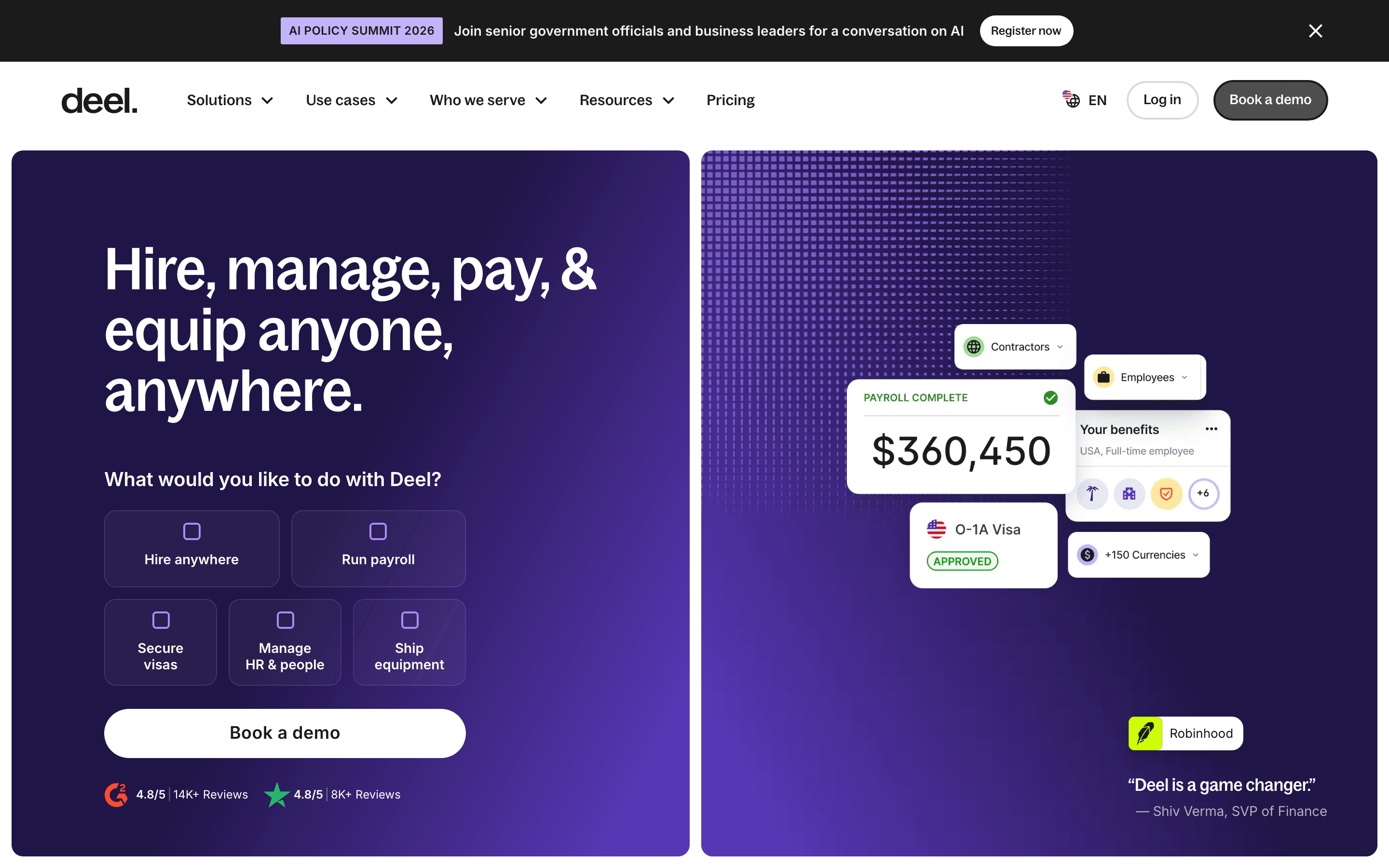
Deel isn't really one product competing with Workday. It's a stack of separately priced services, including EOR, contractor management, contractor-of-record, global payroll, Deel HR, Deel IT, and Deel Mobility, that a company assembles as needed, usually starting with EOR or contractor payments before adding HR. Deel HR's Core module is the cheapest entry point of any tool in this comparison at $5/employee/month, a real published price rather than a quote, and legal employment coverage in 110+ countries removes the need to open foreign entities the way Workday assumes a company already has. Costs scale sharply from there: Standard EOR starts at $599/employee/month and Enterprise EOR at $899, and Contractor of Record jumps to $325/contractor/month versus $49 for standard contractor management. There's no free trial on any line, and estimating a full multi-product quote means reading several separate price lists rather than one page. Deel is the right call when the actual pain point is global hiring, not domestic HR.
Pros
- + Covers EOR, contractor payments, global payroll, HR, and IT device management under one login, so distributed teams need fewer vendors
- + Contractor management charges no subscription fee to the contractor, and USD-to-USD payouts carry no currency conversion cost
- + Legal employment coverage in 110+ countries removes the need to set up foreign entities to hire full-time staff
Cons
- – EOR pricing starts at $599/employee/month and rises to $899/employee/month for Enterprise. That's far more per head than running payroll through a domestic PEO
- – No free trial on any product line. You evaluate the platform through a sales demo, not self-serve signup
Gusto
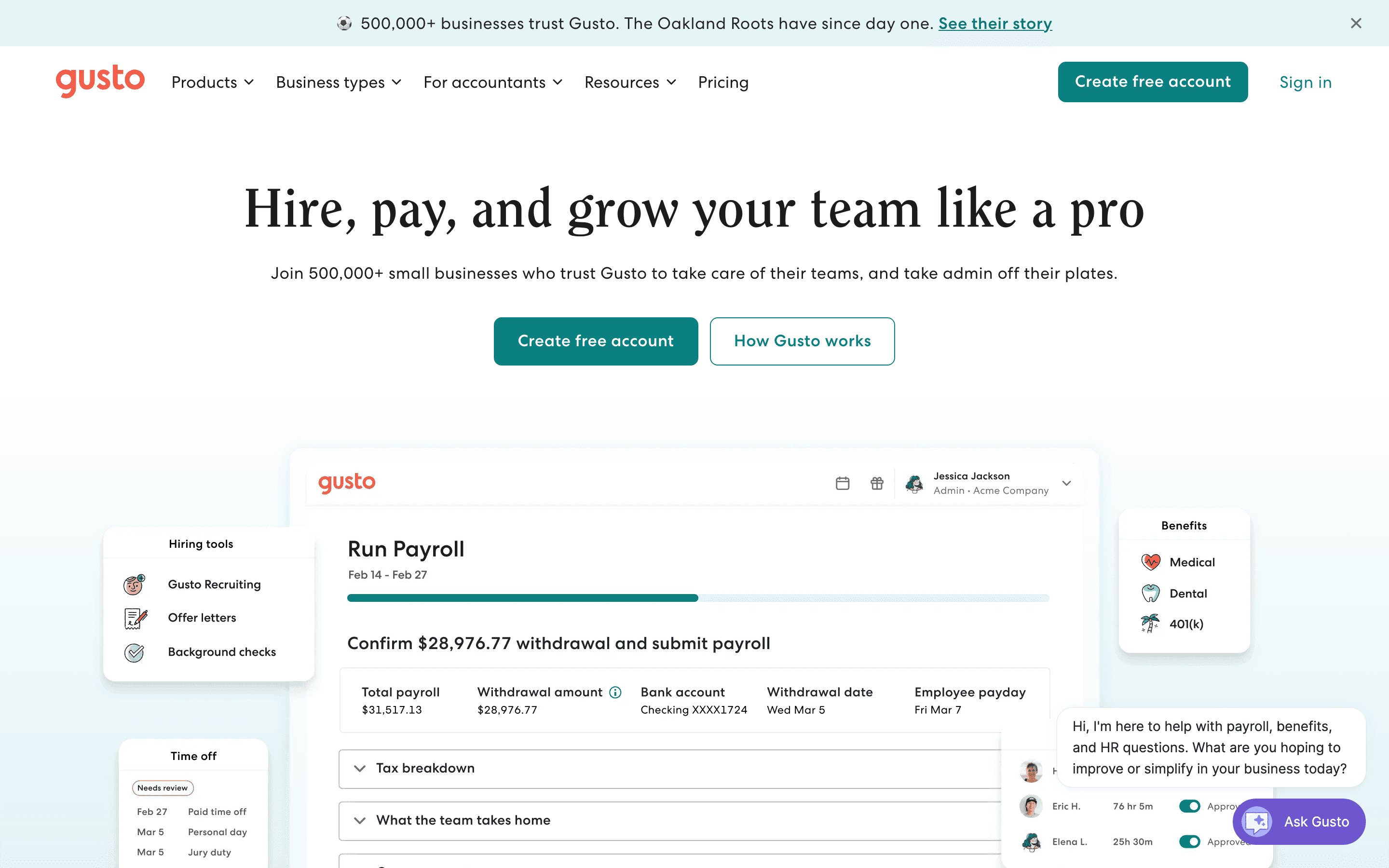
Gusto solves a much narrower problem than Workday: running US payroll correctly and cheaply. Four plans, Contractor Only, Simple, Plus, and Premium, combine a flat monthly base fee with a per-person add-on, from $35+$6/person up to $180+$22/person, and every tier includes unlimited payroll runs and full tax filing with no long-term contract. That transparency and month-to-month billing sit at the opposite end of the spectrum from Workday's quote-only, multi-year procurement process, and most small businesses can be running payroll within a day or two rather than months. The catch is scope: multi-state payroll forces an upgrade from Simple to Plus, core HR extras like priority support and the HR resource center are paid add-ons even on Plus, and full-time payroll outside the US and 12 supported EOR countries isn't possible at all. Gusto raised Simple's base fee from $40 to $49 in March 2026, narrowing its price edge, but it remains far cheaper than anything Workday-scale.
Pros
- + Every plan includes unlimited payroll runs and full tax filing at no extra charge
- + No long-term contract, month-to-month billing, cancel any time
- + Guided self-serve setup that most small businesses finish in one to two days, versus multi-week rollouts on heavier HRIS platforms
Cons
- – Per-person fees stack on top of the base fee, so total cost scales quickly as headcount grows
- – Multi-state payroll requires upgrading from Simple ($49/mo) to Plus ($80/mo), which pushes many growing teams into a pricier tier
SAP SuccessFactors is the alternative least likely to solve what actually pushed someone off Workday, since it shares nearly all of the same complaints: no published pricing, sales-quote-only access, and third-party estimates of $250,000-$500,000 in year-one cost plus $100,000 to over $2 million in implementation for mid-market and enterprise deployments. What it offers instead is a reason to switch for a specific buyer: companies already running SAP ERP/S4HANA that want HR data natively integrated with that finance backbone, something Workday can't provide since it's a separate ecosystem. The 1H 2026 release added suite-wide agentic AI, including a Payroll Alert Resolution Agent, Goal Creation and Progress Agents, and a Learning Compliance Agent, plus native SmartRecruiters integration, showing investment comparable to Workday's own AI push. Mandatory support plans add roughly 22% of license cost on top of subscription fees. Treat this as a lateral move for SAP-centric enterprises, not a cost or simplicity upgrade over Workday.
Pros
- + Broad module coverage (core HR, payroll, recruiting, onboarding, learning, performance, compensation, succession) under one vendor
- + Deep native integration with SAP ERP/S4HANA and SAP Business Technology Platform for large SAP shops
- + Agentic AI features added across recruiting, payroll, learning, and performance in the 1H 2026 release
Cons
- – No published pricing anywhere. Every deal requires a sales call and a custom quote
- – Bundle module pricing means costs scale fast. Third-party estimates put a full suite at $250,000-$500,000 in year-one cost for a 1,000-employee company
Should your product be on this hr & hcm list?
If you build a tool that belongs next to the ones above, submit it. A human reviews every submission. Approved products get their own page with pricing and screenshots, plus a place in the comparisons where they fit. It is free. You sign in with your work email so you can follow the decision, and there is no password to create.
Workday alternatives: FAQ
What's the best Workday alternative for a small or mid-sized business?+
For companies under roughly 500 employees, BambooHR and Gusto are the most realistic fits. BambooHR publishes per-employee tiers from $10-$25/month for core HR, hiring, and onboarding, and Gusto starts at $49/mo + $6/employee for full-service US payroll with unlimited runs and tax filing included. Both let you see real prices without a sales call, unlike Workday.
Which Workday alternative has published pricing?+
BambooHR, Gusto, and Deel all publish real per-seat prices on their own pricing pages. Rippling, HiBob, and SAP SuccessFactors are quote-only for their core HR/HCM products, the same as Workday.
Is there a genuinely cheaper alternative for global payroll and hiring than Workday?+
Deel is built specifically for this: legal employment (EOR) in 110+ countries starting at $599/employee/month, and contractor payments in 120+ currencies from $49/contractor/month, both priced on Deel's own pricing page. Workday has no equivalent EOR or contractor-payment product at all.
Should a large enterprise leave Workday for SAP SuccessFactors?+
Usually only if it's already running SAP ERP/S4HANA. SuccessFactors shares Workday's quote-only pricing and multi-hundred-thousand-dollar implementation costs, so it solves an integration problem for existing SAP shops rather than a cost or simplicity problem versus Workday.
Workday alternatives: pricing compared
Entry price, billing model, and whether pricing is public. 3 of 7 publish pricing you can check without talking to sales.
| Tool | Starting price | Billing | Free option | Pricing disclosed |
|---|---|---|---|---|
| Workday | Custom / quote | quote-only | Trial (30 days, but only for the Workday Adaptive Planning module (financial planning), requested via a form; no trial is offered for core HCM/Payroll) | Not disclosed |
| Rippling | Custom / quote | quote-only | Trial (14 days for Rippling IT only; core HR/payroll requires a sales demo, no self-serve trial) | Not disclosed |
| BambooHR | $10/seat/mo | tiered | No | Public |
| HiBob | Custom / quote | quote-only | No | Not disclosed |
| Deel | $5/seat/mo | tiered | No | Public |
| Gusto | $49/seat/mo | tiered | Trial (No free trial on core plans; sign-up is free until you run payroll) | Public |
| SAP SuccessFactors | Custom / quote | quote-only | No | Not disclosed |
How we made these picks. We compare tools on public pricing, features, and hands-on assessment, then verify every price against the vendor's own page. We never accept payment for rankings. Read the full methodology. Spotted an error? Report it.
More hr & hcm comparisons
Further reading
- The real cost of quote-only pricing - Quote-only pricing means no vendor number exists until you book a call. 15 of 69 tools we track hide pricing this way, mostly enterprise suites.
- SaaS pricing tracker: 69 tools checked (July 2026) - We track pricing for 69 SaaS tools across 10 categories: entry price, free tier, billing basis, and check date, all grouped by category for July 2026.