Top Honeycomb Alternatives in 2026
Here for Honeycomb itself? See the full Honeycomb profile, pricing & reviews →
Suggest a change- If you want one platform that covers infrastructure, APM, logs, and security instead of tracing alone, choose Datadog. Datadog bundles infrastructure monitoring, APM, log management, and security into one product with over 1,000 integrations, so you stop running Honeycomb next to a separate infra tool.
- If you already run Prometheus, Loki, or Tempo and want to keep tracing on infrastructure you control, choose Grafana. Grafana Cloud's LGTM stack ingests OTLP natively across logs, traces, and metrics and bills on usage like Honeycomb, and you can self-host the open-source core, so you are never fully locked into a hosted bill.
- If you want one all-in-one platform but with per-seat pricing instead of Datadog's per-host/per-product metering, and value NRQL as a single query language across APM, infra, and logs, choose New Relic. New Relic covers APM, infrastructure, logs, and tracing in one login with a genuinely usable free tier (100GB ingest, one full platform user), and NRQL lets you query the whole platform instead of stitching together separate tools, though the first full-platform seat is $10/month on Standard, each additional seat is $99/month (up to 5), or $349-$418.80/month per seat unlimited on Pro.
- If cost predictability matters more than a mature APM feature set and you want to keep full-fidelity logs and traces without sampling, choose Axiom. Axiom's compression keeps storage cheap and its free tier covers 500GB of ingest a month, which undercuts Honeycomb's event-based Pro pricing for teams that just want to keep everything.
- If your real problem is errors breaking releases more than slicing high-cardinality traces, and you want one of the cheapest ways in, choose Sentry. Sentry ties every error straight to the release and commit that caused it, and its Team plan starts at $26 a month billed annually ($29 billed monthly) versus Honeycomb Pro's $150, a real difference for a small team.
- If you are already debugging with BubbleUp across high-cardinality OpenTelemetry traces or tracing AI agent runs, choose stay on Honeycomb. None of these five match BubbleUp's automatic dimension analysis or Honeycomb's Agent Timeline view for tracing LLM agent workflows, and switching would mean giving up the exact debugging workflow that likely drew you to Honeycomb in the first place.
Honeycomb built its name on BubbleUp: draw a box around a spike in a graph and it tells you which dimensions are different in that group, instead of making you guess which dashboard to check next. That works well for teams sending high-cardinality OpenTelemetry traces and debugging production issues that live in the intersection of user ID, region, and build version rather than a CPU graph.
Teams leave Honeycomb for two main reasons: the event-based bill can climb faster than expected as traffic or instrumentation grows, and some teams want one platform that also covers infrastructure and host monitoring instead of tracing alone. The alternatives below cover both directions, from full-stack incumbents to cheaper, usage-based tracing tools.
Honeycomb alternatives compared
| Tool | Best for | Starting price | Free option | Last update |
|---|---|---|---|---|
| DatadogBest for one-platform breadth | Teams that want one platform for infra, APM, and logs instead of stitching together open source tools | $15/host/mo | Yes | June 2026 |
| GrafanaBest if you already run Prometheus or Grafana | Teams that already run Prometheus, Loki, or Tempo and just want a dashboard layer on top | $19/mo | Yes | June 2026 |
| New RelicBest for all-in-one with a usable free tier | Teams that want one platform for APM, infra, logs, and traces instead of running several separate tools | $10/seat/mo | Yes | June 2026 |
| AxiomBest for cost-predictable full-fidelity logging | Teams that want to keep full-fidelity logs and traces at high volume without paying per-host or per-GB-ingested list price | $25/mo | Yes | June 2026 |
| SentryBest value / cheapest annual switch | Engineering teams that want error alerts tied directly to the code and release that broke | $26/mo | Yes | July 2026 |
Why teams switch from Honeycomb
Costs can rise sharply as traffic grows, traces get deeper, or teams add more OpenTelemetry attributes
Honeycomb bills by event volume rather than seats or hosts, so instrumentation growth shows up directly in the bill.
Sending all infrastructure events without sampling gets expensive
A G2 reviewer cited in third-party analysis said unsampled infra event volume pushed costs up, which is why teams need a deliberate sampling strategy to keep spend predictable.
Enterprise pricing is quote-only past the Pro plan
Budgeting beyond Pro's roughly 750M events/month requires a sales conversation instead of a self-serve number.
The best Honeycomb alternatives, ranked
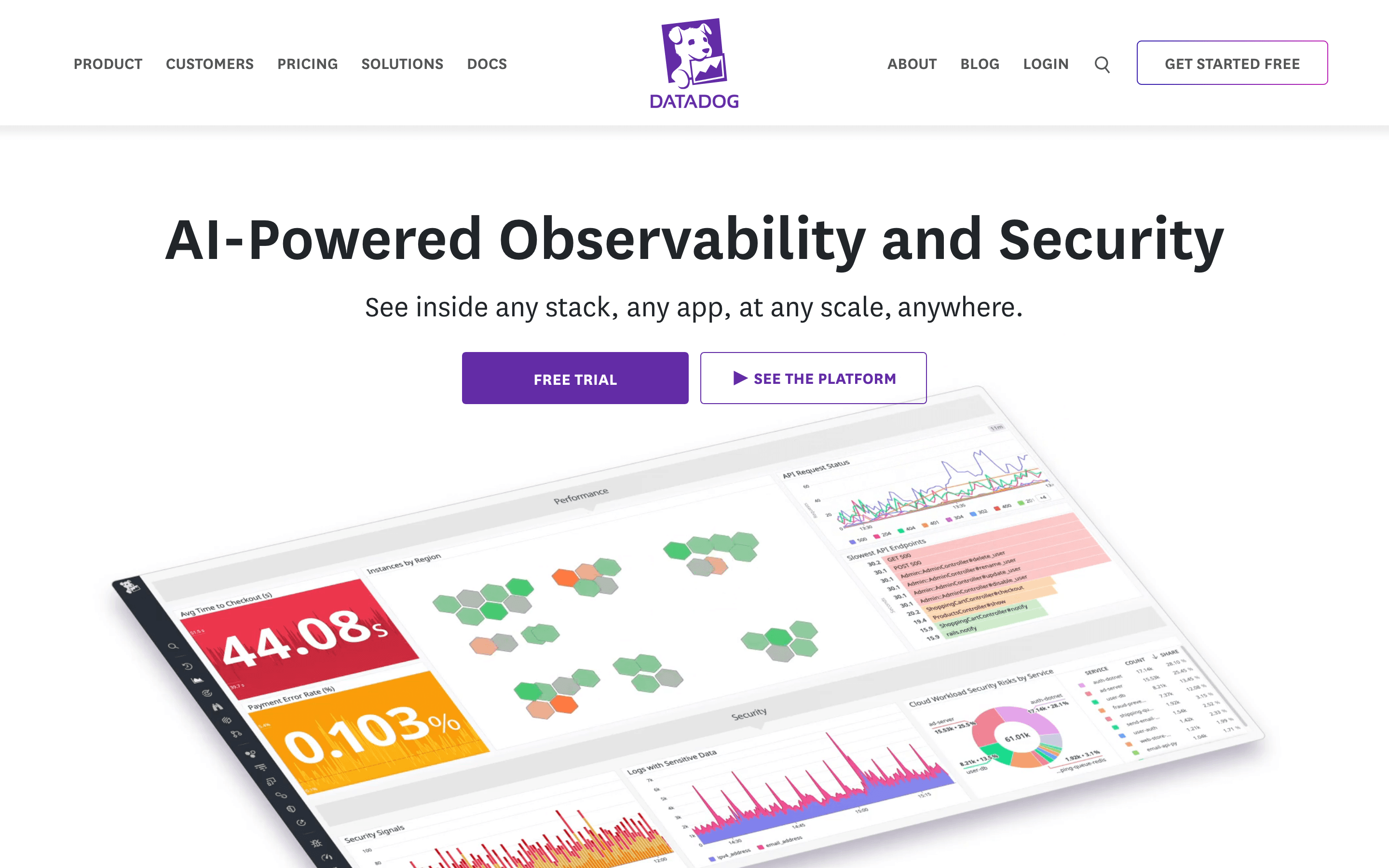
Datadog is the platform most teams put next to Honeycomb when the conversation shifts from 'best tracing tool' to 'one vendor for everything.' It covers infrastructure metrics, APM, logs, real user monitoring, and security in a single product, backed by more than 1,000 integrations, so a team can drop Honeycomb and also stop paying for a separate host-monitoring tool. The tradeoff is the billing model: instead of Honeycomb's single event-based number, Datadog meters infra hosts, APM hosts, log ingestion, log indexing, and custom metrics separately, and host counts use a high-water-mark calculation that bills a multi-day autoscaling spike at its peak for the whole month. Datadog also lacks anything as fast as BubbleUp for isolating which dimension explains an anomaly. Pick it for breadth, not for matching Honeycomb's specific debugging workflow.
Pros
- + Covers infra, APM, logs, RUM, and security in one product with shared dashboards and one query language
- + 1,000+ integrations, so most cloud services and tools plug in without custom work
- + Free tier and 14-day trial with no credit card, so you can test it before committing
Cons
- – Pricing is split across many separately metered products (hosts, containers, custom metrics, log ingestion, log indexing), so the real bill is hard to predict from the pricing page alone
- – Host billing excludes only the top 1% of hourly readings each month, so a multi-day autoscaling spike, not just a brief one, can set the whole month's charge at that peak
Grafana is the closest technical cousin to Honeycomb on billing model, not on data model: both bill on usage rather than seats, and both appeal to engineers who want to query raw telemetry rather than click through fixed dashboards. But Grafana Cloud is the LGTM stack (Loki for logs, Grafana for visualization, Tempo for traces, Mimir for metrics), four separately-modeled backends rather than Honeycomb's single unified event model, though all three ingest OTLP data natively today. Grafana Cloud's free tier covers 10k metric series and 50GB each of logs, traces, and profiles a month, and the open-source LGTM stack can be self-hosted, so a team is never fully locked into a hosted bill the way Honeycomb's model requires. The catch is that Grafana meters seven or more independent dimensions at once, metrics cardinality chief among them, so adding labels or a second Kubernetes cluster can multiply the bill faster than raw data volume would suggest. There is no BubbleUp equivalent; you build the correlation yourself across separate backends.
Pros
- + Real free forever tier: 10k metric series and 50 GB each of logs, traces, and profiles per month, no credit card
- + Self-hosting the open-source core is a genuine option, not just a marketing claim, so you're never fully locked into the cloud bill
- + Volume discounts kick in automatically as usage grows, and Adaptive Metrics/Adaptive Logs can cut ingested volume automatically
Cons
- – Metrics pricing is driven by cardinality, not raw data volume, so adding labels or a second Kubernetes cluster can multiply your series count and your bill far faster than you'd expect
- – Costs are metered across seven or more independent dimensions (metrics, logs, traces, profiles, k6, synthetics, hosts), each with its own rate, which makes the bill hard to forecast
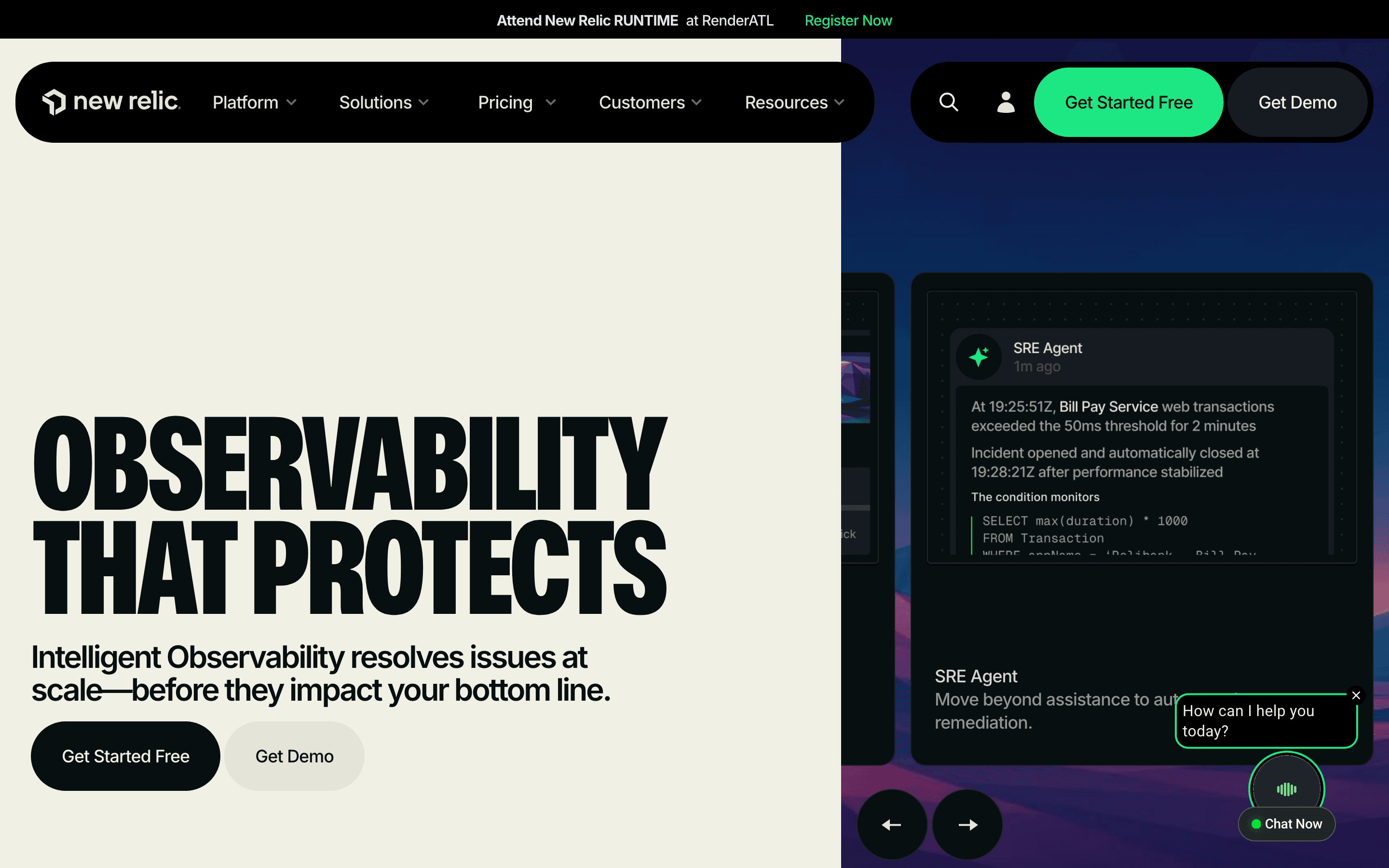
New Relic makes sense for a team leaving Honeycomb that wants APM, infrastructure, logs, and tracing in one login rather than a tracing-focused specialist tool. Its free tier includes 100GB of ingest a month and one full platform user, and NRQL gives a real query language across the whole platform. A single full platform seat is only $10 a month on the Standard plan, but each additional seat (up to 5) costs $99 a month, and a team that wants unlimited full platform seats has to move to Pro at $349-$418.80 a seat, so teams past the first user often restrict most engineers to read-only access and route incident work through a few licensed people, the opposite of Honeycomb's unlimited-seats model. New Relic also just shipped Preflight, an open-source MCP server that tracks token cost and session quality for AI coding assistants like Claude Code and Cursor next to your production telemetry, a feature none of the other alternatives here currently match.
Pros
- + One platform covers APM, infrastructure, logs, traces, and synthetics, so you're not paying for and maintaining separate tools
- + Genuinely useful free tier: 100 GB/month ingest and one full platform user, no credit card required
- + NRQL gives you a real query language across all your telemetry instead of a fixed set of dashboards
Cons
- – Full platform seats, the tier that unlocks APM and distributed tracing, cost $99-$418.80/month depending on plan, so giving your whole team incident access gets expensive fast
- – Engineers on cheaper Core or Basic seats can't see APM or tracing during an incident, which pushes teams toward screen-sharing with a licensed colleague
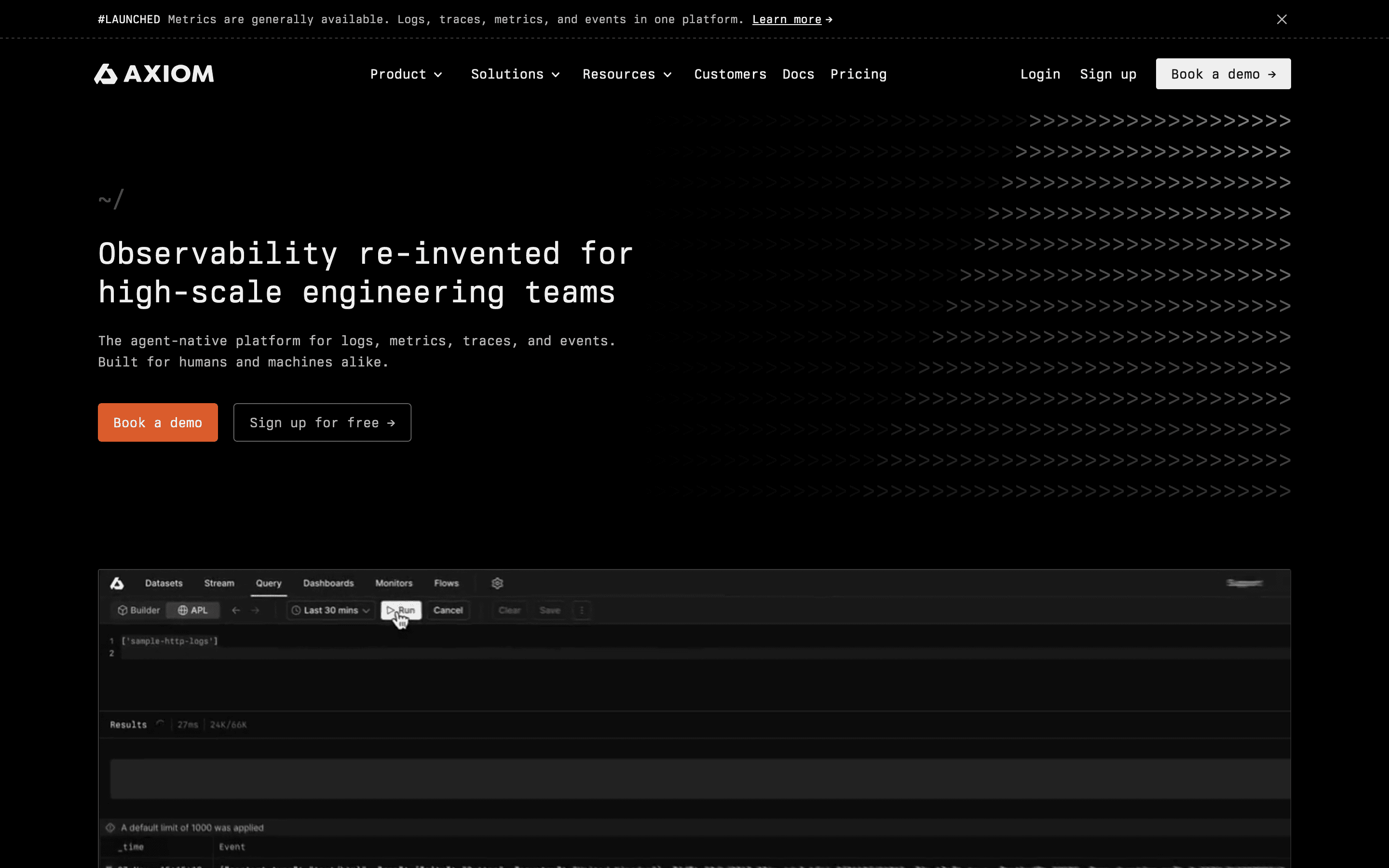
Axiom is the alternative that keeps Honeycomb's usage-based, OpenTelemetry-native shape but optimizes hard for cheap, full-fidelity retention instead of debugging features. The free Personal plan covers 500GB of ingest and 25GB of storage a month for one user, and the paid Cloud plan is a flat $25 platform fee plus metered credits with no minimum commitment. Compression keeps long retention affordable in a way per-GB-stored tools aren't. What you give up is maturity: Axiom's metrics and dashboards are newer and thinner than a dedicated APM tool's, there is nothing resembling BubbleUp, and query compute itself is metered, so heavy ad hoc querying during an incident, exactly when you need it most, can spike the bill. Best for teams that want to stop sampling and just keep everything, cheaply.
Pros
- + Generous always-free allowance (500 GB ingest, 25 GB storage) that's usable for real small projects, not just a trial
- + No minimum commitment on the paid plan, just a $25/month base fee plus metered usage
- + Storage costs are low because of Axiom's compression, so keeping long retention windows doesn't get expensive the way it does on per-GB-stored tools
Cons
- – Query compute is metered, so a bad incident where you're running lots of ad hoc queries and refreshing dashboards can spike your bill right when you're already under pressure
- – The Bring Your Own Cloud plan for data residency has no published price, so teams have to talk to sales to even get a ballpark
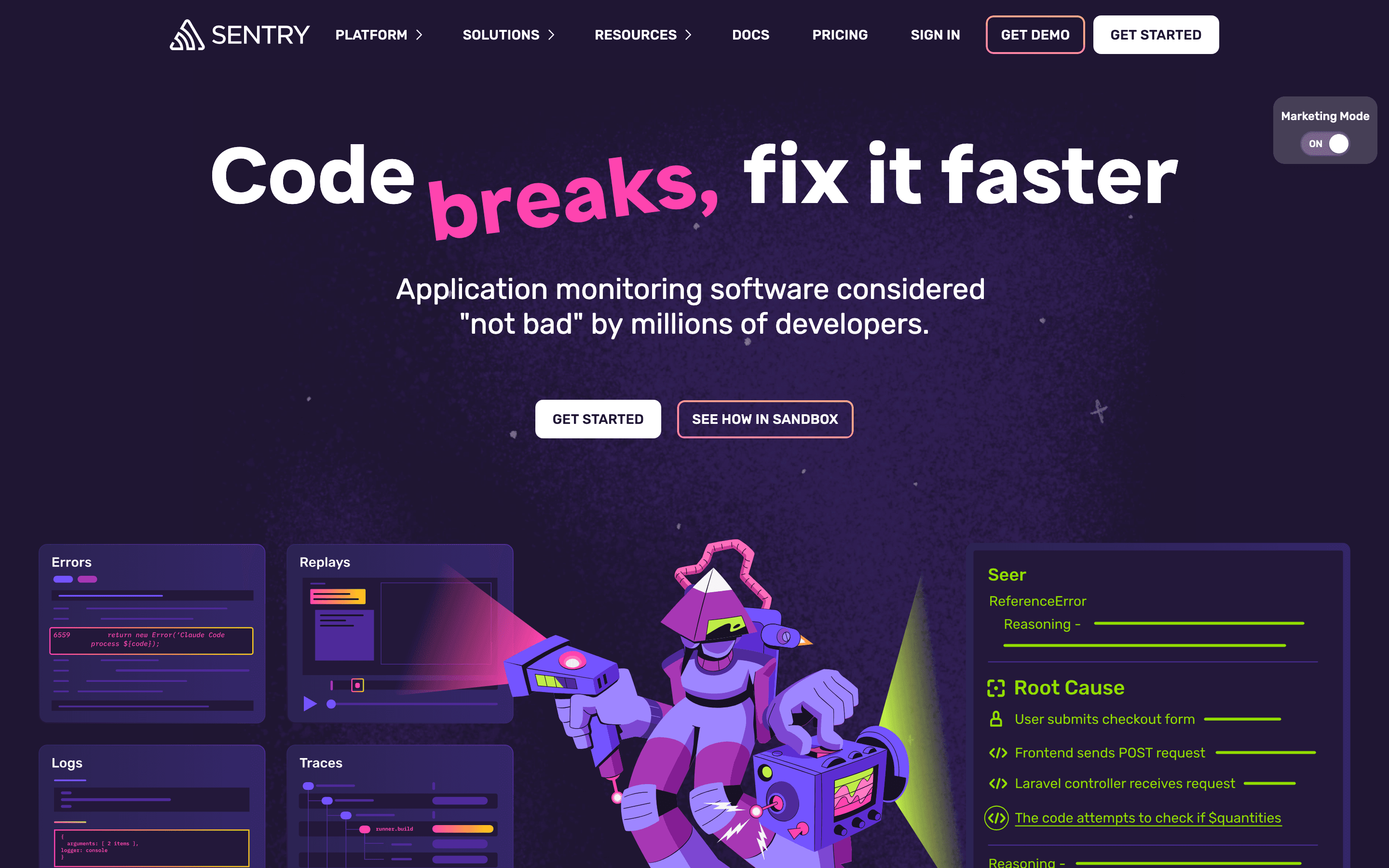
Sentry is the cheapest realistic switch on this list if you're ready to bill annually, and the right one if the job you actually need done is tying errors to the release and commit that caused them rather than slicing arbitrary high-cardinality dimensions. The free Developer plan covers 5k errors and 5M spans for one user, and the Team plan starts at $26 a month with unlimited users when billed annually ($29 billed monthly), versus Honeycomb Pro's $150. That said, Axiom's $25/month plan is billed monthly with no minimum commitment, so a buyer who isn't ready to commit annually can get in slightly cheaper there, though Axiom bills usage past its included allowance while Sentry's Team price is flat. Every tier's data quota and overage rate is published, so cost is easier to model up front. The gap is scope: Sentry's tracing exists to support error investigation, not to replace a dedicated observability platform, and usage-based billing still means a bad deploy or retry loop can spike a bill well past the prepaid quota once you're on the metered overage rates.
Pros
- + Free Developer plan covers a real amount of usage (5k errors, 5M spans) for solo projects, not just a token trial
- + Every tier's data quota and every overage rate is published on the pricing page, so you can model cost before committing
- + Unlimited users on paid plans means adding teammates doesn't raise the bill
Cons
- – Usage-based billing means a bad deploy or a retry loop can spike your bill in a single day: one documented case put error overages alone at roughly $5,700/month plus $1,560 in span overages on top of the $80 Business base, at 20M errors and 500M spans a month
- – Business-tier overage rates for errors and spans run about double the Team-tier rate at the same volume (e.g. $0.0003 vs $0.00015 per error at the highest usage tier); replay overage is priced the same on both plans
Should your product be on this observability & error monitoring list?
If you build a tool that belongs next to the ones above, submit it. A human reviews every submission. Approved products get their own page with pricing and screenshots, plus a place in the comparisons where they fit. It is free. You sign in with your work email so you can follow the decision, and there is no password to create.
Honeycomb alternatives: FAQ
What is the closest alternative to Honeycomb?+
Grafana Cloud is the closest match on billing model: both bill on usage rather than seats. Its data model differs, though, since the LGTM stack splits logs, traces, and metrics into separately-modeled Loki/Tempo/Mimir backends you correlate yourself, all of which accept OTLP natively, rather than Honeycomb's single unified event model, and Grafana meters far more separate dimensions overall.
Is there a cheaper alternative to Honeycomb for a small team?+
Sentry's Team plan starts at $26 a month billed annually ($29 billed monthly) with unlimited users, and its free Developer plan covers 5,000 errors and 5 million spans, both well under Honeycomb Pro's $150 starting price. Axiom's $25/month plan is cheaper still and has no minimum commitment, if you don't need Sentry's error-to-release tracking.
Which Honeycomb alternative avoids usage-based billing surprises?+
None fully do. Datadog, Grafana, Axiom, and Honeycomb itself are all usage-based, and even New Relic's per-seat model adds per-GB data overage on top. Sentry publishes every tier's overage rate up front, which makes it the easiest of the group to model in advance.
Does any alternative match Honeycomb's BubbleUp feature?+
Not exactly. Datadog and New Relic both have AI-assisted investigation features, but neither automatically isolates which dimension explains an anomaly the way BubbleUp does.
Honeycomb alternatives: pricing compared
Entry price, billing model, and whether pricing is public. 6 of 6 publish pricing you can check without talking to sales.
| Tool | Starting price | Billing | Free option | Pricing disclosed |
|---|---|---|---|---|
| Honeycomb | $150/mo | usage-based | Yes | Partly public |
| Datadog | $15/host/mo | usage-based | Yes | Partly public |
| Grafana | $19/mo | usage-based | Yes | Partly public |
| New Relic | $10/seat/mo | tiered | Yes | Partly public |
| Axiom | $25/mo | usage-based | Yes | Partly public |
| Sentry | $26/mo | usage-based | Yes | Partly public |
How we made these picks. We compare tools on public pricing, features, and hands-on assessment, then verify every price against the vendor's own page. We never accept payment for rankings. Read the full methodology. Spotted an error? Report it.