Top Opsgenie Alternatives in 2026
Here for Opsgenie itself? See the full Opsgenie profile, pricing & reviews →
Suggest a change- If you want the closest like-for-like replacement with a published price and a mature escalation engine, choose PagerDuty. its free plan mirrors Opsgenie's own 5-user cap and Professional starts at a published $21/seat/month with 750+ integrations, so switching doesn't mean relearning how alerting works.
- If you want AI to write your incident timeline and postmortem instead of doing it by hand, choose incident.io. it's built to automate the post-acknowledgment work Opsgenie leaves entirely manual, drafting timelines and postmortems with AI inside the same Slack or Teams channel where the incident happened.
- If you want the deepest AI-assisted incident response, an AI scribe on every call plus an AI chat panel, and don't mind paying for two separate $20/seat products, choose Rootly. its AI scribe sits in on incident calls and its AI chat panel answers questions mid-incident, work Opsgenie leaves to you, though Incident Response and On-Call are billed as two separate products with no free plan.
- If you already pay for uptime monitoring and log tooling and want on-call folded into that same bill, choose Better Stack. its Responder seat routes alerts from the same logs, traces, and uptime checks you're already sending it, so incidents and the telemetry that explains them live in one timeline instead of two tools.
- If you already have an active Opsgenie contract and alerting still works for now, choose start migrating before the 2027 shutdown. Opsgenie's alerting engine still functions, so there's no need to rush the switch, but Atlassian shuts the product down entirely on April 5, 2027. PagerDuty is the closest like-for-like target, so line up your move to it well before the deadline rather than at the last minute.
Opsgenie still works if you already have it, but Atlassian closed it to new customers on June 4, 2025, and plans to shut it down entirely on April 5, 2027. If you're setting up on-call alerting today, or planning your migration off Opsgenie before that deadline, you need a tool that actually does the job Opsgenie does: routing alerts, running escalations, and tracking who's on call.
The four tools below all do that job. Where they differ is what happens after the page fires. Opsgenie hands off to manual work the moment an incident is acknowledged, no runbooks, no automated write-up. Every alternative here builds on that gap with runbooks, AI-drafted timelines, or postmortem automation, so the real choice is how much of that extra workflow you want to pay for.
Opsgenie alternatives compared
| Tool | Best for | Starting price | Free option | Last update |
|---|---|---|---|---|
| PagerDutyBest overall replacement | Engineering orgs already running complex, multi-team on-call rotations across many services | $21/seat/mo | Yes | June 2026 |
| incident.ioBest for AI-drafted postmortems | Engineering teams already living in Slack or Teams who want incident channels, paging, and status pages in one tool | $15/seat/mo | Yes | June 2026 |
| RootlyBest for AI-native incident response | Teams that already run incident response inside Slack and want less manual timeline and retro writing | $20/seat/mo | Trial (About 2 weeks) | July 2026 |
| Better StackBest if you want monitoring and on-call in one bill | Small to mid-size engineering teams that want uptime monitoring, logs, and on-call in one tool instead of stitching together three vendors | $29/seat/mo | Yes | November 2025 |
Why teams switch from Opsgenie
Atlassian closed Opsgenie to new customers and is shutting it down entirely
Opsgenie stopped selling to new customers on June 4, 2025, and Atlassian plans a full shutdown on April 5, 2027, forcing every remaining customer onto Jira Service Management or a different vendor.
The forced migration to Jira Service Management often costs far more
JSM Premium, the tier that matches Opsgenie Standard's features, lists at $51.42/agent/month against Opsgenie Standard's $19.95/user/month, a 158% increase confirmed by independent pricing analysis. incident.io's interviews with 125 customers put the real-world jump at roughly 2x as well, though that figure comes from a competitor's self-published research.
Reliability complaints about the alerting pipeline
Users on Atlassian's own community forum report Opsgenie's mobile app failing to override silent or Do Not Disturb mode on Android and iOS, so pages go unheard. incident.io's survey of 125 customers separately reported alerts not routing at all and stretches of full alerting outages, though that claim comes from a competitor's self-published research and isn't independently confirmed here.
The best Opsgenie alternatives, ranked
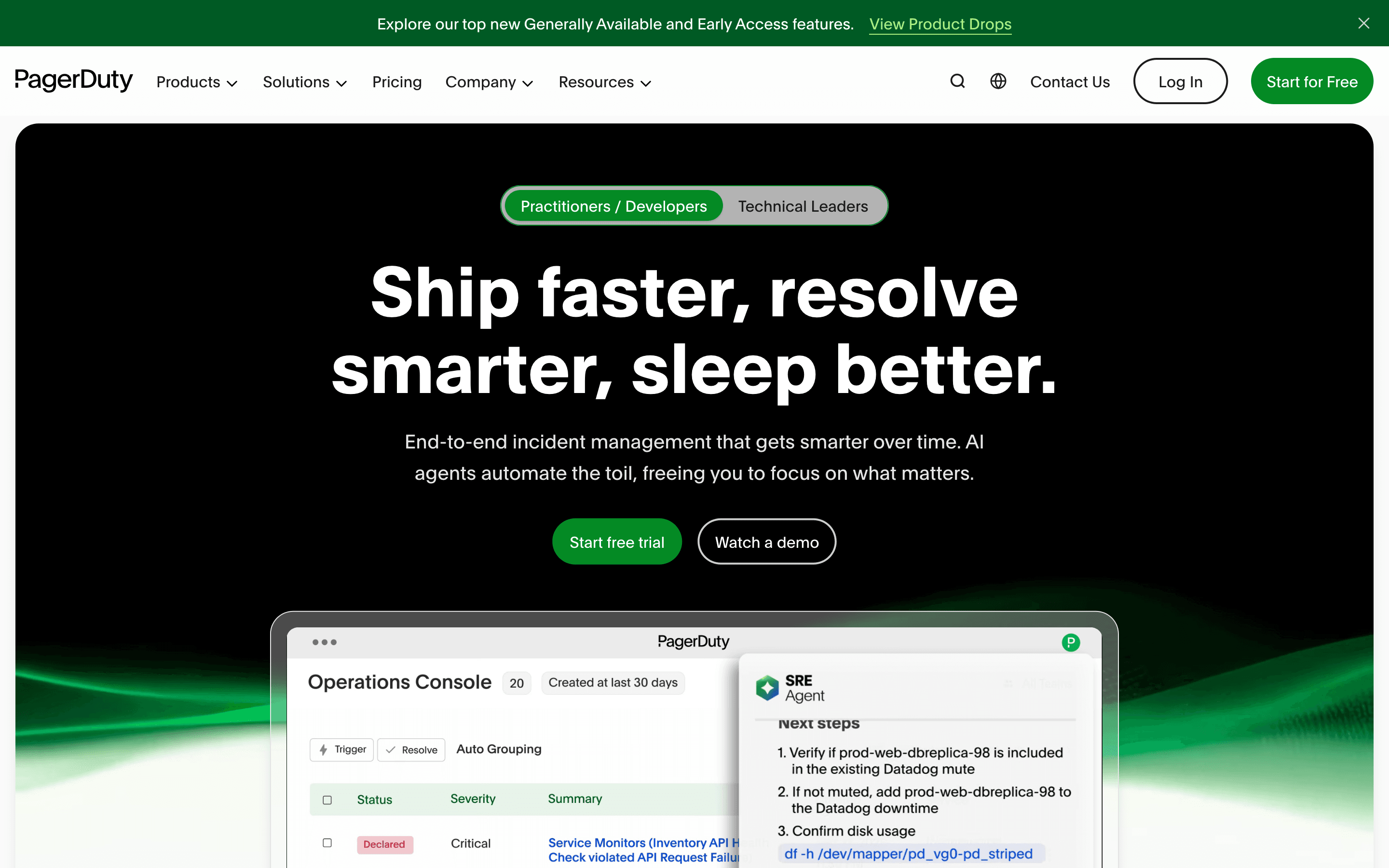
PagerDuty is the closest like-for-like replacement for Opsgenie's core job: alert routing, escalation policies, and on-call schedules, done at enterprise scale. Its free plan matches Opsgenie's, capped at 5 users with one schedule and one escalation policy, and Professional starts at $21/seat/month billed annually, close to Opsgenie's own Standard tier. What you get for the jump is 750+ integrations, mature ITSM tooling including bi-directional ServiceNow sync, and status pages built in rather than bolted on. The tradeoff shows up at renewal: reviewers and forum threads describe steep price increases once a team's usage grows, and Enterprise pricing isn't published. If your team just wants alerting and on-call that works the way Opsgenie did, without relearning a new workflow, PagerDuty is the safest migration target.
Pros
- + Free plan works for a small team's basic on-call needs, no card required
- + 750+ integrations cover almost any monitoring or ticketing tool you already run
- + Escalation policies, schedules, and post-incident review tooling are mature and battle-tested
Cons
- – Per-seat price climbs fast once you need custom fields, more incident types, or higher AI Action limits, and Enterprise pricing isn't published
- – Some capabilities, like advanced status page limits and premium chat actions, are split across tiers rather than included at one price
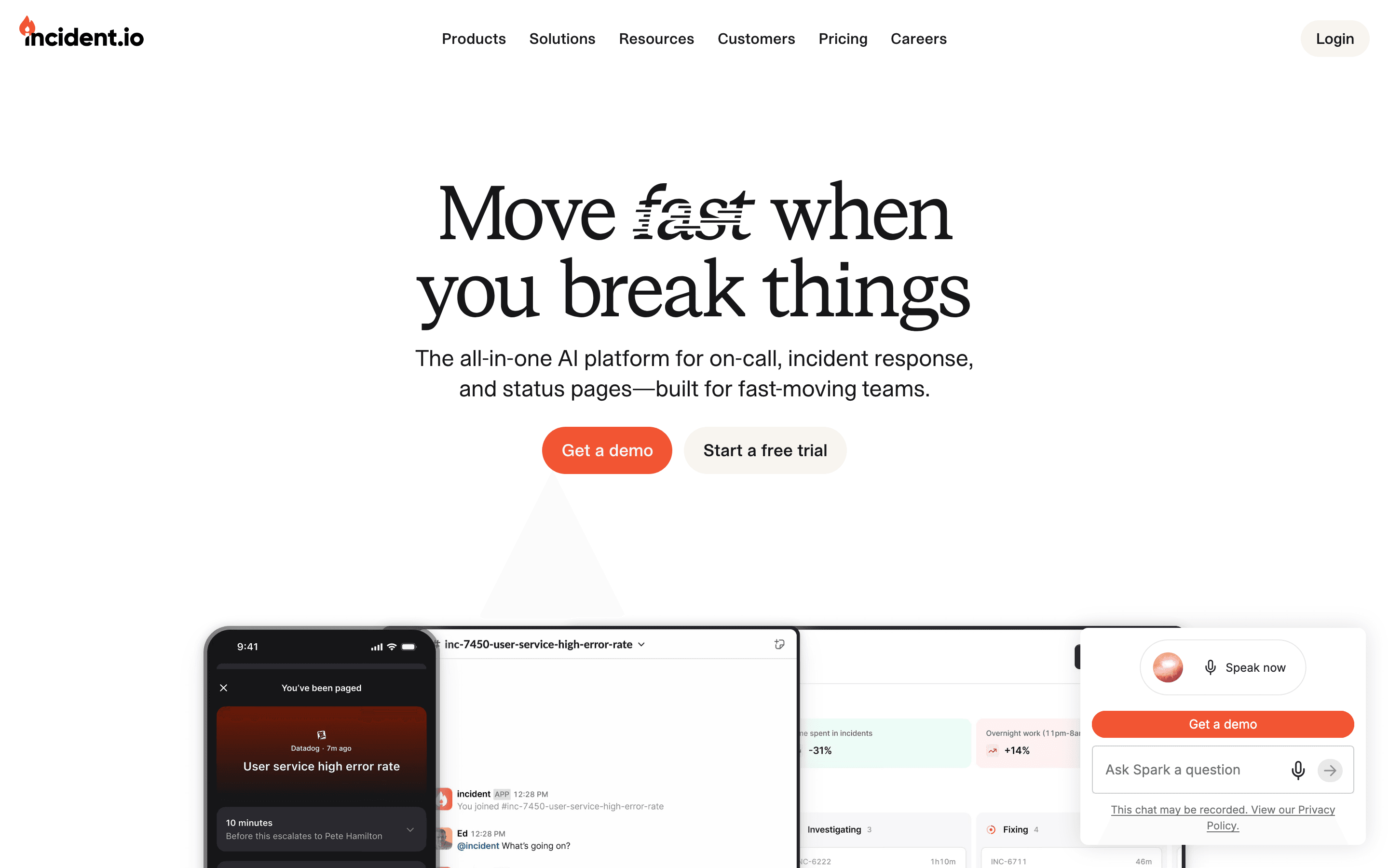
incident.io is built to fix the exact thing Opsgenie leaves undone: everything after an alert fires. It runs incident channels, on-call paging, and status pages inside Slack or Teams, then uses AI to draft the incident timeline and the first pass of the postmortem, work that's entirely manual on Opsgenie. The catch is the headline price. Team looks like $19/seat/month, but on-call paging is billed separately at $10-20/user/month on top, so a team running real rotations pays closer to $29-45/seat. Status pages are also limited until you reach Enterprise, whose pricing isn't published. For a team that wants less time spent writing up what happened and is fine paying for on-call as its own line item, incident.io is the strongest AI-native pick, and it ships new features fast.
Pros
- + Slack and Teams integration feels native, not bolted on
- + AI-written post-mortem drafts save real time after an incident
- + Status pages, on-call, and incident response are one product instead of three separate bills
Cons
- – The advertised per-seat price doesn't include on-call, which is a separate charge on top
- – Status pages are limited on lower tiers: Team gets one public page, Pro adds one internal page, unlimited pages only on Enterprise
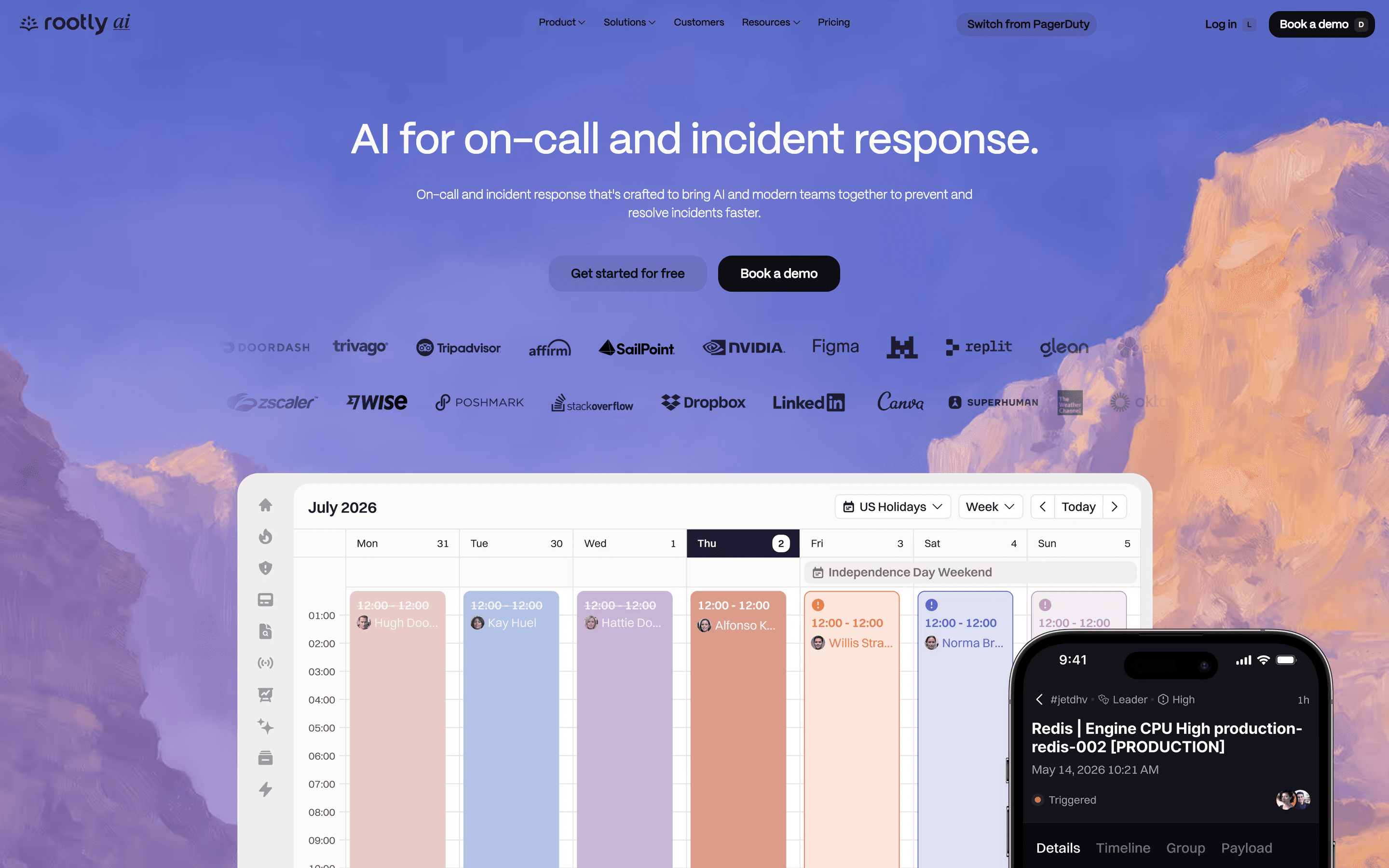
Rootly runs incident response inside Slack with an AI scribe that sits in on incident calls and an AI chat panel for asking questions mid-incident, both aimed at cutting the manual writing Opsgenie leaves to you. The catch is the price: Incident Response and On-Call are sold as two separate $20/seat/month products, so a team running both pays close to $40/seat, roughly double the $20 headline number, and there's no free plan at all. Rootly does run a startup discount, up to 50% off for younger, smaller companies, and pay-what-you-can under 25 employees. Contracts also commonly carry a 5-10% automatic annual increase unless you negotiate it out at signing. Rootly suits a team that wants the deepest AI-assisted incident workflow and has budget for two products instead of one.
Pros
- + Deep Slack-native workflow so responders don't have to switch tools mid-incident
- + AI scribe and AI chat cut down on manual timeline and retro writing
- + Startup program gives real discounts, including pay-what-you-can under 25 employees
Cons
- – Incident Response and On-Call are two separate $20/seat products, so a team using both is paying close to $40/seat, not $20
- – Enterprise pricing, SCIM, and unlimited schedules are all quote-only, with no published numbers
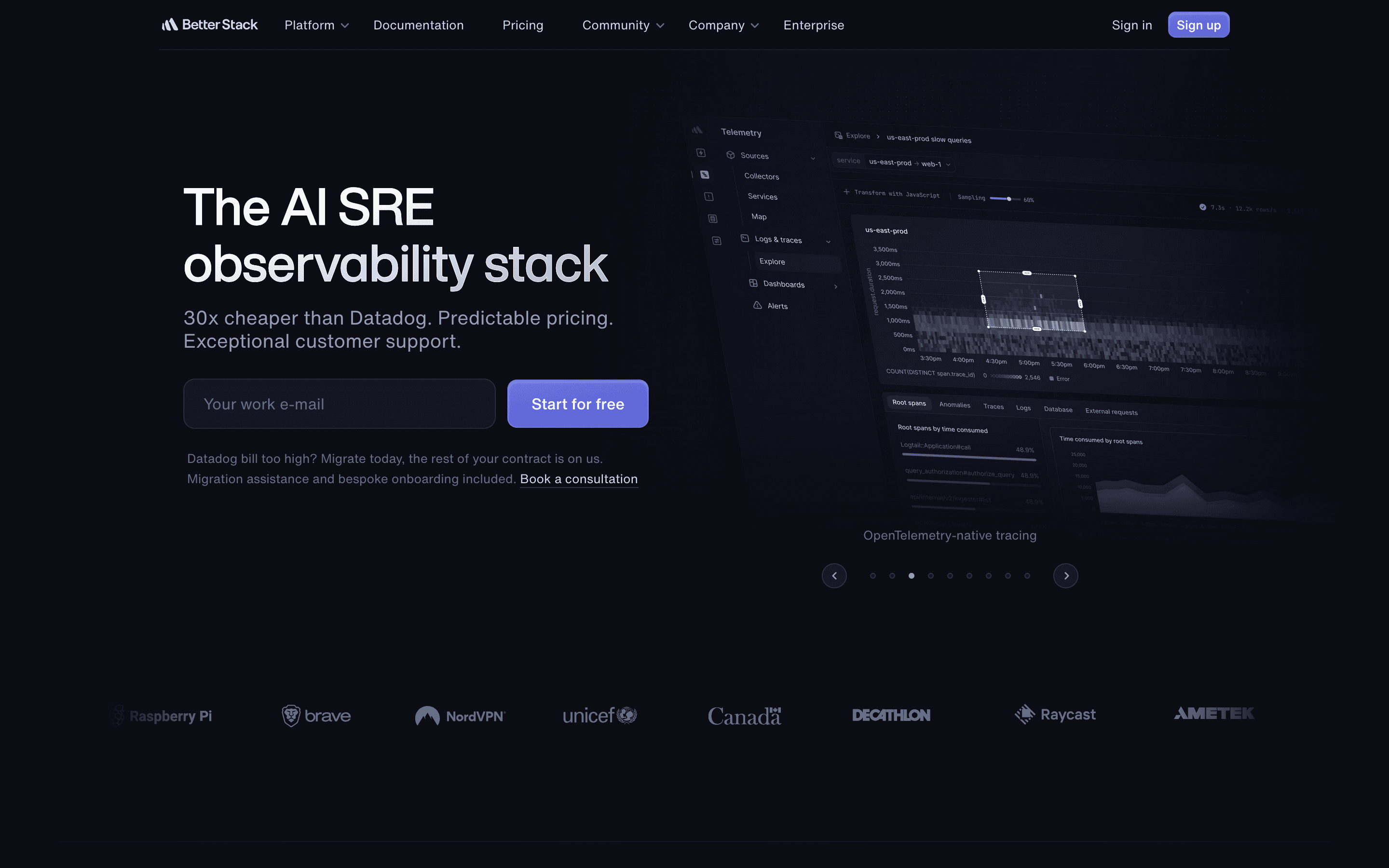
Better Stack folds on-call paging into a broader observability platform: uptime monitoring, logs, traces, and error tracking sit next to escalation policies and schedules in one dashboard. A Responder seat, the piece that actually replaces Opsgenie's paging, runs $29-34/seat/month, more than Opsgenie's own Essentials tier or PagerDuty's entry Professional plan. Nearly everything past that base seat, status pages, Slack/Teams workflows, call routing, SSO, is billed as a separate add-on, so the real monthly bill takes work to model even though every line item is published. It's also the newest entrant to incident management specifically, so its escalation and postmortem tooling has less track record than the others here. Better Stack is the right call for a team that already wants to consolidate monitoring and on-call under one bill, not one that just wants simple paging.
Pros
- + Responder pricing ($29-34/seat/month) is public and itemized down to the dollar for every add-on, unlike vendors that gate on-call pricing behind a sales call
- + Free tier is genuinely usable: 10 monitors, 100k exceptions, and 5k session replays a month at $0
- + On-call, uptime checks, and telemetry live in one product, so incidents and the logs that explain them sit in the same timeline
Cons
- – Real monthly cost is hard to predict because status pages, call routing, Slack/Teams workflows, SSO, and audit logs are all separate paid add-ons
- – Phone/live support is reserved for higher-spend accounts, so smaller teams are on email and chat
Should your product be on this incident management & on-call list?
If you build a tool that belongs next to the ones above, submit it. A human reviews every submission. Approved products get their own page with pricing and screenshots, plus a place in the comparisons where they fit. It is free. You sign in with your work email so you can follow the decision, and there is no password to create.
Opsgenie alternatives: FAQ
What's the best Opsgenie alternative overall?+
PagerDuty is the closest match to what Opsgenie does: alert routing, escalation policies, and on-call schedules, with a free plan that mirrors Opsgenie's own 5-user cap and a published price for the first two paid tiers.
Why are teams leaving Opsgenie?+
Atlassian closed Opsgenie to new customers on June 4, 2025, and will shut it down entirely on April 5, 2027. Independent pricing analysis shows the forced move to Jira Service Management Premium costs 158% more than Opsgenie Standard for the same feature set, and users on Atlassian's own community forum report Opsgenie's mobile alerts sometimes failing to override silent mode.
Is there a free Opsgenie alternative?+
Yes. PagerDuty's free plan covers 5 users, and incident.io's Basic plan is free with one schedule and one status page.
Which Opsgenie alternative is cheapest for a small team?+
incident.io's free Basic plan covers a small team at no cost, with one on-call schedule and one status page. PagerDuty's free tier also covers up to 5 users with basic paging. Both give a small team more headroom than Opsgenie's own free plan without paying up front.
Opsgenie alternatives: pricing compared
Entry price, billing model, and whether pricing is public. 5 of 5 publish pricing you can check without talking to sales.
| Tool | Starting price | Billing | Free option | Pricing disclosed |
|---|---|---|---|---|
| Opsgenie | $9.45/seat/mo | per-seat | Yes | Public |
| PagerDuty | $21/seat/mo | per-seat | Yes | Partly public |
| incident.io | $15/seat/mo | per-seat | Yes | Partly public |
| Rootly | $20/seat/mo | per-seat | Trial (About 2 weeks) | Partly public |
| Better Stack | $29/seat/mo | per-seat | Yes | Partly public |
How we made these picks. We compare tools on public pricing, features, and hands-on assessment, then verify every price against the vendor's own page. We never accept payment for rankings. Read the full methodology. Spotted an error? Report it.