Orum Review
AI parallel dialer built to raise live connect rates for outbound SDR teams
Is this your product? Claim this page · Request a change
Looking for a Orum alternative? See our ranked comparison.→What is Orum?
Orum is a parallel dialer for outbound sales teams. It calls multiple numbers at once per rep, uses AI to detect voicemail, screeners, and dial trees across 20+ languages, and bridges the first live human to the rep, so reps spend more of their day talking instead of listening to rings and voicemail.
It plugs into your existing CRM and sales engagement tools, Salesforce, HubSpot, Outreach, Salesloft, Gong Engage, and Apollo, rather than replacing them. Beyond dialing, Orum adds Salesfloor, where managers can drop into live calls as audio-only listeners, plus AI coaching that scores finished calls and runs AI roleplay practice.
It's built specifically for high-volume outbound calling teams, not as a general sales engagement platform. There's no email sequencing or LinkedIn outreach built in.
Orum screenshots
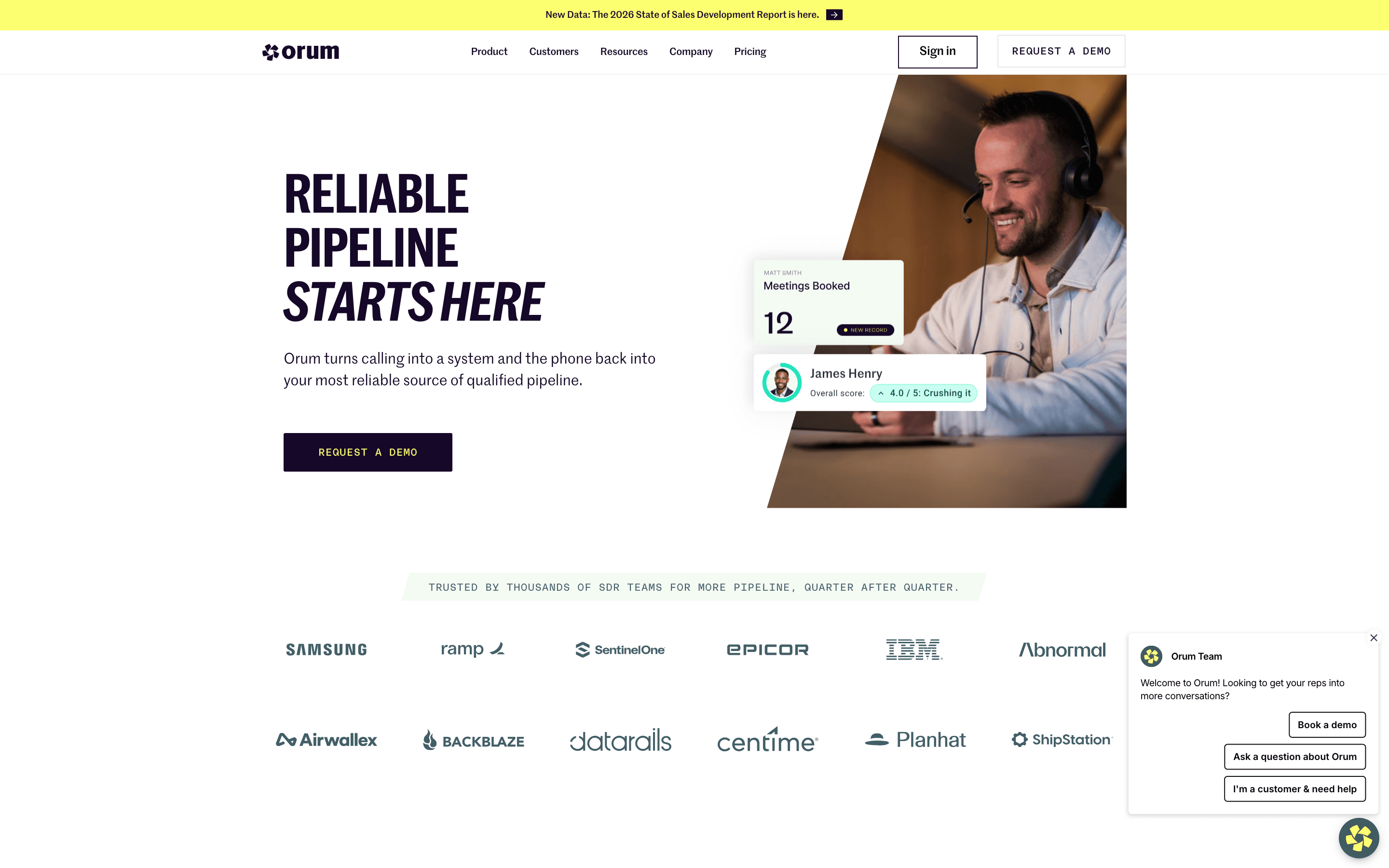

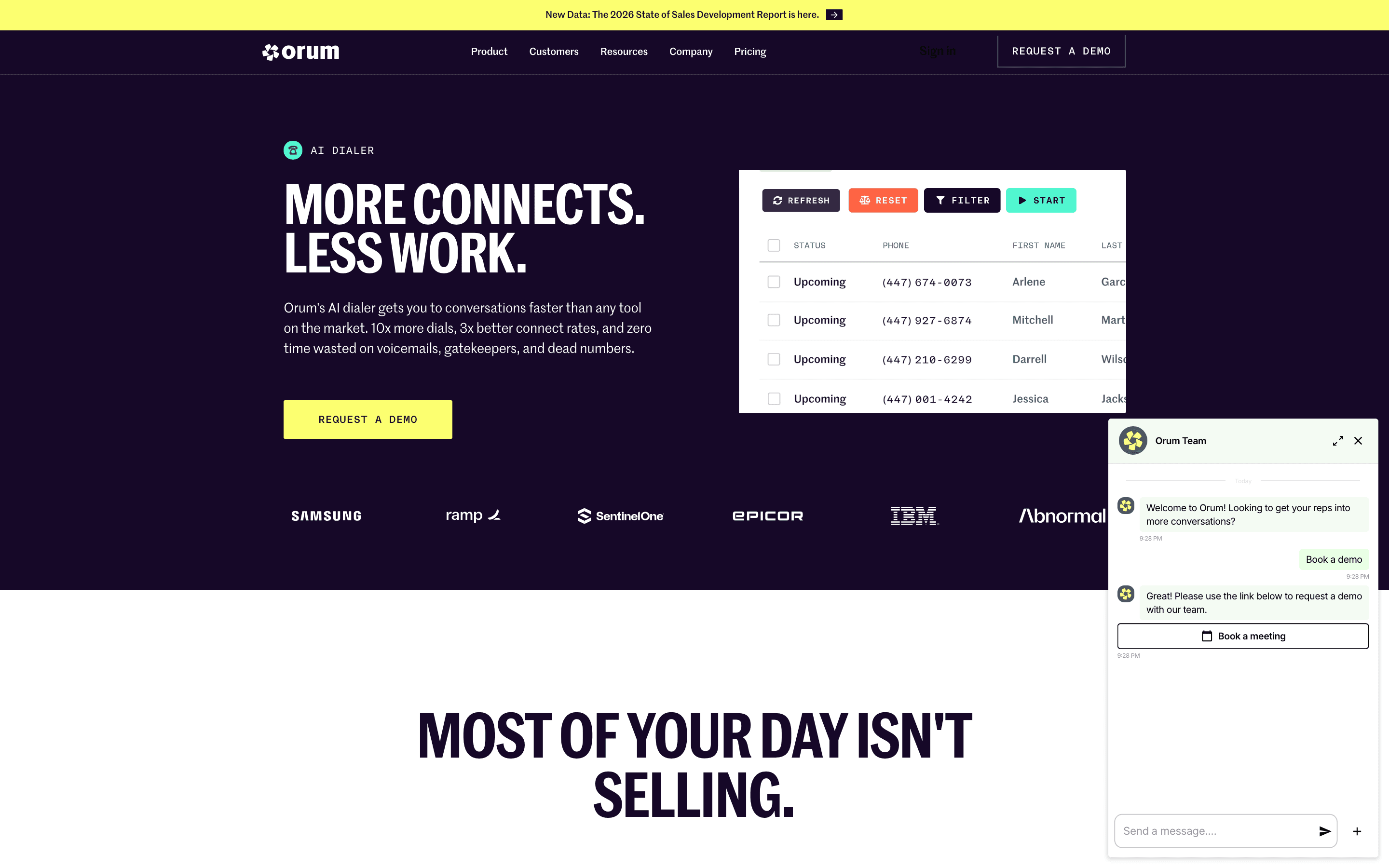
Who it's for
- ✓ SDR teams doing high volume cold calling who want to push dial counts up without adding headcount
- ✓ Sales orgs that already run Salesforce, Outreach, or Salesloft and want a dialer that sits on top of that stack
- ✓ Managers who want a live audio salesfloor view plus AI call scoring and roleplay coaching across a team of dialers
Who should look elsewhere
- ✗ Small teams or solo reps not ready for a 3-seat minimum and a 12-month contract
- ✗ Teams that want one tool for calling, email, and LinkedIn instead of stitching several together
- ✗ Reps who rely on long, relationship-building calls, since parallel dialing's connect delay works against natural conversation starts
Pros
- + Meaningfully increases raw dial volume per rep per hour compared with manual or single-line dialing
- + Deep integrations with the CRMs and sales engagement tools SDR teams already run
- + Salesfloor gives managers a live audio listen-in view without needing extra tools
- + Strong third-party review scores (7.9/10 composite and 95% likeliness to recommend on SoftwareReviews) driven by reliability and time saved on dialing
Cons
- – No published pricing, so every deal starts with a sales call and a quote
- – Annual contracts only, no month-to-month option to test it out
- – 3-seat minimum and reported per-seat costs well above most competing dialers
- – Parallel dialing's connection delay causes dropped starts and a lower connect-to-meeting conversion rate than single-line power dialing, per third-party reporting that cites Orum's own performance data
Orum pricing
What you pay for
Orum keeps its prices off the website entirely. You get plan names and feature lists, then a 'Request Pricing' button. Buyers who've gone through the sales process report per-seat annual pricing that starts high compared to most dialers, plus a 3-seat minimum and a mandatory 12-month contract, so budget for a real sales conversation before you can compare it against anything else on price.
No public entry price to compare, so budget depends on a sales quote.
| Plan | Price | Highlights |
|---|---|---|
| Launch | Custom | Unlimited dials · 5 caller IDs per month · Parallel dialing up to 5 lines · Analytics, Salesfloor, Boost Connect, multi-integration · 3-seat minimum |
| Ascend | Custom | Everything in Launch · International calling in 160+ regions · 200 data enrichment credits per month · Up to 10 parallel lines · 10 caller IDs per user per month · AI acceleration, advanced permissions · 3-seat minimum |
| Ascend Limited | Custom | Add-on tier for reps who don't dial full time |
Orum does not publish prices. Its pricing page routes every plan to 'Request Pricing' or a demo call. Third-party buyer reports and vendor-cost trackers put Launch at $250 per user per month billed annually with a 3-seat minimum (a $9,000/year floor), and Ascend at roughly $400-800 per user per month depending on team size and negotiation, plus a one-time onboarding/implementation fee commonly cited in the $1,000-$5,000 range. Treat those figures as market estimates, not confirmed vendor pricing, since they come from resellers and review sites rather than Orum's own site. All plans require an annual contract; there is no month-to-month option, and at least one buyer reported being held to a second year.
Pricing verified July 7, 2026 · source
How Orum's pricing compares
Orum next to its closest alternatives on entry price, billing, and whether pricing is public.
| Tool | Starting price | Billing | Free option | Pricing disclosed |
|---|---|---|---|---|
| Orum | Custom / quote | quote-only | Trial (Trial capped at 500 dials) | Not disclosed |
| Nooks | Custom / quote | quote-only | No | Not disclosed |
| Trellus | $34.99/seat/mo | per-seat | No | Partly public |
| Salesfinity | $200/seat/mo | per-seat | No | Partly public |
| PhoneBurner | $140/seat/mo | per-seat | Trial (Free trial with test minutes, no credit card required to start) | Public |
| Aircall | $30/seat/mo | per-seat | Trial (7 days) | Partly public |
Top Orum alternatives
Orum FAQ
How much does Orum cost?+
Orum doesn't post prices. You have to request a quote. Buyer reports put the entry Launch plan around $250 per seat per month billed annually, with a 3-seat minimum, and the Ascend plan around $400-800 per seat per month depending on team size and negotiation.
Does Orum offer a free trial or a free plan?+
There's no free forever plan. The trial is capped at 500 dials, not a set number of days.
Can I pay month to month instead of signing an annual contract?+
No. Every Orum plan requires an annual commitment, with no month-to-month option to try it short-term.
Does parallel dialing hurt call quality?+
Some reps report a 1-2 second delay between a prospect picking up and the rep joining the call, which leads to more hang-ups and awkward starts than single-line dialing.