Top Trustpilot Alternatives in 2026
Here for Trustpilot itself? See the full Trustpilot profile, pricing & reviews →
Suggest a change- If you run an ecommerce or DTC store and want Trustpilot's review-and-widget job without the 12-month prepaid contract, choose REVIEWS.io. It runs month to month with no annual lock-in and its free plan gives real review collection instead of a demo. Google Seller Ratings and Klaviyo sync need the $79/month Start-Up plan, not the $29 entry tier.
- If you're a B2B software company and want reviews that actually move software buyers through their comparison shortlist, choose G2. G2's audience is software buyers running structured comparisons, and its category badges carry more weight in that process than a generic consumer review badge. Buyer intent data is a separately-quoted add-on on top of already-custom Professional and Enterprise pricing, not something the $299/month Starter tier includes.
- If you have enterprise budget and want reviews tied directly to lead capture and account-level buying intent, choose TrustRadius. Its Customer Voice package bundles a guided review campaign with lead capture and CRM integration, a sales-focused combination Trustpilot doesn't offer at any price.
- If you need a review badge that non-software buyers already recognize and trust across many countries and industries, choose stay on Trustpilot. None of the alternatives here match its general consumer brand recognition outside B2B software, and its new AI search visibility tracking shows it adapting to buyers who research brands inside tools like ChatGPT and Claude too.
Trustpilot is the review platform most buyers recognize on sight, and its badge is often the fastest single stamp of trust a founder or marketer can put on a homepage. The tradeoff is baked into the business model: every paid tier is a 12-month prepaid contract, not a subscription you can cancel mid-year, the free plan caps out at 50 review invitations a month, and API access is billed as a separate add-on no matter which tier you're on.
The four tools below are public third-party review marketplaces like Trustpilot itself, where strangers read and leave reviews you don't control. That independence is the actual mechanism behind Trustpilot's badge, so REVIEWS.io, G2, Capterra, and TrustRadius are the real substitutes here. Self-serve testimonial tools like Senja and Testimonial.to do a different job: they help you curate quotes from customers you already have and publish them on your own site. That's useful, but it's not a public marketplace strangers can browse, so those tools aren't ranked as Trustpilot alternatives here.
One thing to know before you evaluate all four: G2 and Capterra aren't fully independent options anymore. G2 completed its acquisition of Capterra, GetApp, and Software Advice in February 2026, and the two sites now share a single review pool, one PPC backend, and the same buyer intent data layer. Cross-shopping them still makes sense if you want to compare their audiences and pricing, but you're really choosing between two storefronts on one parent company, not four separate vendors.
Trustpilot alternatives compared
| Tool | Best for | Starting price | Free option | Last update |
|---|---|---|---|---|
| REVIEWS.ioBest for ecommerce | Ecommerce stores on Shopify or BigCommerce that want reviews feeding straight into product pages and Google Seller Ratings | $29/mo | Yes | May 2026 |
| G2Best for B2B software credibility | B2B software vendors who need reviews and category rankings to show up in buyer research and RFPs | $299/mo | Yes | March 2026 |
| CapterraBest free option | Vendors who want a free place customers already search when comparing software | Free tier + custom | Yes | June 2026 |
| TrustRadiusBest for enterprise lead capture | B2B software vendors who want a dedicated team running structured review campaigns instead of doing it themselves | Free tier + custom | Yes | March 2026 |
Why teams switch from Trustpilot
Auto-renewal price hikes are easy to miss
Trustpilot sends a price increase notice by email before each 12-month renewal. Missing it locks the business into another year at the new rate with no refund.
Every paid plan is a 12-month prepaid contract
There's no month-to-month option on any paid tier, and downsizing mid-year doesn't get you a refund on the unused months.
Legitimate reviews can get auto-removed with little recourse
A Capterra reviewer reported a genuine review getting pulled by Trustpilot's automated detection for suspected advertising content, with no real appeal despite providing documentation.
The free plan and API access both cap out fast
Free is limited to 50 review invitations a month, and API access is billed as a separate paid add-on on every tier, including Enterprise.
The best Trustpilot alternatives, ranked
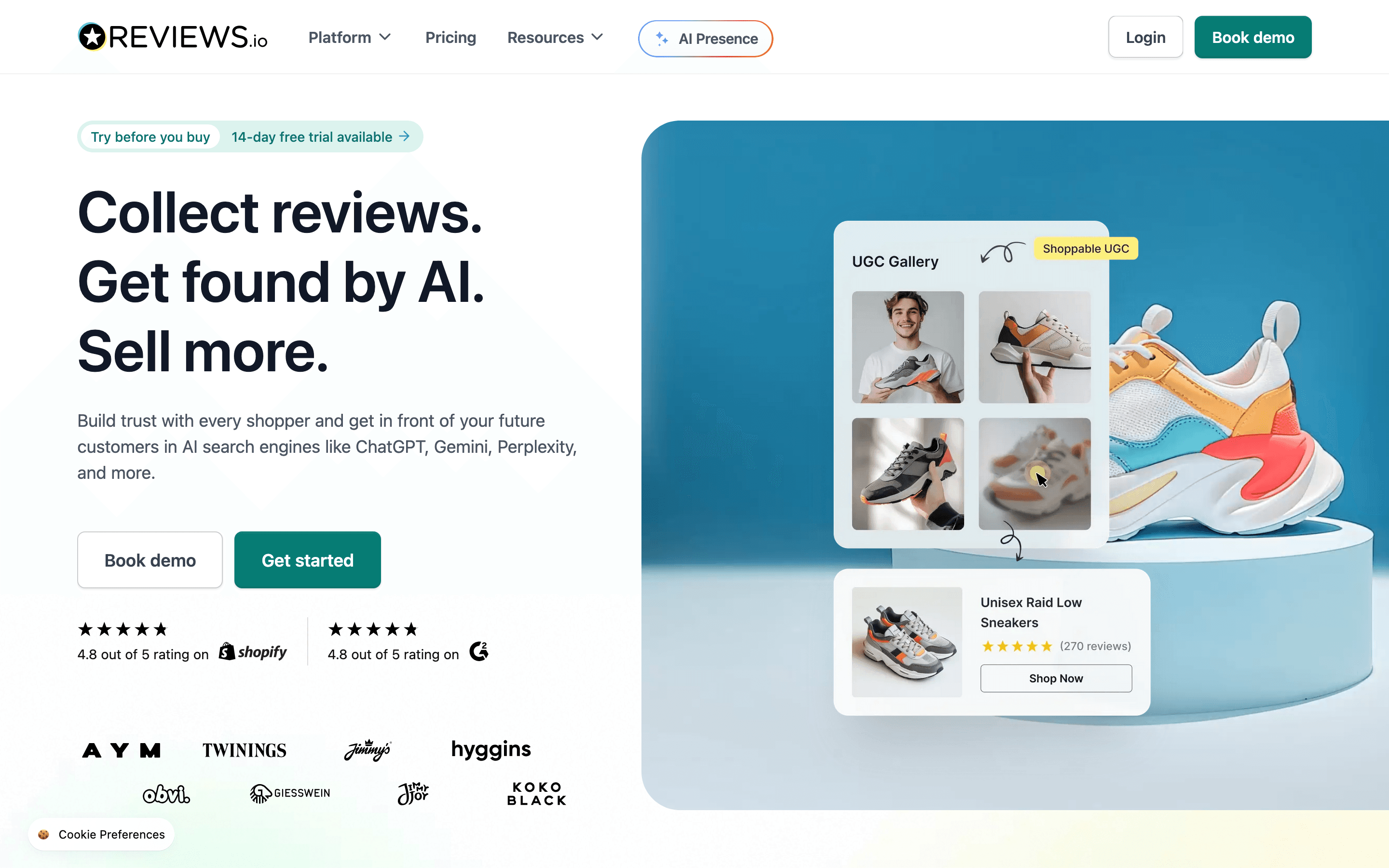
REVIEWS.io is the closest like-for-like swap for Trustpilot's actual job: collect reviews by invitation, display them in widgets, and feed star ratings into Google search results. The free plan covers 25 invites a month, in the same spirit as Trustpilot's 50-invite cap, and Essentials starts at $29/month, billed monthly with no annual contract, a direct fix for Trustpilot's biggest complaint. The catch is that the features most stores actually want don't come cheap. Google Seller Ratings and Klaviyo sync need the $79/month Start-Up plan, and AI review summaries and reputation management don't unlock until the $175/month Grow plan. Pricing is also charged per domain, so a brand running multiple storefronts pays for each one separately, the same trap Trustpilot sets.
Pros
- + Free plan covers real review collection, not just a demo
- + Deep native Shopify support: metafields, checkout-page surveys, a Tapcart app
- + No long-term contract, every plan is month-to-month
Cons
- – Google Seller Ratings and Klaviyo sync are locked out until the $79/month Start-Up plan
- – AI summaries, reputation management, and competitor analysis need the $175/month Grow plan
G2 is the natural swap for B2B software companies, since it's the review site software buyers actually use to shortlist vendors, closer to Trustpilot's brand recognition but for a software-only audience. The free tier only gets a listing. The Starter plan ($299/month, for businesses under 100 employees) adds gift-card incentives and a better profile, but G2 itself says that price nearly doubles to $599/month at year-two renewal. Professional and Enterprise are quote-only, with real negotiated deals running $11,400-$28,300 a year and multi-profile Enterprise contracts reaching $50,000-$95,000. Vendors also report 7-12% renewal increases with no new features, plus support routed through a chatbot that just files a ticket. The payoff for that spend is a buyer intent data layer and category badges that carry real weight in software purchase decisions, something Trustpilot doesn't offer.
Pros
- + Large existing buyer audience, so a strong profile and badge set genuinely drives inbound leads
- + Free tier lets you claim a profile and collect reviews before paying anything
- + Buyer intent and market data (on paid tiers) show which companies are researching your category
Cons
- – Professional and Enterprise pricing is quote-only, and reported deal sizes vary widely (roughly $11,400 to $28,300/year, and more for multi-profile Enterprise contracts), which makes budgeting hard
- – Vendors report renewal price increases of roughly 7-12% even with no added features or seats
Capterra costs nothing to use for the core job of collecting and displaying reviews. Listing, responding to reviews, and earning badges are all free, unlike Trustpilot's 50-invite ceiling on its free tier. Extra visibility runs through a pay-per-click auction instead of a subscription, starting at $2/click and rising in $0.25 increments, with no published minimum spend or rate card, so real cost depends entirely on how competitive your category is. Since G2 completed its acquisition of Capterra, GetApp, and Software Advice in February 2026, a single review pool and PPC campaign now show up across all three sites, plus expanded buyer intent data. The downside is that bidding is a sealed auction, so vendors don't see competitor bids and can get outbid without warning, and reviewers have flagged gift-card review incentives that don't always pay out.
Pros
- + Listing, collecting reviews, responding to reviews, and displaying badges cost nothing
- + Same review pool and PPC spend cover Capterra, GetApp, and Software Advice at once
- + Buyer intent data now spans all four G2-family sites, so paid customers see more in-market accounts than before the acquisition
Cons
- – No published rate card. Real cost per click depends on how many competitors bid in your category, and can run well past the $2 starting bid
- – Bidding runs as a sealed second-price auction, so vendors don't see competitor bids and can be charged more to hold rank without warning
TrustRadius is the enterprise-grade swap. It pairs guided, in-depth review collection with lead capture and CRM integration, turning reviews into a sales channel rather than just a trust badge. That's also why it costs the most on this list. Pricing is never published. TrustRadius's own vendor site names $30,000 per product per year for its Customer Voice package, and independent deal data puts real contracts between $24,900 and $62,896 a year depending on company size. Reviewers get a longer questionnaire that produces more detailed, credible feedback than a one-line star rating, and paid tiers add account-level intent data on who's researching your category. The tradeoff shows up in reviewer complaints: promised gift cards for writing reviews reportedly go unpaid or get cut in half, and some honest submissions get rejected for vague quality reasons.
Pros
- + Reviews are gated behind a longer questionnaire, which tends to produce more detailed, credible-sounding buyer feedback than a one-line star rating
- + Lead capture and CRM integration are built into the review campaign, so a review can turn into a sales lead without extra tooling
- + Intent data shows which accounts are researching your category, not just people who already landed on your page
Cons
- – Pricing is never published. You have to talk to sales before you know if this fits your budget
- – Real contracts run in the tens of thousands of dollars a year per product, out of reach for smaller vendors
Should your product be on this reviews & social proof list?
If you build a tool that belongs next to the ones above, submit it. A human reviews every submission. Approved products get their own page with pricing and screenshots, plus a place in the comparisons where they fit. It is free. You sign in with your work email so you can follow the decision, and there is no password to create.
Trustpilot alternatives: FAQ
What's the closest alternative to Trustpilot for an ecommerce store?+
REVIEWS.io. It runs on the same invitation-based collection model, feeds into Google Seller Ratings, and integrates natively with Shopify and BigCommerce, without Trustpilot's 12-month prepaid contract.
Is there a free Trustpilot alternative?+
Capterra is free to list on, collect reviews, respond to them, and display badges, with no subscription required. You only pay if you want extra visibility through its pay-per-click auction.
Which Trustpilot alternative works best for a B2B software company?+
G2, since it's the review site software buyers actually use to shortlist vendors during a purchase. Capterra is the budget option, free to list on and now sharing G2's buyer intent data since their February 2026 merger.
Can I move my existing Trustpilot reviews to another tool?+
Senja can import testimonials directly from 18 other platforms, including Trustpilot, G2, and Shopify, so you don't have to ask customers to write new ones from scratch. It's a separate self-serve testimonial tool, not a public review marketplace, so it isn't ranked as a Trustpilot alternative above.
Trustpilot alternatives: pricing compared
Entry price, billing model, and whether pricing is public. 3 of 5 publish pricing you can check without talking to sales.
| Tool | Starting price | Billing | Free option | Pricing disclosed |
|---|---|---|---|---|
| Trustpilot | $99/domain/mo | tiered | Yes | Partly public |
| REVIEWS.io | $29/mo | tiered | Yes | Partly public |
| G2 | $299/mo | tiered | Yes | Partly public |
| Capterra | Free tier + custom | usage-based | Yes | Not disclosed |
| TrustRadius | Free tier + custom | quote-only | Yes | Not disclosed |
How we made these picks. We compare tools on public pricing, features, and hands-on assessment, then verify every price against the vendor's own page. We never accept payment for rankings. Read the full methodology. Spotted an error? Report it.