Top Better Stack Alternatives in 2026
Here for Better Stack itself? See the full Better Stack profile, pricing & reviews →
Suggest a change- If you need the most mature on-call platform with the deepest catalog of integrations and ITSM ties, choose PagerDuty. PagerDuty's 750+ integrations cover enterprise workflows that Better Stack's telemetry-first product was never built for, and if you need bi-directional ServiceNow sync too, that's on the custom-quote Enterprise tier, not the $21/seat Professional plan.
- If your team already declares incidents in Slack or Teams and wants AI-drafted timelines and post-mortems without adopting a new chat surface, choose incident.io. incident.io runs entirely inside Slack or Teams and its AI drafts the incident timeline and post-mortem for you, something Better Stack's incident view doesn't do, though AI-written post-mortems specifically need the $25/seat Pro plan, not the $19/seat Team plan; Team only gets AI-suggested next steps.
- If you want an AI agent sitting inside every incident call taking notes and answering questions, and you can absorb paying for on-call and incident response as two separate bills, choose Rootly. Rootly's AI scribe and AI chat panel run in every incident, though Incident Response and On-Call are billed as separate $20/seat products that add up faster than Better Stack's single Responder seat.
- If you mainly need uptime monitoring, log and metric ingestion, and on-call paging in one dashboard, and you're fine reading an itemized usage-based bill to get there, choose stay on Better Stack. none of these four alternatives bundle telemetry ingestion, uptime checks, and on-call the way Better Stack does, so switching to a pure incident-management tool means running a separate observability vendor alongside it.
Better Stack bundles uptime monitoring, logs, and on-call paging into one product with usage-based pricing, but the on-call side is only a few years old and the real bill gets complicated fast once status pages, call routing, Slack/Teams workflows, and SSO all show up as separate line items. Engineers who own the rotation usually go looking for an alternative once they need more mature escalation logic, a proven incident-response process, or just a simpler bill for paging alone.
The three tools ranked here all compete directly for on-call and incident response. Opsgenie is left off: Atlassian closed it to new customers in June 2025 and is shutting it down in April 2027, so it isn't something you can actually switch to today, only something existing customers are migrating off of. PagerDuty is the safest, most established pick if you need breadth of integrations and ITSM ties. incident.io and Rootly are the Slack-native, AI-forward options for teams that already run incidents in chat.
Better Stack alternatives compared
| Tool | Best for | Starting price | Free option | Last update |
|---|---|---|---|---|
| PagerDutyBest for enterprise-scale on-call | Engineering orgs already running complex, multi-team on-call rotations across many services | $21/seat/mo | Yes | June 2026 |
| incident.ioBest for Slack-native incident response | Engineering teams already living in Slack or Teams who want incident channels, paging, and status pages in one tool | $15/seat/mo | Yes | June 2026 |
| RootlyBest for AI inside every incident call | Teams that already run incident response inside Slack and want less manual timeline and retro writing | $20/seat/mo | Trial (About 2 weeks) | July 2026 |
Why teams switch from Better Stack
The jump from the free plan to a paid plan feels too steep for small teams
Reviewers ask for a lower-priced tier for startups and sites running under 10 monitors, saying the gap between free and the first paid tier is too wide.
Costs climb once you outgrow your plan's included monitor slots
Reviewers say paid plans get expensive relative to simpler monitoring tools once extra monitor capacity beyond your plan's allotment gets billed separately.
The real monthly bill is hard to predict
Status pages, call routing, Slack/Teams workflow automation, SSO, and audit logs are all separate paid add-ons on top of the per-seat Responder price, so the number you budget for rarely matches the number you get invoiced.
On-call and escalation tooling is newer and less proven than dedicated incident platforms
Better Stack entered incident management in 2021, so its escalation policies and postmortem tooling have less real-world track record than PagerDuty or Opsgenie, both running for over a decade.
The best Better Stack alternatives, ranked
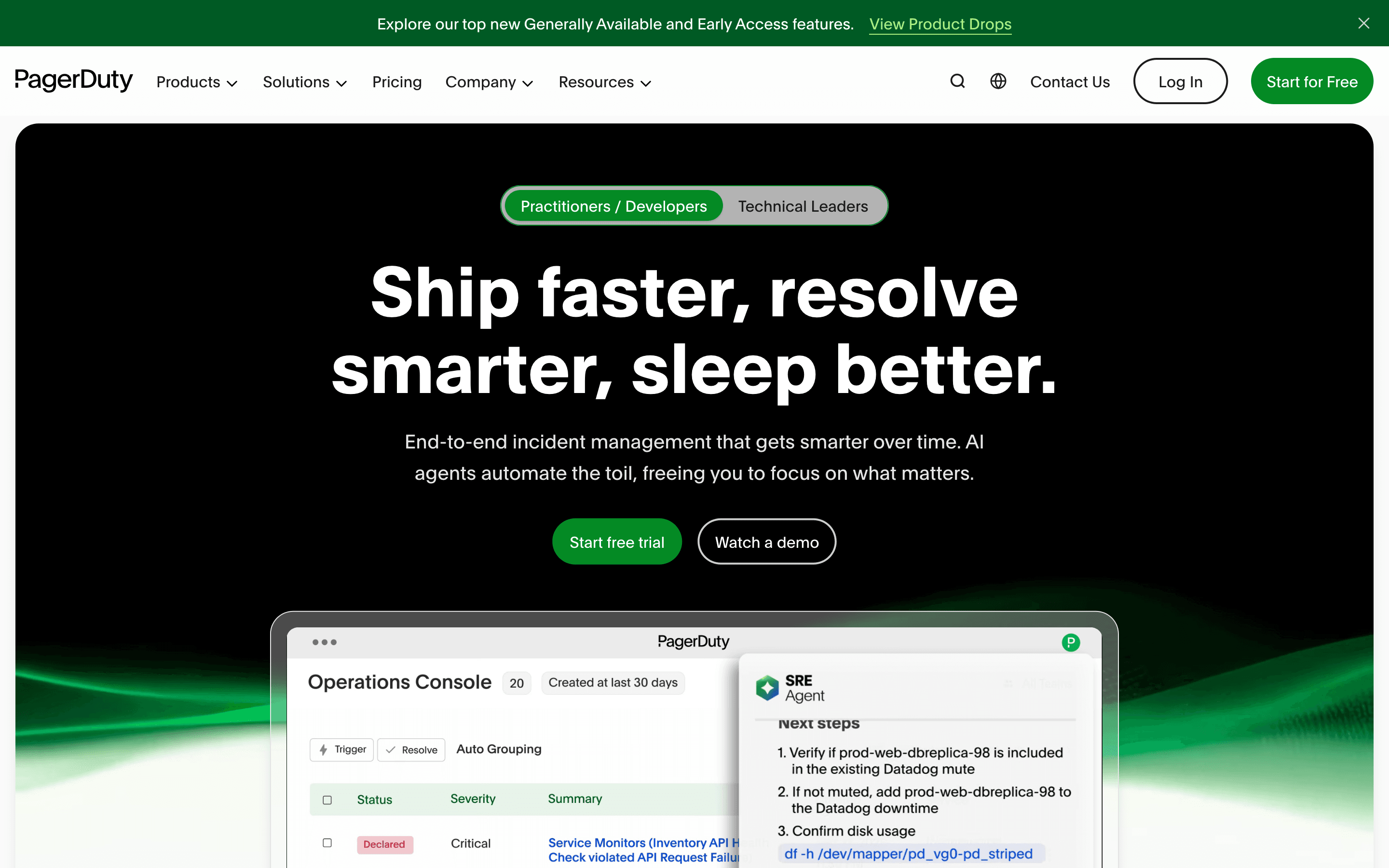
PagerDuty is the standard a lot of on-call rotations get built around, and it's the safest default if you're leaving Better Stack because you need deeper escalation logic, ITSM ties, or a vendor with more than a decade of track record instead of one that only entered incident management in 2021. Its free plan covers up to 5 users with one schedule and one escalation policy, and Professional starts at $21/seat/month billed annually, close to Better Stack's $29 Responder seat. Where PagerDuty pulls ahead is breadth: 750+ integrations on the Professional plan and post-incident review tooling built over 15+ years, none of which Better Stack's telemetry-first product tries to match. Bi-directional ServiceNow sync specifically is an Enterprise-tier feature with quote-only pricing, not something the $21/seat Professional plan includes. The tradeoff is the same one that pushes people off PagerDuty in the first place: seat price climbs fast once you need custom fields or more incident types, and Enterprise pricing is quote-only.
Pros
- + Free plan works for a small team's basic on-call needs, no card required
- + 750+ integrations cover almost any monitoring or ticketing tool you already run
- + Escalation policies, schedules, and post-incident review tooling are mature and battle-tested
Cons
- – Per-seat price climbs fast once you need custom fields, more incident types, or higher AI Action limits, and Enterprise pricing isn't published
- – Some capabilities, like advanced status page limits and premium chat actions, are split across tiers rather than included at one price
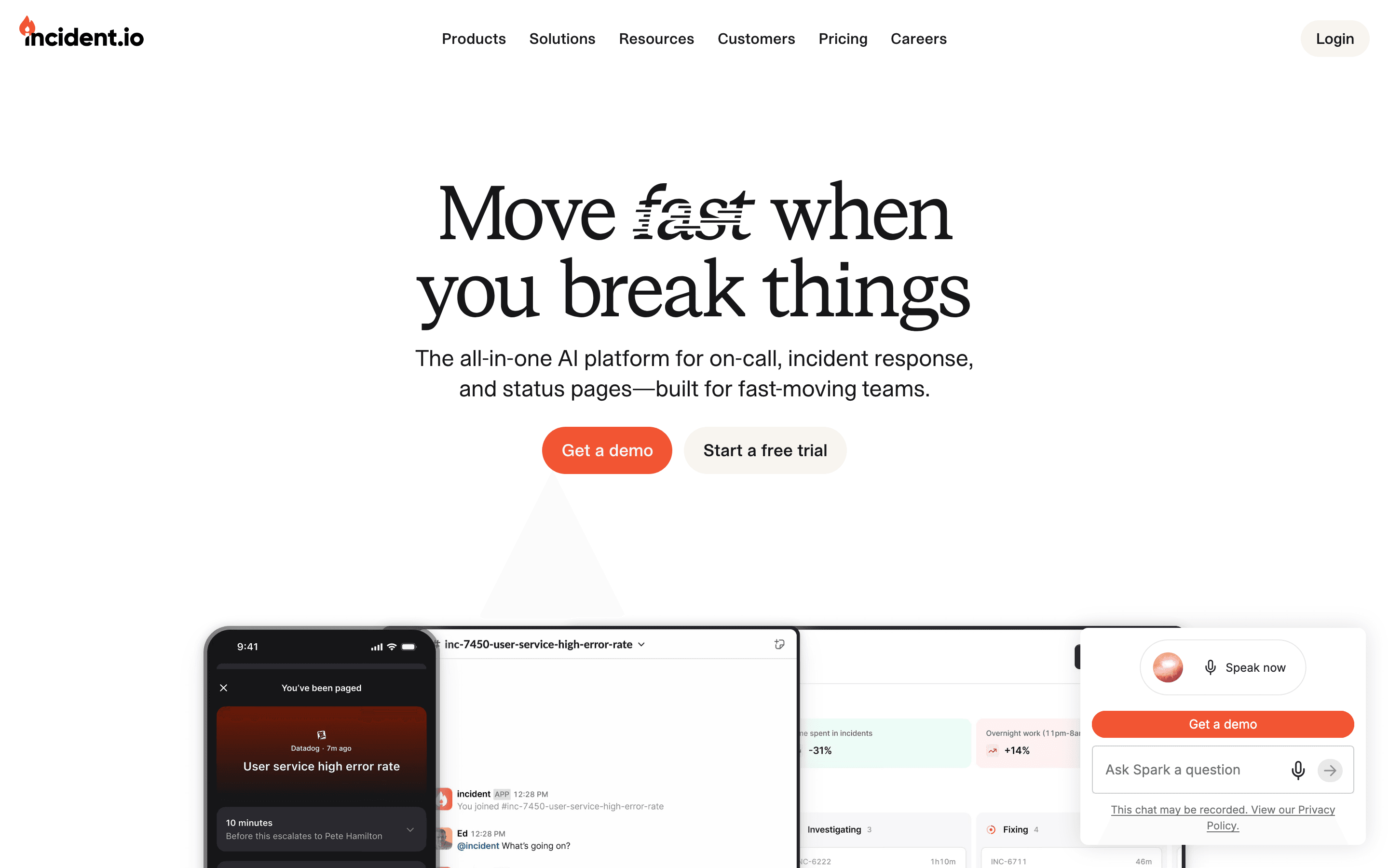
incident.io is the closer match if what actually pulled you toward Better Stack was a modern, engineer-friendly product with a real AI layer, not a specific need for uptime monitoring. Both companies started in 2021, and incident.io runs a similar playbook of a usable free tier plus per-seat pricing, but focused entirely on declaring incidents in Slack or Teams, paging the right responder, and drafting the post-mortem afterward with AI. The catch mirrors Better Stack's own biggest complaint: the $19/seat (monthly) or $15/seat (billed annually) Team price doesn't include on-call, which is a separate $10 to $20 per user add-on, so a team running real rotations pays closer to $29-45/seat. AI-written post-mortems also aren't part of Team; that needs the $25/seat Pro plan, with Team limited to AI-suggested next steps. Status pages are also capped on the lower tiers. incident.io fits teams that want Slack-native incident channels and AI post-mortems more than bundled telemetry, and are willing to pay for Pro plus on-call as separate line items, much like they did on Better Stack.
Pros
- + Slack and Teams integration feels native, not bolted on
- + AI-written post-mortem drafts save real time after an incident
- + Status pages, on-call, and incident response are one product instead of three separate bills
Cons
- – The advertised per-seat price doesn't include on-call, which is a separate charge on top
- – Status pages are limited on lower tiers: Team gets one public page, Pro adds one internal page, unlimited pages only on Enterprise
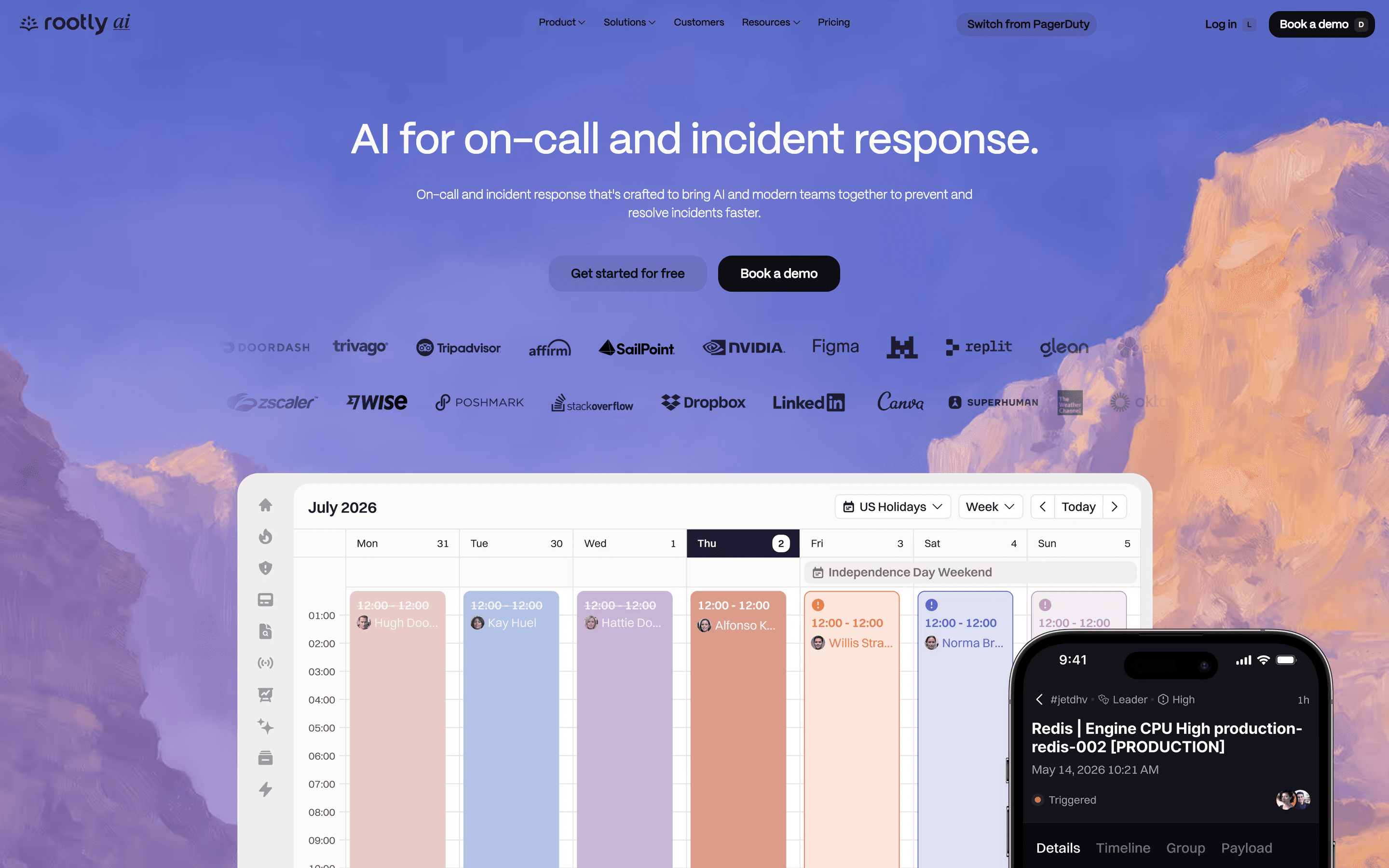
Rootly is the AI-heaviest option here, built for teams that already run incidents in Slack and want an AI scribe sitting in on calls, an AI chat panel for asking questions mid-incident, and similar-incident matching pulled from past incidents. Unlike Better Stack, there's no free tier at all, just a roughly two-week trial, and Incident Response and On-Call are sold as two separate $20/seat products, so a team running both pays close to $40/seat before any Enterprise add-ons. That's a real step up from Better Stack's $29-34 Responder seat. Rootly's startup program offsets this somewhat, with up to 50% off for younger, smaller companies and pay-what-you-can pricing under 25 employees. Contracts also commonly carry a 5-10% automatic annual increase, so budget for renewal negotiation. Rootly is the switch for teams chasing the deepest AI copilot inside incidents, not the ones leaving Better Stack to spend less.
Pros
- + Deep Slack-native workflow so responders don't have to switch tools mid-incident
- + AI scribe and AI chat cut down on manual timeline and retro writing
- + Startup program gives real discounts, including pay-what-you-can under 25 employees
Cons
- – Incident Response and On-Call are two separate $20/seat products, so a team using both is paying close to $40/seat, not $20
- – Enterprise pricing, SCIM, and unlimited schedules are all quote-only, with no published numbers
Should your product be on this incident management & on-call list?
If you build a tool that belongs next to the ones above, submit it. A human reviews every submission. Approved products get their own page with pricing and screenshots, plus a place in the comparisons where they fit. It is free. You sign in with your work email so you can follow the decision, and there is no password to create.
Better Stack alternatives: FAQ
What's the closest alternative to Better Stack for on-call alerting?+
PagerDuty is the closest match for teams that mainly want mature, proven on-call paging with the widest integration library. Its Professional tier starts at $21/seat/month billed annually, close to Better Stack's $29 Responder seat, and it adds ITSM ties Better Stack doesn't have.
Is there a free alternative to Better Stack's on-call features?+
PagerDuty's free plan is the one that actually includes on-call: up to 5 users, one on-call schedule, and one escalation policy, no paid seat needed. incident.io's free Basic plan also includes one on-call schedule. Rootly has no free tier at all.
Why isn't Opsgenie included as a Better Stack alternative?+
Atlassian closed Opsgenie to new customers and trials on June 4, 2025, and plans to shut it down completely on April 5, 2027. It only still works for existing customers, so it isn't a real option for anyone evaluating a new tool today.
Should I switch away from Better Stack if I just need uptime monitoring and basic paging?+
Probably not. None of PagerDuty, incident.io, or Rootly bundle uptime checks, logs, and metrics the way Better Stack does. Switching to a pure incident-management tool means keeping a separate monitoring vendor running alongside it.
Better Stack alternatives: pricing compared
Entry price, billing model, and whether pricing is public. 4 of 4 publish pricing you can check without talking to sales.
| Tool | Starting price | Billing | Free option | Pricing disclosed |
|---|---|---|---|---|
| Better Stack | $29/seat/mo | per-seat | Yes | Partly public |
| PagerDuty | $21/seat/mo | per-seat | Yes | Partly public |
| incident.io | $15/seat/mo | per-seat | Yes | Partly public |
| Rootly | $20/seat/mo | per-seat | Trial (About 2 weeks) | Partly public |
How we made these picks. We compare tools on public pricing, features, and hands-on assessment, then verify every price against the vendor's own page. We never accept payment for rankings. Read the full methodology. Spotted an error? Report it.