Top Cal.com Alternatives in 2026
Here for Cal.com itself? See the full Cal.com profile, pricing & reviews →
Suggest a change- If you want the most direct, well-known scheduling-link substitute with the same free-to-Teams-to-Enterprise shape as Cal.com, choose Calendly. it matches Cal.com's tiering almost step for step, and adds Marketo and Pardot sync at the Teams level for CRM-heavy sales teams, something Cal.com doesn't offer at all.
- If you send a lot of one-off links to people who hate picking blindly from a slot grid, choose SavvyCal. its calendar-overlay booking page shows both sides where their availability actually lines up, and team scheduling ships on the base Basic plan with no upsell.
- If you live back-to-back in meetings across time zones and want to replace your calendar app, not just bolt a booking link onto it, choose Vimcal. it's built for speed and multi-timezone handling first, with booking links as one feature rather than the whole product.
- If your real problem is losing focus time and task deadlines to a calendar full of meetings, choose Reclaim. it auto-schedules habits and tasks pulled from tools like Asana and Linear around your meetings, something Cal.com doesn't attempt at all.
- If you want your task list and to-do deadlines auto-scheduled alongside meeting booking, not just calendar defense like Reclaim, choose Motion. it adds docs and light project-management on top of task auto-scheduling, going further than Reclaim's calendar-only scope, though it costs more and caps AI credits per plan.
- If you're a revenue team with an inbound web-form pipeline that needs Salesforce territory routing and an SDR-to-AE handoff before the meeting even happens, choose Chili Piper. its routing and handoff flow goes deeper than Cal.com's routing forms, though it starts at $15,000 a year for 15 seats with no monthly option.
- If you're a solo user or small team that just needs a free booking link and round-robin scheduling once you grow, choose stay on Cal.com. its free plan is unlimited on event types and calendars, not a time-limited trial, and the Teams and Organizations tiers publish real per-seat prices without a sales call.
Cal.com built its name as the open source alternative to Calendly, then went closed source in April 2026, a move that pushed some longtime users to start looking elsewhere. For founders, sales reps, and recruiters who spend the day booking and rebooking meetings, that's a real moment to check whether Cal.com's free-to-Organizations ladder still fits, or whether one of these tools does the job better for how you actually work.
The tools below split into two groups. Calendly, SavvyCal, and Vimcal are direct scheduling-link substitutes, the same core job as Cal.com. Reclaim and Motion start from a different angle: they auto-schedule your own calendar around meetings rather than just taking bookings from other people. Chili Piper only fits if your real problem is routing inbound leads to a sales team, not personal scheduling.
Cal.com alternatives compared
| Tool | Best for | Starting price | Free option | Last update |
|---|---|---|---|---|
| CalendlyBest free alternative | Solo founders, recruiters, and reps who just need a booking link and a free calendar sync | $10/seat/mo | Yes | April 2026 |
| SavvyCal | Founders, sales reps, and recruiters who send a lot of one-off scheduling links and want the recipient to see a friendlier, less generic-looking calendar picker | $10/seat/mo | Yes | — |
| VimcalBest for people who live in their calendar all day | Founders, execs, and sales reps who take calls across many timezones and want a calendar that feels instant | $20/seat/mo | Yes | June 2026 |
| ReclaimBest for protecting focus time | Founders, reps, and recruiters who keep losing focus time to back-to-back meetings and want it defended automatically | $10/seat/mo | Yes | June 2026 |
| MotionBest for combining task management with booking | Founders and individual contributors who want their task list turned into an actual calendar without manual time-blocking | $29/seat/mo | Trial (Free trial on paid plans (exact length not disclosed on the pricing page)) | August 2025 |
| Chili PiperBest for enterprise inbound lead routing | Sales teams with an SDR-to-AE handoff process who need inbound leads booked and routed automatically | Custom / quote | No | January 2026 |
Why teams switch from Cal.com
Cal.com went closed source in April 2026 after five years as an open project
Some users say they're migrating to alternatives specifically to keep a self-hostable, open source option, since Cal.com now attributes the change to AI-assisted vulnerability scanning.
Add-ons like the Cal.ai phone agent bill separately by usage
Cal.ai bills at $0.29/minute after bundled credits run out, so a team leaning on add-ons pays more than the advertised seat price suggests.
Moving from Teams to Organizations more than doubles the per-seat price
Teams is $12/seat/month and Organizations is $28/seat/month, a jump many buyers hit earlier than Cal.com's tiering assumes since SSO, SCIM, and compliance certifications only start at Organizations.
The best Cal.com alternatives, ranked
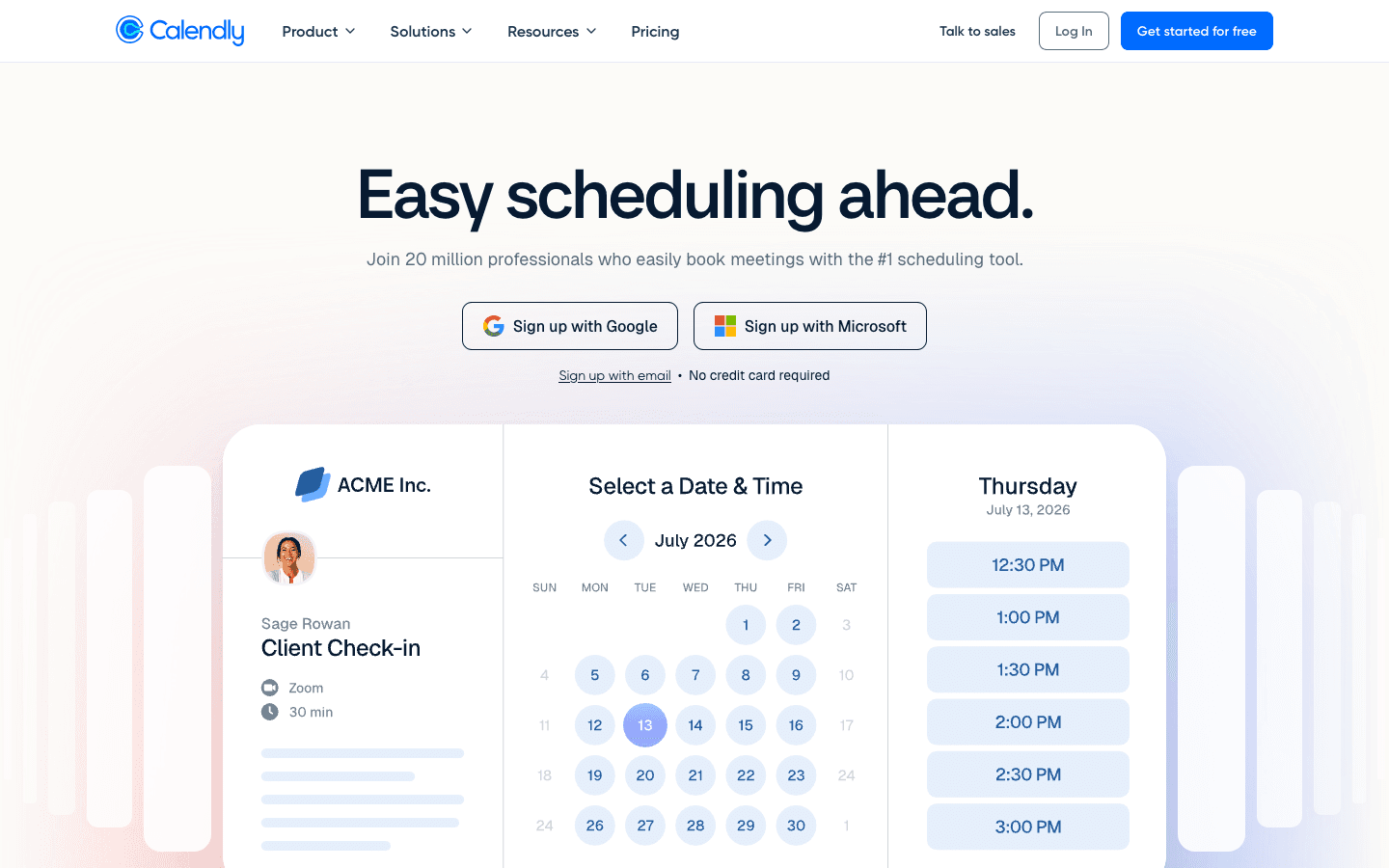
Calendly is the most direct swap for Cal.com's core job: a scheduling link, shared once, that lets someone book time without email back-and-forth. Both tools use the same free-to-Teams-to-Enterprise shape, so switching is mostly about migrating booking pages, not relearning a new mental model. Calendly's free plan covers one event type and one calendar, tighter than Cal.com's unlimited free tier, but Standard at $10/seat/month (annual) unlocks unlimited event types plus native HubSpot, Mailchimp, Stripe, and PayPal integrations, plus Zapier and webhooks. That HubSpot sync matches what Cal.com already gives away free. Salesforce sync is a different story: Cal.com includes it free, but on Calendly it only appears on the $16/seat Teams plan, alongside round-robin distribution and lead qualification and routing, close to Cal.com's Teams price. Teams also adds Marketo and Pardot sync, which Cal.com doesn't offer at all. So a buyer who relies on Cal.com's free Salesforce sync needs to budget for Calendly Teams, not Standard. The catch: SSO is a paid add-on even on Teams, and jumping to Enterprise means a quote-only contract starting around $15,000 a year, a steeper cliff than Cal.com's $28/seat Organizations tier for the same SSO and compliance needs.
Pros
- + Free plan covers a real single-event-type use case, not just a demo
- + Round-robin and lead-routing features are strong once you're on Teams
- + Deep native integrations with Salesforce, HubSpot, Zapier, and video tools
Cons
- – SSO is a paid add-on on Teams instead of being included, so security basics cost extra
- – Enterprise is quote-only and starts around $15,000/year, a steep jump from Teams even for a 5-person team
SavvyCal
SavvyCal solves the same booking-link problem as Cal.com but flips the interface: instead of a bare grid of open slots, it overlays your calendar on the guest's so you both see where the good times actually overlap. That's a real difference for founders and reps who send a lot of one-off links to people who dislike picking blindly from a grid. Team scheduling (round robin, collective, group) and meeting polls are included on the $10/seat Basic plan, no upsell needed. The tradeoff versus Cal.com is the limited free plan: it only covers meeting polls and sharing your availability, so a full booking link costs $10-17/month, and custom domains, paid bookings, branding removal, and delegated access all sit behind the pricier $17 Premium tier. There's also no native mobile app, just a responsive web site, which reviewers flag as a gap for anyone managing bookings from their phone between meetings.
Pros
- + The calendar-overlay booking page is genuinely a different (and less annoying) experience for the person picking a time than a plain slot grid
- + Meeting polls, delegate scheduling, and round robin/collective team modes are all included rather than scattered across add-ons
- + Ships real product updates regularly, including link lockdown windows and multi-language booking pages
Cons
- – The free plan is limited to meeting polls and sharing your availability with paid users, so your own full scheduling link needs Basic or Premium
- – Custom domains, paid bookings via Stripe, branding removal, and delegated access all sit behind the pricier $17/seat Premium tier

Vimcal is a different kind of substitute: it replaces your calendar app entirely rather than adding a booking link on top of Google Calendar, which is what Cal.com does. For founders, reps, and executive assistants who spend the whole day inside their calendar, speed (keyboard shortcuts, near-instant event creation) and multi-timezone handling matter more than Cal.com's routing forms. Personal booking links and group polling are included on the $20/seat/month Standard plan, and Vimcal EA, at $75/seat/month, adds tools built specifically for assistants managing someone else's schedule, like auto-created and self-deleting calendar holds. The real gap next to Cal.com: no native Apple Calendar support, only Google and Outlook, which has pushed some users to cancel. It's also priced well above Cal.com's Teams tier, with no free plan beyond a limited iOS-only tier.
Pros
- + Built for speed, with keyboard shortcuts and a near-instant interface for creating and editing events
- + Strong timezone tools for coordinating across several locations at once
- + Vimcal EA has features purpose-built for executive assistants, like auto-created and self-deleting calendar holds
Cons
- – Standard tier is $20/seat/month, more expensive than most consumer calendar apps
- – No native Apple Calendar support, only Google (and Outlook), which has caused some users to cancel
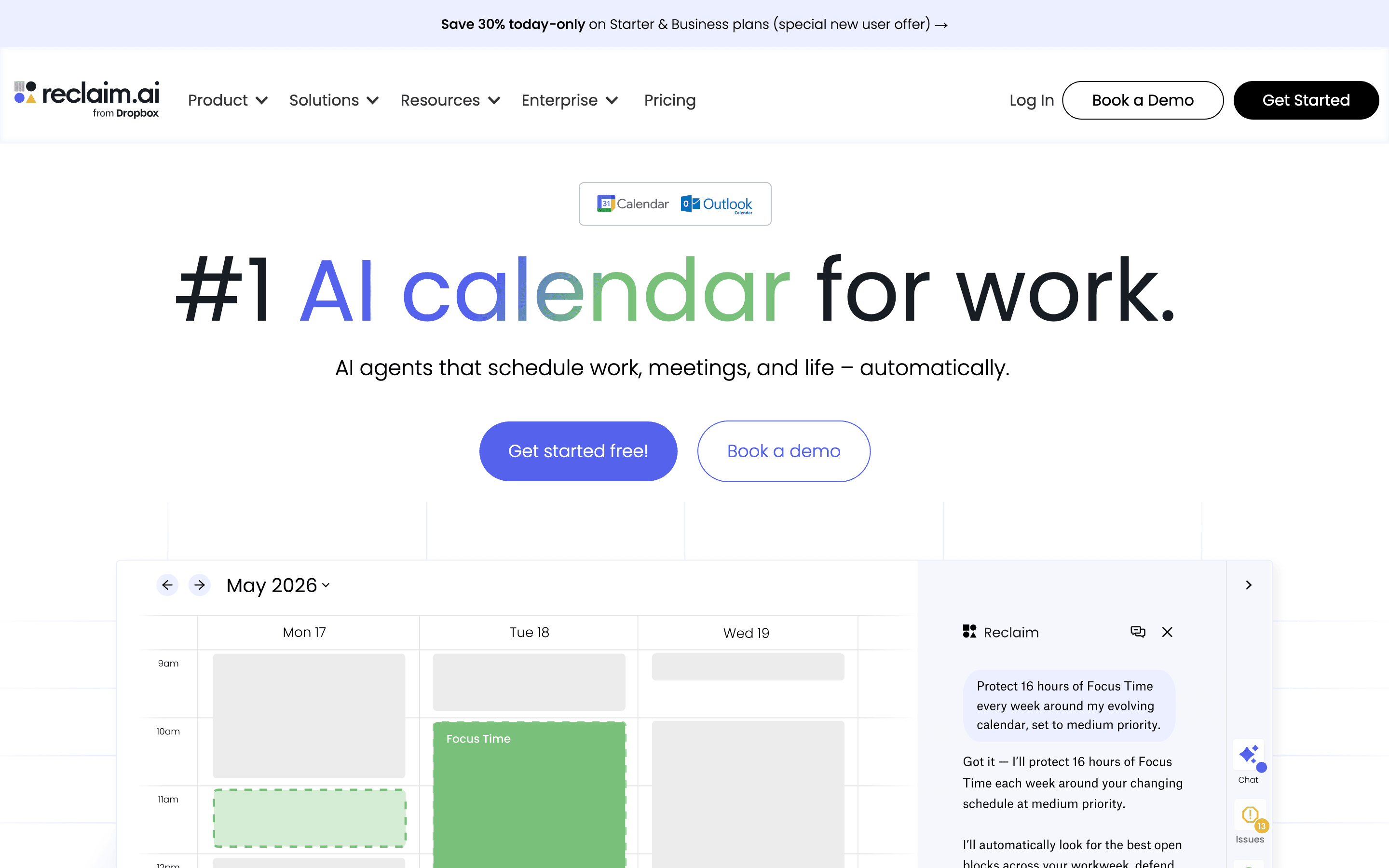
Reclaim starts from a different problem than Cal.com. Instead of a link for other people to book you, it auto-schedules your own focus time, habits, and tasks pulled from Asana, ClickUp, Jira, Linear, or Todoist, moving them around your calendar as meetings land. It still ships scheduling links, so it can replace Cal.com's core function too, just with fewer links on the free Lite tier, one, versus Cal.com's unlimited. Starter at $10/seat/month (annual) sits close to Cal.com's Teams price and includes 10 AI Agents and 3 scheduling links. Backed by Dropbox since 2024, it keeps shipping, including Outlook support and Slack out-of-office sync. The most cited gap is no mobile app, an odd miss for a tool meant to manage your day, and it doesn't touch email at all, so it solves the calendar problem specifically, not your whole workday.
Pros
- + Publishes real self-serve pricing with no forced sales call, which is rare in this category
- + Habits and task-scheduling actually move around your calendar as meetings get booked, instead of sitting as a static block you have to manually protect
- + Free Lite plan is a genuine forever-free tier, not a time-limited trial
Cons
- – No mobile app, which reviewers on G2 cite as the most common complaint for a tool meant to manage your daily schedule
- – Free Lite plan has been trimmed over time and now caps out at 1 calendar sync, 1 scheduling link, and a 1-week scheduling range
Motion goes further than Cal.com in scope: on top of meeting booking pages, it auto-schedules your tasks into open calendar slots and reshuffles them when a new meeting lands, plus docs and light project management on the Business AI tier. That makes it a real option for founders who want to replace both a scheduling tool and a to-do list app, not just Cal.com. The cost of that scope is price and complexity: there's no free plan, Pro AI runs $29/seat/month billed monthly (or $19 annually), and each plan carries a monthly AI credit cap that adds overage charges once you burn through it. Capterra reviewers call it expensive for what it does and describe an interface that takes real time to learn. If all you need is a booking link like Cal.com's, Motion is more tool than most teams want to pay for and learn.
Pros
- + Auto-schedules tasks and reshuffles your day automatically when meetings change
- + Combines calendar, tasks, docs, and light project management so you can drop a couple of point tools
- + Team plans billed annually bring the per-seat price down by roughly a third versus monthly billing
Cons
- – No free plan, and the pricing page doesn't disclose how long the free trial actually runs
- – AI credit caps mean your actual bill can climb above the base seat price once you use up your monthly allowance

Chili Piper only makes sense for a narrow slice of Cal.com buyers: revenue teams with an inbound web-form pipeline who need leads qualified, routed by Salesforce territory, and booked in one motion, the same job Cal.com's routing forms and round-robin do at a smaller scale. Its Routing & Scheduling plan starts at $15,000/year for 15 seats, with no monthly billing and no free trial, a different budget conversation entirely from Cal.com's $12-28/seat ladder. The SDR-to-AE handoff flow and territory-based routing are genuinely deeper than what Cal.com's routing forms offer. But for a founder or small sales team that just needs booking links and basic round-robin, Chili Piper is the wrong tool: it requires an annual contract, a 15-seat minimum, and platform fees on top of per-seat cost that scale with lead volume and aren't shown until a sales call.
Pros
- + Routes and books inbound leads automatically instead of just showing a calendar link
- + Deep Salesforce integration for territory-based and round-robin routing
- + SDR-to-AE handoff flow is built in, not bolted on
Cons
- – No public per-seat pricing and no free trial or free plan
- – Entry plan requires a 15-seat, $15,000/year annual contract with no monthly billing option
Should your product be on this meeting scheduling list?
If you build a tool that belongs next to the ones above, submit it. A human reviews every submission. Approved products get their own page with pricing and screenshots, plus a place in the comparisons where they fit. It is free. You sign in with your work email so you can follow the decision, and there is no password to create.
Cal.com alternatives: FAQ
What's the best free Cal.com alternative?+
Calendly is the closest match. Its free plan covers one event type and one calendar connection, a real single-user use case rather than a time-limited trial, the same shape as Cal.com's own free tier.
Which Cal.com alternative is built for people who live back-to-back in meetings?+
Vimcal. It's a calendar app first, with booking links as one feature, built for founders, sales reps, and executive assistants who need speed and multi-timezone handling more than routing forms.
Is Chili Piper worth it for a small team replacing Cal.com?+
Usually not. Chili Piper's entry plan starts at $15,000 a year for 15 seats with no monthly billing, built for revenue teams that need Salesforce lead routing, not a small team that just needs booking links.
Is Reclaim a real alternative to Cal.com, or a different kind of tool?+
It's a different starting point. Reclaim auto-schedules your own focus time, habits, and tasks around your meetings, and includes scheduling links as one feature, so it fits if your real problem is a calendar full of meetings crowding out everything else, not just needing a booking link.
Cal.com alternatives: pricing compared
Entry price, billing model, and whether pricing is public. 7 of 7 publish pricing you can check without talking to sales.
| Tool | Starting price | Billing | Free option | Pricing disclosed |
|---|---|---|---|---|
| Cal.com | $12/seat/mo | per-seat | Yes | Partly public |
| Calendly | $10/seat/mo | per-seat | Yes | Partly public |
| SavvyCal | $10/seat/mo | per-seat | Yes | Public |
| Vimcal | $20/seat/mo | per-seat | Yes | Partly public |
| Reclaim | $10/seat/mo | per-seat | Yes | Public |
| Motion | $29/seat/mo | per-seat | Trial (Free trial on paid plans (exact length not disclosed on the pricing page)) | Public |
| Chili Piper | Custom / quote | quote-only | No | Partly public |
How we made these picks. We compare tools on public pricing, features, and hands-on assessment, then verify every price against the vendor's own page. We never accept payment for rankings. Read the full methodology. Spotted an error? Report it.