Top Dremio Alternatives in 2026
Here for Dremio itself? See the full Dremio profile, pricing & reviews →
Suggest a change- If you need one platform for Spark-scale data engineering, ML training, and lakehouse queries together, not just a query layer, choose Databricks. It adds Delta Lake, Unity Catalog governance, and MLflow-based ML on top of the same open-lakehouse idea Dremio pursues, and it runs natively across AWS, Azure, and GCP.
- If you want a mature SQL-first warehouse with the strongest built-in governance and security options, choose Snowflake. Business Critical and VPS editions add Tri-Secret Secure encryption, HIPAA and PCI support, and private connectivity that Dremio's free Community Edition leaves out entirely.
- If you're already running on Google Cloud and want the simplest possible serverless setup, choose Google BigQuery. There's no cluster, DCU, or Reflection concept to learn. Storage and compute scale on their own, and the first 1 TiB scanned each month is free.
- If you're already all-in on AWS and want a data warehouse tightly integrated with S3, Glue, and QuickSight rather than a cross-cloud lakehouse, choose Amazon Redshift. Redshift Spectrum queries S3 data in place and Serverless bills per RPU-hour with no charge when idle, but it only runs on AWS, unlike Databricks, Snowflake, or Starburst.
- If you like Dremio's model of querying data in place across many sources but want a bigger company behind the engine and true multi-cloud reach, choose Starburst. It runs a managed distribution of Trino built for the same federated, Iceberg-native pattern, ships on AWS, GCP, and Azure, and keeps a free tier for up to 3 clusters.
- If you already run Community Edition self-hosted on Iceberg tables and don't want to add a new vendor relationship right now, choose stay on Dremio. Community Edition still queries Iceberg in place for free with no time limit, and switching mostly trades one usage-based, ownership-uncertain platform for another.
Dremio queries Apache Iceberg tables in place, using a free self-hosted Community Edition and a caching layer called Reflections to speed up repeat queries without a separate ETL step. It's a solid pick for teams already standardized on Iceberg. But Enterprise pricing is quote-only, DCU-based billing on Dremio Cloud takes time to learn, and Dremio is now part of SAP after the acquisition closed on July 6, 2026, which adds real uncertainty about roadmap and support terms going forward.
None of the five alternatives below copy Dremio's exact model. Starburst is the closest match: also Iceberg-native, also federates queries across sources, also keeps a genuinely free tier. Databricks takes the open-lakehouse idea further and bundles in Spark data engineering and ML training on top. Snowflake, Google BigQuery, and Amazon Redshift are SQL-first warehouses that increasingly support Iceberg tables, but they still expect data to live inside their own storage and governance model rather than being queried purely where it sits.
Dremio alternatives compared
| Tool | Best for | Starting price | Free option | Last update |
|---|---|---|---|---|
| DatabricksBest for a unified engineering and ML platform | Data engineering and data science teams running large-scale Spark pipelines and ML training on the same data | Free tier + custom | Yes | July 2026 |
| SnowflakeBest for enterprise governance | Teams that need to run SQL analytics, data engineering, and AI workloads on one governed copy of data instead of stitching together separate systems | Custom / quote | Trial (30 days with $400 in free credits) | June 2026 |
| Google BigQueryBest value for light or bursty workloads | Teams already on Google Cloud or using Google Analytics 4, Google Ads, and other Google data sources that need a warehouse with native connectors | $6.25/TiB scanned | Yes | July 2026 |
| Amazon RedshiftBest for AWS-only teams | Teams already on AWS who want a data warehouse tightly integrated with S3, Glue, QuickSight, and other AWS services | $0.375/RPU-hour | Trial ($300 credit (90-day expiration) for first-time Redshift Serverless users; in regions without Serverless, a two-month free trial for provisioned clusters (up to 750 hours/month)) | April 2026 |
| StarburstBest free option | Teams that need to query data across multiple warehouses, lakes, and databases without building new ETL pipelines | $0.5/credit | Yes | May 2026 |
Why teams switch from Dremio
Enterprise pricing is quote-only
Dremio doesn't publish Enterprise rates. It's consumption-based like Dremio Cloud, but you need to talk to sales to get a number, which makes it hard to budget or compare against competitors upfront.
DCU-based billing is hard to predict
Dremio Cloud charges $0.20 per Dremio Compute Unit, a time-based measure that covers query execution, Reflections, and background processing rather than a simple per-query charge, which makes cost forecasting harder than it looks at first.
Community Edition lacks governance and cataloging
The free, self-managed Community Edition skips governance and data-cataloging features entirely, pushing any serious production deployment toward the paid Enterprise or Cloud tiers.
SAP now owns Dremio
SAP completed its acquisition of Dremio on July 6, 2026, after announcing the deal in May 2026. That adds uncertainty about independent product direction, pricing, and support terms going forward.
The best Dremio alternatives, ranked
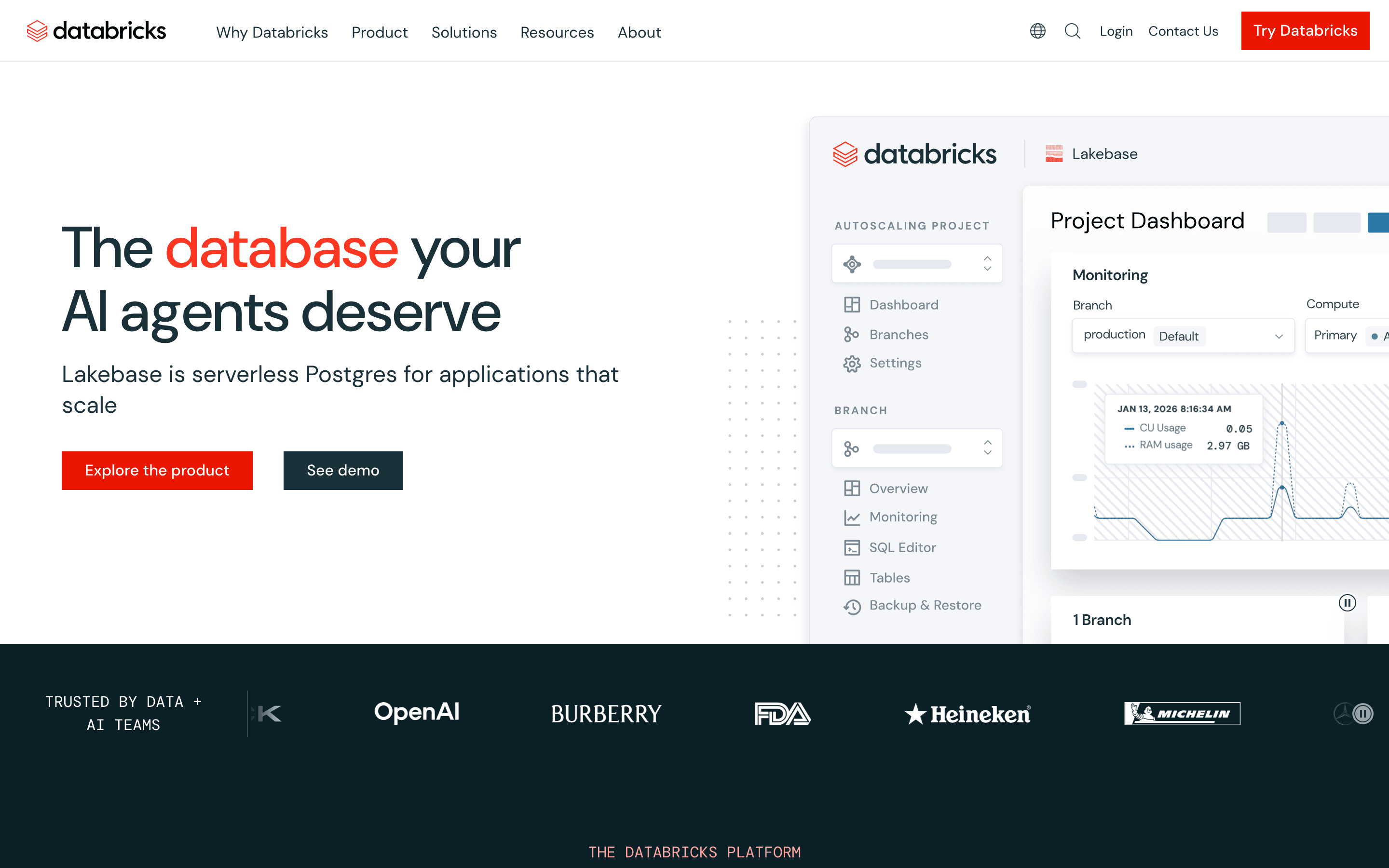
Databricks is the biggest step up from Dremio in scope. Both are lakehouse platforms built around open table formats, Delta Lake for Databricks and Iceberg for Dremio, but Databricks bundles data engineering, SQL analytics, and full ML/AI tooling into one governed platform instead of staying focused on query and BI. Unity Catalog covers governance that Dremio's free Community Edition skips, and Mosaic AI plus Foundation Model APIs go well beyond Dremio's newer AI_GENERATE and AI_CLASSIFY SQL functions. It bills by Databricks Unit (DBU) consumed per second, with no published rate card, similar in spirit to Dremio's DCU model but broader in what it covers. Teams whose real need is Spark-scale engineering and ML training alongside analytics get more from Databricks. Teams that just want a lightweight Iceberg query layer will find Databricks heavier than they need, with a steeper learning curve to match.
Pros
- + One platform for data engineering, SQL analytics, and ML/AI, so you avoid separate warehouse-plus-ML-platform sprawl
- + Open formats, Delta Lake and Unity Catalog, cut lock-in compared with proprietary warehouse storage formats
- + Runs natively on AWS, Azure, and GCP, which helps multi-cloud or cloud-migrating organizations
Cons
- – No public price list. Total cost depends on DBU rates that vary by cloud, region, and workload, and you need a calculator or a sales call to estimate it
- – Usage-based DBU billing, plus separate cloud infrastructure cost, makes budgeting and cost governance harder than flat per-seat pricing
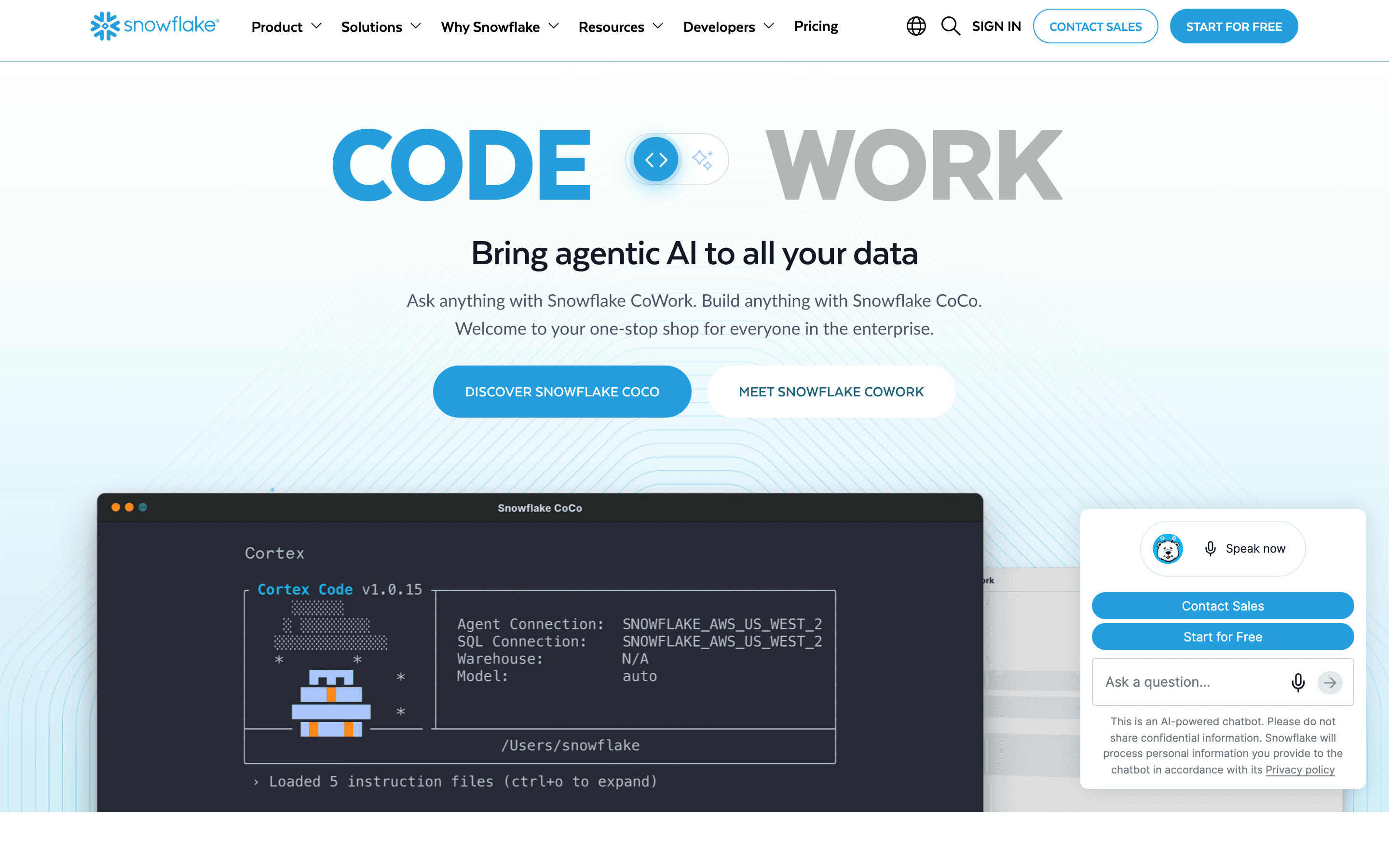
Snowflake trades Dremio's self-hosted, Iceberg-native model for a fully managed SQL warehouse with a longer track record. It separates compute and storage billing like Dremio does, and now supports Apache Iceberg tables natively, so teams don't have to duplicate data into a proprietary format either. Where it pulls ahead is governance and security. Business Critical and VPS editions add Tri-Secret Secure encryption, HIPAA and PCI support, and private connectivity, none of which exist in Dremio's free Community tier. Snowpark and Cortex extend SQL into Python, Java, and Scala plus managed AI functions, covering some of the same ground as Dremio's AI agent and semantic layer. The tradeoff is cost transparency. Snowflake publishes no flat price at all, not even the per-unit rate Dremio Cloud gives you at $0.20 per DCU, so estimating spend takes a calculator or a sales call either way.
Pros
- + Compute and storage scale and bill independently, so idle warehouses can auto-suspend to stop charges
- + Native support for Apache Iceberg tables lets teams query open-format data without duplicating it into proprietary storage
- + Snowpark and Cortex let SQL, Python, and AI/LLM workloads run against the same data and governance model instead of separate platforms
Cons
- – No published flat price. You have to use the consumption calculator or get a sales quote to estimate real monthly cost
- – Per-credit compute rates differ by edition, cloud provider, and region, which makes it harder to compare quotes
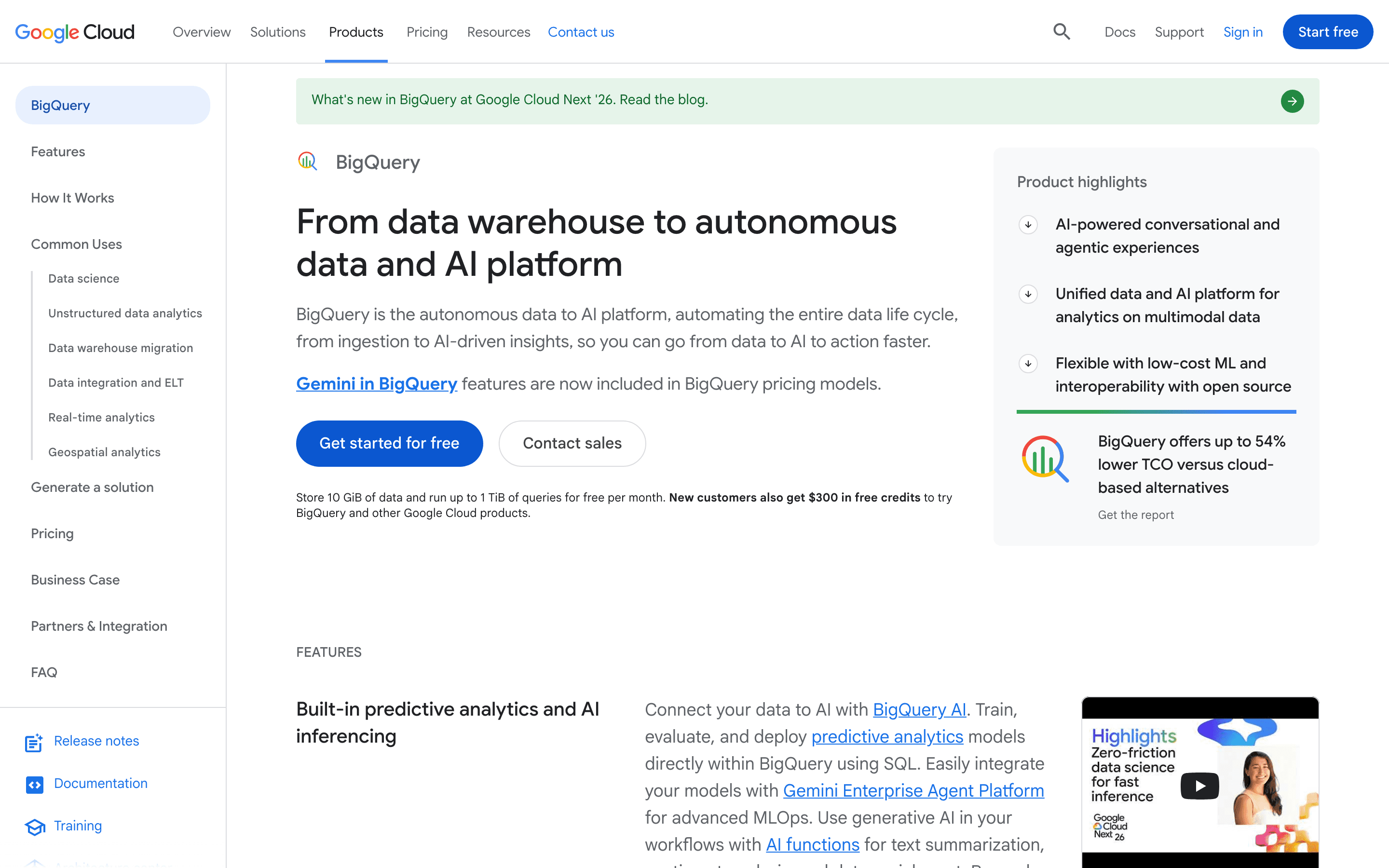
BigQuery is the most serverless option here, with no equivalent to Dremio's self-hosted Community Edition or its Reflections caching layer. Google fully manages scaling, so there's no DCU-style unit to learn and no engine to size. On-demand queries cost $6.25 per TiB scanned, with the first 1 TiB free each month, which makes light or bursty workloads cheap in a way Dremio's consumption model doesn't clearly beat. BigQuery ML lets teams run models with plain SQL, a lighter-weight parallel to Dremio's AI_GENERATE and AI_CLASSIFY functions. The catch is ecosystem lock-in. BigQuery is built for Google Cloud, with deep native ties to Google Analytics 4, Ads, and Firebase, while Dremio queries data across AWS, Azure, and on-prem sources without favoring one cloud. Teams outside the Google stack, or those querying Iceberg tables directly across clouds, may not gain much by switching.
Pros
- + A true serverless model: no cluster sizing, node types, or manual scaling decisions
- + On-demand pricing means light or bursty workloads can run for very little, and the first 1 TiB of query data per month is free
- + Deep native integration with Google Analytics 4, Google Ads, Firebase, and other Google Cloud and Workspace data sources via BigQuery Data Transfer Service
Cons
- – On-demand billing is per-query and scan-based, so an unindexed or unfiltered query on a large table can generate a large, surprising charge
- – Editions and slot pricing (Standard, Enterprise, Enterprise Plus) add a second, more complex pricing dimension once teams outgrow on-demand pricing
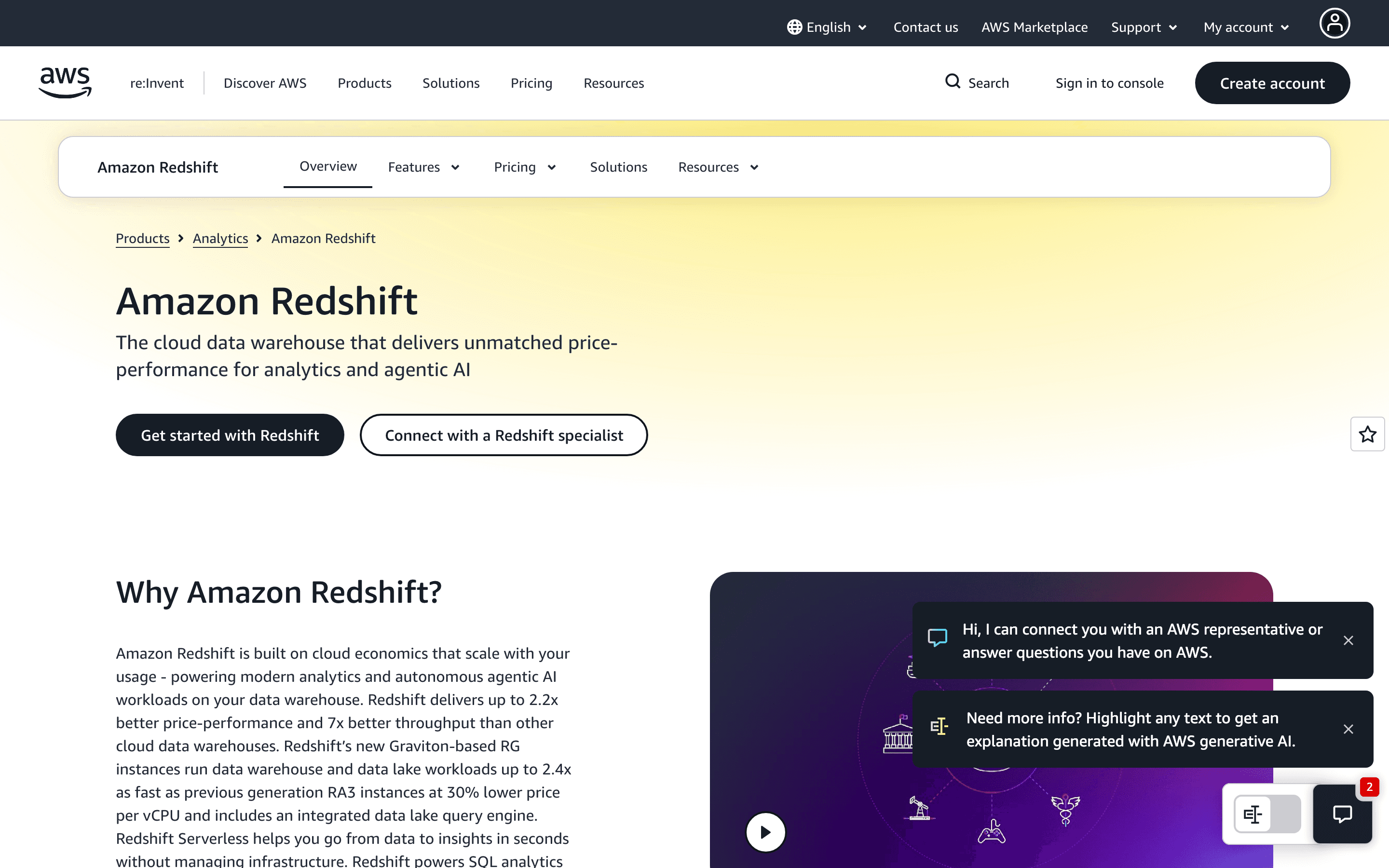
Amazon Redshift suits teams who want to stay inside AWS rather than run a cross-cloud lakehouse like Dremio. Redshift Serverless bills per RPU-hour with a 4-RPU minimum, so an active workgroup runs roughly $1.50 an hour at minimum, a more predictable floor than Dremio Cloud's DCU-based billing but still consumption-based either way. Redshift Spectrum queries data sitting in S3 directly at $5 per TB scanned, covering some of the same in-place querying idea Dremio applies to Iceberg tables generally. What Redshift doesn't offer is a free, no-time-limit self-hosted tier. Its only no-cost option is a 90-day trial credit, versus Dremio's Community Edition, which stays free forever. It's also AWS-only, so the multi-cloud or on-prem deployments that Dremio supports through self-managed Enterprise aren't an option with Redshift at all.
Pros
- + Deep native integration with the AWS ecosystem (S3, Glue, Lambda, QuickSight, SageMaker, IAM) means less glue code for teams already on AWS
- + Redshift Serverless removes cluster sizing and management. You pay per RPU-hour and pay nothing while idle
- + Redshift Spectrum lets you query data sitting in S3 directly, without loading it into the warehouse first, at $5/TB scanned
Cons
- – No standing free tier. The only no-cost options are a 90-day/$300 Serverless credit or a two-month provisioned trial. After that, standard on-demand billing kicks in automatically
- – Pricing is split across compute (provisioned node-hour or serverless RPU-hour), managed storage (per GB-month), Spectrum scans (per TB), and Concurrency Scaling, so total cost is harder to estimate up front than with single-metric competitors
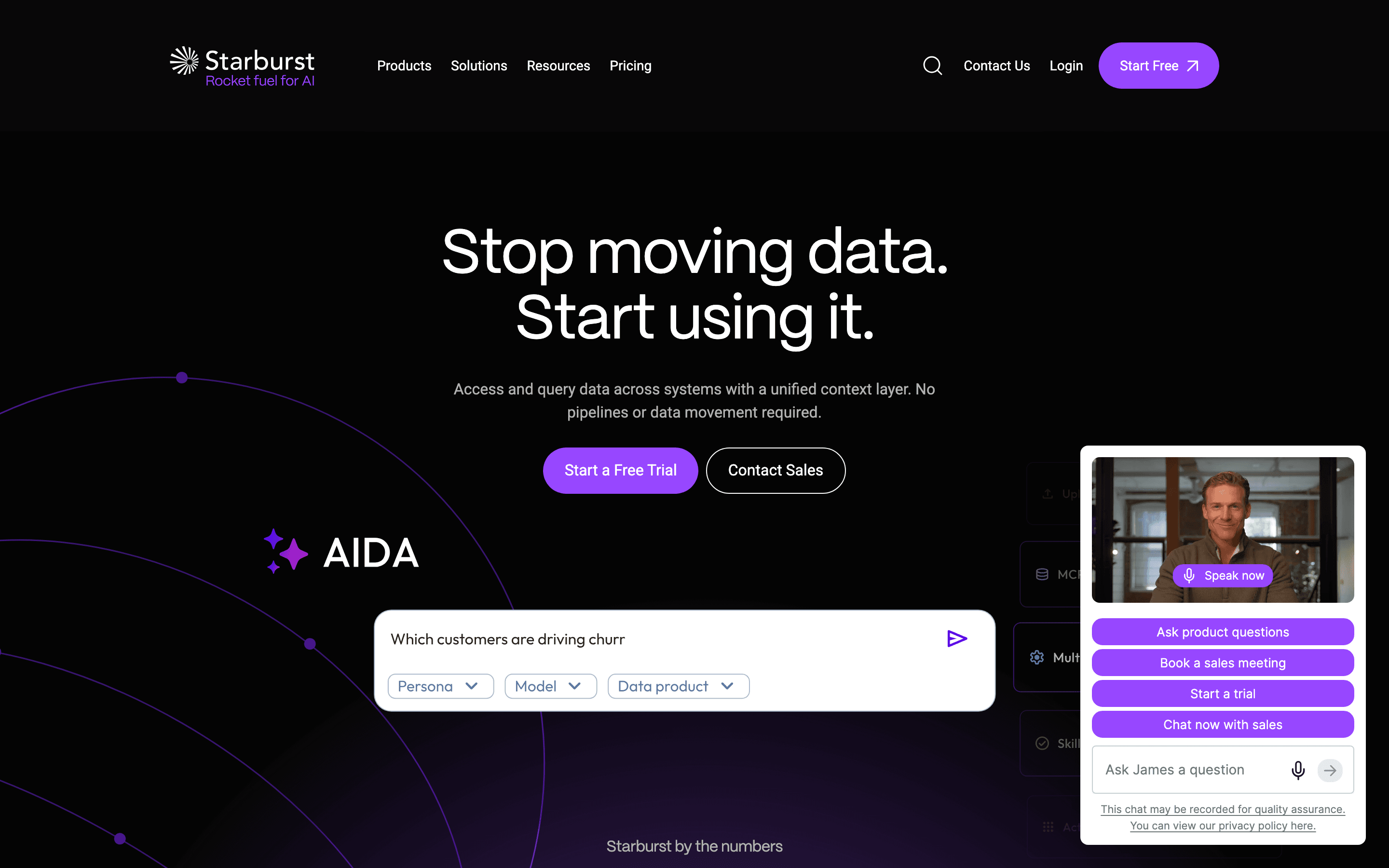
Starburst is the closest architectural match to Dremio. Both are built around Apache Iceberg and the Icehouse pattern, both query data across multiple sources without moving it first, and both offer a genuinely free tier alongside a quote-only Enterprise product. The difference is emphasis. Dremio leans toward a single cataloged lakehouse with its own Arrow-based query engine and Reflections for acceleration. Starburst runs a managed distribution of Trino built explicitly for federating across many warehouses and lakes at once, including Snowflake, BigQuery, Redshift, and Databricks. Starburst Galaxy's free tier covers up to 3 clusters indefinitely, similar in spirit to Dremio Community Edition, though Starburst's paid tiers, running $0.50 to $1.00 per credit, add ABAC and SCIM access control that Dremio reserves for its quote-only Enterprise edition. AIDA, Starburst's natural-language assistant, only reached general availability in May 2026, making it newer than Dremio's own AI features.
Pros
- + Queries data in place across S3, Snowflake, BigQuery, Redshift, Databricks, and other sources, no data movement required
- + Free forever tier for up to 3 clusters, good for evaluation or small workloads
- + Current CTO Martin Traverso and other original Presto/Trino creators sit on Starburst's technical leadership team, so the company stays close to the open-source engine
Cons
- – Usage-based credit pricing makes cost forecasting harder than flat per-seat plans, and the effective rate depends on your cloud provider and region
- – Starburst Enterprise pricing is quote-only with no public numbers
Should your product be on this data & analytics platforms list?
If you build a tool that belongs next to the ones above, submit it. A human reviews every submission. Approved products get their own page with pricing and screenshots, plus a place in the comparisons where they fit. It is free. You sign in with your work email so you can follow the decision, and there is no password to create.
Dremio alternatives: FAQ
What is the best free alternative to Dremio?+
Starburst Galaxy's free tier, limited to 3 clusters with no time limit, is the closest match to Dremio's free Community Edition among these alternatives. Databricks also has a Free Edition, but it's built for learning and experimentation, not production workloads.
Why are teams looking to switch away from Dremio?+
The main reasons are quote-only Enterprise pricing that's hard to budget against, DCU-based billing on Dremio Cloud that takes time to learn, and the uncertainty created by SAP completing its acquisition of Dremio on July 6, 2026.
Which Dremio alternative is best for querying data across multiple clouds and warehouses without moving it?+
Starburst is the closest fit. Its managed Trino engine federates queries across S3, Snowflake, BigQuery, Redshift, and Databricks, which matches Dremio's own in-place querying approach more closely than any of the SQL-first warehouses.
Is there a Dremio alternative with flat, predictable pricing instead of usage billing?+
No. Databricks, Snowflake, Google BigQuery, Amazon Redshift, and Starburst are all usage-billed in some form, same as Dremio. BigQuery and Redshift Serverless publish clearer per-unit list rates than Databricks or Snowflake, but none of them offer a flat per-seat plan.
Dremio alternatives: pricing compared
Entry price, billing model, and whether pricing is public. 4 of 6 publish pricing you can check without talking to sales.
| Tool | Starting price | Billing | Free option | Pricing disclosed |
|---|---|---|---|---|
| Dremio | $0.2/DCU | usage-based | Yes | Partly public |
| Databricks | Free tier + custom | usage-based | Yes | Not disclosed |
| Snowflake | Custom / quote | usage-based | Trial (30 days with $400 in free credits) | Not disclosed |
| Google BigQuery | $6.25/TiB scanned | usage-based | Yes | Public |
| Amazon Redshift | $0.375/RPU-hour | usage-based | Trial ($300 credit (90-day expiration) for first-time Redshift Serverless users; in regions without Serverless, a two-month free trial for provisioned clusters (up to 750 hours/month)) | Partly public |
| Starburst | $0.5/credit | usage-based | Yes | Public |
How we made these picks. We compare tools on public pricing, features, and hands-on assessment, then verify every price against the vendor's own page. We never accept payment for rankings. Read the full methodology. Spotted an error? Report it.