Top Motion App Alternatives in 2026
Here for Motion App itself? See the full Motion App profile, pricing & reviews →
Suggest a change- If you want Motion-style top-creatives analytics bundled with competitor research, ad creation, and client reporting in one workspace, choose Adside. Adside runs the same top-creatives leaderboard Motion is known for, ranking your best-performing ads by spend and result, and wraps it into a full Meta, Google and LinkedIn ad workflow: competitor research, AI creative briefs, ad generation, and recurring client reports, all in one workspace billed per brand rather than per seat. Motion is a pure analytics layer you connect to any ad account you already run; Adside is built for teams running Meta, Google and LinkedIn ads at $590 to $990 per brand a month, so pick it when you want the leaderboard plus the work around it in one tool. We operate this site and also build Adside, so treat this as disclosure, not a neutral pick, and note it has no free trial and is too new to have independent G2 or Capterra reviews.
- If you need a dedicated, always-on tracker for specific competitors' ad accounts plus a big search engine for creative research, choose Foreplay. Foreplay's Spyder is built specifically for competitor monitoring, watching named accounts around the clock and surfacing new creative automatically, and Discovery searches a library of more than 100 million ads. Atria's higher tiers also let you follow up to 200 brands, but Atria doesn't document that feature with the same detail, so if competitor tracking is the main reason you're switching, Foreplay is the safer bet.
- If you want an AI agent that proactively watches your account and competitors and drafts new ad concepts without being asked, choose Atria. Atria's Raya agent monitors your ad accounts and competitors on its own and pushes out tagged insights and creative concepts instead of waiting for a prompt.
- If you run real budget on Google Ads or need Northbeam or Google Analytics attribution tied directly to your creative tagging, choose stay on Motion. Neither Foreplay nor Atria analyzes Google Ads creative, and only Motion connects its tagging to Northbeam or Google Analytics attribution data.
Motion tags and ranks your Meta, TikTok, and YouTube ads so you can see which hooks, formats, and angles are actually working. It's a solid self-serve pick under $50k a month in spend, but the moment you cross that line, pricing turns into a sales call with no published number, and there's no free trial to test it first.
Atria does the closest version of Motion's core job: Radar auto-tags your creative by hook, persona, USP, and format, and Raya adds a proactive AI agent that works without prompting. Foreplay covers different ground. It tracks named competitors' ad accounts around the clock and analyzes your own ad spend and creative performance, but it has no hook, format, or angle auto-tagging feature, and Foreplay itself lists deep tagging of your swipe file as something it's not built for. Both are real alternatives, just for different reasons, and both are ranked below.
Adside leads our list, with a caveat: we operate this site and also build Adside, so treat its placement as disclosure, not a neutral verdict. It does the same core job as Motion, a Top Creatives view that ranks your best-performing ads by spend and result, and then adds competitor research, AI creative briefs, ad copy and resized creative, and client reporting in one workspace. The trade-off is honest: Adside is built for teams running Meta, Google and LinkedIn ads and priced per brand, while Motion is a pure analytics layer that connects to any ad account you already run. See the FAQ below for more.
Motion App alternatives compared
| Tool | Best for | Starting price | Free option | Last update |
|---|---|---|---|---|
| AdsideBest all-in-one platform to produce and run ads | In-house B2B marketing teams that want research, creative, and reporting for Meta, Google and LinkedIn ads in one tool instead of stitching several apps together | $590/brand/mo | No | — |
| ForeplayBest for competitor ad tracking | Creative strategists and media buyers who want one place to save and organize ad inspiration from Meta, TikTok, and LinkedIn | $49/seat/mo | Trial (7 days, but you must enter a card to start it and you're auto-billed when it ends unless you cancel first) | June 2026 |
| AtriaBest for a proactive AI creative agent | E-commerce brands and agencies spending $5,000+ a month on Meta and TikTok who need to see what's working across their own and competitors' creative | $129/seat/mo | Trial (1,000 free credits to try the product, no credit card required (this is a credit allowance, not a time-boxed trial)) | February 2026 |
Why teams switch from Motion App
Pricing scales with ad spend, not features
Motion's Starter tier is $250/month and covers brands spending up to $50k/month, but growing past that spend line pushes you into a quote-only Pro plan with no published price.
No built-in fatigue alerts
Motion doesn't flag a creative that's starting to decline, so teams catch fatigue manually instead of getting a warning before performance drops off.
The best Motion App alternatives, ranked
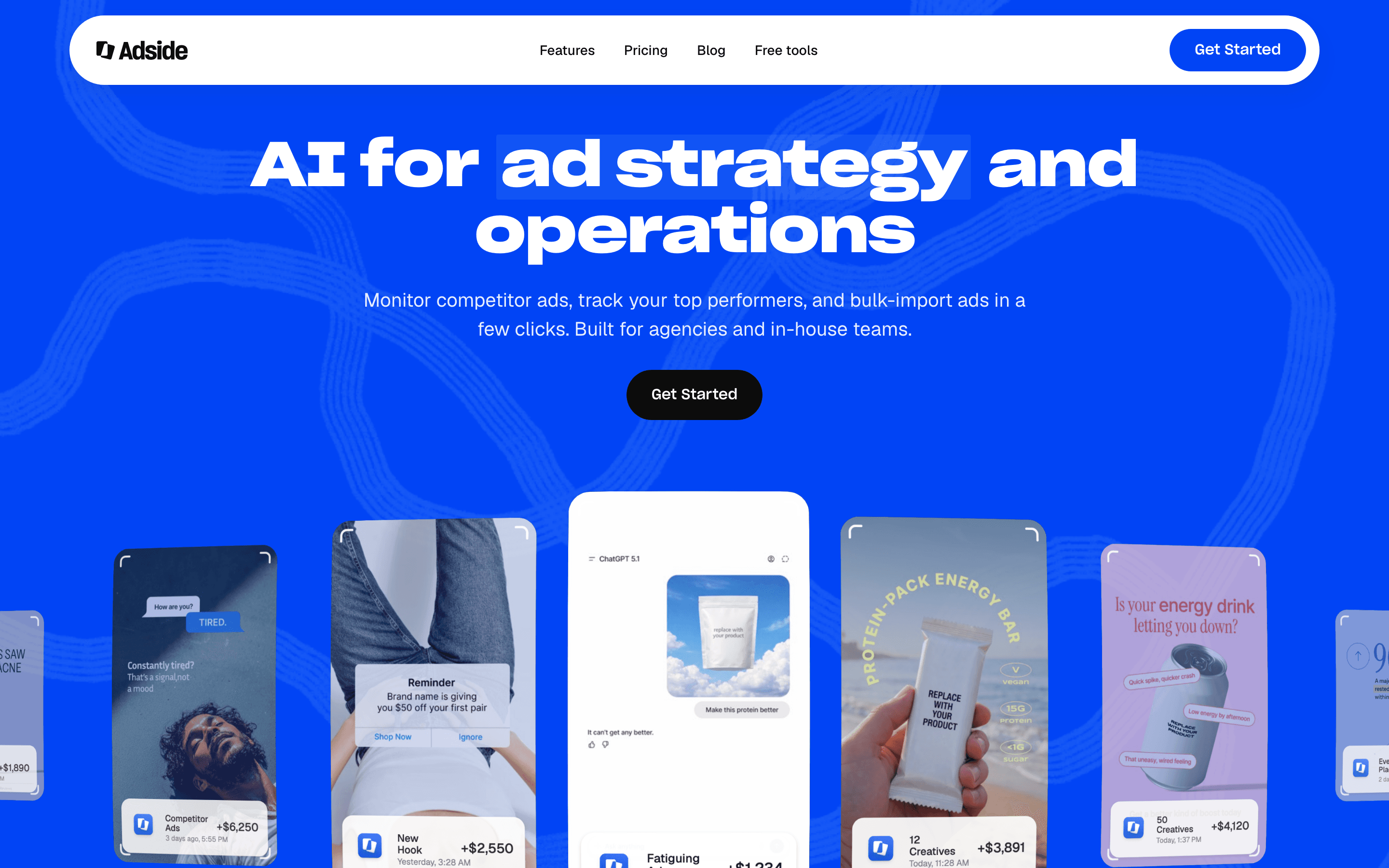
Adside does the same core job as Motion: a Top Creatives view that ranks your best-performing ads by spend and result, so you can see which creative is winning. On top of that leaderboard, it pulls competitor ads from Meta, Google, and LinkedIn ad libraries into research boards, watches X, Reddit, and G2 for market sentiment, turns that into AI creative briefs, generates ad copy and resized creative, and schedules client reports. It runs the full Meta ad workflow in one workspace instead of a stack of separate tools. The honest trade-off: Adside is built for teams running Meta, Google and LinkedIn ads and priced per brand, $990 a month or $590 billed annually, while Motion is a pure analytics layer that connects to any ad account you already run. There's no free tier or trial, and it's too new to have independent G2 or Capterra reviews. We operate this site and also build Adside, so weigh this as disclosure, not a neutral recommendation.
Pros
- + Per-brand pricing means unlimited team members at no extra cost, unlike per-seat competitors
- + Runs Meta, Google and LinkedIn campaigns end to end, from competitor research to reporting, in one workspace
- + Built-in creative analytics with a top-creatives view, so you see which ads win without a separate reporting tool like Motion or Atria
Cons
- – No free tier or free trial, so you commit to a paid plan before testing it on a live account
- – The self-served product covers Meta, Google and LinkedIn only; TikTok, Snapchat and Reddit require the managed service
Foreplay's overlap with Motion isn't tagging, it's competitor tracking and performance analytics. Spyder watches named competitor accounts on Meta, TikTok, and LinkedIn so new creative shows up automatically, and Lens analyzes your own ad spend and creative performance. Discovery adds a search engine over more than 100 million ads for when you need ideas beyond your own saved swipes. What Foreplay doesn't do is auto-tag creative by hook, format, or angle the way Motion and Atria both do; Foreplay itself lists deep tagging and categorization of your swipe file as something it's not built for. The catch on the parts a Motion switcher actually wants, Spyder tracking and Lens analytics, is that they only turn on at the $149/month Workflow tier billed annually ($175 monthly), not the $49 Basic plan, and extra seats cost $20 each. A public API launched in June 2026 lets you pull that competitor and creative data into your own tools instead of working only inside Foreplay. One knock on the swipe file, that its board-and-folder setup gets disorganized as saved ads pile up, comes from a comparison post on rival Atria's own blog, so weigh it as a competitor's pitch rather than independent reviewer consensus.
Pros
- + Discovery search covers 100M+ ads, useful for creative research beyond your own saved swipes
- + Spyder gives always-on competitor tracking instead of manually checking ad libraries
- + Chrome extension and mobile app make it fast to save ads from wherever you find them
Cons
- – Competitor tracking and ad performance analytics (Spyder, Lens) sit behind the Workflow plan at $149/month, not the $49 Basic plan
- – Per-seat pricing at $20 per extra user adds up fast for agencies running multiple client teams
Atria is built for teams already spending real money on Meta and TikTok who want an AI layer that works without being asked. Radar auto-tags your creative by hook, persona, USP, and format, close to what Motion does, and Raya, added in February 2026, proactively monitors your account and competitors and pushes out new ad concepts instead of waiting for a prompt. Its paid tiers also include a brand-following allowance, 50 brands on Core up to 200 on Business, so there's some competitor watching built in here too, though Atria's own materials don't say whether that means live alerts or just a saved list, so don't assume it matches Spyder's always-on monitoring. It pulls from a library of more than 25 million ads for competitor research and is used daily by creative teams at brands like Ipsy, Kitsch, and Blenders Eyewear. Core starts at $129/month billed annually (about $159 monthly) and includes 4,000 AI credits that reset every month rather than rolling over, so uneven usage months mean buying top-up credits. Trustpilot reviewers also report billing and cancellation problems, including a cancel button some describe as not working, worth checking before you commit.
Pros
- + Competitor ad library of 25M+ ads plus auto-tagging saves real time versus manual creative research
- + Raya agent proactively surfaces insights and new ad concepts instead of requiring you to prompt it every time
- + Used daily by creative teams at known e-commerce brands like Ipsy, Kitsch, and Blenders Eyewear
Cons
- – Entry price of $129/month billed annually (about $159/month billed monthly) is hard to justify for teams spending under $5K a month on paid social
- – AI credits reset every month and don't roll over, which creates unpredictable costs for teams with variable usage
Should your product be on this ad creative analytics list?
If you build a tool that belongs next to the ones above, submit it. A human reviews every submission. Approved products get their own page with pricing and screenshots, plus a place in the comparisons where they fit. It is free. You sign in with your work email so you can follow the decision, and there is no password to create.
Motion App alternatives: FAQ
What's the biggest reason teams leave Motion for something else?+
Two things come up most: Motion's pricing scales with ad spend rather than a flat rate, so growing past $50k/month in spend pushes you into a quote-only Pro plan, and Motion has no built-in alerts when a creative starts declining, so teams have to catch fatigue manually.
Which Motion alternative is best for tracking competitors' ads?+
Foreplay. Its Spyder feature tracks named competitor accounts around the clock, though that feature only unlocks on the $149/month Workflow plan and above.
Is there a tool that does Motion-style creative analytics and also builds and runs the ads?+
Adside does. It runs a Top Creatives leaderboard that ranks your best-performing ads by spend and result, the same core view Motion is known for, and it also writes ad copy, generates creative, and rotates ads automatically. It's built for teams running Meta, Google and LinkedIn ads and priced per brand, where Motion is a pure analytics layer you connect to any ad account. We operate this site and also build Adside, and it's too new to have independent reviews on G2 or Capterra.
Is there a free alternative to Motion?+
No. Foreplay and Atria both require a paid plan. Foreplay has a 7-day trial that requires a card and auto-bills at the end, and Atria gives 1,000 free credits with no card required, but neither is a genuinely free tier. Adside, mentioned above, also has no free tier.
Motion App alternatives: pricing compared
Entry price, billing model, and whether pricing is public. 4 of 4 publish pricing you can check without talking to sales.
| Tool | Starting price | Billing | Free option | Pricing disclosed |
|---|---|---|---|---|
| Motion App | $250/mo | tiered | No | Partly public |
| Adside | $590/brand/mo | per-brand | No | Public |
| Foreplay | $49/seat/mo | per-seat | Trial (7 days, but you must enter a card to start it and you're auto-billed when it ends unless you cancel first) | Partly public |
| Atria | $129/seat/mo | tiered | Trial (1,000 free credits to try the product, no credit card required (this is a credit allowance, not a time-boxed trial)) | Partly public |
How we made these picks. We compare tools on public pricing, features, and hands-on assessment, then verify every price against the vendor's own page. We never accept payment for rankings. Read the full methodology. Spotted an error? Report it.
Disclosure: TopAlternativesTo is run by the team behind Adside. It is ranked here on the same criteria as every other tool.