Top SonarQube Alternatives in 2026
Here for SonarQube itself? See the full SonarQube profile, pricing & reviews →
Suggest a change- If you want SonarQube's SAST, secrets, and SCA scanning but billed per developer instead of by lines of code, choose Codacy. it runs the same static analysis, secret detection, and software composition analysis stack as SonarQube, layers an AI reviewer on top, and charges $18 per active committer per month instead of scaling with codebase size.
- If you want penetration testing and SOC 2 or HIPAA audit evidence bundled with code review, choose CodeAnt. CodeAnt runs continuous blackbox, whitebox, and graybox pentesting alongside its SAST and secrets scanning, and reports SOC 2, HIPAA, and VAPT audit evidence under one $24-per-seat contract, closer to SonarQube's compliance depth than a comment-only reviewer gets you.
- If your main complaint with SonarQube is the lines-of-code bill and you want one of the most widely integrated AI PR reviewers at a per-developer starting price, choose CodeRabbit. it charges only developers who actually open pull requests, starting at $24/seat/month, is free forever on public repositories, and now attaches source attribution to every comment so you can see which rule triggered it.
- If you're in a regulated industry running COBOL, ABAP, or other legacy languages, or you need hard pass/fail quality gates enforced across dozens of repos, choose stay on SonarQube. no tool on this list matches its 30-40+ language coverage, its enforceable quality gates, or its MISRA, OWASP, and PCI DSS rule depth.
SonarQube is the default for gating code quality and security before it merges: static analysis, quality gates, and coverage of 30-40+ languages including older enterprise ones like COBOL and ABAP. It has real teeth, but two costs show up as codebases grow. Pricing scales with lines of code analyzed rather than how active the team is, so Enterprise-tier bills can get prohibitive fast. Reviewers also describe the web interface as dated and say triaging issues slows down once the count climbs on a large codebase.
The tools below are AI code reviewers that comment on pull requests and also run their own static analysis, SAST, secrets scanning, or SCA. They are the tools a real SonarQube buyer, an engineering lead who owns code quality and review velocity, would actually cross-shop: ones that catch the same class of bugs and vulnerabilities before merge, priced per developer instead of by codebase size. That per-developer pricing isn't always fully flat, though: Codacy and CodeAnt bill a flat per-seat rate, while CodeRabbit's plans carry usage-based overage once a team's pull request volume climbs past the included cap.
SonarQube alternatives compared
| Tool | Best for | Starting price | Free option | Last update |
|---|---|---|---|---|
| CodacyBest overall substitute | Engineering leads who want one tool covering code quality, security scanning, and AI PR review instead of stitching several together | $18/seat/mo | Yes | July 2026 |
| CodeAntBest for compliance and security depth | Engineering leads who want code review, SAST, secrets scanning, and pentesting under one contract instead of stitching together four vendors | $24/seat/mo | Trial (14 days, no credit card required, unlimited seats and 100 PR reviews included) | July 2026 |
| CodeRabbitBest for PR review adoption | Teams that want PR reviews to happen automatically without changing their GitHub or GitLab workflow | $24/seat/mo | Yes | July 2026 |
Why teams switch from SonarQube
Enterprise costs climb fast because pricing scales with lines of code, not usage
Teams report Enterprise-tier costs get prohibitive as codebases grow, since SonarQube bills by lines of code analyzed rather than how active the team is; one team said running parallel analysis was out of reach because Enterprise pricing didn't fit their budget.
The web interface feels dated and slows down on large codebases
Reviewers say the interface hasn't kept pace with modern developer tools and feels cluttered, and that navigating and triaging issues gets slow as the issue count grows.
Enterprise and Data Center pricing is quote-only
Teams that need unlimited users, SSO, or the added language and security coverage in the top tiers can't see a real number until they talk to sales.
The best SonarQube alternatives, ranked
Codacy is the closest match to what SonarQube actually does: static analysis, SAST, secret detection, software composition analysis, and infrastructure-as-code scanning, all reported as pull request checks. On top of that stack it layers an AI Reviewer that comments and suggests fixes, plus AI Guardrails that extend the same policy checks into coding agents like Claude Code and Cursor before they even commit. Pricing flips the model that trips up SonarQube buyers: instead of billing by lines of code, Codacy charges per developer who actually commits, starting at $18/seat/month on Team, with a free Developer plan and free use on open source. The tradeoff is real tuning work. Reviewers say Codacy flags a lot of low-priority issues out of the box, and it only scans GitHub, GitLab, and Bitbucket Cloud, so on-premise Git servers are out. Business (enterprise) pricing is still quote-only.
Pros
- + Free Developer plan and free usage for open-source projects with no time limit
- + One platform for code quality, SAST, secrets, SCA, and AI PR review instead of separate tools
- + AI Guardrails extend policy checks into coding agents themselves, not just PR checks
Cons
- – Reviewers report real tuning work is needed to get the signal-to-noise ratio down; out of the box it flags a lot of low-priority issues
- – Business (enterprise) tier is quote-only, so you can't compare cost against competitors without a sales call
CodeAnt bundles AI pull request review with static analysis, secret scanning, infrastructure-as-code checks, software composition analysis, and automated penetration testing, the closest thing on this list to SonarQube's compliance depth. It reports SOC 2, HIPAA, and VAPT audit evidence alongside the review, and adds a DORA metrics dashboard most engineering leads would otherwise have to build separately. Founded in 2023 and a Y Combinator alum, CodeAnt publishes its price instead of hiding it behind a sales call: Premium is $24/seat/month, with a 14-day trial that unlocks the full product, unlimited seats, and 100 PR reviews with no card required. The catch is that static analysis and SAST on Premium only run against pull requests, not full-repo scans; that depth is reserved for the quote-only Enterprise plan, which also adds on-prem or VPC deployment for teams that need SonarQube Server-style self-hosting.
Pros
- + One price covers code review, SAST, secrets detection, IaC scanning, and DORA metrics instead of separate line items
- + Trial unlocks the full product with unlimited seats and no card, so a team can pilot it before committing
- + Publishes its per-seat price instead of forcing every buyer through a sales call
Cons
- – Static analysis and SAST on the Premium plan only run on pull requests, not full repo scans, unless you go Enterprise
- – Enterprise pricing (SSO, on-prem, dedicated success manager) is quote-only, so total cost for larger teams isn't visible upfront
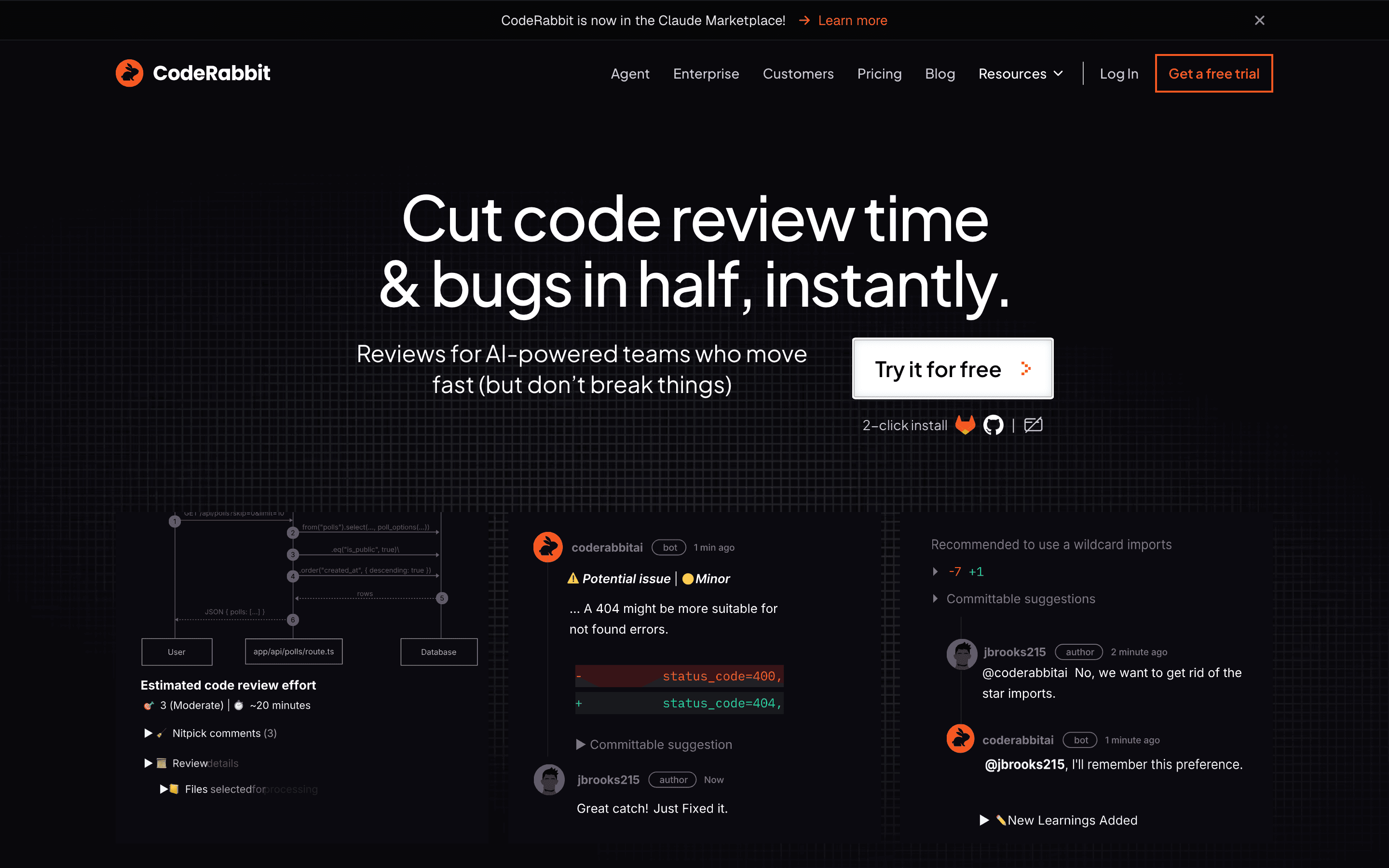
CodeRabbit is one of the most widely integrated AI code reviewers, running as an app on GitHub, GitLab, Azure DevOps, and Bitbucket plus an IDE extension and CLI. Pro adds linter and SAST support on top of the core PR comments, so it isn't pure diff commentary, though it doesn't match Codacy or CodeAnt's full security scanning stack. Pricing counts only developers who open pull requests, not every repo collaborator, starting at $24/seat/month billed annually, with a free tier that never expires on public repositories. A recent update added source attribution, so every flagged issue traces back to the specific rule that triggered it, closer to the transparency of a SonarQube quality gate. The real limit is the hourly review cap on every plan; teams that ship a lot of pull requests will hit it and need the usage-based add-on or a higher tier, so the bill isn't as flat as the per-seat sticker price suggests.
Pros
- + Free forever on public repositories, no seat limit
- + Charges only for developers who open pull requests, not the whole team
- + Recent update adds source attribution so you can see which guideline triggered a comment
Cons
- – Each plan caps reviews per developer per hour; teams that exceed it need the usage-based add-on or a higher tier
- – Review quality is diff-focused, so it can miss bugs that only show up when you look at the whole codebase
Should your product be on this ai code review list?
If you build a tool that belongs next to the ones above, submit it. A human reviews every submission. Approved products get their own page with pricing and screenshots, plus a place in the comparisons where they fit. It is free. You sign in with your work email so you can follow the decision, and there is no password to create.
SonarQube alternatives: FAQ
What's the best free alternative to SonarQube?+
For a single developer, Codacy's Developer plan is free forever with no time limit, and CodeRabbit is free forever on public repositories. Neither fully replaces SonarQube's own free Community Build for self-hosted static analysis, but both add AI-written review comments SonarQube's free tier doesn't.
Which SonarQube alternative has the closest security scanning (SAST, secrets, SCA)?+
Codacy runs static analysis, secret detection, and software composition analysis alongside its AI review, the closest match to SonarQube's core scanning stack. CodeAnt also covers all three: static analysis, secrets scanning, and SCA with CVSS/EPSS-scored dependency vulnerabilities, and adds continuous penetration testing and compliance audit reporting on top.
What's the cheapest paid alternative to SonarQube?+
Codacy's Team plan starts at $18 per seat per month, the lowest published per-seat price among the alternatives that still run SAST, secret, and SCA scanning to match SonarQube's core security coverage.
Do any of these alternatives support self-hosted or on-prem deployment like SonarQube Server?+
Yes. CodeRabbit and CodeAnt both offer self-hosted or on-prem deployment on their Enterprise plans, though those plans are quote-only.
SonarQube alternatives: pricing compared
Entry price, billing model, and whether pricing is public. 4 of 4 publish pricing you can check without talking to sales.
| Tool | Starting price | Billing | Free option | Pricing disclosed |
|---|---|---|---|---|
| SonarQube | $34/mo | usage-based | Yes | Partly public |
| Codacy | $18/seat/mo | per-seat | Yes | Partly public |
| CodeAnt | $24/seat/mo | per-seat | Trial (14 days, no credit card required, unlimited seats and 100 PR reviews included) | Partly public |
| CodeRabbit | $24/seat/mo | per-seat | Yes | Partly public |
How we made these picks. We compare tools on public pricing, features, and hands-on assessment, then verify every price against the vendor's own page. We never accept payment for rankings. Read the full methodology. Spotted an error? Report it.