Heroku Review
The original app platform: git push to deploy, now in Salesforce maintenance mode
Is this your product? Claim this page · Request a change
Looking for a Heroku alternative? See our ranked comparison.→What is Heroku?
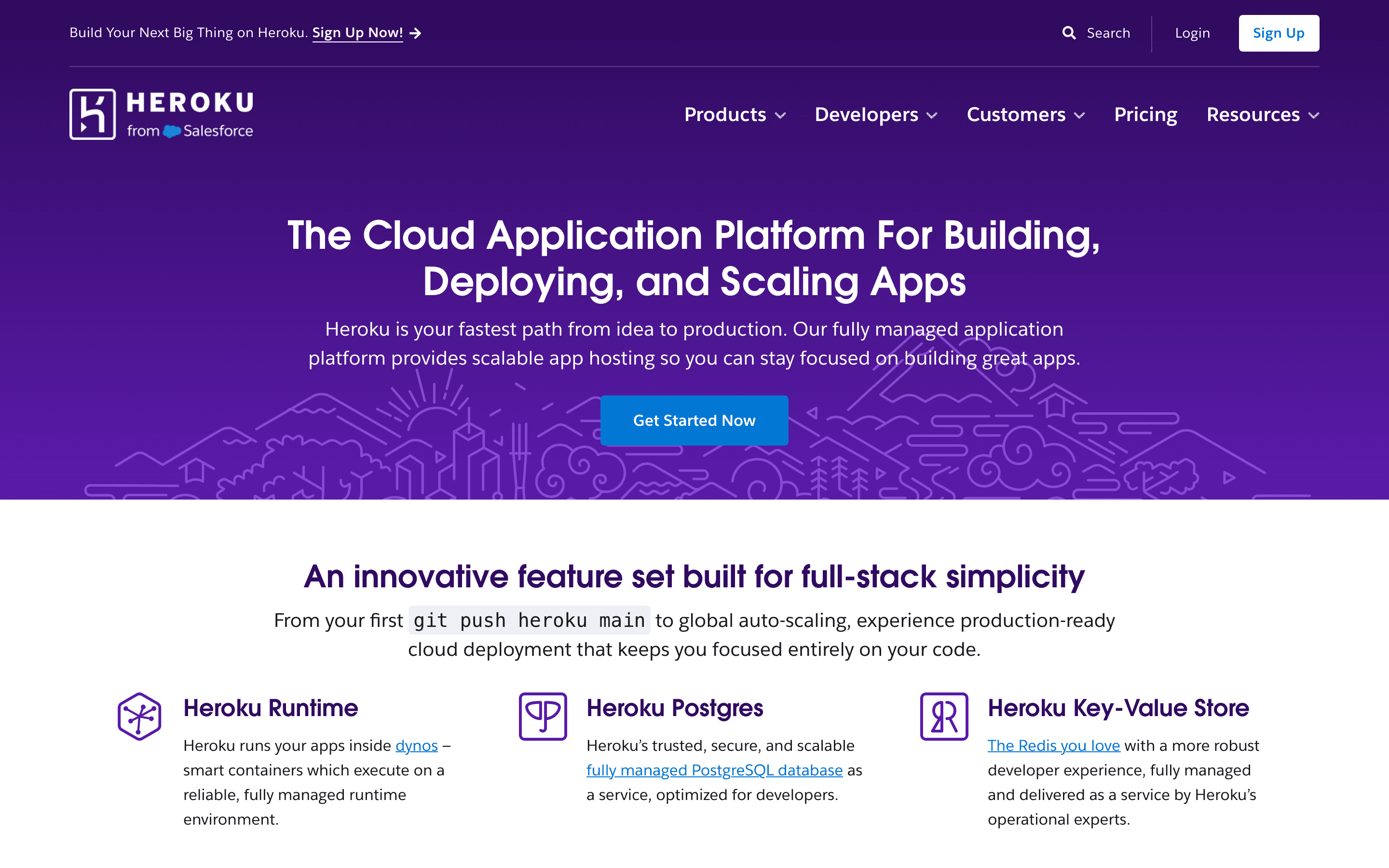
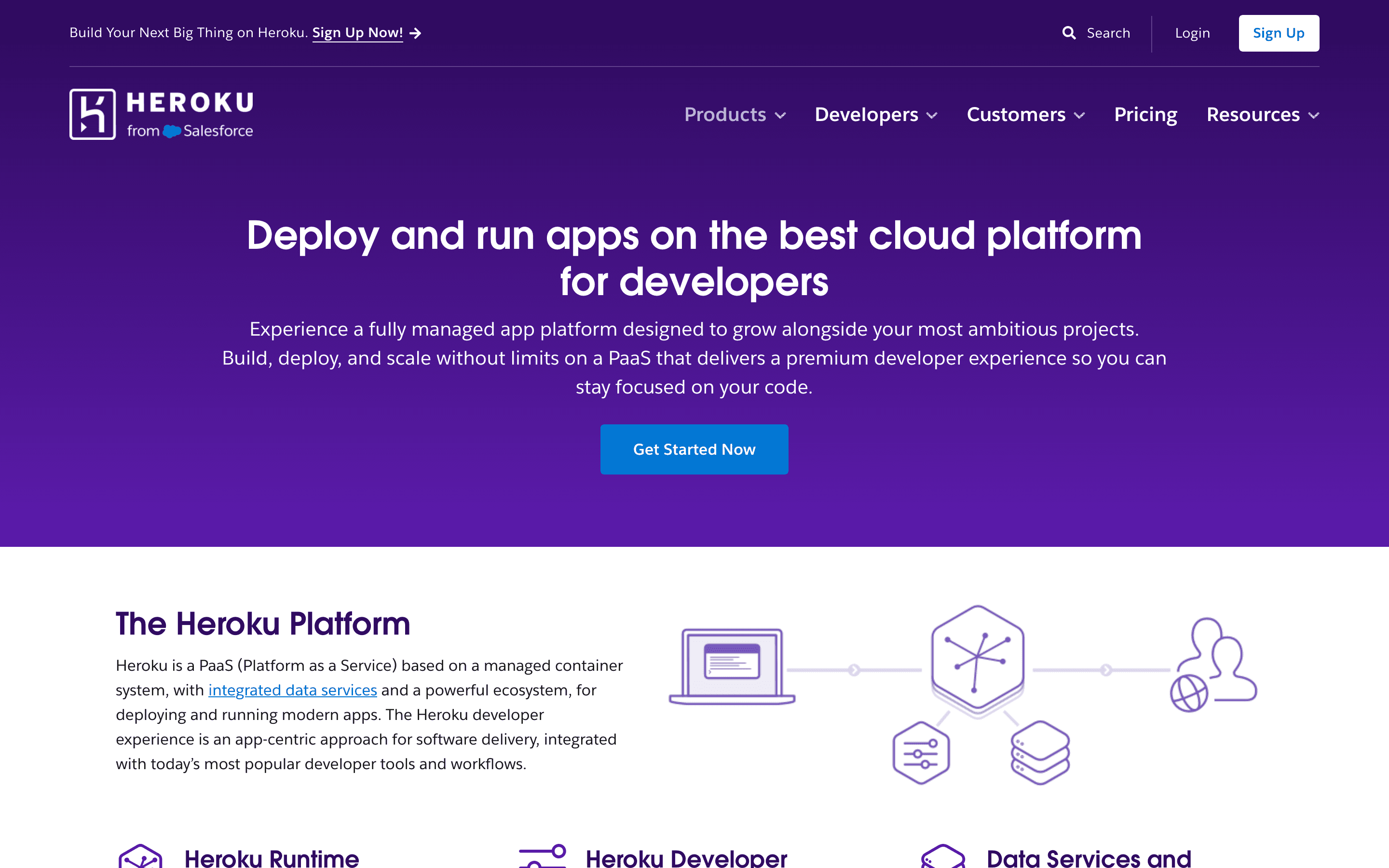
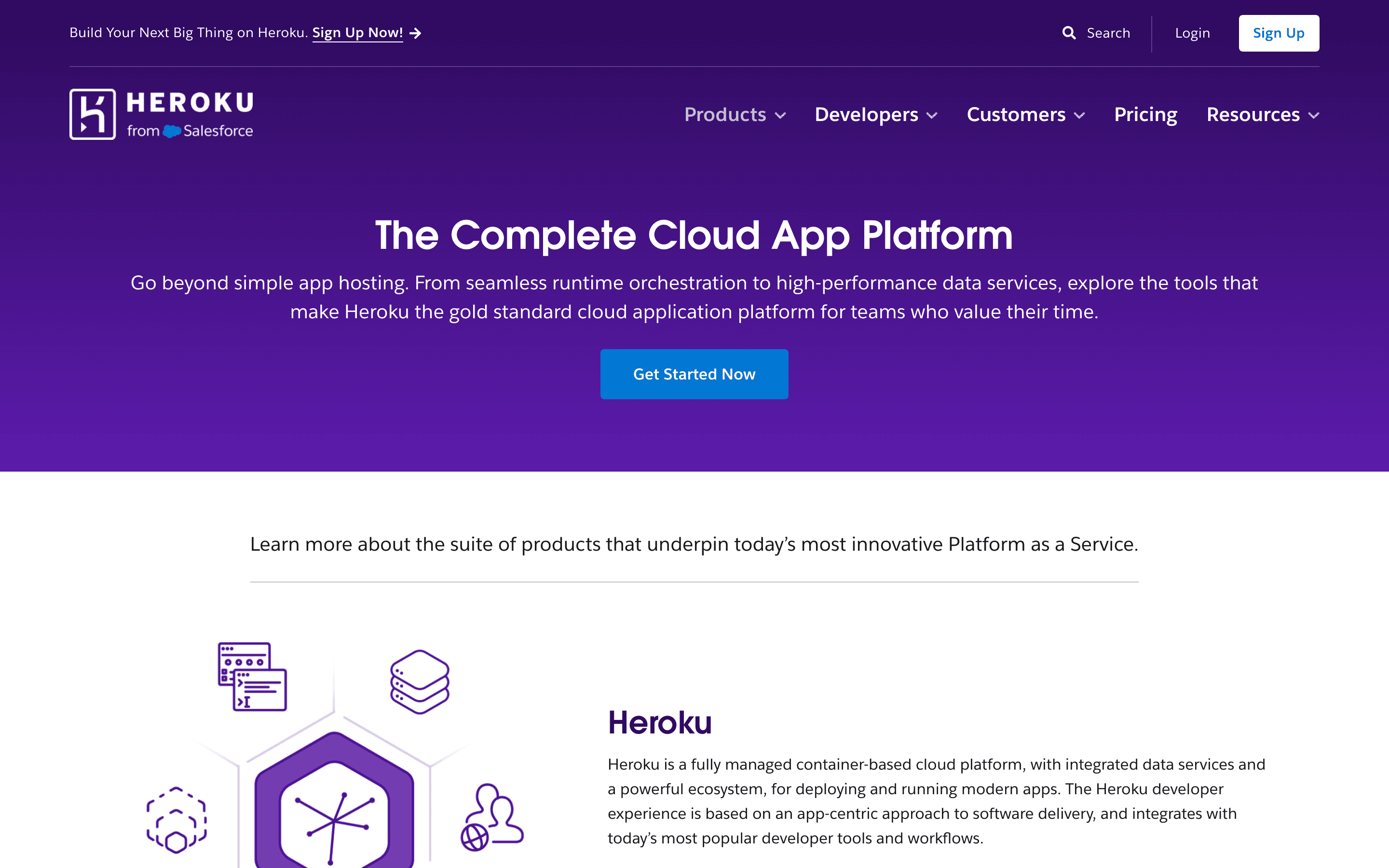
Heroku is a platform-as-a-service for deploying web apps without managing servers. You push code, Heroku builds it into a container (a "dyno") and runs it, and you add databases and other services as add-ons from its marketplace. It popularized the git-push-to-deploy workflow that most modern platforms still copy.
Salesforce owns Heroku and announced in February 2026 that it is moving the product into a "sustaining engineering" model: security and stability fixes continue, but new feature work has stopped and Salesforce is no longer signing new Enterprise contracts. Existing customers keep running as before, but the roadmap is effectively frozen while Salesforce redirects investment to its own AI products.
Day to day, Heroku still works the way it always has. You pick a dyno size, attach a Postgres or Redis-compatible add-on, and deploy from git or GitHub. The 2025 "Fir" runtime added Kubernetes-backed dynos with OCI image support, but that sits alongside the older Cedar dynos rather than replacing them yet.
Heroku screenshots
Who it's for
- ✓ Teams already running production apps on Heroku who value stability over new features
- ✓ Small teams that want a fully managed Postgres and Redis alongside the app host and don't want to shop around for add-ons
- ✓ Rails, Node, or Python apps that fit Heroku's buildpack model without custom infrastructure needs
Who should look elsewhere
- ✗ New projects choosing a platform today, given Heroku's roadmap is frozen and cheaper, more actively developed options exist
- ✗ Cost-sensitive teams, since dyno, database, and add-on costs stack quickly compared with usage-based competitors
- ✗ Teams that need modern features like edge functions or built-in preview environments without third-party add-ons
Pros
- + Simple git-push deploy workflow with almost no setup
- + Wide add-on marketplace covering databases, caching, monitoring, and more without leaving the platform
- + Mature, well-documented CLI and buildpacks for most common languages
- + Managed Postgres, Redis-compatible Key-Value Store, and Kafka are built in rather than bolted on
Cons
- – No free tier since November 2022; the cheapest working setup runs about $10/month before add-ons
- – Salesforce confirmed in February 2026 that Heroku is in sustaining engineering mode: no new features and no new Enterprise contracts
- – Costs escalate fast because dynos, databases, and add-ons are priced and billed separately
- – Suffered two major outages in June 2025, one lasting over 15 hours, that renewed questions about platform reliability
Heroku pricing
At about $5/month to start, it is one of the cheaper options in App Hosting & PaaS.
| Plan | Price | Highlights |
|---|---|---|
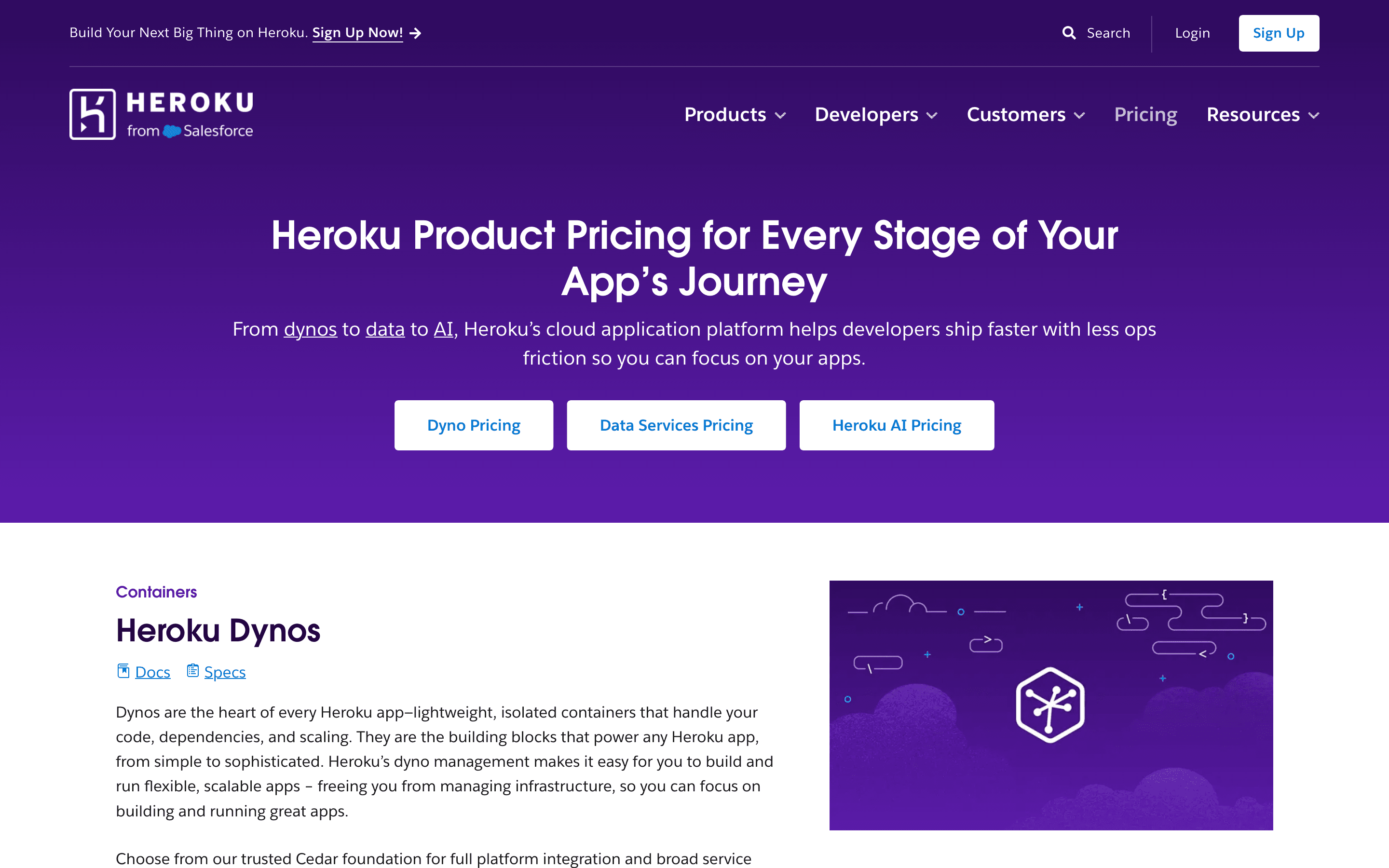
| Eco dyno | $5/mo | Shared 0.5 GB RAM dyno · Meant for small hobby or side-project apps · Sleeps when idle |
| Basic dyno | $7/mo | 0.5 GB RAM, no sleeping · Free SSL |
| Standard-1X dyno | $25/mo | 0.5 GB RAM · Simple horizontal scalability, app metrics and threshold alerts |
| Standard-2X dyno | $50/mo | 1 GB RAM |
| Performance-M dyno | $250/mo | 2.5 GB RAM · Dedicated compute resources · Autoscaling |
| Performance-L dyno | $500/mo | 14 GB RAM · Dedicated compute resources · Autoscaling |
| Postgres Essential-0 | $5/mo | 1 GB storage, shared database |
| Postgres Standard-0 | $50/mo | 4 GB RAM, 64 GB storage, dedicated server |
There is no free tier. Heroku killed all free dynos, databases, and Redis in November 2022; the cheapest way to run an app now is a $5/month Eco dyno plus a $5/month Essential-0 Postgres database. Dynos are metered by the second and capped at the monthly price shown. Real app cost stacks a dyno plan, a Postgres (or Key-Value Store) plan, and any add-ons separately, so total spend is usually well above the entry price. Private Spaces, Shield (HIPAA/PCI), and Apache Kafka on Heroku run on their own, much higher priced tiers (Private and Shield dynos start around $125 and $150/month). Enterprise pricing beyond Private Spaces is quote-only, and Salesforce stopped writing new Enterprise contracts in February 2026. Prices confirmed on the live pricing page.
Pricing verified July 22, 2026 · source
How Heroku's pricing compares
Heroku next to its closest alternatives on entry price, billing, and whether pricing is public.
| Tool | Starting price | Billing | Free option | Pricing disclosed |
|---|---|---|---|---|
| Heroku | $5/mo | usage-based | No | Public |
| Vercel | $20/seat/mo | usage-based | Yes | Partly public |
| Netlify | $9/mo | tiered | Yes | Partly public |
| Render | $25/mo | tiered | Yes | Partly public |
| Railway | $5/mo | usage-based | Trial ($5 one-time usage credit for new accounts, no credit card required) | Partly public |
| Fly.io | Custom / quote | usage-based | Trial (New accounts get a trial that lasts 7 days or 2 hours of total machine runtime, whichever comes first, capped at 10 machines and 20GB of volume storage. Dedicated IPv4s, performance-class CPUs, and GPUs are not available during the trial.) | Partly public |
Is Heroku still actively developed?
Last significant update: March 2026. Doubled the default compressed slug size from 500MB to 1GB, extended build timeouts, and shipped Heroku CLI v11, rebuilt on ESM and oclif v4. The post also confirmed Heroku is now run under a sustaining engineering model focused on stability, security, and reliability rather than new features.
Top Heroku alternatives
Heroku FAQ
Is Heroku still being developed?+
Not with new features. In February 2026 Salesforce announced Heroku is moving to a sustaining engineering model: security and stability fixes continue, but there's no new feature roadmap, and Salesforce has stopped signing new Enterprise contracts.
Does Heroku have a free plan?+
No. Heroku removed all free dynos, databases, and Redis on November 28, 2022. The cheapest working app today needs a $5/month Eco dyno plus a $5/month Essential-0 Postgres plan.
How much does Heroku actually cost to run a small app?+
Expect at least $10 to $15/month once you add a dyno and a database, since Heroku prices dynos, Postgres, and add-ons separately rather than bundling them into one plan price.
Has Heroku had reliability problems recently?+
Yes. In June 2025 Heroku had two major outages within about a week, including one that lasted over 15 hours and took down the dashboard, CLI, and many deployed apps.