Top Bullhorn Alternatives in 2026
Here for Bullhorn itself? See the full Bullhorn profile, pricing & reviews →
Suggest a change- If you want the closest all-in-one agency replacement, with sourcing, client and candidate portals, and back-office invoicing in one system at a published entry price, choose Crelate. Crelate is built for the same staffing agencies and executive search firms as Bullhorn and bundles ATS, recruiting CRM, sourcing, and portals into one platform, with its two entry tiers published at $85 and $119 a seat instead of hidden behind a quote.
- If the reason you're leaving is Bullhorn hiding its Pro-tier price and you want to see per-seat pricing at every tier before you buy, choose Recruit CRM. Recruit CRM publishes real per-seat prices for all three plans, Pro at $95, Business at $135, and Enterprise at $215, so unlike Bullhorn's quote-only Pro tier you see the full cost of automation and AI before a sales call.
- If you run temp or contract desks and need compliance expiry checks and a shift audit trail tied to each placement, choose Vincere. Vincere's Innovation Pulse release added automatic compliance checks that flag documents expiring before a contract ends and a full shift audit trail on every placement, the kind of contract-desk workflow Bullhorn handles through its separate Middle Office products.
- If candidate sourcing is your bottleneck and you want a built-in profile database plus a free tier to test before committing, choose Loxo. Loxo builds an 850 million-plus profile sourcing database and AI outreach agents into its Professional tier, and its free plan gives one user a real ATS and CRM with no time limit, so you can try it first, something Bullhorn offers no trial or free plan for.
- If broad job-board distribution and a large integration ecosystem matter more than seeing a price up front, choose JobAdder. JobAdder posts to more than 200 job boards through Broadbean and carries 100-plus integrations backed by SEEK, though it publishes no pricing at all, so you learn what a seat costs only after a demo.
- If your agency depends on 120-plus VMS connections, the 350-plus app marketplace, and Middle Office timesheets and invoicing running at scale in one system, choose stay on Bullhorn. None of these five match Bullhorn's 120-plus VMS connections, 350-plus marketplace apps, and built-in Middle Office timesheet and invoicing products, so a large agency running vendor management and back-office billing through Bullhorn would lose ecosystem depth by switching.
Bullhorn is an ATS and CRM built for staffing and recruiting agencies. Job orders, candidate submittals, client billing, VMS connections, and Middle Office timesheets and invoicing all live in one system, priced per seat. The plan most agencies actually buy, Pro, is quote-only, and reviewers report renewal increases of around 20% with no new features to show for it.
Agencies shopping alternatives usually leave for one of two reasons: they can't see the real price of the CRM and automation features until a sales call, or they're paying for more than they use. The tools below are the staffing-specific ATS and CRM platforms a Bullhorn buyer would actually cross-shop, ranked by how closely each replaces Bullhorn's own job: running candidates, clients, and placements for an agency in one system.
Bullhorn alternatives compared
| Tool | Best for | Starting price | Free option | Last update |
|---|---|---|---|---|
| CrelateBest all-in-one agency replacement | Staffing and search agencies that want sourcing, CRM, and ATS in one system instead of stitching tools together | $85/seat/mo | No | June 2026 |
| Recruit CRMBest transparent pricing | Recruitment and executive search agencies that want an ATS with modern AI sourcing and resume parsing built in, not bolted on | $95/seat/mo | Trial (No stated end date, but the vendor says usage limits apply during the trial) | — |
| VincereBest for temp and contract desks | Staffing and recruitment agencies that want CRM, ATS, and job order management in one system built for their industry | GBP 69/seat/mo | Trial (3-6 weeks for the AI modules only, via a "Try Now, Pay Later" programme) | March 2026 |
| LoxoBest candidate sourcing | Retained search and direct-hire firms that want sourcing, CRM, and outreach in one system | $169/seat/mo | Yes | — |
| JobAdder | Recruitment agencies that want one system for candidates, clients, jobs, and placements without stitching together separate tools | Custom / quote | No | — |
Why teams switch from Bullhorn
Renewal prices climb about 20% with no new features
Reviewers report Bullhorn tries to raise pricing by roughly 20% at contract renewal, turning a $20,000-a-year deal into about $28,800 by year three with no new features to show for it.
Agencies say they pay for more than they use
Bullhorn's Value for Money score on Capterra is 3.7 out of 5, its lowest-rated category, with agencies reporting added charges for custom fields, training, and data migration on exit.
The pricing that matters most is hidden behind a quote
Starter and Core prices are public, but Pro, the plan Bullhorn calls its most popular and the one with real CRM and automation features, along with every Recruitment Cloud edition, is quote-only.
The best Bullhorn alternatives, ranked
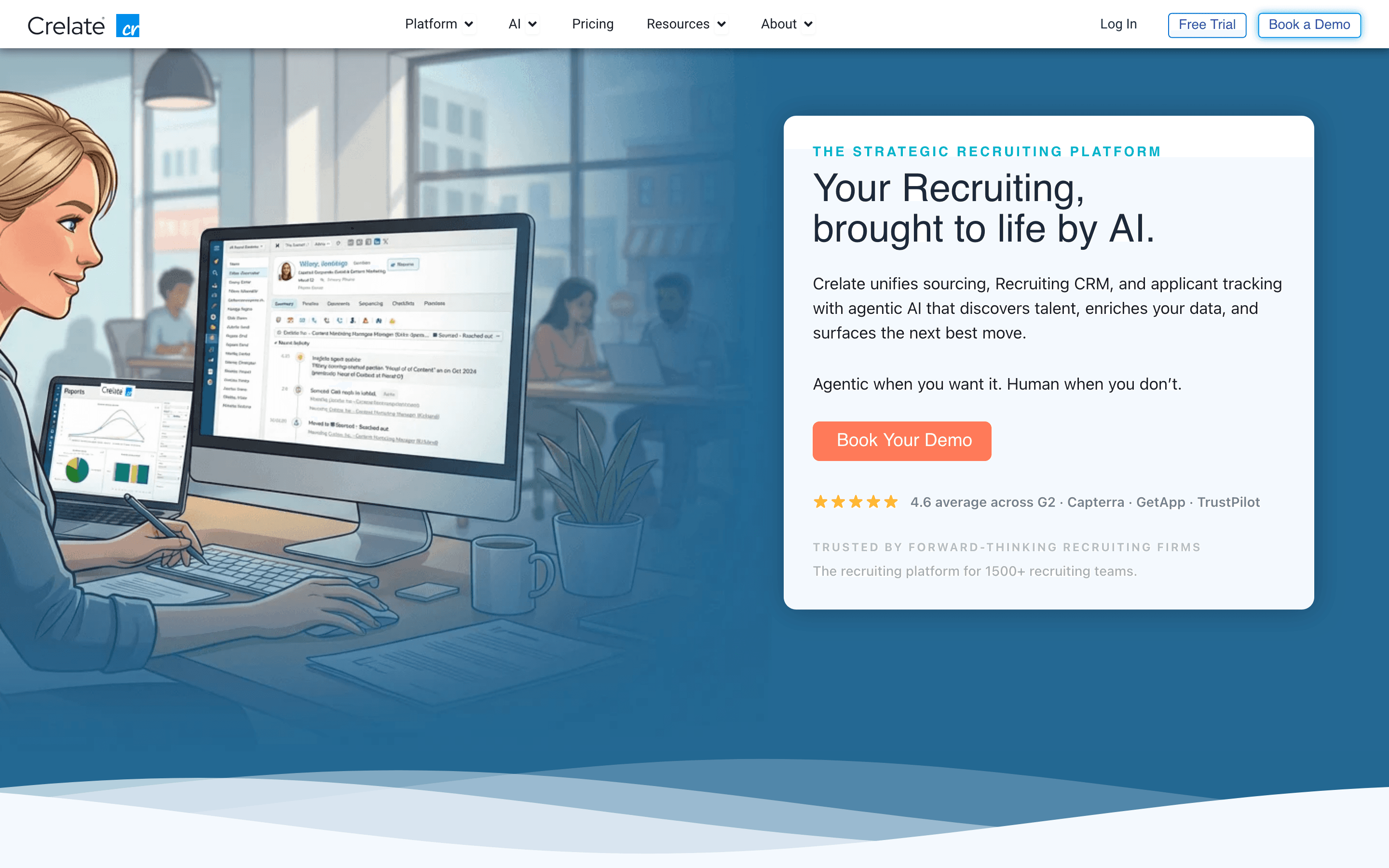
Crelate is the closest like-for-like replacement for Bullhorn. It carries the same positioning, a recruiting CRM and ATS built for staffing agencies and executive search firms, and combines ATS, CRM, candidate sourcing, and client and candidate portals in one system rather than selling them as separate products. It also has a back office for invoicing, closer to Bullhorn's Middle Office than most tools on this list get. The main advantage over Bullhorn is pricing you can see: Essentials is $85 a seat and Business is $119, both published, so a small agency can budget without a sales call. The tradeoff mirrors Bullhorn's own, since automation and sequencing only unlock at the quote-only Business Plus tier, and reviewers report the LinkedIn sourcing extension is unreliable and text sequences need manual triggering. Pick Crelate for the all-in-one agency fit at a lower, more visible entry price.
Pros
- + Combines ATS, CRM, sourcing, and portals in one platform instead of separate tools
- + Essentials and Business tiers have published per-seat prices, so small agencies can budget without a sales call
- + Free trial requires no credit card
Cons
- – Automation and sequencing, a core desk-running feature, is locked behind the custom-priced Business Plus tier
- – Business Plus and Enterprise pricing is quote-only, so agencies can't compare true cost until they talk to sales
Recruit CRM answers the single biggest reason agencies leave Bullhorn: pricing opacity. It publishes real per-seat prices for all three plans, Pro at $95, Business at $135, and Enterprise at $215, so you see the true cost of automation, analytics, and LinkedIn messaging up front instead of hitting Bullhorn's quote-only Pro wall. It is built specifically for recruitment and executive search agencies, with AI resume parsing, GPT integration, and AI sourcing included from the entry Pro plan, and it ships an MCP server so you can query candidate and job data from Claude or ChatGPT directly. The limits are clear too: Pro caps you at one email sequence and two AI candidate matches, and workflow automation, advanced analytics, and data enrichment are metered add-ons unless you reach Enterprise. It does not bundle timesheets and invoicing the way Bullhorn's Middle Office does, since that runs as a separate product line.
Pros
- + Vendor publishes actual per-seat prices for all three plans instead of forcing a sales call
- + AI resume parsing, GPT integration, and AI sourcing are included starting on the entry Pro plan
- + Recruit CRM MCP server lets agencies query their own candidate and job data from Claude or ChatGPT directly
Cons
- – Pro plan caps you at 1 email sequence and 2 AI candidate matches, both of which most agencies will outgrow fast
- – Workflow automation, advanced analytics, LinkedIn messaging, data enrichment, and extra job board credits are all separate paid add-ons unless you're on Enterprise
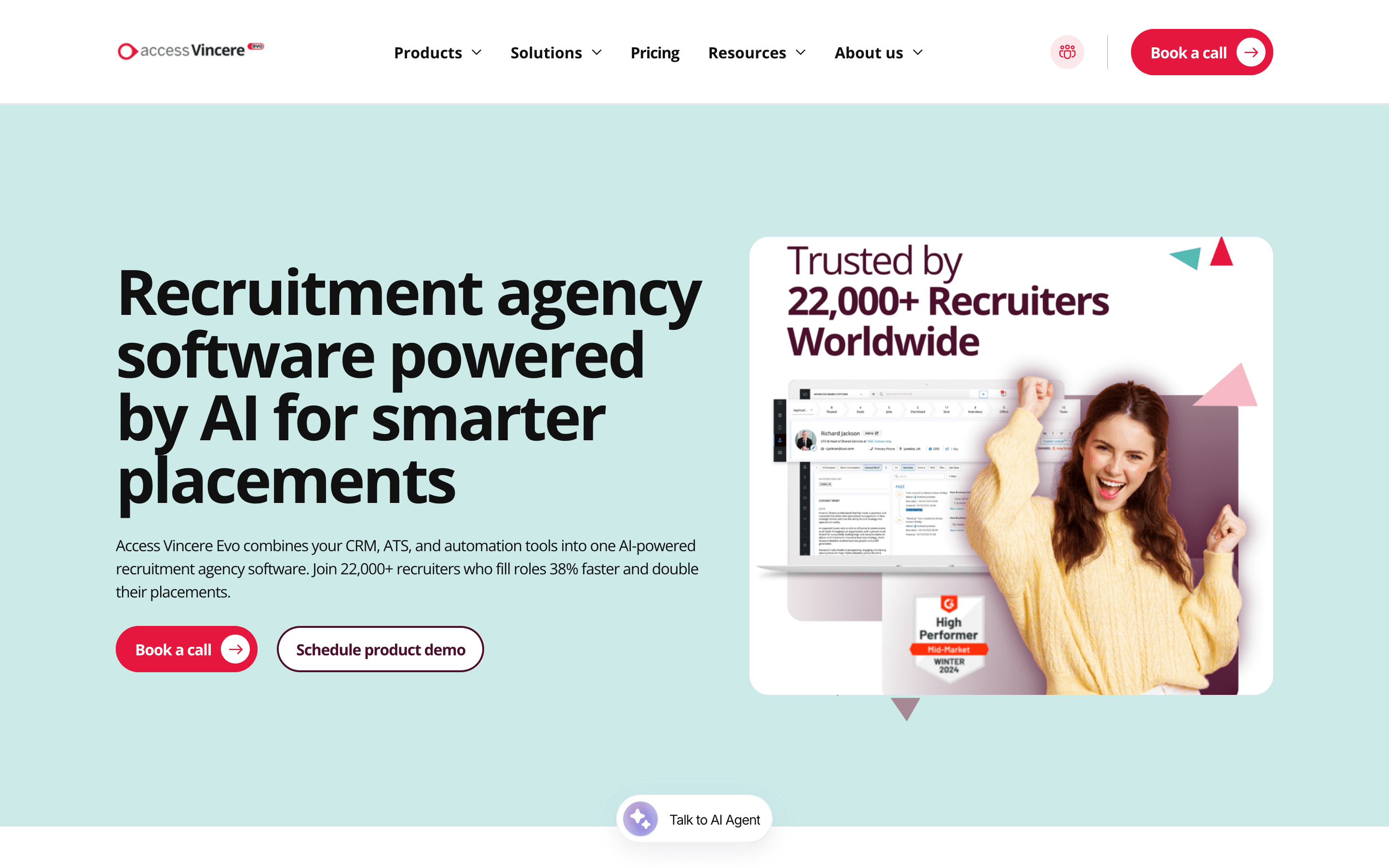
Vincere is the most Bullhorn-like option for agencies running temp and contract desks. Built specifically for staffing and recruitment agencies and now sold as Access Vincere Evo under The Access Group, it covers candidate and client records, job orders, and placements, and its Innovation Pulse release added automatic compliance checks for expiring documents and a full shift audit trail on every placement, the contract-desk workflow Bullhorn handles through Middle Office. Where it does not improve on Bullhorn is pricing. The core CRM and ATS licence starts at 69 British pounds a seat per month, but Vincere publishes no tier breakdown beyond that figure, and the four AI add-ons are billed per agency from 25 to 349 pounds on top, so every plan funnels to a sales call. Choose Vincere when compliance and shift tracking for contract desks matter more than the transparent pricing a Bullhorn switcher is often chasing.
Pros
- + Combines CRM, ATS, and placement/compliance tracking built specifically around staffing agency workflows
- + Regular product releases (Innovation Pulse) with features aimed at real desk problems like compliance expiry and shift disputes
- + AI add-ons are modular, so agencies can start with the base CRM and add automation later instead of buying everything up front
Cons
- – CRM tier pricing beyond the 69 pound/seat starting figure is not published; you don't know what you'll actually pay until you talk to sales
- – AI features are a separate line item priced per agency, so the advertised starting price understates what a fully-featured setup costs
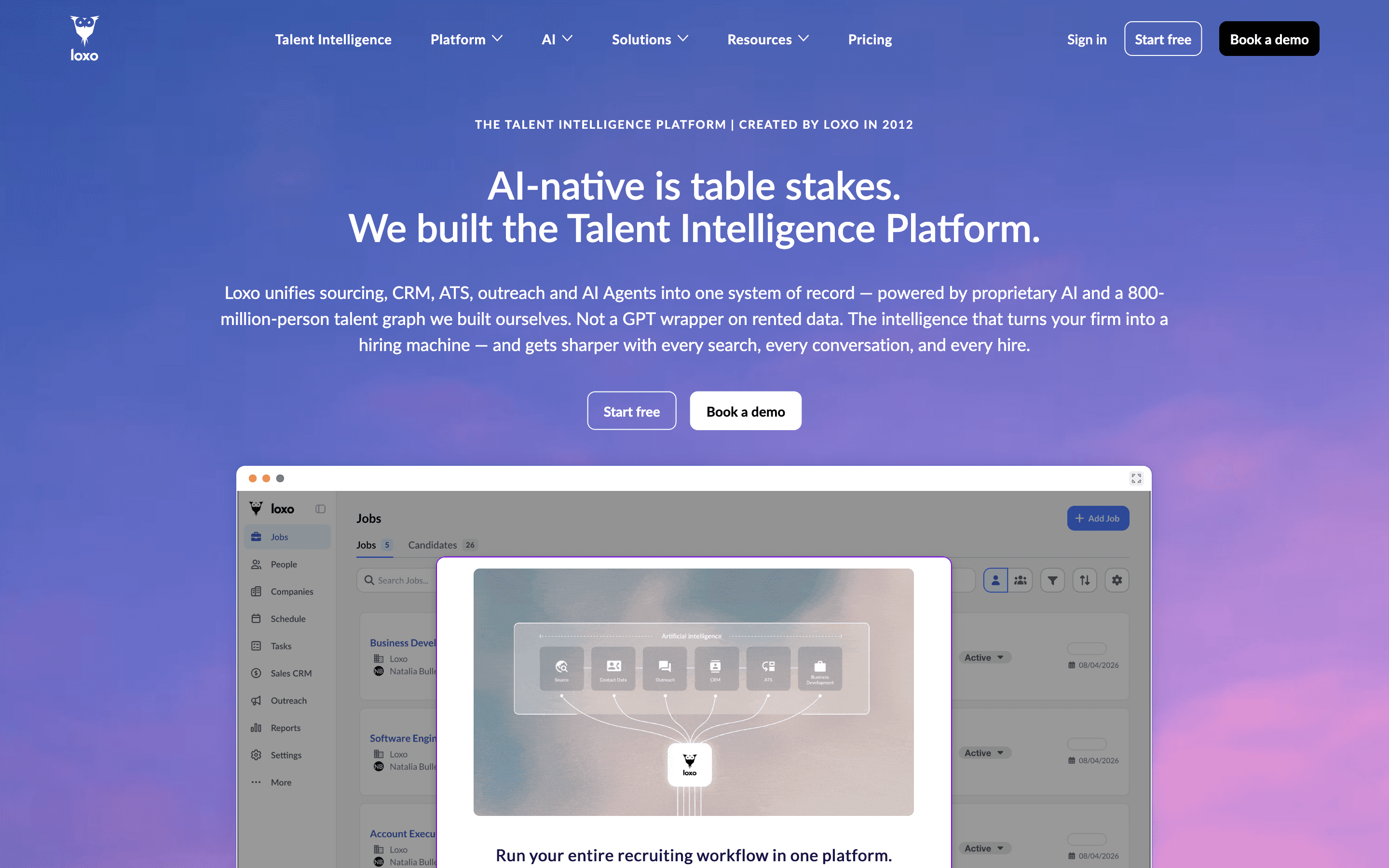
Loxo fits agencies whose main gap in Bullhorn is candidate sourcing rather than back-office depth. Its Professional tier bundles an 850 million-plus profile talent database, AI outreach agents, and an AI notetaker for interviews, sourcing firepower Bullhorn does not build in the same way. The free plan is a genuine draw for a Bullhorn switcher, since it gives one user a real ATS and CRM with no time limit, and Bullhorn offers no free plan or trial at all. The catch is familiar: Professional and Enterprise, the tiers that actually include the sourcing database and AI agents, are quote-only, so you trade one opaque pricing wall for another, and the one published paid tier, Basic, is $169 a seat billed annually. Reviewers also flag automated outreach as limited and clunky and support as slow outside the US. Choose Loxo for sourcing depth and a free trial path, not for pricing clarity.
Pros
- + Combines ATS, CRM, sourcing database, and outreach in one platform instead of separate tools
- + AI notetaker and AI agents cut down manual note-taking and outreach drafting
- + Free tier gives a real, usable ATS/CRM for a single user with no time limit
Cons
- – Professional and Enterprise pricing is hidden behind a sales call, so real cost for the features most agencies want isn't published
- – Automated outreach campaigns are described by users as limited and clunky
JobAdder
JobAdder is a recruitment CRM and ATS for agencies and in-house teams, covering candidate and client records, job posting, and placement tracking in one system. Its strengths echo parts of Bullhorn's breadth: multi-posting to more than 200 job boards through Broadbean, 100-plus integrations backed by SEEK, and Adder Intelligence for candidate summaries and relevancy ratings. It fits a Bullhorn agency that leans on wide board distribution. The weaknesses make it the loosest fit of the five for a switcher, though. JobAdder publishes no pricing at all, not even a starting figure, so budgeting means a demo and a sales process, a step behind Bullhorn, which at least lists Starter and Core. Add-ons like SSO, Broadbean distribution, and the hiring manager portal cost extra, Adder Intelligence only appears from Recruiter Essential up, and reviewers report the platform is hard to customize. Pick JobAdder for its board network, not for pricing you can see.
Pros
- + Covers the full desk workflow: CRM, ATS, job posting to 200+ boards, and placement tracking in one place
- + Adder Intelligence gives candidate summaries and relevancy ratings without extra tooling
- + 100+ third-party integrations, so it slots into an existing tech stack
Cons
- – No published pricing, so budgeting means going through a demo and sales process first
- – Reviewers report the platform is hard to customize to specific workflows
Should your product be on this staffing & recruiting crm list?
If you build a tool that belongs next to the ones above, submit it. A human reviews every submission. Approved products get their own page with pricing and screenshots, plus a place in the comparisons where they fit. It is free. You sign in with your work email so you can follow the decision, and there is no password to create.
Bullhorn alternatives: FAQ
What is the best alternative to Bullhorn?+
Crelate is the closest fit for most agencies leaving Bullhorn. It is built for the same staffing agencies and executive search firms and combines ATS, recruiting CRM, sourcing, and portals in one system, and it publishes its two entry tiers at $85 and $119 a seat instead of hiding the CRM behind a quote like Bullhorn's Pro plan.
Which Bullhorn alternative has the most transparent pricing?+
Recruit CRM. It publishes Pro at $95, Business at $135, and Enterprise at $215 per seat per month. Bullhorn only publishes its Starter ($99) and Core ($165) tiers, leaving the Pro plan most agencies actually need behind a quote.
Which alternative is best for staffing agencies running temp or contract desks?+
Vincere. Its Innovation Pulse release added automatic compliance checks that flag documents expiring before a contract ends and a full shift audit trail tied to each placement, the contract-desk workflow Bullhorn handles through its separate Middle Office products.
Is there a free option to test before switching from Bullhorn?+
Loxo has a free plan that gives one user a real ATS and CRM with no time limit, plus a 7-day trial of Professional features. Bullhorn itself has no free plan and no free trial for any tier.
Bullhorn alternatives: pricing compared
Entry price, billing model, and whether pricing is public. 5 of 6 publish pricing you can check without talking to sales.
| Tool | Starting price | Billing | Free option | Pricing disclosed |
|---|---|---|---|---|
| Bullhorn | $99/seat/mo | tiered | No | Partly public |
| Crelate | $85/seat/mo | tiered | No | Partly public |
| Recruit CRM | $95/seat/mo | per-seat | Trial (No stated end date, but the vendor says usage limits apply during the trial) | Public |
| Vincere | GBP 69/seat/mo | per-seat | Trial (3-6 weeks for the AI modules only, via a "Try Now, Pay Later" programme) | Public |
| Loxo | $169/seat/mo | tiered | Yes | Partly public |
| JobAdder | Custom / quote | quote-only | No | Not disclosed |
How we made these picks. We compare tools on public pricing, features, and hands-on assessment, then verify every price against the vendor's own page. We never accept payment for rankings. Read the full methodology. Spotted an error? Report it.