Top Fetcher Alternatives in 2026
Here for Fetcher itself? See the full Fetcher profile, pricing & reviews →
Suggest a change- If you want the closest price match to Fetcher with plain-language search and a free plan, choose Juicebox. Juicebox's Starter plan runs $119 a seat a month, just above Fetcher's $115 Self-serve tier, and lets you describe a candidate in a sentence instead of building a boolean string.
- If you need to search a much bigger pool of passive candidates with filters like security clearance or inferred technical skills, choose SeekOut. SeekOut indexes more than 1 billion profiles with filters Fetcher doesn't offer, and its Recruit Core plan still gives you a real self-serve price.
- If you're sourcing across dozens of sites and want to fold your CRM and outreach sequencer into one contract, choose hireEZ. hireEZ searches 45+ platforms from one query and bundles CRM, outreach, and screening, so you can drop separate tools Fetcher doesn't replace.
- If your team already runs on Greenhouse, Workday, Lever, or iCIMS and you want AI sourcing and fraud screening layered on top without switching systems, choose Gem. Gem plugs directly into those ATS platforms and adds an AI Fraud Detection Agent that flags fabricated candidates, something Fetcher has no equivalent for.
- If you're a solo recruiter or small team who wants a published self-serve price plus the option of a dedicated human sourcer for a few open roles, choose stay on Fetcher. Fetcher's Amplify plan is the only one of these four that includes a real person sourcing your highest-priority roles at a flat included seat price, rather than as a separately priced add-on like SeekOut Spot.
Fetcher pairs an AI sourcing engine with real self-serve pricing, so solo recruiters and small teams can start finding candidates with verified contact info without a sales call. Its Amplify plan even adds a human sourcer for a handful of roles, which is unusual at this price point.
Recruiters and sourcers look elsewhere when they need a bigger passive-candidate database, tighter integration with their ATS, or more room to consolidate sourcing, outreach, and screening into one contract than Fetcher's smaller-team-focused plans allow.
Fetcher alternatives compared
| Tool | Best for | Starting price | Free option | Last update |
|---|---|---|---|---|
| JuiceboxBest value / closest price match | Recruiters and sourcers who want to describe a candidate in plain language instead of writing boolean strings | $119/seat/mo | Yes | July 2026 |
| SeekOutBest for a bigger passive-candidate database | Solo recruiters or small in-house teams who want self-serve pricing without a sales call | $149/seat/mo | Trial (14 days on Recruit Core, no credit card required) | July 2026 |
| GemBest for teams staying on their current ATS | Sourcers and recruiters who want one tool for finding candidates across many sites, tracking outreach, and rediscovering past applicants | $130/mo | Trial (Companies under 30 employees get Gem All-in-One free for 6 months, then 50% off) | April 2026 |
| hireEZBest for consolidating sourcing, CRM, and outreach tools | Recruiting teams running multiple point tools (sourcing, CRM, sequencer) who want to fold them into one contract | $494/seat/mo | Trial (7 days (Solo Recruiter plan)) | November 2025 |
Why teams switch from Fetcher
The AI sourcing engine sometimes surfaces candidates who don't fully match the job
Reviewers on G2 report Fetcher's AI occasionally returns candidates missing a stated education or credential requirement, which pushes some teams to try a different match engine.
The Self-serve plan's 300-lead-a-month cap gets tight fast
Teams sourcing for more than one open role at a time run into the cap and either upgrade or look at a tool without as tight a monthly ceiling.
Customization is limited for smaller teams
Third-party sourcing tool roundups flag Fetcher as less configurable than some competitors for teams that want more control over search and workflow setup.
The best Fetcher alternatives, ranked
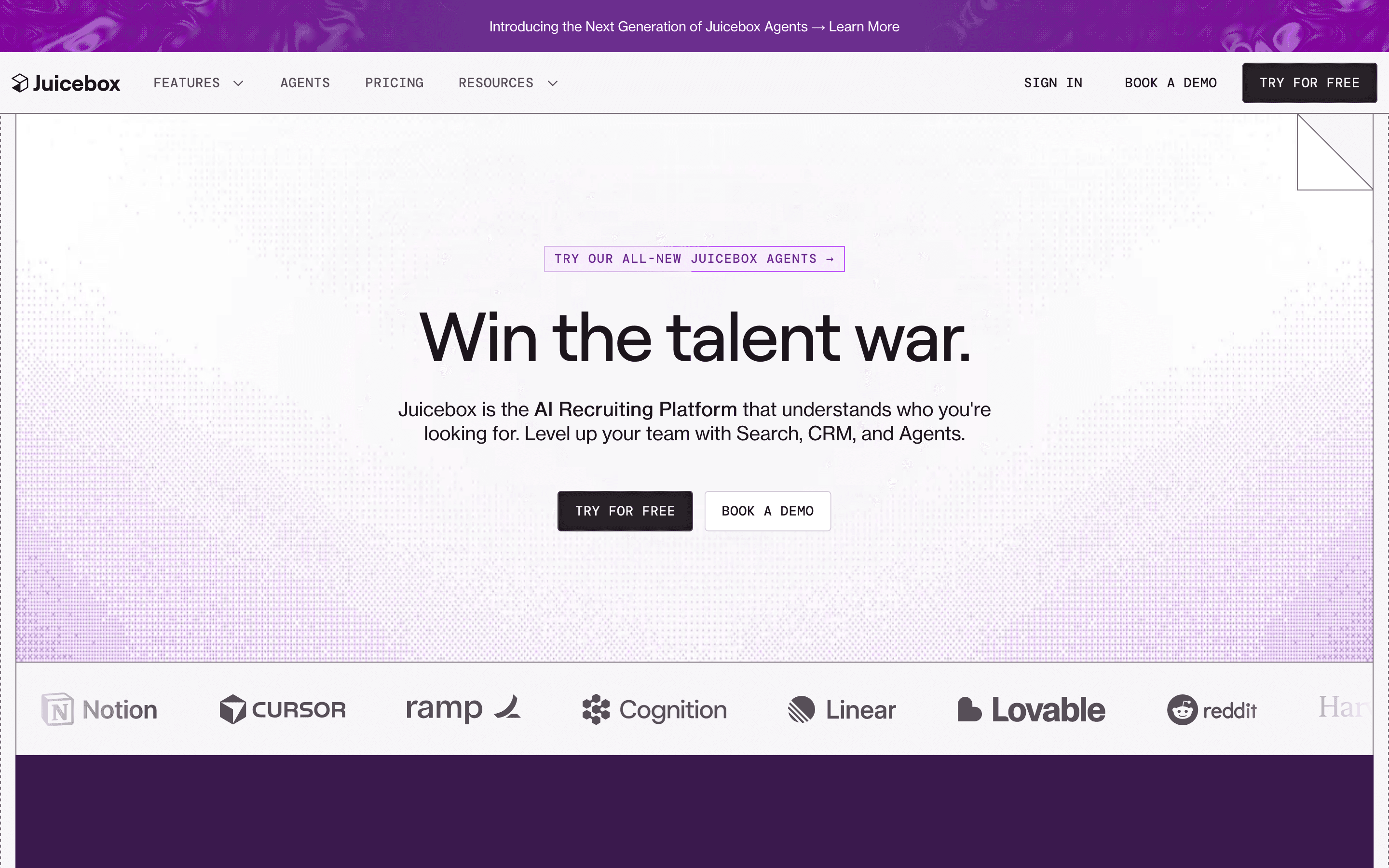
Juicebox is the closest price match to Fetcher. Starter runs $119 a seat a month against Fetcher's $115 Self-serve tier, and both target solo recruiters and small teams who want a real number before they buy. The big difference is how you search. Juicebox's PeopleGPT takes a plain-language description of the candidate you want instead of a boolean string, then returns people with verified email and phone numbers attached from a claimed 800 million profiles. Its new Hiring Manager Workflows let a hiring manager score candidates a recruiter sourced and feed that feedback into the next search, something Fetcher doesn't offer. The tradeoff is contact and export credits: Starter caps you at 500 a month, and Growth tops out at 5 seats before you hit a quote-only Business plan. If Fetcher's lead cap or search style is the problem, Juicebox is the direct swap.
Pros
- + Plain-language search (PeopleGPT) replaces boolean strings and returns candidates with verified emails and phone numbers already attached
- + AI Agent add-on can keep sourcing and emailing against a standing search without a recruiter re-running it each week
- + Hiring Manager Workflows lets non-recruiters give structured feedback on candidates without a separate tool or spreadsheet
Cons
- – Contact and export credits are capped even on paid plans (500 on Starter, 1,500 on Growth), and heavy sourcing months can burn through them fast
- – Growth tops out at 5 seats, so any team bigger than that has to move to a quote-only Business plan
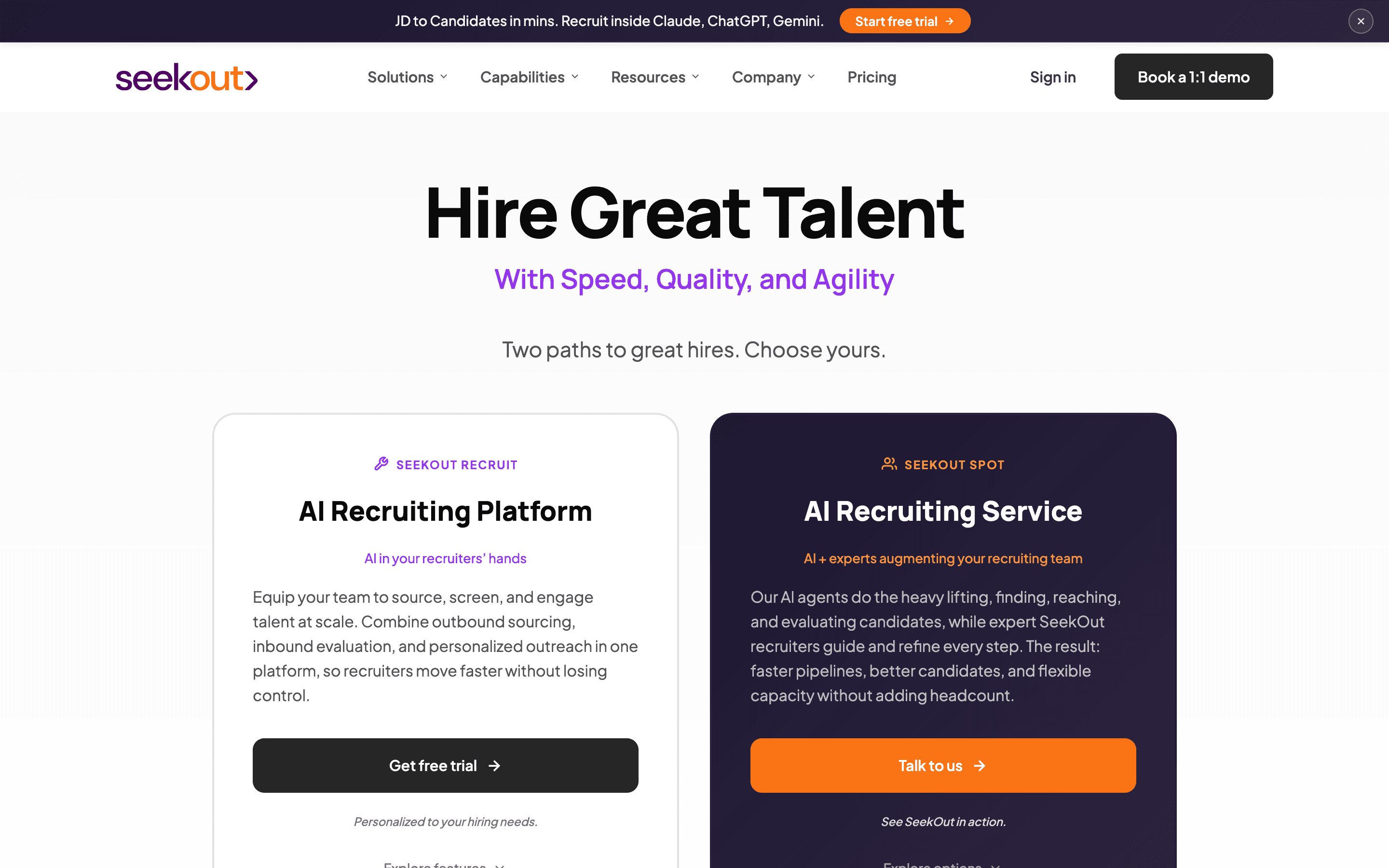
SeekOut is the pick when Fetcher's 500M+ database feels small, but you pay well over Fetcher's price for it. SeekOut indexes more than 1 billion profiles with filters aimed squarely at passive candidates: inferred technical skills, security clearance, veteran status, and diversity attributes that Fetcher doesn't surface. Recruit Core, its 2026 self-serve tier, costs $179 a seat a month with no annual commitment, the same monthly-billed basis as Fetcher's $115 Self-serve tier, for up to 3 seats. That's a premium of over 55% for the bigger database and extra filters. SeekOut also offers $149 a seat a month if you prepay a year upfront. Above Recruit Core, every tier is quote-only and scales per seat, including ATS rediscovery that resurfaces past applicants and a Sam AI screening layer on the top tier. SeekOut also ships an MCP server so its AI Assistant works inside Claude, ChatGPT, and Gemini, not just its own app. SeekOut Spot, its done-for-you sourcing service, is priced separately from Recruit Core and billed per role, per contractor, or on outcomes, so a human sourcer here costs extra rather than coming included in a seat price the way Fetcher's Amplify plan does. The catch on the software itself is the same kind of usage cap Fetcher has: 500 contact credits and 1,000 exports a month on Recruit Core, so a bigger database doesn't mean unlimited use.
Pros
- + 1B+ profile index with filters most competitors don't have, like security clearance and inferred skills
- + Recruit Core gives individuals and small teams a real price and self-checkout instead of a forced sales call
- + AI Assistant now works through SeekOut's own MCP server inside Claude, ChatGPT, and Gemini, not just the SeekOut app
Cons
- – Recruit Core caps you at 3 seats, 500 contact credits, and 1,000 exports a month, so growing teams outgrow it fast
- – Every tier past Core is quote-only, so you can't compare real prices without a sales conversation
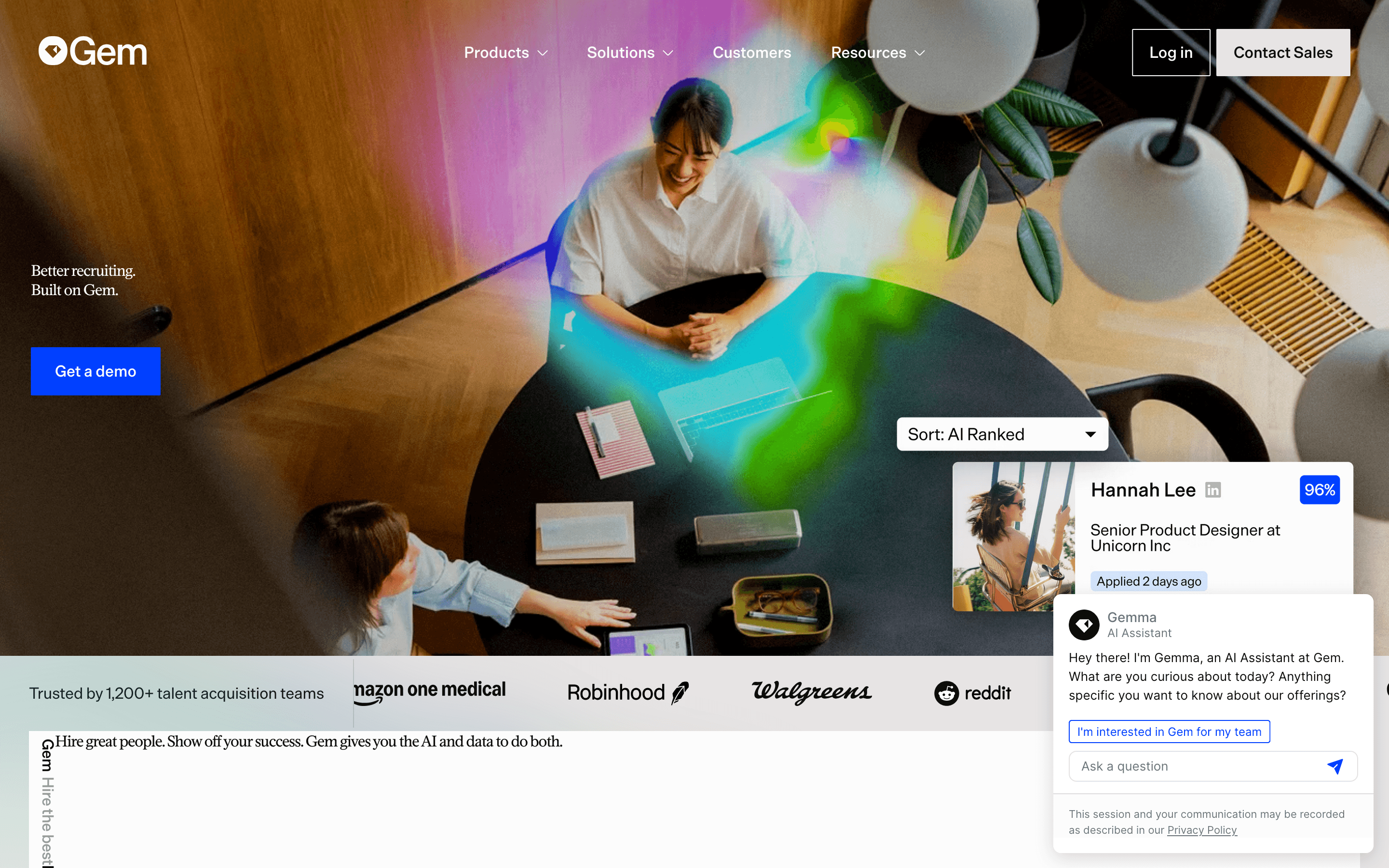
Gem fits teams that have outgrown treating sourcing and their ATS as two separate jobs. Its AI Sourcing Agent searches over 800 million profiles and hands back verified contact info, similar to Fetcher, but Gem is built to sit on top of Greenhouse, Workday, Lever, or iCIMS, or replace your ATS outright with Gem All-in-One. Its April 2026 AI Fraud Detection Agent checks resume metadata, identity signals, and device data to flag fabricated or AI-generated candidates before a recruiter looks at them, a feature Fetcher has no equivalent for. The catch is pricing: both main plans are quote-only and scaled to headcount, with only a startup program publishing real numbers, and even that pushes teams over 30 employees to a Contact Sales button. If you want ATS-level depth and fraud screening more than a published price, Gem is worth the sales call.
Pros
- + AI Sourcing Agent searches 800M+ profiles and surfaces candidates with verified contact info already attached, cutting time spent manually finding emails
- + Works as a layer on top of Greenhouse, Workday, Lever, or iCIMS, so you don't have to migrate off your ATS to get AI sourcing and outreach
- + Fraud Detection Agent screens applications for fake or AI-generated candidates before a recruiter reviews them, which matters more as application fraud rises
Cons
- – No published pricing for the standard plans, both Gem + Your ATS and Gem All-in-One require a sales quote based on headcount
- – Self-serve startup pricing tops out at 30 FTE, above that the same calculator still pushes you to a Contact Sales button even though it displays a rate
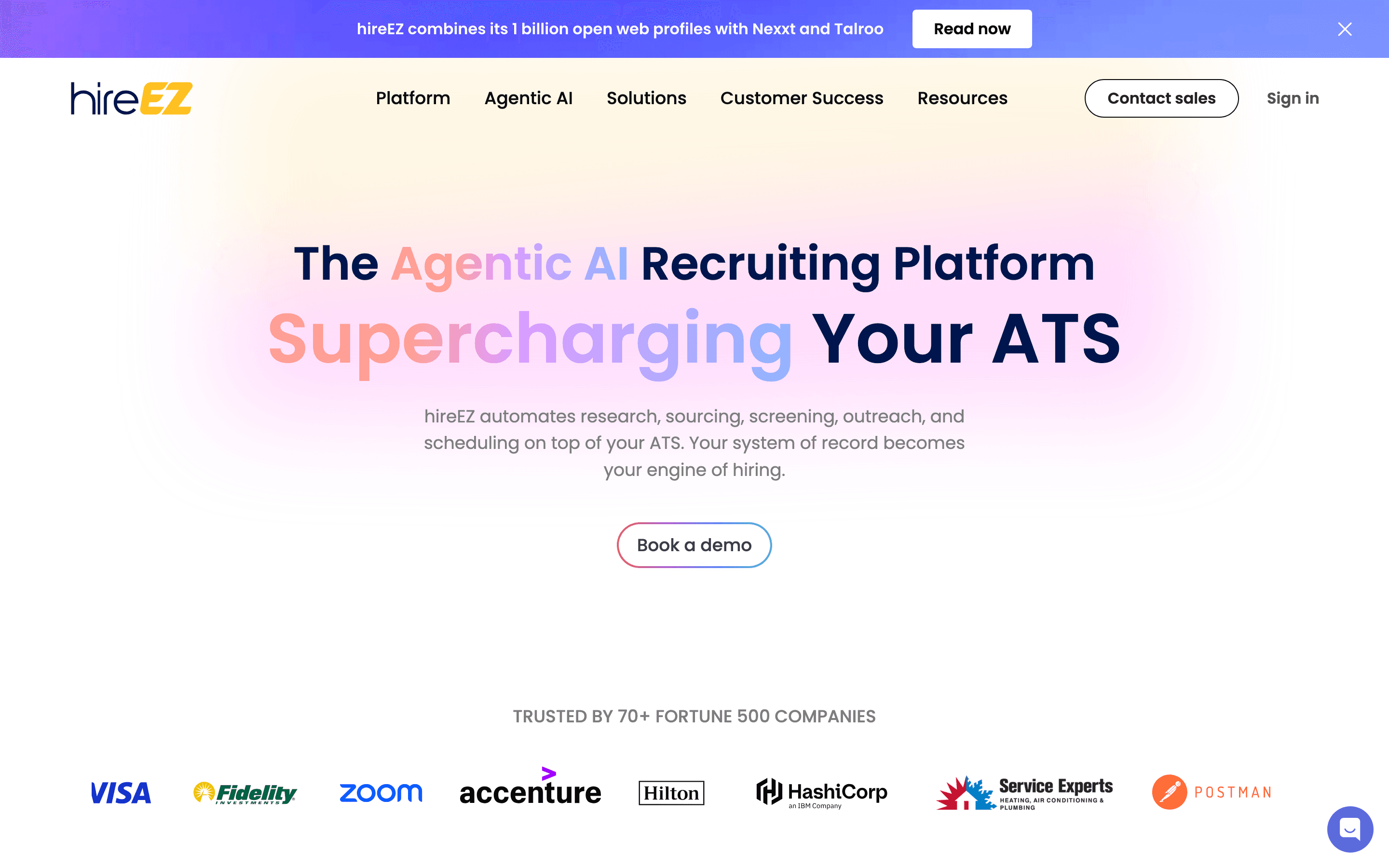
hireEZ is built for teams that want to stop paying for sourcing, a CRM, and a sequencer as three separate contracts. It searches 45+ sourcing platforms from one query, then runs outreach and tracks replies inside the same tool, with native integrations into Workday, iCIMS, Greenhouse, and SAP that Fetcher doesn't match. Its November 2025 ResumeSense feature scans resumes for hidden text and signs of AI tampering before a recruiter trusts what's on the page. The real difference from Fetcher is price and scope: Solo Recruiter starts at $494 a month, more than four times Fetcher's Self-serve tier, and Enterprise pricing is set against the tools you're consolidating rather than a flat per-seat rate. hireEZ makes sense once you're replacing several tools at once. It's overkill if you just need a cheaper way to find and email candidates.
Pros
- + Searches 45+ platforms from one query instead of tab-hopping between sites
- + Native integrations with major ATS platforms (Workday, iCIMS, Greenhouse, SAP) so it slots into an existing stack
- + Bundles sourcing, CRM, outreach, and screening, which can replace several separate subscriptions
Cons
- – No public pricing beyond the single $494/month solo tier, so team and enterprise buyers have to go through a sales call and a 4-week verification step before getting a number
- – Enterprise pricing is pegged to your current tool spend rather than a flat per-seat rate, which makes it hard to compare against competitors up front
Should your product be on this talent sourcing list?
If you build a tool that belongs next to the ones above, submit it. A human reviews every submission. Approved products get their own page with pricing and screenshots, plus a place in the comparisons where they fit. It is free. You sign in with your work email so you can follow the decision, and there is no password to create.
Fetcher alternatives: FAQ
What's the cheapest real alternative to Fetcher?+
Juicebox's Starter plan is $119 a seat a month, the closest published price to Fetcher's own $115 Self-serve tier, and it includes verified email and phone contacts.
Which Fetcher alternative has the biggest candidate database?+
SeekOut indexes more than 1 billion profiles, roughly double Fetcher's 500M+, with filters for security clearance and inferred technical skills that Fetcher doesn't offer.
Is there a Fetcher alternative that includes fraud detection on applicants?+
Gem's AI Fraud Detection Agent checks resume metadata, identity verification, and device signals to flag fake or AI-generated candidates, a feature Fetcher doesn't have.
Which alternative is best if I want to drop separate CRM and sequencer tools?+
hireEZ bundles sourcing, CRM, outreach, and screening into one contract and searches 45+ platforms from a single query, aimed at teams consolidating several point tools.
Fetcher alternatives: pricing compared
Entry price, billing model, and whether pricing is public. 5 of 5 publish pricing you can check without talking to sales.
| Tool | Starting price | Billing | Free option | Pricing disclosed |
|---|---|---|---|---|
| Fetcher | $115/seat/mo | tiered | No | Partly public |
| Juicebox | $119/seat/mo | per-seat | Yes | Partly public |
| SeekOut | $149/seat/mo | tiered | Trial (14 days on Recruit Core, no credit card required) | Partly public |
| Gem | $130/mo | tiered | Trial (Companies under 30 employees get Gem All-in-One free for 6 months, then 50% off) | Partly public |
| hireEZ | $494/seat/mo | tiered | Trial (7 days (Solo Recruiter plan)) | Partly public |
How we made these picks. We compare tools on public pricing, features, and hands-on assessment, then verify every price against the vendor's own page. We never accept payment for rankings. Read the full methodology. Spotted an error? Report it.