Top GitHub Copilot Alternatives in 2026
Here for GitHub Copilot itself? See the full GitHub Copilot profile, pricing & reviews →
Suggest a change- If you want an agent-first editor with the most mature parallel and cloud agent workflow, choose Cursor. Cursor runs agents across the IDE, CLI, Slack, and mobile, and its Composer mode lets you run several agents in parallel across different repos and branches at once.
- If you already pay for an LLM API key and want a terminal-native loop where every edit lands as a git commit, choose Aider. Aider is free and open source, works with almost any model including local ones through Ollama, and commits each change to git automatically so you can review or revert it with plain git commands.
- If your code legally or contractually can't leave your own infrastructure, choose Tabnine. Tabnine is the only tool on this list that offers self-hosted, VPC, and air-gapped deployment with a zero-code-retention guarantee and certifications like SOC 2 and ISO 27001.
- If you already run Sourcegraph Enterprise for code search across a large multi-repo codebase, choose Sourcegraph Cody. Cody draws its context from Sourcegraph's code search index across your whole codebase rather than just the open file, and it now ships only as part of a Sourcegraph Enterprise contract.
- If you mainly want fast inline completions with only occasional chat and you're already living inside GitHub pull requests and Actions, choose stay on GitHub Copilot. Code completions and next-edit suggestions stay unlimited and unmetered on every paid Copilot plan even after your AI credits run out, so light users can avoid the usage-based pricing risk entirely while keeping Copilot's deep GitHub integration and multi-model catalog under one bill.
GitHub Copilot is the default AI pair programmer for most developers, mostly because it already lives inside GitHub, VS Code, Visual Studio, and JetBrains IDEs. But its June 2026 move to usage-based AI credits changed the math: chat, agent mode, code review, and the CLI now draw down a metered pool instead of running on a flat fee, and trade press reported some heavy agent users seeing bills rise as much as 100-fold for the same workflows.
That has developers looking elsewhere: agent-first editors with more mature parallel agent workflows, a free tier that doesn't run dry mid-month, a terminal tool with no subscription at all, or an enterprise platform built for code that can't leave your own infrastructure. The right pick depends on whether you want a flat bill, a real free plan, deep security controls, or just the fastest agent for your workflow.
GitHub Copilot alternatives compared
| Tool | Best for | Starting price | Free option | Last update |
|---|---|---|---|---|
| CursorBest for agent power users | Developers who want one agent that works the same way in the IDE, the terminal, and Slack | $20/seat/mo | Yes | July 2026 |
| AiderBest for a pay-as-you-go terminal workflow | Developers who already pay for an LLM API key and want a terminal-native editor loop instead of a chat window | Free tier + custom | Yes | May 2026 |
| TabnineBest for security and compliance | Regulated or security-sensitive teams that need code completions and chat without sending code to a public cloud model | $39/seat/mo | No | July 2026 |
| Sourcegraph Cody | Large engineering orgs already paying for Sourcegraph Enterprise who want AI chat and completions layered on their existing code search index | $16000/yr | No | July 2026 |
Why teams switch from GitHub Copilot
GitHub's June 2026 move to usage-based AI credits caught many users off guard
Trade press reported some customers running heavy agent-mode or chat workloads saw bills rise as much as 100-fold versus the old flat-rate system after the June 1, 2026 change.
Agent-heavy usage burns through a plan's credit pool fast
Chat, agent mode, code review, and the CLI all draw from the same shared credit pool, so a single long agent session can eat a month's allotment in days, pushing heavy users toward the $100-a-seat Max plan.
Self-serve Business sign-ups are paused for smaller orgs
GitHub paused new self-serve Business sign-ups for organizations on GitHub Free or Team as of April 22, 2026, and Enterprise requires GitHub Enterprise Cloud outright, adding a dependency on top of the seat price.
The best GitHub Copilot alternatives, ranked
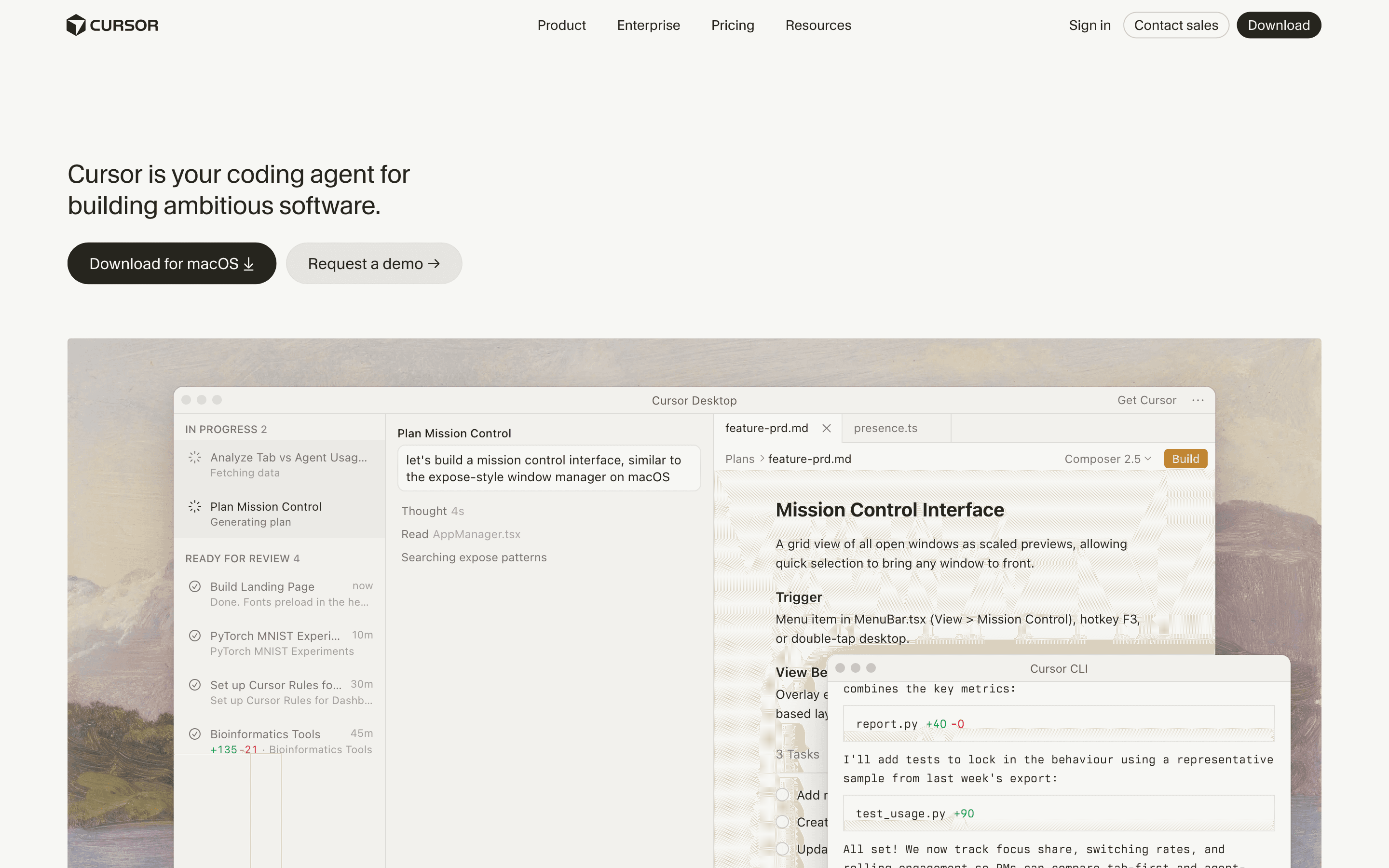
Cursor is the closest thing to a direct competitor: a VS Code fork with its own agent layer instead of an extension bolted onto someone else's editor. Pro starts at $20 a month ($16 billed annually), a step up from Copilot Pro's $10, but you get agents that run in the IDE, a CLI, Slack, and now a mobile app for reviewing cloud sessions on the go. Composer mode runs several agents in parallel across different repos or branches, and Cursor Router picks the right model per request automatically in Auto mode. Like Copilot, pricing is usage-based past your included allowance, and Cursor's own 2025 switch to metered billing caught existing users off guard the same way Copilot's June 2026 change did. Enterprise pricing is quote-only, so budgeting a bigger rollout still takes a sales call.
Pros
- + Runs agents across IDE, CLI, Slack, and mobile, so you can hand off work from wherever you already are
- + Supports multiple model providers instead of locking you into one vendor's models
- + Cloud and background agents let you parallelize work across several tasks or repos at once
Cons
- – Usage-based billing on top of the seat price means your real monthly cost is hard to predict in advance
- – The 2025 move from fixed request limits to metered, API-cost-linked billing caught existing users off guard with much higher effective costs
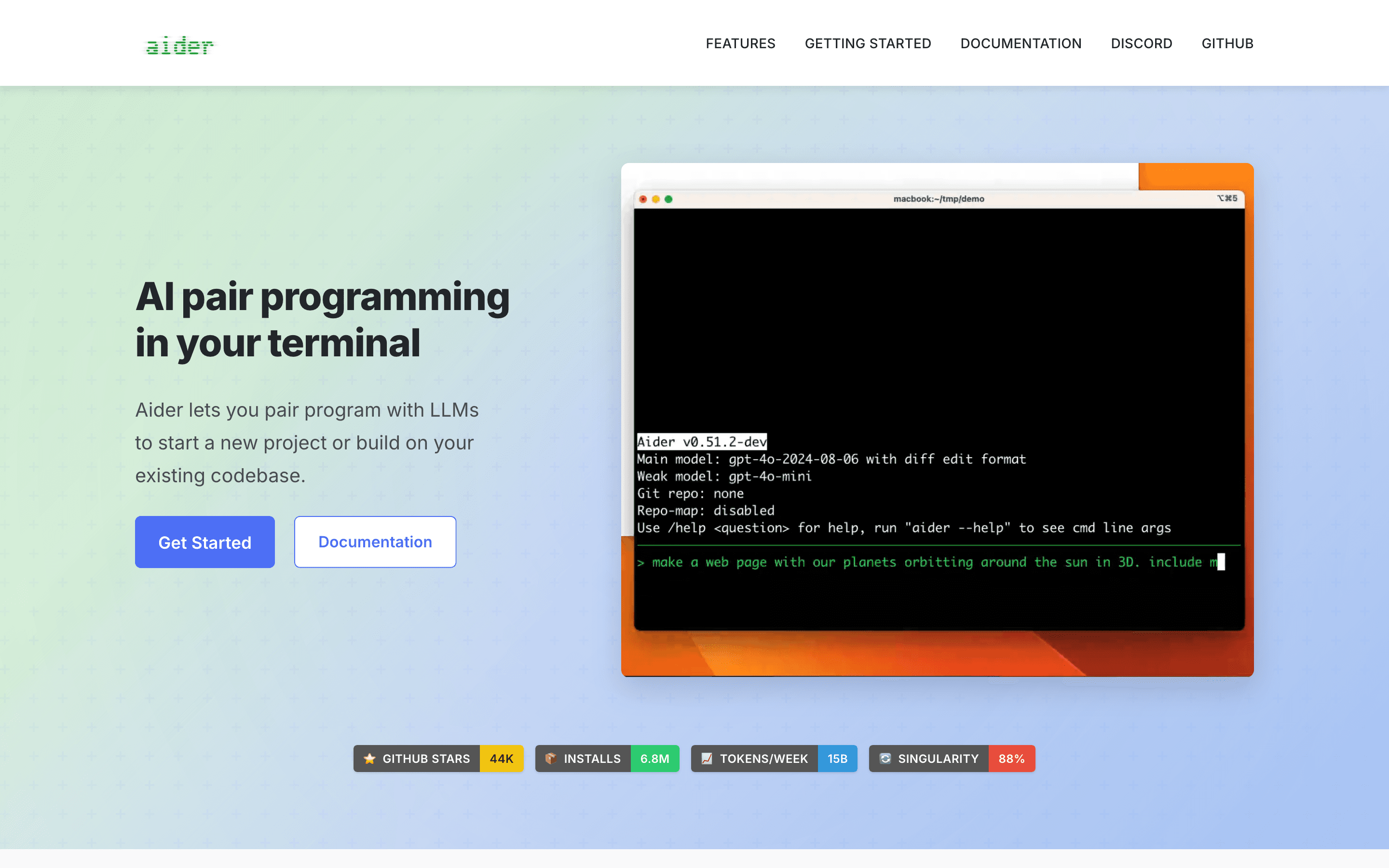
Aider is the outlier here: a free, open-source, terminal-only tool with no company, no dashboard, and no subscription behind it. You install it with pip, point it at whatever LLM API key you already have (Claude, GPT, DeepSeek, Gemini, or a local Ollama model), and it edits your repo directly, committing every change to git with a real commit message so reverting a bad edit is just git revert. That model-agnostic, pay-only-for-tokens setup appeals to developers who want full control over cost and model choice rather than a bundled plan. The tradeoff is real: no GUI, no official support beyond GitHub issues and Discord, and third-party benchmarks put it around 60% on SWE-bench Verified, a meaningfully lower score than the fully agentic mode in Cursor, so out-of-the-box task completion can lag behind those more polished, all-in-one options.
Pros
- + Free and open source, no subscription or seat cost
- + Works with almost any LLM, including Claude, GPT, DeepSeek, Gemini, and local models via Ollama
- + Every change is a git commit with a real message, so undoing an edit is just `git revert`
Cons
- – No pricing means no cost predictability. Your bill scales with token usage and the model you pick, not a flat fee
- – No official support channel. Help comes from GitHub issues and community Discord, not a vendor
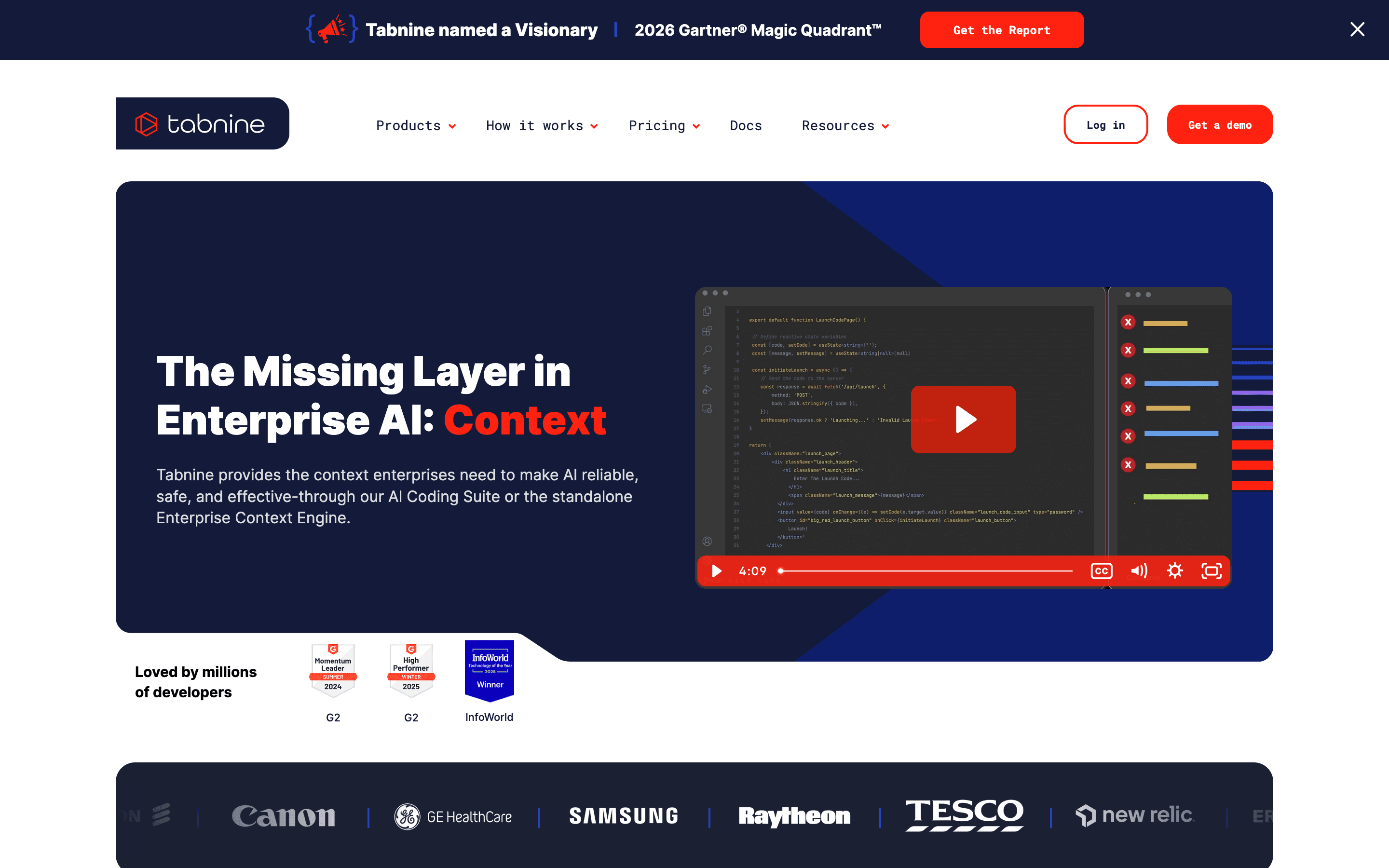
Tabnine targets the buyer Copilot can't fully serve: teams whose code can't touch a public cloud model. Both of its plans, Code Assistant at $39 a seat per month and Agentic Platform at $59, support self-hosted, VPC, or fully air-gapped deployment with zero code retention, plus SOC 2, ISO 27001, and GDPR certifications. That security posture, not completion quality, is the reason to pick it. Tabnine retired its free Basic tier and its roughly $9-a-month Dev plan in 2025, so there's no cheap way in anymore, and both remaining plans require annual billing with no published trial. Reviewers consistently rate its raw completion quality below Copilot and Cursor, which makes this a compliance-driven choice more than a better-coding-experience one.
Pros
- + Self-hosted, VPC, and air-gapped deployment options that most AI coding tools don't offer
- + Zero code retention and compliance certifications (SOC 2, ISO 27001, GDPR) that pass security reviews other tools fail
- + Context Engine connects unlimited repos across GitHub, GitLab, and Bitbucket on the Agentic plan
Cons
- – No free tier and no published trial, so you commit to annual billing before testing it properly
- – Entry price of $39/seat/month is 2-4x Copilot or Cursor's entry price
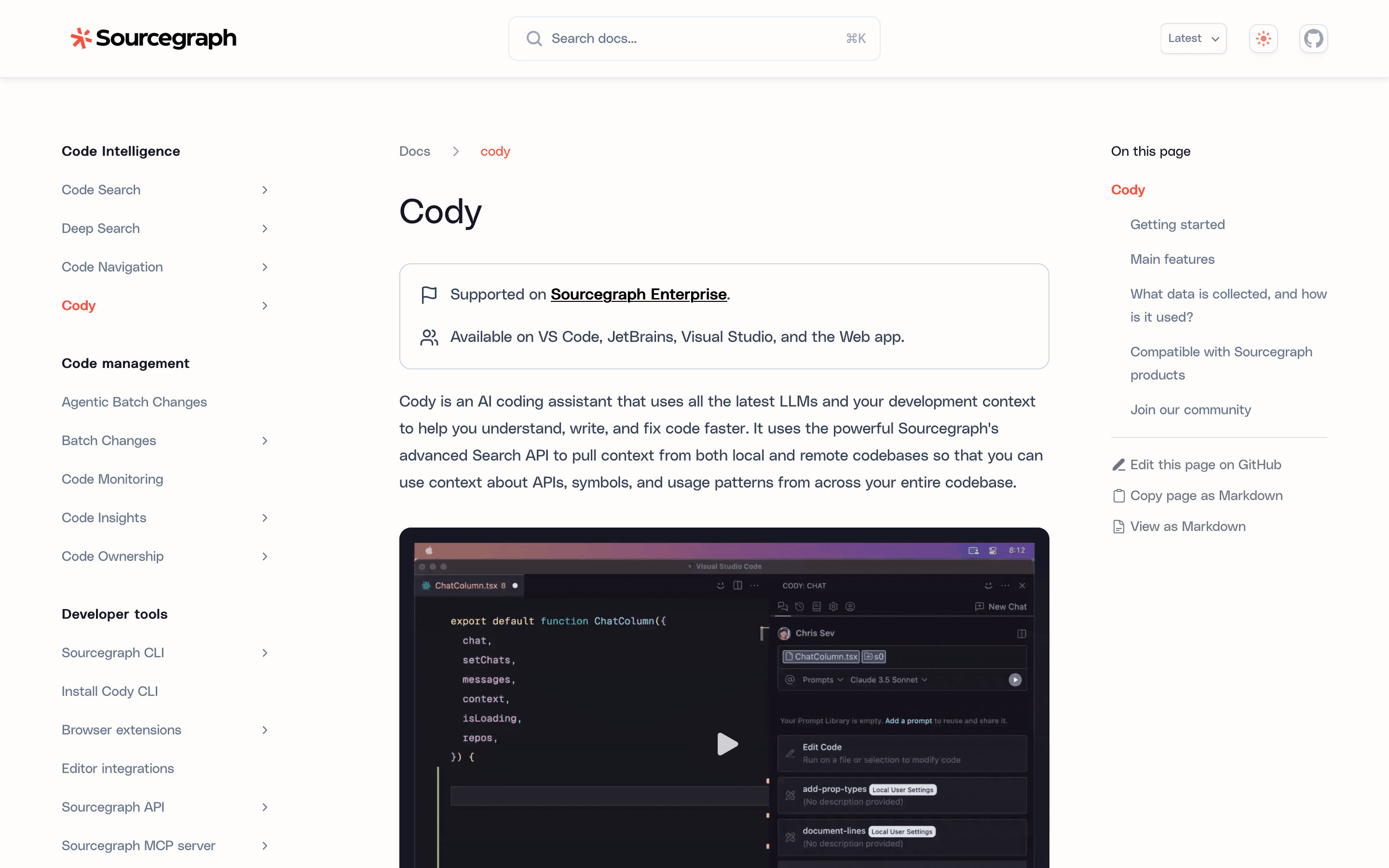
Cody only exists now as a feature inside Sourcegraph Enterprise, starting at $16,000 a year on a contract that scales with team size. Sourcegraph shut down the free and Pro self-serve plans in July 2025 with about a month's notice and pointed individual developers at Amp, a separate product, instead. What's left is built for large engineering orgs that already run Sourcegraph for code search across a big multi-repo codebase: Cody's chat and completions draw context from that search index rather than just the open file, and Enterprise bundles Batch Changes and admin controls Copilot doesn't offer. It's a serious alternative only if you're already buying Sourcegraph Enterprise or need that scale of cross-repo context. There's no self-serve path for anyone else.
Pros
- + Context comes from Sourcegraph's code search index, so it can pull in relevant code from across a large multi-repo codebase, not just open files
- + Bundled with Sourcegraph Enterprise features like Batch Changes, Insights, and admin controls that standalone AI coding tools don't offer
- + Enterprise plan includes AI credits with no monthly expiry and rollover on renewal
Cons
- – No free tier, no free trial, and no self-serve signup. You have to talk to sales and sign an enterprise contract starting at $16K a year
- – Sourcegraph killed the individual and small-team product (Cody Free and Cody Pro) in July 2025 with under a month's notice, so it is not a safe long-term bet for anyone outside a large enterprise deal
Should your product be on this ai coding assistants list?
If you build a tool that belongs next to the ones above, submit it. A human reviews every submission. Approved products get their own page with pricing and screenshots, plus a place in the comparisons where they fit. It is free. You sign in with your work email so you can follow the decision, and there is no password to create.
GitHub Copilot alternatives: FAQ
What's the best free alternative to GitHub Copilot?+
Aider is the closest to genuinely free: it's open source and costs nothing itself, though you pay per token for whichever LLM you connect it to. Cursor and Tabnine both offer limited free tiers with lighter usage caps than their paid plans.
Is Cursor cheaper than GitHub Copilot?+
No. Cursor's Pro plan is $20 a month versus Copilot Pro's $10, and both charge extra for usage past their included allowance at metered rates tied to the underlying model's cost.
Which GitHub Copilot alternative works entirely in the terminal?+
Aider is built terminal-first with no GUI at all. Copilot also has a CLI, but Aider is free and open source with no vendor subscription behind it, so your only cost is the LLM API key you bring.
Is there a GitHub Copilot alternative for teams that can't use a public cloud AI model?+
Tabnine is built for that case, with self-hosted, VPC, and air-gapped deployment plus a zero-code-retention guarantee across both of its paid plans.
GitHub Copilot alternatives: pricing compared
Entry price, billing model, and whether pricing is public. 4 of 5 publish pricing you can check without talking to sales.
| Tool | Starting price | Billing | Free option | Pricing disclosed |
|---|---|---|---|---|
| GitHub Copilot | $10/seat/mo | usage-based | Yes | Public |
| Cursor | $20/seat/mo | usage-based | Yes | Partly public |
| Aider | Free tier + custom | usage-based | Yes | Not disclosed |
| Tabnine | $39/seat/mo | per-seat | No | Partly public |
| Sourcegraph Cody | $16000/yr | quote-only | No | Partly public |
How we made these picks. We compare tools on public pricing, features, and hands-on assessment, then verify every price against the vendor's own page. We never accept payment for rankings. Read the full methodology. Spotted an error? Report it.