Top Jumio Alternatives in 2026
Here for Jumio itself? See the full Jumio profile, pricing & reviews →
Suggest a change- If you want Jumio's AML screening and ongoing monitoring bundled in, but with pricing you can see before a sales call, choose Sumsub. Its Compliance tier bundles AML screening and ongoing monitoring for a published $1.85 per check with a $299 monthly minimum, versus Jumio's quote-only pricing and buyer-reported annual minimums starting at $25,000.
- If you want an AI decision backed by human specialists reviewing the cases the model flags, choose Veriff. Its Plus and Premium plans add trained verification specialists who review sessions the AI flags as uncertain, which cuts false rejections without you staffing a review team yourself.
- If you want compliance and product teams to edit verification logic themselves instead of filing an engineering ticket, choose Persona. Persona's Dynamic Flow is a no-code builder for verification logic and screen copy, and its Essential plan publishes a real $250 a month starting price instead of gating every tier behind a sales call.
- If your verification volume is low or unpredictable and a fixed annual minimum doesn't make sense, choose Didit. Didit gives 500 full KYC verifications free every month, permanently, then bills per module with no minimum commitment or contract, the opposite of Jumio's buyer-reported $25,000-plus annual floor.
- If you already run payments through Stripe and only need a lightweight document-plus-selfie check, not AML or ongoing monitoring, choose Stripe Identity. Stripe Identity bills $1.50 per verification on your existing Stripe account and invoice with no new vendor contract, though it has no built-in AML screening, monitoring, or KYB, so it only covers the part of Jumio's job that stops at the ID check.
- If you already operate at large regulated-bank scale and need continuous post-onboarding risk monitoring plus a long enterprise track record under one contract, choose stay on Jumio. Jumio Watch's continuous post-onboarding risk scoring isn't matched by any alternative here, and Jumio's decade-plus track record processing over a billion verifications carries weight in bank-grade vendor due diligence that newer challengers can't offer yet. At true enterprise volume, the per-verification cost gap with self-serve alternatives narrows too.
- If you want Jumio's own sales-led, broad-coverage model and are fine confirming AML and sanctions screening coverage with sales yourself, choose Onfido. Onfido covers 2,500+ document and passport types across 195+ countries with a no-code Workflow Studio for sequencing checks, closely matching Jumio's own enterprise-contract model for buyers not prioritizing published pricing.
- If you want every add-on, sanctions screening, proof of address, manual review, 3D liveness, priced and itemized separately instead of bundled into a forced tier, choose iDenfy. iDenfy publishes a $135/month Basic floor and prices each add-on on its own, so you pay for exactly the checks you use instead of negotiating a bundled contract like Jumio's.
Jumio is built for banks, fintechs, and crypto exchanges that need ID verification bundled with AML screening and ongoing monitoring, backed by document coverage across 200+ countries. That depth comes at a cost: Jumio publishes no prices at all, and buyer-reported data puts per-verification costs at $0.75-$8, annual contract minimums from $25,000, and implementation fees of $5,000-$50,000 on top, numbers you only learn after a sales call.
Teams shop alternatives for two different reasons: some want Jumio's AML-and-monitoring depth with pricing they can actually see, others just need lighter ID verification and don't want to sign an enterprise contract at all. The seven tools below split across both groups, from full KYC/AML platforms built for the same regulated buyer to lighter, usage-based options for teams that don't need the whole compliance stack.
Jumio alternatives compared
| Tool | Best for | Starting price | Free option | Last update |
|---|---|---|---|---|
| SumsubBest value for AML compliance | Fintech, crypto, and gambling companies that need AML screening and ongoing monitoring, not just document checks | $1.35/check | Trial (14 days, includes 50 free checks) | July 2026 |
| VeriffBest for human-reviewed edge cases | Fintech, crypto, and marketplace teams that need pass/fail KYC decisions with an audit trail and are under roughly 10,000 verifications a month | Usage-based | Trial (15 days, up to 50 live verification sessions, no credit card required) | July 2026 |
| Onfido | Regulated businesses (fintech, gambling, crypto, banking) that need broad document and country coverage for KYC/AML and are willing to go through a sales-led contract process | Custom / quote | No | August 2026 |
| Persona | Compliance and engineering teams that want a self-serve, publicly priced entry point before committing to an enterprise KYC contract | $250/mo | Trial (60 days, up to 50 services, sandbox only (no credit card, production access needs a business verification review)) | July 2026 |
| iDenfy | Startups and mid-size fintechs that want usage-based pricing instead of a flat per-seat license, with the option to add approved-only billing | $135/mo | Trial (14 days, 10 free identity verifications) | July 2026 |
| DiditBest free option | Engineering teams that want to prototype or ship KYC without a sales call or minimum commit | Usage-based | Yes | July 2026 |
| Stripe IdentityBest for teams already on Stripe | Teams already on Stripe for payments who want ID verification added to onboarding without a new vendor contract or separate billing relationship | $1.5/verification | No | June 2026 |
Why teams switch from Jumio
Jumio publishes no pricing anywhere
Every price comes from a sales conversation; the company's own site substitutes a TCO calculator for a rate card, so teams can't budget before talking to sales.
Buyer-reported costs run well above self-serve competitors
Vendr's buyer data puts per-verification cost at $0.75-$8 depending on volume, with annual contract minimums from $25,000 to $100,000+ and implementation fees of $5,000-$50,000+ on top.
The enterprise contract structure doesn't fit smaller or usage-light teams
Third-party reviews describe Jumio's sales-led, minimum-commit structure as a poor match for startups and mid-market teams that want to start verifying users the same day.
The best Jumio alternatives, ranked
Sumsub is the closest match to what Jumio buyers are actually shopping for: document checks, AML screening, ongoing monitoring, and transaction monitoring in one product, aimed at the same regulated fintech, crypto, and gambling buyers. The difference is that Sumsub publishes real numbers. Basic starts at $1.35 per check with a $149 monthly minimum for teams that mainly want fraud deterrence, and Compliance adds AML screening and ongoing monitoring at $1.85 per check with a $299 minimum, both a fraction of Jumio's buyer-reported $25,000-plus annual floor. SumScript and the Summy AI copilot let compliance teams adjust verification and monitoring rules without an engineering ticket. The catches: Enterprise-tier features like travel rule support and business verification are quote-only, and at least one reviewer reported an unannounced 200% price jump on renewal, so read the contract terms before signing.
Pros
- + Compliance and Enterprise tiers cover AML screening, ongoing monitoring, and travel rule in one platform instead of stitching together separate vendors
- + SumScript rule builder plus Summy AI's plain-language level and rule assistance lets compliance teams adjust verification and transaction-monitoring logic without waiting on engineering
- + Charges only for successful verifications, not every attempt
Cons
- – Monthly minimum commitment ($149 on Basic, $299 on Compliance) applies even in low-volume months
- – Enterprise pricing is quote-only, so the AML, travel rule, and business verification features some regulated teams need aren't priced up front
Veriff fits teams that want Jumio-style pass/fail KYC decisions with an audit trail, but priced per session instead of negotiated. Essential runs fully automated at $0.80 a session ($49/month minimum); Plus and Premium add trained verification specialists who review whatever the AI flags as uncertain, the main lever for cutting false rejections. The tradeoff against Jumio's AML bundle: sanctions and PEP screening is a $0.64-per-session add-on here, not built in, and ongoing monitoring costs another $0.09 per session on top. Self-serve plans also cap at 10,000 sessions a month and 15 a minute, so real growth pushes you into custom Enterprise pricing anyway, similar to where Jumio buyers already are. Still, the 15-day, 50-session free trial with no credit card lets engineering test the real flow before anyone signs a contract, which Jumio's sales-gated process doesn't offer.
Pros
- + Human specialist review on Plus and Premium catches edge cases pure-AI vendors miss, without you staffing a review team
- + No setup fee and a 15-day, 50-session free trial with no credit card, so engineering can test the real flow before committing
- + You're billed for completed sessions only, not failed retries, which matters for conversion-sensitive signup flows
Cons
- – Real compliance coverage costs more than the sticker price: sanctions/PEP screening, extra data fields, and longer retention are all separate add-ons
- – Self-serve plans hard-cap at 10,000 sessions/month and 15/minute, so growing volume forces a jump to custom Enterprise pricing
Onfido
Onfido, now sold under the Entrust brand after its 2024 acquisition, is the alternative most similar to Jumio's own market position: broad document coverage (2,500+ document and passport types across 195+ countries), no published pricing, and a sales-led contract process. If what frustrates you about Jumio is opaque pricing, Onfido won't fix that. What it changes is scale and integration options: SDKs across web, iOS, Android, and React Native, a no-code Workflow Studio for sequencing checks, and an established base of large regulated customers in banking and gambling. It doesn't advertise AML or sanctions screening as a built-in feature the way Jumio, Sumsub, or Didit do, so compliance-heavy buyers should confirm that directly with sales. Reviewers also flag slow billing and support response times, and the brand is mid-transition into Entrust's larger identity security suite.
Pros
- + Wide document type and country coverage, useful for products onboarding users globally
- + SDKs cover web, iOS, Android, and React Native, so you're not stuck building capture UI from scratch
- + Actively maintained: the web SDK ships small releases roughly every one to two weeks
Cons
- – No public pricing anywhere, so you can't budget or compare costs without opening a sales conversation and signing a contract
- – Multiple reviewers report slow or unresponsive billing and support, including unresolved invoicing errors and no phone support
Persona
Persona suits teams that want a self-serve entry point before committing to anything Jumio-sized. The Essential plan is a real, public $250 a month for 500 verifications, no sales call required, a rarity in this category. It covers both individual KYC and business KYB with ultimate-beneficial-owner checks, and Dynamic Flow, a no-code builder, lets compliance teams change verification logic and screen copy without waiting on engineering. It bills only successful verifications, so an abandoned check from a bad photo doesn't cost anything. The catch is that Growth and Enterprise, the tiers with the fuller fraud and AML tooling regulated teams eventually need, are quote-only just like Jumio, and Essential itself locks you into a 12-month minimum contract even at the entry price. G2 reviewers also flag cost as a weak point once volume grows past the entry tier.
Pros
- + Essential plan has a real, public price ($250/month) with no sales call required, unlike most KYC competitors that gate every tier behind "contact us"
- + Bills per successful verification, so users who abandon a check mid-flow due to a bad photo or slow camera don't cost you anything
- + Dynamic Flow lets non-engineers change verification logic and copy, which matters when compliance rules or fraud patterns shift faster than your release cycle
Cons
- – Growth and Enterprise pricing is entirely quote-only, so budgeting past 500 services a month means a sales negotiation
- – The Essential plan requires a minimum 12-month contract even at the entry price, so you can't trial the paid tier month to month
iDenfy
iDenfy is a straightforward usage-based swap for teams that want published pricing and itemized add-ons instead of a bundled enterprise contract. Basic starts at $135 a month for up to 100 verifications at $1.35 each, with sanctions screening, proof of address, manual review, and 3D liveness all priced separately so you only pay for what you use. Premium raises the floor to $325 a month but discounts nearly every add-on. The default billing model charges for every verification attempt, not just approved ones, unlike Persona or Sumsub; approved-only billing costs an extra $0.50 per check. Enterprise adds KYB, ongoing AML monitoring, and up to $500,000 in cyber insurance, but like Jumio, it's quote-only. Reviewers note the system has occasionally approved a verification with a second person visible in frame, worth testing directly.
Pros
- + Add-ons are itemized and priced per verification, sanctions screening, proof of address, manual review, and 3D liveness among them, instead of being bundled into a forced higher tier
- + Premium discounts nearly every add-on versus Basic, so cost per verification falls as you commit to the higher plan
- + Full white-label flow plus API, SDK, and no-code widget covers most integration paths
Cons
- – Both Basic and Premium bill per verification attempt by default; paying only for approved passes costs an extra $0.50 per verification on top of the plan price
- – Premium's monthly minimum is $325, more than double Basic's $135 floor, for a per-verification rate that only drops from $1.35 to $1.30
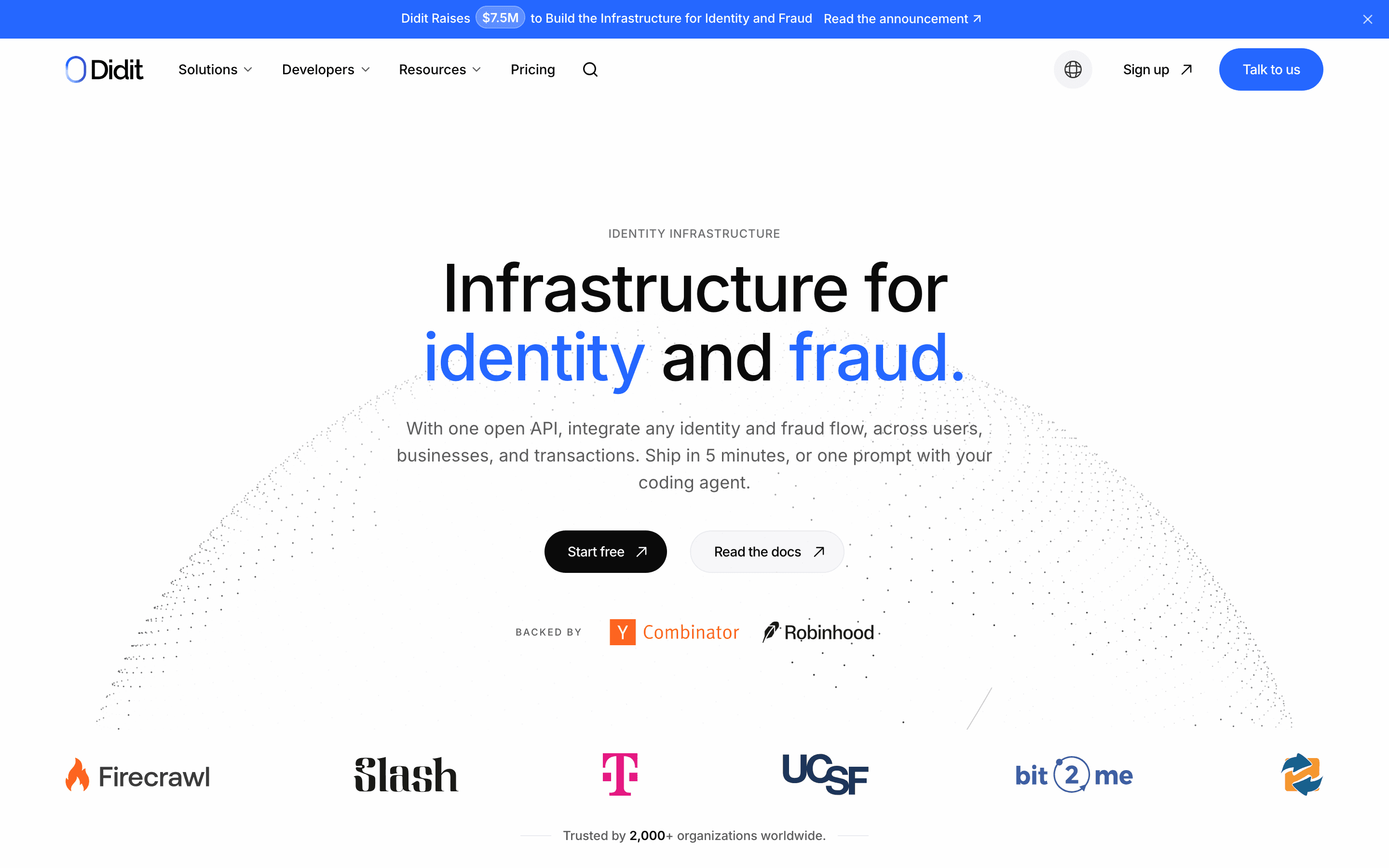
Didit is the pick for teams that find Jumio's enterprise minimums out of proportion to their actual volume. Its free tier gives 500 full KYC verifications a month, permanently, no card required, and everything past that bills per module rather than per seat: a full KYC bundle runs $0.33, individual checks like liveness or face match cost a few cents. It covers KYB, AML screening, transaction monitoring, and travel rule support behind one API, with a sandbox mode that doesn't bill or hit external providers. The real gap versus Jumio is track record: Didit was founded in 2023, so buyers who weigh vendor longevity heavily during due diligence will find less history here, and reviewers flag LATAM AML list coverage as still being built out. Enterprise features like manual review and white-labeling are quote-only, same as the incumbents.
Pros
- + 500 full KYC checks free every month, indefinitely, not a time-limited trial
- + Per-module usage pricing means you don't pay for checks you don't run, and failed verifications are free
- + No minimums or annual contract required to start on the paid tier
Cons
- – Company is young (founded 2023), so there's less of a track record than incumbents like Onfido or Jumio for buyers who weigh vendor longevity heavily
- – AML list coverage for LATAM countries is still being built out, according to reviewers
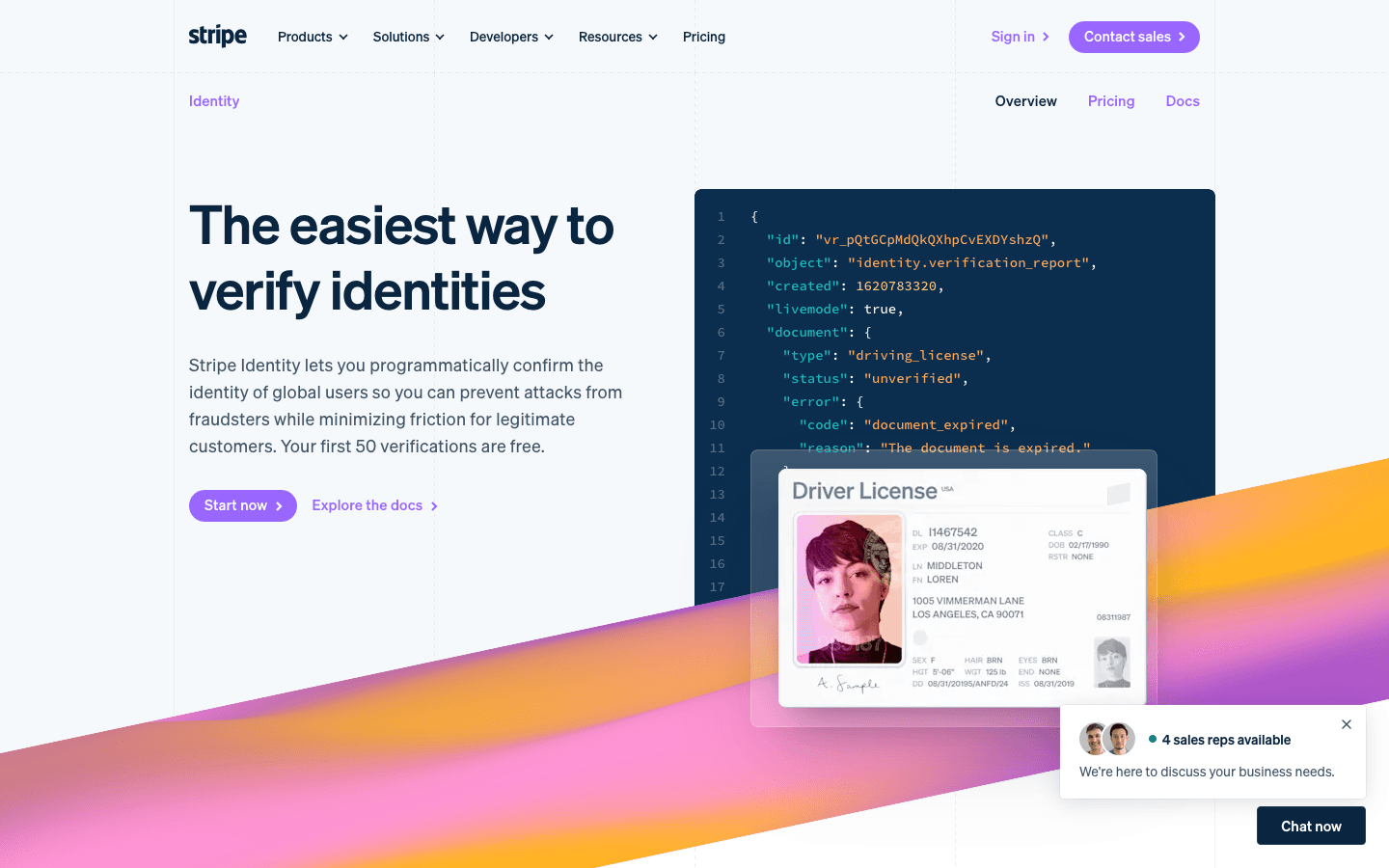
Stripe Identity is the narrowest fit on this list, and that's the point for the right buyer. If you already take payments through Stripe, adding ID verification means calling another API on your existing account, not signing a new vendor contract. It checks a government ID against a selfie across 120+ countries at a flat $1.50 per verification, charged whether the result passes or not, with no subscription or minimum. What it doesn't do is the part that defines Jumio's core pitch: no AML or sanctions-list screening, no ongoing monitoring, and no KYB verification are built into the product. Regulated teams that need those would be pairing Stripe Identity with something else, not replacing Jumio outright. It also only activates on Stripe accounts based in about 34 supported countries, even though it can verify documents from users anywhere.
Pros
- + Same account, dashboard, and monthly invoice as Stripe payments, so no separate vendor to onboard or reconcile
- + Prebuilt, brandable capture UI for web and mobile in 53 languages, so you are not building document-scan UX from scratch
- + Pay-per-verification with no subscription commitment, which suits products that only need to verify a fraction of users
Cons
- – Only Stripe accounts based in one of about 34 supported countries can activate Identity at all, so merchants outside that list are locked out even though the product can verify end-user documents from over 120 countries
- – No AML/sanctions screening, ongoing monitoring, or KYB in the product itself, so regulated teams still need to bolt on another tool
Should your product be on this identity verification & kyc list?
If you build a tool that belongs next to the ones above, submit it. A human reviews every submission. Approved products get their own page with pricing and screenshots, plus a place in the comparisons where they fit. It is free. You sign in with your work email so you can follow the decision, and there is no password to create.
Jumio alternatives: FAQ
What's the best Jumio alternative for AML screening and ongoing monitoring?+
Sumsub. Its Compliance tier bundles AML screening, ongoing monitoring, and proof-of-address checks for a published $1.85 per check with a $299 monthly minimum, the same regulatory coverage Jumio sells but with a price you can see before talking to sales.
Is there a free alternative to Jumio?+
Didit gives 500 full KYC verifications free every month, permanently, with no card required. It's the only tool here with an ongoing free tier; the others offer time-limited or session-capped trials instead.
Why doesn't Jumio publish its prices?+
Jumio prices per verification based on volume and which services you use, document checks, biometrics, AML, monitoring, and only gives you a number after a sales call. Buyer-reported data (Vendr) puts costs at $0.75-$8 per verification with annual minimums from $25,000.
Which Jumio alternative doesn't include AML or sanctions screening?+
Stripe Identity. It verifies documents and matches selfies at $1.50 per check but has no AML/sanctions screening, ongoing monitoring, or KYB built in, so it only replaces the ID-check part of what Jumio does.
Jumio alternatives: pricing compared
Entry price, billing model, and whether pricing is public. 6 of 8 publish pricing you can check without talking to sales.
| Tool | Starting price | Billing | Free option | Pricing disclosed |
|---|---|---|---|---|
| Jumio | Custom / quote | quote-only | No | Not disclosed |
| Sumsub | $1.35/check | usage-based | Trial (14 days, includes 50 free checks) | Partly public |
| Veriff | Usage-based | usage-based | Trial (15 days, up to 50 live verification sessions, no credit card required) | Partly public |
| Onfido | Custom / quote | quote-only | No | Not disclosed |
| Persona | $250/mo | usage-based | Trial (60 days, up to 50 services, sandbox only (no credit card, production access needs a business verification review)) | Partly public |
| iDenfy | $135/mo | usage-based | Trial (14 days, 10 free identity verifications) | Partly public |
| Didit | Usage-based | usage-based | Yes | Partly public |
| Stripe Identity | $1.5/verification | usage-based | No | Public |
How we made these picks. We compare tools on public pricing, features, and hands-on assessment, then verify every price against the vendor's own page. We never accept payment for rankings. Read the full methodology. Spotted an error? Report it.
More identity verification & kyc comparisons
Further reading
- Identity Verification & KYC Pricing Compared - Published entry prices for Didit, Veriff, Sumsub, Stripe Identity, iDenfy and Persona, plus how to handle quote-only vendors like Jumio and Onfido.