Top Railway Alternatives in 2026
Here for Railway itself? See the full Railway profile, pricing & reviews →
Suggest a change- If you want the closest match to Railway's git-push workflow with a managed Postgres, Redis, and workers bundled in, choose Render. Render deploys web services, background workers, cron jobs, and a managed Postgres or Redis-compatible cache from the same Git push, with compute prorated to the second the same way Railway meters usage.
- If you need multi-region placement or want direct control over Docker, volumes, and private networking, choose Fly.io. Fly.io runs your app as Docker Machines in the regions you pick, with Wireguard private networking and per-second billing, for teams that have outgrown Railway's more automatic multi-service abstraction.
- If your app is a Next.js frontend that needs global edge delivery and automatic PR preview URLs more than a managed backend database, choose Vercel. Vercel builds Next.js and gives every push an edge-cached preview deploy out of the box, which Railway does not offer since it is built around backend services rather than frontend delivery.
- If your app is mostly static pages with light serverless functions and you want a genuinely usable free plan, choose Netlify. Netlify's free plan includes unlimited deploy previews and a real CDN at $0, which beats Railway's setup of a one-time $5 trial credit and no ongoing free tier.
- If you already have a multi-service Railway project (web, worker, cron, database) wired together with private networking and just want better cost visibility, choose stay on Railway. Railway shipped CLI usage tracking and spending limits in July 2026, so you can keep the existing project setup and get more control over the same usage-based bill instead of rebuilding it elsewhere.
Railway deploys a Git repo straight to a running app, with managed Postgres, Redis, and background workers wired into the same project and billing that meters usage by the second. Developers start looking elsewhere when that usage-based bill runs past what they expected, or when they want a permanent free tier instead of a one-time trial credit.
The closest substitutes fall into two groups: full backend platforms that copy Railway's git-push-and-it-runs model (Render, Fly.io), and frontend-first platforms (Vercel, Netlify) that fit teams whose app is mostly a frontend with light backend needs. Which one wins depends on whether you need a managed database and workers, or edge delivery for a frontend framework.
Railway alternatives compared
| Tool | Best for | Starting price | Free option | Last update |
|---|---|---|---|---|
| RenderBest overall alternative | Solo developers and small teams who want git-push deploys for web apps, APIs, workers, and cron jobs without managing servers | $25/mo | Yes | July 2026 |
| Fly.ioBest for multi-region or more infra control | Developers who want to run Docker containers in multiple regions without managing Kubernetes | Custom / quote | Trial (New accounts get a trial that lasts 7 days or 2 hours of total machine runtime, whichever comes first, capped at 10 machines and 20GB of volume storage. Dedicated IPv4s, performance-class CPUs, and GPUs are not available during the trial.) | June 2026 |
| VercelBest for Next.js frontends | Teams already building on Next.js who want deploys and previews to just work without infra setup | $20/seat/mo | Yes | July 2026 |
| NetlifyBest free tier for small teams | Frontend teams that want git-push deploys, PR previews, and a CDN without managing servers | $9/mo | Yes | July 2026 |
Why teams switch from Railway
Usage bills can run past what you budgeted for
Railway bills usage per second with no hard cap by default, so users end up asking in Railway's own community forum how to restrict usage so a Hobby-plan bill doesn't run past a set threshold.
There's no permanent free plan
New accounts get a one-time $5 trial credit, and after that the cheapest paid plan is $5 a month, with no ongoing free tier to fall back on.
Business-grade support costs extra on the Pro plan
Business Class Support ships included only on Enterprise; Pro users have to pay for it as an add-on rather than getting it as part of their base plan.
The best Railway alternatives, ranked
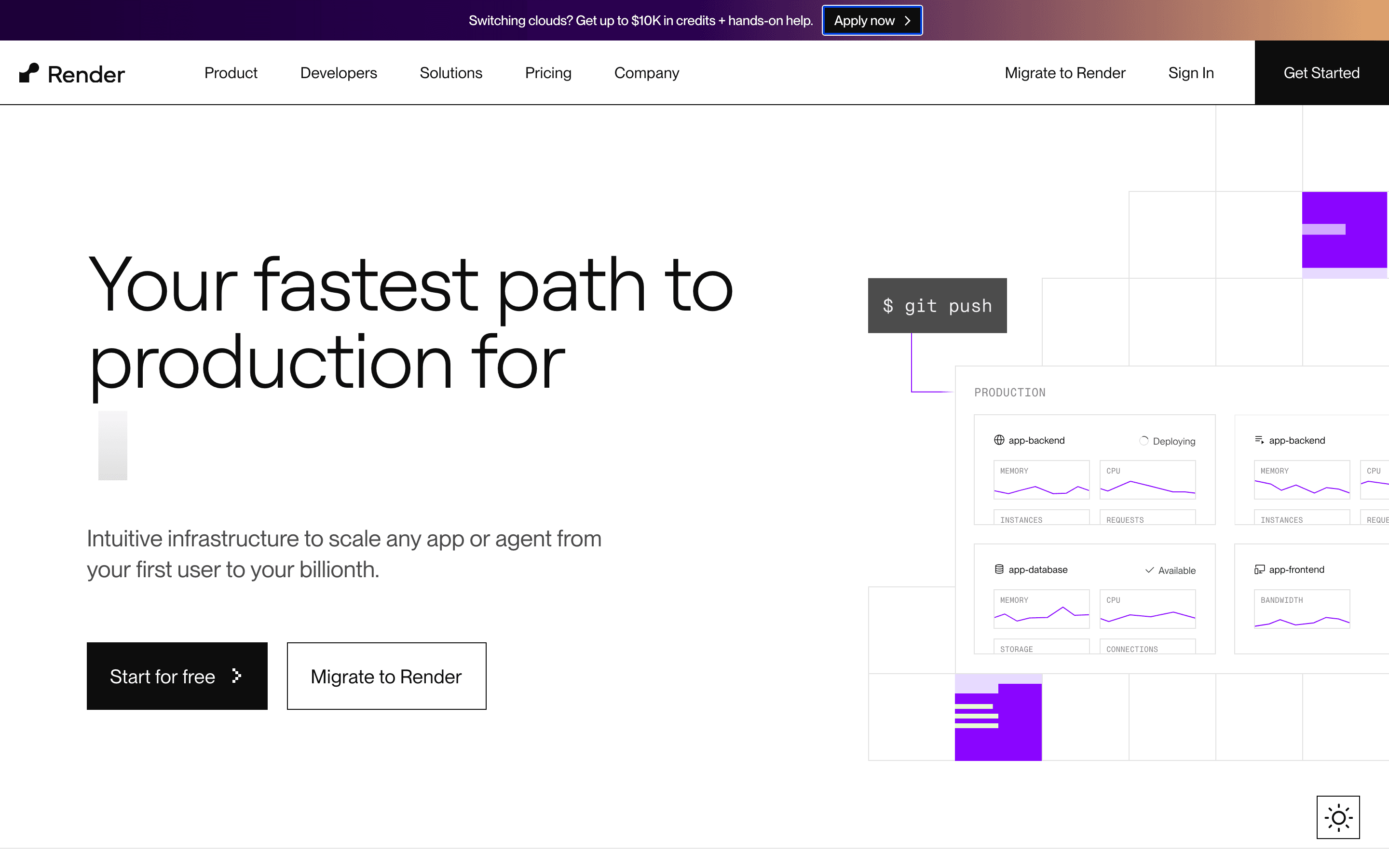
Render is the closest match to Railway's day-to-day workflow. Push to a Git repo and it builds and deploys web services, background workers, cron jobs, and static sites, with managed Postgres and a Redis-compatible Key Value store as first-class add-ons rather than third-party plugins. Pricing splits into a flat workspace fee (free Hobby, $25/month Pro with unlimited seats) plus compute billed per service and prorated to the second, similar in spirit to how Railway charges. Render's free Hobby plan actually deploys up to 25 services and a real Postgres database, something Railway doesn't offer since it dropped its own free tier down to a one-time trial credit. The tradeoff: bandwidth, custom domains, and dedicated IPs all bill separately on top, so a production app still costs more than the sticker price, and free databases expire after 30 days.
Pros
- + Free Hobby plan covers a real static site, web service, Postgres database, and Redis-compatible cache with no card required
- + Compute is prorated to the second, so cron jobs and Workflows tasks only cost you while they're actually running
- + Paid Postgres instances now include PgBouncer connection pooling at no extra charge (added July 2026)
Cons
- – Every layer, bandwidth, storage, custom domains beyond the included count, dedicated IPs, is billed separately, so a real production app costs noticeably more than the workspace fee alone
- – Free Postgres databases expire 30 days after creation and are deleted if not upgraded within a 14-day grace window, which catches teams off guard mid-project
Fly.io fits teams that want Railway's per-second usage billing but with more hands-on control over infrastructure. You write a Dockerfile, push with fly deploy, and your app runs as a Machine in whichever regions you pick, with Wireguard private networking and managed Postgres available as building blocks rather than one-click templates. A small always-on app runs about $2 a month, and there's no monthly minimum, but like Railway there's no permanent free tier anymore, only a short trial. The real difference from Railway is abstraction level: Fly.io expects you to configure volumes, Machine sizing, and networking yourself, which suits teams that outgrew Railway's more automatic multi-service setup and want global, low-latency placement instead. Some users report flaky builds and coarse team permissions, so it fits developers comfortable managing more of the stack themselves.
Pros
- + True pay-per-second billing means a small always-on app can cost around $2/month
- + Global region picker makes it easy to run instances near your users
- + Handles Docker deployments, private networking (Wireguard), and volumes without a separate cloud account
Cons
- – No free tier for new accounts; the old 3-VM always-on free allowance ended in October 2024
- – Pricing is spread across many small usage-based line items (compute, volumes, snapshots, IPs, certs, egress by region), which makes total cost harder to predict upfront than a flat plan
Vercel is the right alternative when the app leaving Railway is really a frontend, especially a Next.js one. Every Git push gets an automatic preview URL, the framework integration is native since Vercel maintains Next.js, and its global edge network handles static and cached content without server config. Where it diverges from Railway is the backend: Vercel doesn't offer a native managed Postgres or Redis, or a first-class way to run long-lived background workers, the things Railway bundles into one project. Pricing starts at $20 per seat a month on Pro with usage billed on top for bandwidth, compute, and requests, and there's no default spending cap, so a traffic spike can push a bill well past $20, as one developer's $23,000 DDoS bill and a college student's $3,200 bill both show. Free Hobby use is non-commercial only.
Pros
- + Deploy previews on every pull request work out of the box, no config needed
- + Best-in-class integration with Next.js, since Vercel builds the framework
- + Global edge network keeps static and cached content fast by default
Cons
- – No spending cap by default, so a traffic spike or attack can produce a bill far above what you expected
- – Bandwidth overage past the included 1 TB on Pro adds up quickly for media-heavy sites
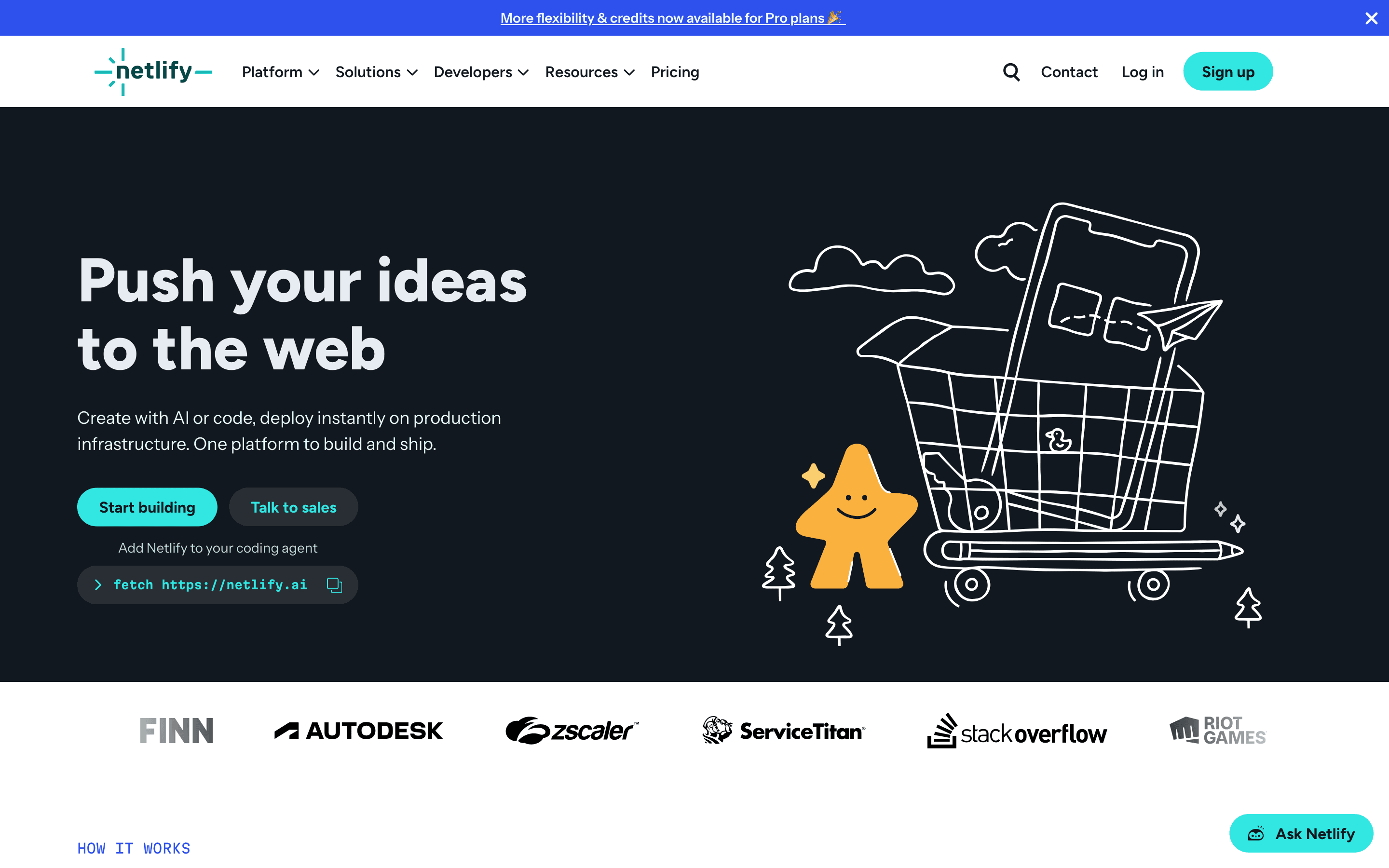
Netlify is the pick for teams whose Railway usage skews toward a frontend site with light backend needs. Git-push deploys, unlimited deploy previews, and a real CDN are free on Netlify's Free tier, and Netlify recently dropped per-seat pricing from Pro, so a flat $20 a month covers unlimited team members. Functions, edge functions, a managed Postgres database, and AI agent runners exist, but they're newer additions layered onto a platform built for static sites first, unlike Railway where multi-service backend deployment is the core design. Everything runs through a single credit pool now instead of separate bandwidth and build-minute limits, which is easier to reason about in theory, but at least one team calculated their real traffic would cost about 30 times their old flat-rate bill under the new model. It fits small, frontend-heavy teams better than heavier backend workloads.
Pros
- + Free tier is genuinely usable for small projects, with unlimited deploy previews and a real CDN
- + Per-seat pricing on Pro is gone, so adding team members doesn't add cost
- + Every credit rate (bandwidth, compute, requests, deploys) is published, so you can build your own cost model instead of guessing
Cons
- – The credit system replaced simple bandwidth/build-minute limits with a bundled unit that's harder to reason about at a glance
- – Teams with high bandwidth or request volume relative to their plan have reported large cost increases after the 2025 pricing change, in some cases many times their old bill
Should your product be on this app hosting & paas list?
If you build a tool that belongs next to the ones above, submit it. A human reviews every submission. Approved products get their own page with pricing and screenshots, plus a place in the comparisons where they fit. It is free. You sign in with your work email so you can follow the decision, and there is no password to create.
Railway alternatives: FAQ
What's the closest alternative to Railway?+
Render. It deploys web services, background workers, cron jobs, and managed Postgres or Redis from a Git push, with compute prorated to the second, which mirrors Railway's own workflow and billing model more closely than any other option.
Is there a free alternative to Railway?+
Render's free Hobby plan and Netlify's free plan both offer real ongoing free tiers. Railway itself has no permanent free plan, only a one-time $5 trial credit for new accounts.
Which Railway alternative fits a Next.js app best?+
Vercel, since it maintains Next.js directly and gives every Git push an edge-cached preview deploy without extra configuration. It's a weaker fit if you need a managed Postgres or Redis, since Vercel doesn't offer those natively the way Railway does.
Railway alternatives: pricing compared
Entry price, billing model, and whether pricing is public. 5 of 5 publish pricing you can check without talking to sales.
| Tool | Starting price | Billing | Free option | Pricing disclosed |
|---|---|---|---|---|
| Railway | $5/mo | usage-based | Trial ($5 one-time usage credit for new accounts, no credit card required) | Partly public |
| Render | $25/mo | tiered | Yes | Partly public |
| Fly.io | Custom / quote | usage-based | Trial (New accounts get a trial that lasts 7 days or 2 hours of total machine runtime, whichever comes first, capped at 10 machines and 20GB of volume storage. Dedicated IPv4s, performance-class CPUs, and GPUs are not available during the trial.) | Partly public |
| Vercel | $20/seat/mo | usage-based | Yes | Partly public |
| Netlify | $9/mo | tiered | Yes | Partly public |
How we made these picks. We compare tools on public pricing, features, and hands-on assessment, then verify every price against the vendor's own page. We never accept payment for rankings. Read the full methodology. Spotted an error? Report it.