Top ScrapingBee Alternatives in 2026
Here for ScrapingBee itself? See the full ScrapingBee profile, pricing & reviews →
Suggest a change- If you're scraping heavily-protected sites like LinkedIn, Amazon, or major retailers at volume, choose Bright Data. its residential, datacenter, ISP, and mobile proxy network is larger than ScrapingBee's and its Web Scraper API ships 1,000+ pre-built scrapers for exactly the sites ScrapingBee's own benchmark shows it failing on.
- If you want the same one-API model as ScrapingBee but don't want to pay credits for blocked or rate-limited requests, choose Zyte. Zyte bills per successful request and doesn't charge for failed or rate-limited calls, which directly fixes ScrapingBee's habit of billing for blocked or CAPTCHA'd pages that still return a 200.
- If you'd rather find an existing scraper than write extraction rules, and want a free plan that isn't a one-time trial, choose Apify. its Actor Store has thousands of ready-made scrapers for specific sites and its free plan renews $5 in credits every month instead of expiring after a single trial.
- If your team is feeding scraped pages into an LLM or RAG pipeline rather than parsing raw HTML, choose Firecrawl. it's built specifically to turn a URL or whole site into clean markdown or JSON in one call, which is the format most AI pipelines actually want.
- If your team has no developer to own an API integration and needs a bigger task count with in-house storage or API access, choose Octoparse. you train a scraper by clicking the fields you want in its built-in browser, with no selectors or code required, and paid plans scale to 100-250 concurrent tasks with a Data Export API to pull results into your own systems.
- If you need a handful of sites re-run on a schedule with results landing straight in a spreadsheet or Zapier, not a bigger in-house pipeline, choose Browse AI. you train a robot once by clicking the data you want, then it re-runs on a schedule or against a bulk list of URLs and exports directly to Google Sheets, Airtable, or Zapier with no API layer to build against.
- If you're a small team scraping mostly non-adversarial sites and just want a simple API without evaluating a marketplace or proxy network, choose stay on ScrapingBee. its single endpoint plus a free 1,000-credit trial already covers straightforward JS-rendering jobs without adding the complexity of a bigger platform.
ScrapingBee gives developers one API call that handles proxies, headless browser rendering, and anti-bot evasion instead of building that stack yourself. It works well for small to mid-size teams scraping mostly non-adversarial sites, but its credit-based pricing hides real cost (JS rendering runs 5x a plain request, stealth proxies 75x, and blocked or CAPTCHA'd pages that still return a 200 still get charged), and independent benchmarking puts its success rate against heavily-protected sites like LinkedIn and Walmart at close to 0%.
Teams usually look elsewhere when they hit one of two walls: the bill is bigger than the credit count implied, or the target site just won't return usable data. The alternatives below split into three groups: API-first competitors built the same way ScrapingBee is (Zyte, Bright Data, Apify), a newer tool built for feeding AI pipelines with markdown or JSON (Firecrawl), and no-code visual builders for teams without a developer to own the integration (Octoparse, Browse AI).
ScrapingBee alternatives compared
| Tool | Best for | Starting price | Free option | Last update |
|---|---|---|---|---|
| ZyteBest pay-per-success pricing | Developers who want a single API call to handle proxy rotation, browser rendering, and anti-bot bypassing instead of building that stack themselves | Usage-based | Yes | November 2025 |
| Bright DataBest for heavily-protected sites | Data teams scraping heavily-protected or high-volume sites that need a large, reliable IP pool | Usage-based | Yes | June 2026 |
| ApifyBest free plan | Developers who want a large library of ready-made scrapers instead of building one from scratch | $29/mo | Yes | June 2026 |
| FirecrawlBest for AI/RAG pipelines | Developers building RAG pipelines or AI agents who want clean markdown/JSON from a URL with one API call | $19/mo | Yes | July 2026 |
| OctoparseBest for non-technical teams | Ops, research, or marketing teams that want scraped data without writing code | $69/mo | Yes | July 2026 |
| Browse AIBest for scheduled monitoring | Ops, marketing, and research teams who need structured data from websites without writing scraper code | $19/mo | Yes | June 2025 |
Why teams switch from ScrapingBee
Credit pricing looks affordable until the bill arrives
JS rendering, premium proxies, and stealth proxies multiply the credit cost per request up to 75x, and credits don't roll over or get refunded when a request comes back blocked.
Success rates on heavily-protected sites are lower than teams expect
Independent benchmarking found only a 31% overall success rate across 13 popular scraping targets, with 0% success on sites like LinkedIn, Walmart, Twitter, and Zillow.
The best ScrapingBee alternatives, ranked
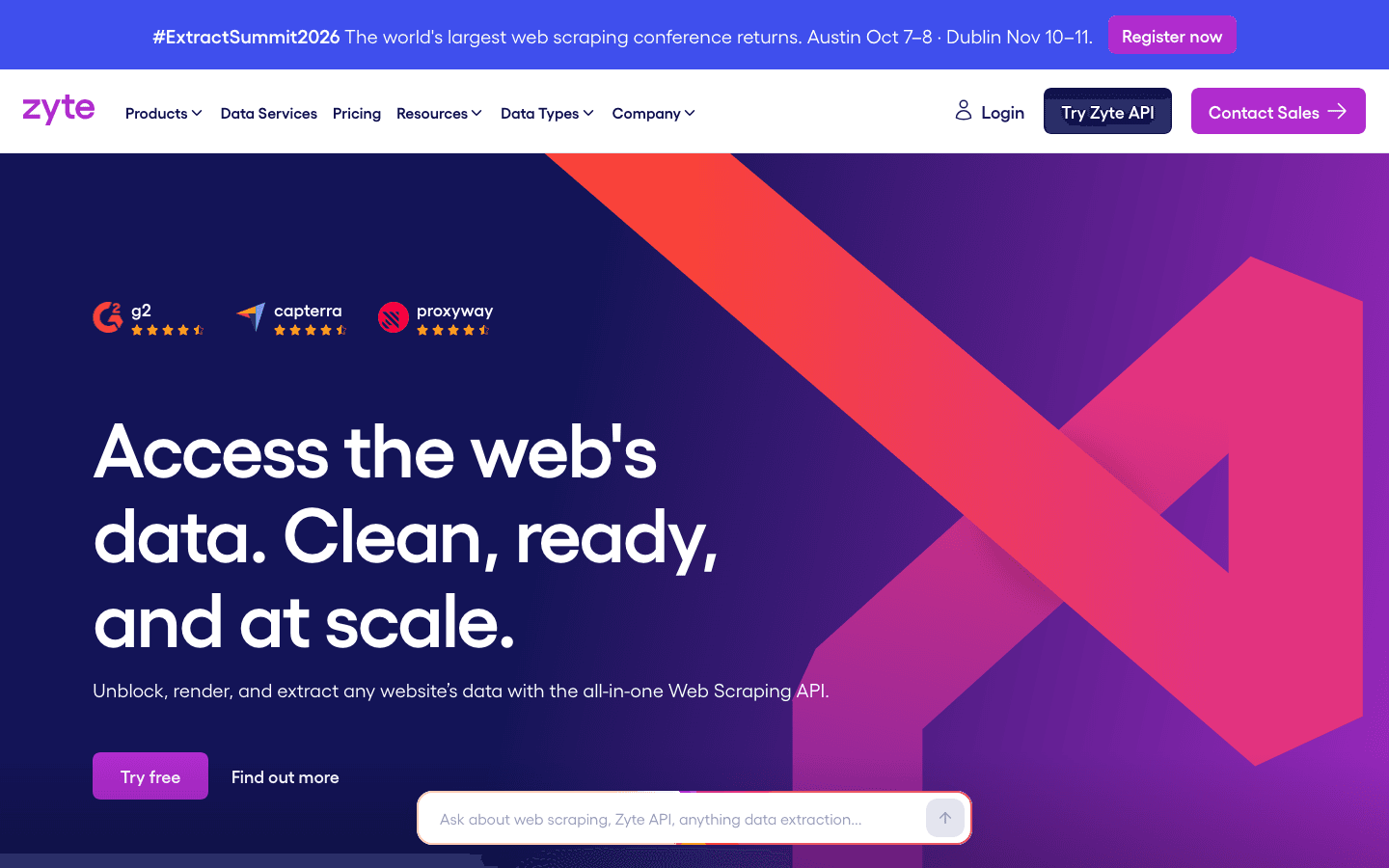
Zyte is the closest like-for-like swap for ScrapingBee: send a URL, get back HTML or extracted data, with proxy rotation, headless rendering, and anti-bot handling done for you. The billing model is the real difference. Zyte charges per successful request, and pay-as-you-go HTTP requests run $0.13-$1.27 per 1,000, dropping to $0.06-$0.61 per 1,000 with a $500/month commitment. Failed or rate-limited requests aren't charged at all, which fixes ScrapingBee's biggest complaint: paying credits for blocked pages. Browser-rendered requests still cost up to 13x a plain request, so JavaScript-heavy targets aren't cheap here either, and some reviewers report support tickets taking days rather than hours. The pricing relief isn't guaranteed either: multiple Trustpilot reviewers say the advertised spending-limit feature on pay-as-you-go accounts didn't work as described and report bills far above what they expected, so ask Zyte directly how the cap is enforced before relying on it. Teams already on Scrapy get an extra reason to switch: Scrapy Cloud has a genuinely free-forever tier, and the new Web Scraping Copilot extension writes spiders from plain-language prompts.
Pros
- + Per-request pricing means you don't pay for failed or blocked requests
- + Handles proxy rotation, headless browser rendering, and CAPTCHA/anti-bot bypass in one API instead of separate tools
- + Scrapy Cloud and the Web Scraping Copilot VS Code extension give existing Scrapy users a direct path from local development to hosted spiders
Cons
- – Browser-rendered requests cost up to roughly 13x the equivalent HTTP request, so costs scale fast on JavaScript-heavy sites
- – Zyte API and Zyte Data are paid only, with just a $5 signup credit for the first billing month; the genuinely free plan lives on the separate Scrapy Cloud product and caps crawls at 1 hour
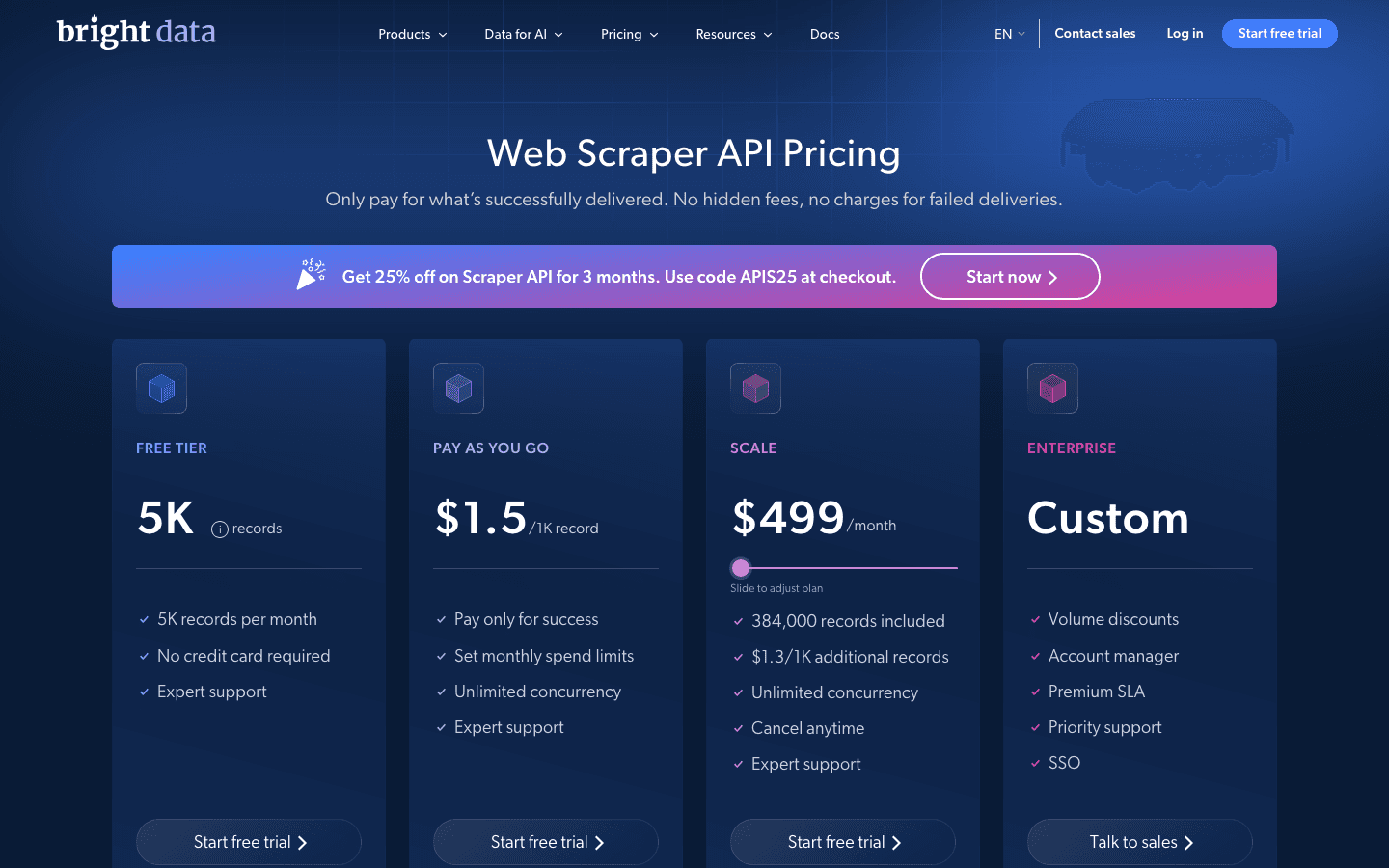
Bright Data is the pick for the sites ScrapingBee struggles with most. Its residential, datacenter, ISP, and mobile proxy network is larger than anything ScrapingBee runs on its own, and its Web Scraper API ships 1,000+ pre-built scrapers covering exactly the kind of heavily-protected targets ScrapingBee's own benchmark shows it failing on. Pay-as-you-go Web Scraper API and SERP API pricing starts at $1.50 per 1,000 successful records, and like Zyte, you're only billed for successful deliveries, not blocked pages. The tradeoff is complexity: pricing is split across separate pages for proxies, Web Scraper API, SERP API, and Datasets, so working out a real monthly number takes more effort than reading one ScrapingBee plan card. It's also overkill for a small team testing an idea, and full datasets are quote-only.
Pros
- + IP pool size and geographic coverage are hard to match, useful for high-volume or heavily geo-restricted targets
- + 1,000+ pre-built scrapers mean you often don't have to write scraping logic for popular sites
- + You aren't billed for failed requests on the Web Scraper API and SERP API pay-as-you-go plans, only successful deliveries
Cons
- – Pricing is spread across many separate product pages (proxies, Web Scraper API, SERP API, Scraping Browser, Datasets), so working out your real monthly cost takes effort
- – Pay-as-you-go rates run noticeably higher per unit than the committed monthly plans, which pushes usage-heavy teams toward locking into a $499+/month plan
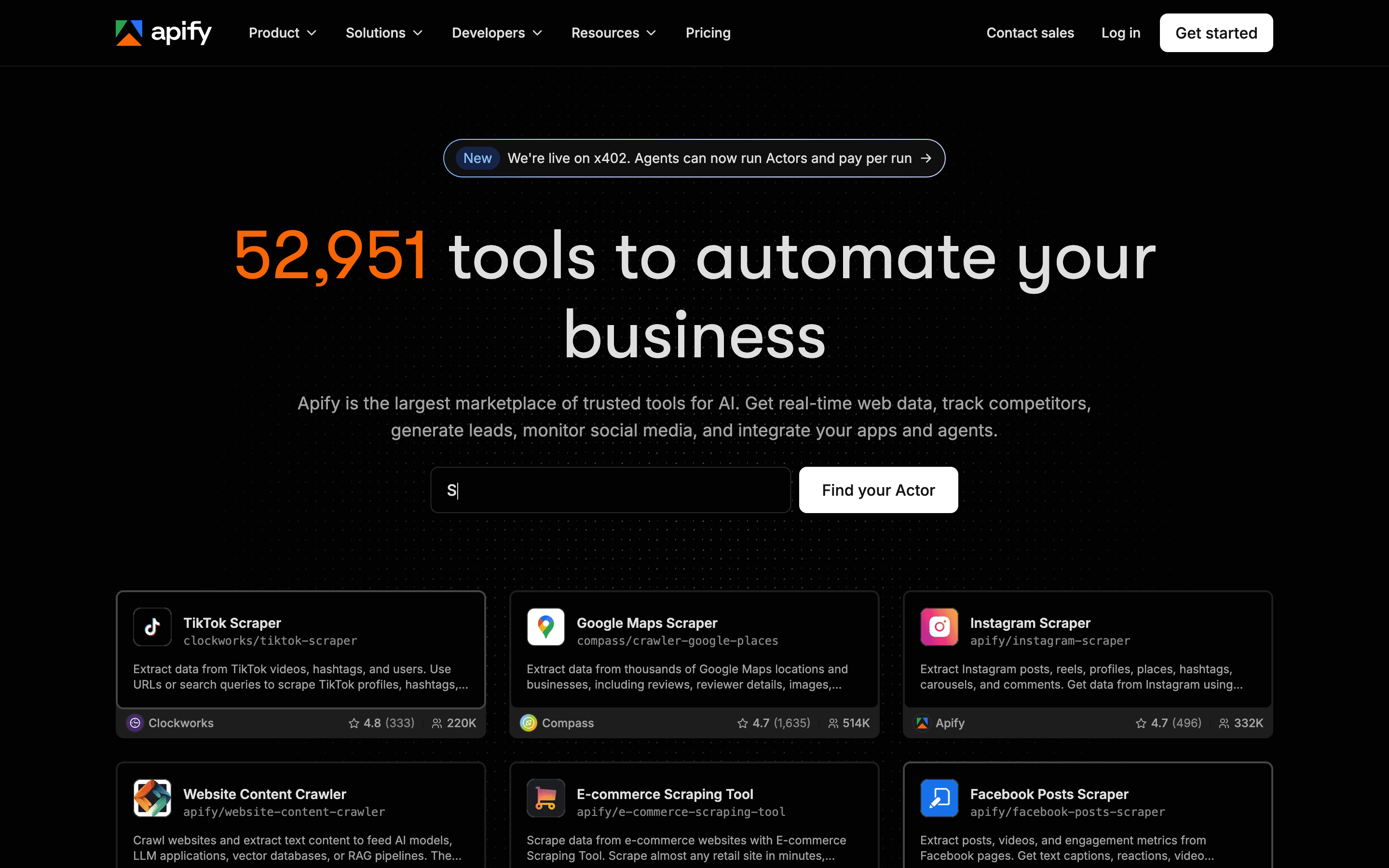
Apify trades ScrapingBee's single generic endpoint for a marketplace: thousands of pre-built Actors for specific sites like Google Maps, Instagram, and Amazon, plus the tools to build your own in JavaScript or Python. For a lot of scraping jobs, that means finding an existing Actor instead of writing extraction rules from scratch. Its free plan comes with $5 in platform credits every month, forever, not a one-time trial like ScrapingBee's 1,000-credit offer. Cost is spread across compute units, proxy bandwidth, and storage rather than one credit meter, which some teams find harder to forecast, and residential proxy bandwidth can become the biggest line item once you're up against sites that fight back. Monthly credits also expire with no rollover, so uneven usage months mean paying for credits you never touch.
Pros
- + Huge marketplace of ready-made Actors, so many scraping jobs need zero code
- + Free plan is genuinely usable for small, occasional jobs, not just a trial
- + Handles the annoying parts of scraping at scale: proxy rotation, browser automation, and result storage
Cons
- – Monthly credits expire with no rollover, so uneven usage months mean paying for credits you don't use
- – Billing has several separate meters (compute units, proxy bandwidth, storage, per-Actor fees from third-party developers), which makes total cost hard to predict in advance
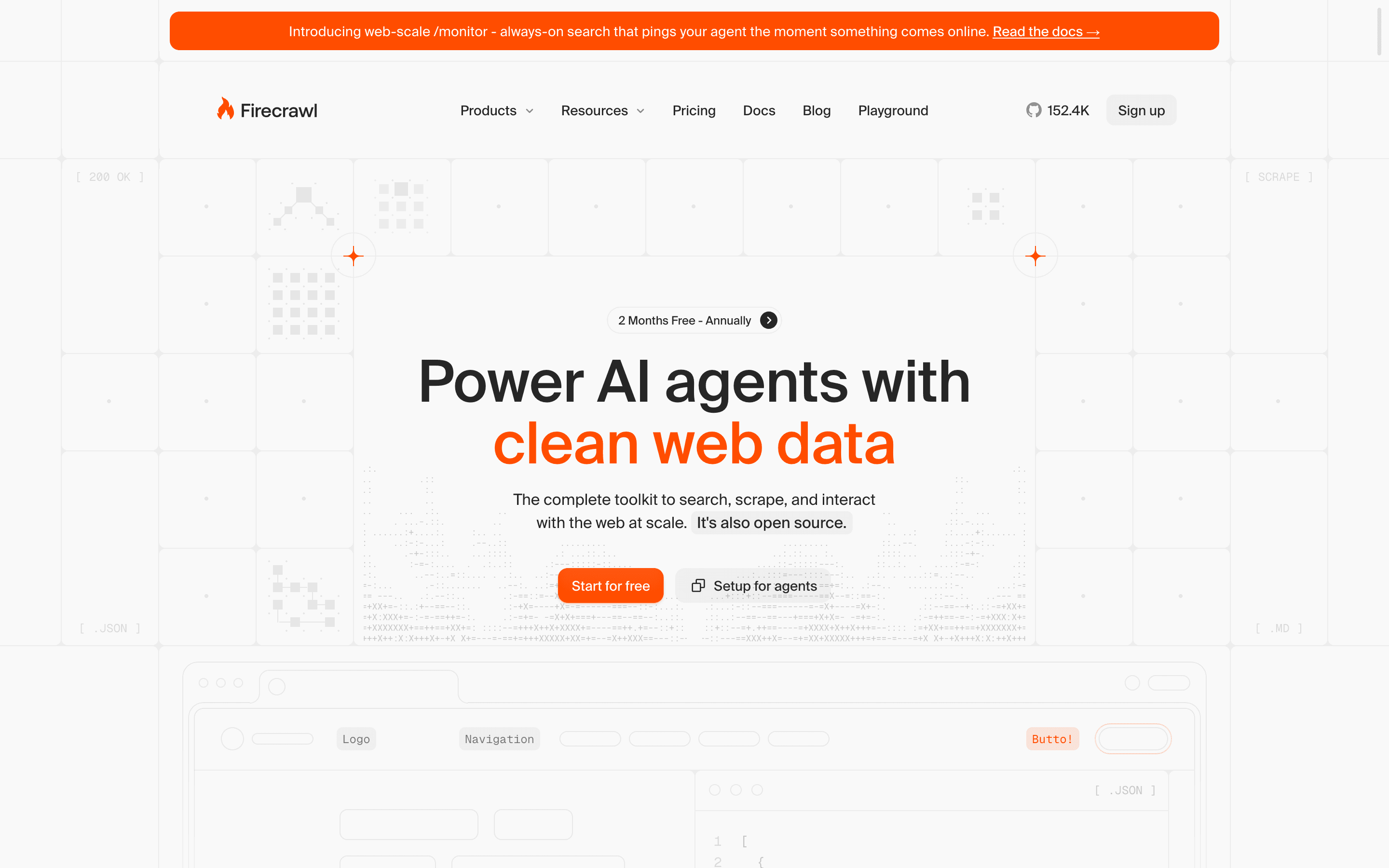
Firecrawl fits developers who don't actually want raw HTML back, they want clean markdown or JSON ready to feed an LLM or a RAG pipeline. Like ScrapingBee it runs on a credit system (1 credit per page for scrape, crawl, and map calls), and it has no pay-as-you-go option: every paid tier is a subscription, starting at $19/month for 5,000 credits. The free plan is more generous than ScrapingBee's one-time trial at 1,000 credits every month, no card required. Enhanced/stealth mode for bot-protected pages costs roughly 5x normal credits, so heavily-defended targets get expensive here too. It's open source and self-hostable, which matters if you want to avoid vendor lock-in, and it's shipping fast, adding a research index, PII redaction, and a web-scale /monitor endpoint through 2026.
Pros
- + One API call converts a page or entire site into markdown or JSON, no HTML parsing needed
- + Generous free tier at 1,000 credits/month with no card required
- + Open source, so you can self-host the core engine if you want to avoid vendor lock-in
Cons
- – Credits don't roll over month to month on standard plans, so paying for a tier and not using it all wastes money that month
- – Enhanced/stealth mode for bot-protected sites costs roughly 5x the normal credits, which adds up fast on harder targets
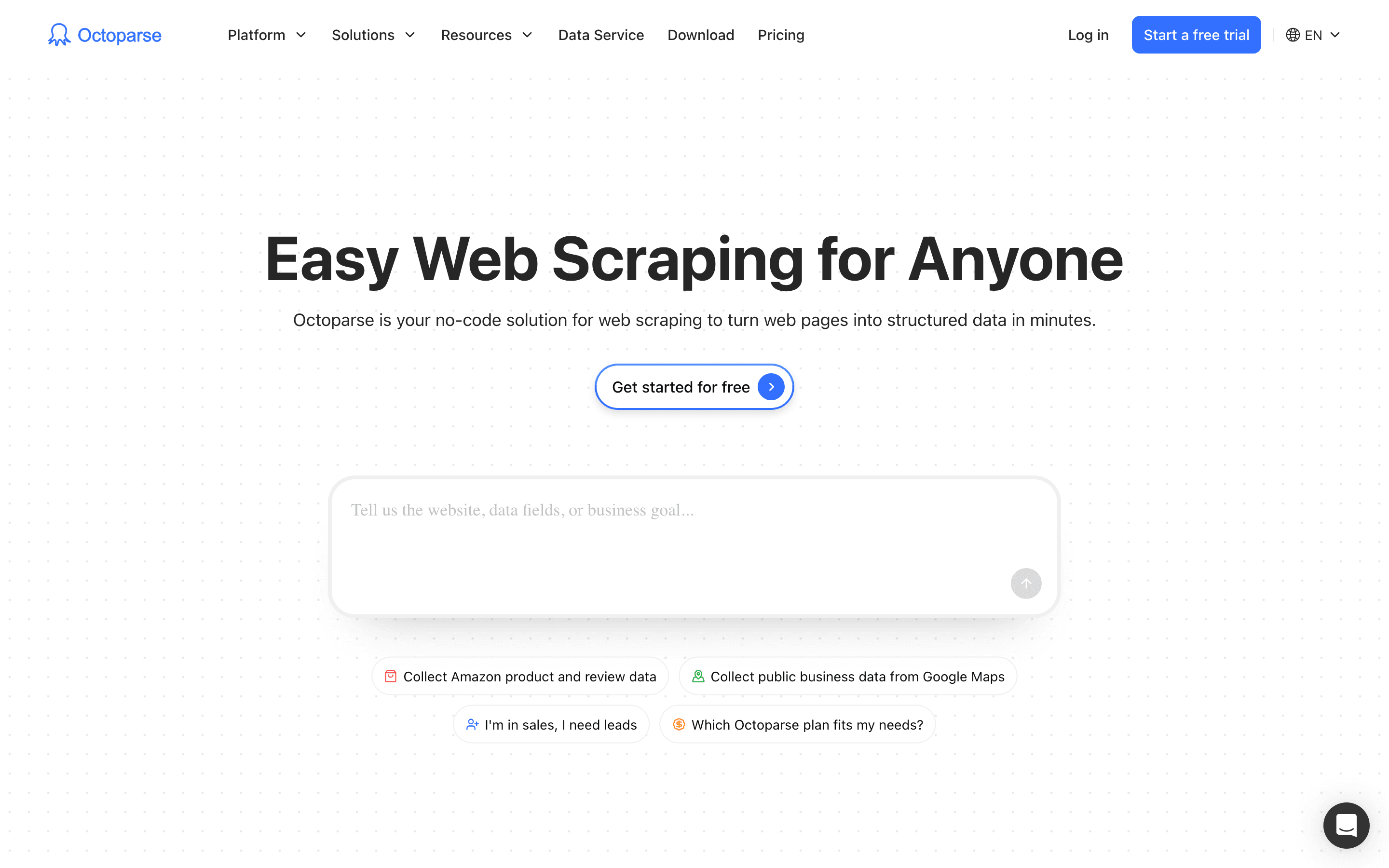
Octoparse swaps ScrapingBee's API-first model for a point-and-click builder: open a site in its built-in browser, click the fields you want, and it infers a template with no selectors or code. That makes it the right pick for ops or research teams without a developer to own an API integration, especially ones pulling from more sites or bigger jobs than Browse AI is built for: Standard scales to 100 concurrent tasks and Professional to 250, and both include a Data Export or Advanced API to pull results into your own systems instead of only a spreadsheet. The free plan exports 50,000 rows a month forever, more generous than ScrapingBee's one-time trial, and 500+ preset templates cover common targets out of the box. Paid plans jump hard: Standard is $83/month (or $69 billed annually) and Professional is $299/month ($249 annually), with proxies and CAPTCHA solving billed as separate add-ons on top. The refund window is a short 5 days, and there's no code-first path for developers who want full control over a headless browser session.
Pros
- + Visual template builder gets a working scraper running in minutes without writing selectors
- + Free plan is a real free tier, not a time-limited trial, with 50,000 rows a month
- + 500+ prebuilt templates for common sites cut setup time for popular targets
Cons
- – Standard price jumps from free to $83/month (or $69/month billed annually) with no mid-tier option, and Professional jumps again to $299/month ($249/month billed annually)
- – Residential proxies ($3/GB), CAPTCHA solving ($1-1.5 per 1,000), and premium pay-per-result templates ($0.001-3 per 1,000 results) are billed as separate add-ons on top of the plan price
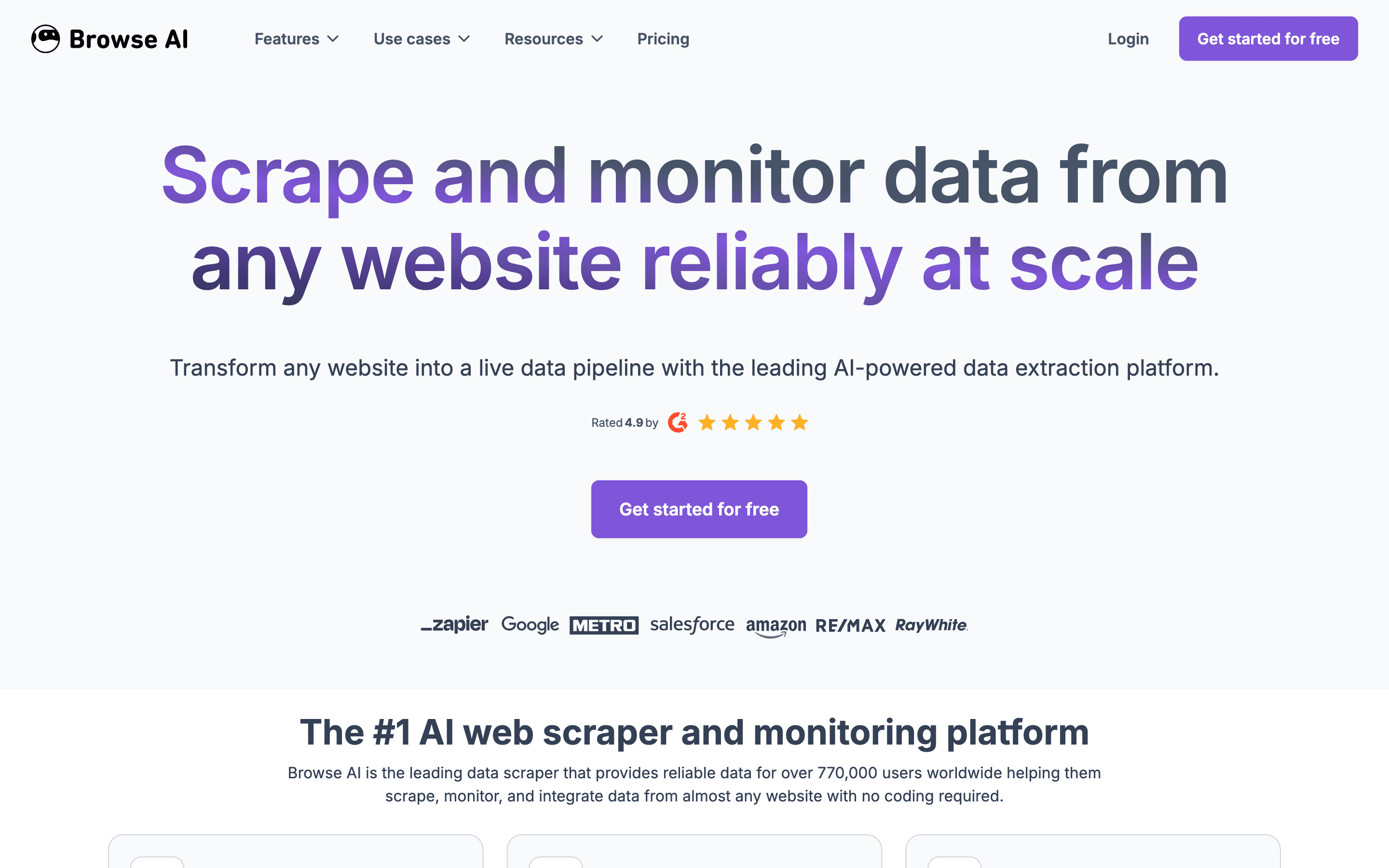
Browse AI is the lighter-weight no-code option, built for a smaller list of sites re-run on a schedule rather than Octoparse's bigger one-off jobs. You train a robot by clicking the data you want, then it re-runs on a schedule or against a bulk list of URLs, exporting directly to Google Sheets, Airtable, or Zapier with no API or in-house storage layer to build against. Credits work on a similar idea to ScrapingBee's (1 credit covers 10 rows or 1 screenshot), and the Free plan gives 50 credits a month with unlimited robots. Personal starts at $19/month billed annually for 12,000 credits a year, jumping to $69/month annually for Professional's 60,000. That jump is steep if you outgrow 5 websites, and there's no code-first API layer for developers who want SDK-level control over proxies or browser sessions. It's SOC 2 Type 2 certified, which matters if a client is asking about data-handling compliance.
Pros
- + Point-and-click robot training with prebuilt robots for common sites, no code required
- + Handles both scheduled monitoring and one-off bulk scraping from thousands of URLs in a single CSV upload
- + Wide range of export options: Google Sheets, Airtable, webhooks, API, and Zapier/Make
Cons
- – Credit-based pricing means heavy scraping and monitoring jobs can burn through your monthly allowance quickly, and G2 reviewers most often cite the free plan's credit limits as the thing they'd change
- – Jump from Personal ($19/month annual) to Professional ($69/month annual) is steep if you outgrow 5 websites or need more credits
Should your product be on this web scraping & data extraction list?
If you build a tool that belongs next to the ones above, submit it. A human reviews every submission. Approved products get their own page with pricing and screenshots, plus a place in the comparisons where they fit. It is free. You sign in with your work email so you can follow the decision, and there is no password to create.
ScrapingBee alternatives: FAQ
What's the best ScrapingBee alternative for scraping LinkedIn or Amazon at scale?+
Bright Data. Its residential, datacenter, ISP, and mobile proxy network is larger than ScrapingBee's, and its Web Scraper API includes 1,000+ pre-built scrapers for specific sites, covering exactly the heavily-protected targets ScrapingBee's own benchmark shows it struggling with.
Is there a free alternative to ScrapingBee?+
Apify's free plan renews $5 in platform credits every month with no expiration date, and Firecrawl's free plan gives 1,000 credits a month, no card required. Both are ongoing free tiers, not a one-time trial like ScrapingBee's 1,000-credit offer.
Why do teams leave ScrapingBee?+
The two most common reasons are pricing and reliability. Credits are deceptively affordable until JS rendering (5x), premium proxies (10x, 25x if combined with JS rendering), and stealth proxies (75x) multiply the real cost, and independent benchmarking found only a 31% success rate against 13 popular scraping targets, with 0% success on sites like LinkedIn and Walmart.
What's the best ScrapingBee alternative for a team with no developers?+
Octoparse or Browse AI. Both use a point-and-click builder instead of an API, so you train a scraper by clicking the fields you want on the page rather than writing code. Octoparse fits larger one-off pulls, scaling to 100-250 concurrent tasks with a Data Export API to pull results into your own systems, while Browse AI fits a handful of sites re-run on a schedule with data landing directly in Google Sheets, Airtable, or Zapier and no API layer of its own.
ScrapingBee alternatives: pricing compared
Entry price, billing model, and whether pricing is public. 7 of 7 publish pricing you can check without talking to sales.
| Tool | Starting price | Billing | Free option | Pricing disclosed |
|---|---|---|---|---|
| ScrapingBee | $49/mo | usage-based | Trial (1,000 API credits, no credit card required) | Partly public |
| Zyte | Usage-based | usage-based | Yes | Partly public |
| Bright Data | Usage-based | usage-based | Yes | Partly public |
| Apify | $29/mo | tiered | Yes | Partly public |
| Firecrawl | $19/mo | tiered | Yes | Partly public |
| Octoparse | $69/mo | tiered | Yes | Partly public |
| Browse AI | $19/mo | tiered | Yes | Public |
How we made these picks. We compare tools on public pricing, features, and hands-on assessment, then verify every price against the vendor's own page. We never accept payment for rankings. Read the full methodology. Spotted an error? Report it.