What accounting software costs in 2026
Accounting software costs $0-$25/month to start, $60-$340/month for a full plan in 2026, verified across six vendors, plus the pricing traps to check.
Why the sticker price isn't the real accounting software cost
Entry-level accounting software runs free to $25 a month, and a plan built for a growing team costs $60 to $275 a month before add-ons, climbing to $340 on QuickBooks' top tier once its August 1, 2026 price increase lands. The accounting software cost that actually matters isn't the number on the cheapest tier. It's whether the vendor bills per seat or per organization, whether payroll rides along or costs extra, and how fast you outgrow the transaction cap that made the cheap tier cheap in the first place.
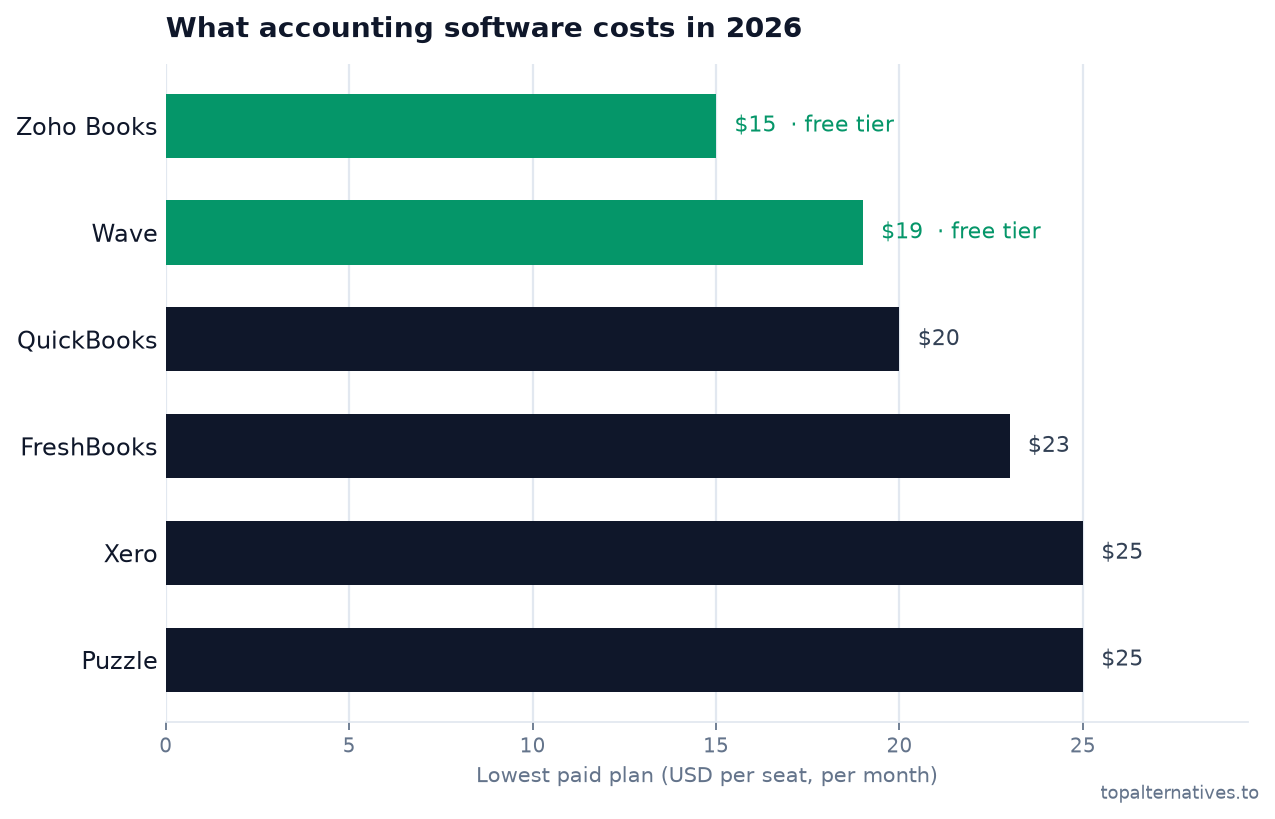
Below is a dated table of entry and top pricing across six vendors, verified against each vendor's own pricing page on July 7, 2026.
| Tool | Cheapest paid plan | Priced per | Free tier | Top listed plan |
|---|---|---|---|---|
| QuickBooks | $20/mo, Solopreneur, 1 user | seat, capped by tier | No | $275/mo, Advanced, up to 25 users (rising to $340/mo Aug 1, 2026) |
| Xero | $25/mo, Early | organization, unlimited users | No | $90/mo, Established |
| FreshBooks | $23/mo, Lite, 5 billable clients | billable clients, 1 user included | No | $70/mo, Premium, unlimited clients |
| Wave | Free, Starter | flat, unlimited users | Yes | $19/mo, Pro, flat |
| Zoho Books | Free under $50K annual revenue | organization, user + invoice caps | Yes | $240/mo billed annually, Ultimate, 15 users |
| Puzzle | Free until $20K in transaction volume, then $25/mo billed annually | flat, no per-seat fee | Conditional | $300/mo billed annually, Scale |
Every number above comes from the vendor's own pricing page, checked July 7, 2026. Confirm your own quote before you buy. Enterprise and multi-client pricing on plans like FreshBooks Select is negotiated and won't match a list price.
Per-seat vs. flat pricing
This is the split that decides your real bill once you have more than one person touching the books. QuickBooks and FreshBooks both charge by user: QuickBooks caps you at 1, 3, 5, or 25 users depending on tier, and FreshBooks includes only 1 user on every plan below its custom Select tier, charging $11 a month for each extra teammate. Xero, Wave, and Puzzle go the other way. Xero and Wave both price per organization with unlimited logins included, and Puzzle's Core plan and up cover 5 or unlimited users at one flat price with no per-seat add-on. Zoho Books sits in between: each tier includes a set number of users (3 on Standard up to 15 on Ultimate), and extra seats cost $2.50 a month each billed annually.
If you're a team of five, QuickBooks charges more the moment you cross Essentials' 3-user cap: Plus, the tier that covers up to 5 users, runs $115 a month. Xero Growing costs $55 a month for that same team, because Xero prices per organization and doesn't care how many people log in.
One detail buyers miss: a per-seat vendor does not only bill for accountants. Anyone who needs to raise an invoice, approve a bill or pull a report is a seat, so operations and sales people quietly inflate the count on QuickBooks and FreshBooks in a way they never do on Xero or Wave.
What changes between 5 seats and 25 seats
Between 5 and 25 seats the flat-rate vendors barely move and the per-seat vendors change tier, which is the entire practical argument for per-organization pricing. On QuickBooks, five users means Plus at $115 a month today and $140 from August 1, 2026; twenty-five users means Advanced at $275 a month today and $340 after the increase. On Xero, the same growth takes you from Growing at $55 to Established at $90, and only because of features and volume, not headcount, since logins stay unlimited on both. Wave stays at $19 a month on Pro no matter who logs in. Puzzle charges no per-seat fee at all, so a hiring spree changes nothing on the invoice until transaction volume moves you up a plan.
Zoho Books is the one to model carefully, because it mixes the two shapes. Ultimate includes 15 users at $240 a month billed annually, and every seat past that is $2.50 a month billed annually, so a 25-person finance and operations team pays the plan price plus a per-head strip on top. FreshBooks is the harshest at scale: every teammate beyond the single included user is $11 a month on top of a plan that is already capped by billable clients, which is why FreshBooks pushes larger firms toward its negotiated Select tier.
Payroll is almost always a separate line item
None of the six vendors above bundle payroll into the base accounting software cost. QuickBooks sells payroll as an add-on across every tier. FreshBooks does the same, and its June 2026 update added post-tax deduction and garnishment management for payroll customers, which only matters if you're already paying for that add-on. Wave sells payroll separately too, on top of its Pro plan. Budget for payroll as its own recurring cost, not something the plan price already covers.
Payroll add-ons also carry their own billing shape, usually a base fee plus a charge per employee paid, so payroll scales with headcount even at vendors whose accounting plan does not. If you picked a flat-rate accounting tool specifically to keep hiring off the invoice, check whether the payroll module quietly reintroduces the per-head cost you were avoiding.
The cheap tiers cap transactions, not just features
The entry price on a pricing page usually comes with a ceiling that has nothing to do with features. Xero's $25 Early plan caps you at 20 invoices and 5 bills a month, a limit a lot of small businesses hit inside their first year, which forces the jump to Growing at $55 a month. Zoho Books' Free plan allows 1,000 invoices and 1,000 bills a year, generous for a true solo operator but a hard wall once volume grows. Paid tiers raise that ceiling in steps, from 5,000 on Standard to 10,000 on Professional and 25,000 on Premium, and even the top two tiers, Elite and Ultimate, still cap out at 100,000 invoices and bills a year instead of going uncapped. FreshBooks caps by client count instead of invoice count: Lite tops out at 5 billable clients, and adding a sixth forces an upgrade to the $43 Plus plan. QuickBooks and Wave don't cap invoice volume, but QuickBooks caps user count per tier and Wave's free Starter plan requires entering every transaction by hand since automated bank feeds are Pro-only.
The free tiers each stop covering a different thing, and knowing which one matters more than the word "free". Wave Starter stops at automation: the ledger is complete, but you are the bank feed. Zoho Books' free plan stops at revenue, ending the moment you pass $50K a year regardless of how few invoices you send. Puzzle's free usage stops at $20K in transaction volume, after which the entry plan is $25 a month billed annually. Read the cap next to the price, not just the price.
Price increases to plan for
QuickBooks is raising list prices again on August 1, 2026: Essentials goes from $75 to $85 a month, Plus from $115 to $140, and Advanced from $275 to $340, while Simple Start holds at $38. That continues a pattern Intuit has repeated most summers for years. Xero has also raised prices multiple times in recent years, according to reviewers on Capterra, though no specific 2026 increase is on its pricing page as of this writing. If a vendor's history includes yearly hikes, budget for next year's price, not this year's.
Billing term matters here too. Puzzle's $25 entry price and $300 Scale plan, and Zoho Books' $240 Ultimate plan, are all quoted billed annually, so check the month to month rate before you line them up against a monthly price from another vendor. An annual commitment usually holds your rate through the term, which is worth something at a vendor that raises list prices on a schedule, but it also means a migration decision six months in comes with sunk cost attached.
Who each tool is wrong for
Every tool on this list is the wrong buy for someone, and the mismatch is almost always about billing shape rather than features. QuickBooks is wrong for a team that adds non-finance staff who still need access, because each tier cap turns a hire into an upgrade. Xero is wrong for a low-volume solo operator who would still be paying $25 a month on Early while capped at 20 invoices, when a free tier elsewhere would cover the same work. FreshBooks is wrong for anyone with many small clients, since Lite stops at 5 billable clients and the count, not the revenue, drives the upgrade. Wave is wrong for a business that needs automated bank feeds without paying for Pro, and wrong again for anyone who wants inventory or deep reporting. Zoho Books is wrong for a company already past $50K in annual revenue that expected the free plan to last, and its per-user add-on makes it awkward for wide, shallow teams. Puzzle is wrong for a traditional small business with no investors and no interest in continuous close, because it is built for venture-backed startups and priced around transaction volume rather than invoicing.
Which accounting software costs less for your business
The cheapest option is whichever one matches how you actually grow: by client, by headcount, or by transaction volume. A solo freelancer invoicing a handful of clients pays least on FreshBooks Lite at $23 a month or Wave's free Starter plan. A small team that wants headcount to stop mattering to the bill fits Xero's flat per-organization pricing better than QuickBooks' per-seat tiers. A business under $50,000 in annual revenue gets a genuinely free plan from Zoho Books, not just a trial. A venture-backed startup that wants books updated continuously instead of closed once a month is the one segment Puzzle is built for, and it skips per-seat fees entirely.
For a full breakdown of who should actually switch and why, see our QuickBooks alternatives ranking and our Xero alternatives ranking. Both compare the same six tools above against the vendor they're most often bought to replace.
Keep reading
FAQ
Is there accounting software that's actually free, with no catch?+
Wave's Starter plan is free forever for invoicing and bookkeeping, with no revenue cap or time limit, but automatic bank feed imports and receipt scanning need the $19/month Pro plan and you still pay 2.9% + $0.60 per card transaction. Zoho Books' Free plan is also free indefinitely, but only while your annual revenue stays under $50,000.
Why is QuickBooks getting more expensive in 2026?+
Intuit is raising Essentials, Plus, and Advanced prices on August 1, 2026, to $85, $140, and $340 a month, continuing a pattern of price increases most summers for the past several years. Simple Start is staying at $38.
Does accounting software charge per user?+
It depends on the vendor. QuickBooks and FreshBooks charge per seat, either through tier-based user caps or a flat per-teammate add-on. Xero, Wave, and Puzzle price per organization instead, with unlimited or flat-rate user counts. Zoho Books includes a set number of users per tier and charges $2.50/user/month for extras billed annually.
What's the cheapest accounting software for a solo freelancer?+
FreshBooks Lite at $23/month covers up to 5 billable clients with mobile mileage tracking included, and Wave's Starter plan is free if you don't mind entering transactions by hand. Which one costs less depends on whether you value automatic bank feeds (FreshBooks includes bank reconciliation on Plus at $43/month; Wave needs its $19/month Pro plan for the same).
Sources
- https://quickbooks.intuit.com/pricing/
- https://www.xero.com/us/pricing-plans/
- https://www.freshbooks.com/pricing
- https://www.waveapps.com/pricing
- https://www.zoho.com/us/books/pricing/
- https://puzzle.io/pricing
- https://www.firmofthefuture.com/product-update/quickbooks-price-changes/
- https://procstat.com/knowledge-center/blog/why-is-quickbooks-getting-so-expensive-everything-small-business-owners-need-to-know/
Should your product be on this list?
If you build a tool that belongs next to the ones above, submit it. A human reviews every submission. Approved products get their own page with pricing and screenshots, plus a place in the comparisons where they fit. It is free. You sign in with your work email so you can follow the decision, and there is no password to create.
Spotted something wrong or out of date? Report it and we'll check it against the source.