Best email marketing tools for ecommerce
Klaviyo fits stores needing order-based flows, Brevo is cheapest for a big quiet list, Mailchimp suits small lists, and ActiveCampaign adds a built-in CRM.
Email marketing tools for ecommerce: the quick answer
If you run a store, the best email marketing tools for ecommerce are Klaviyo, Mailchimp, Brevo, and ActiveCampaign. Klaviyo wins if you're on Shopify and want flows built on real order and browsing data. Brevo wins on cost once your list is large but you don't email it often. Mailchimp is the easiest switch if your list is small and you already know the tool. ActiveCampaign fits if you want a CRM and sales pipeline bundled with your automation. The tool that fits you depends less on features and more on how each one bills as your list grows.
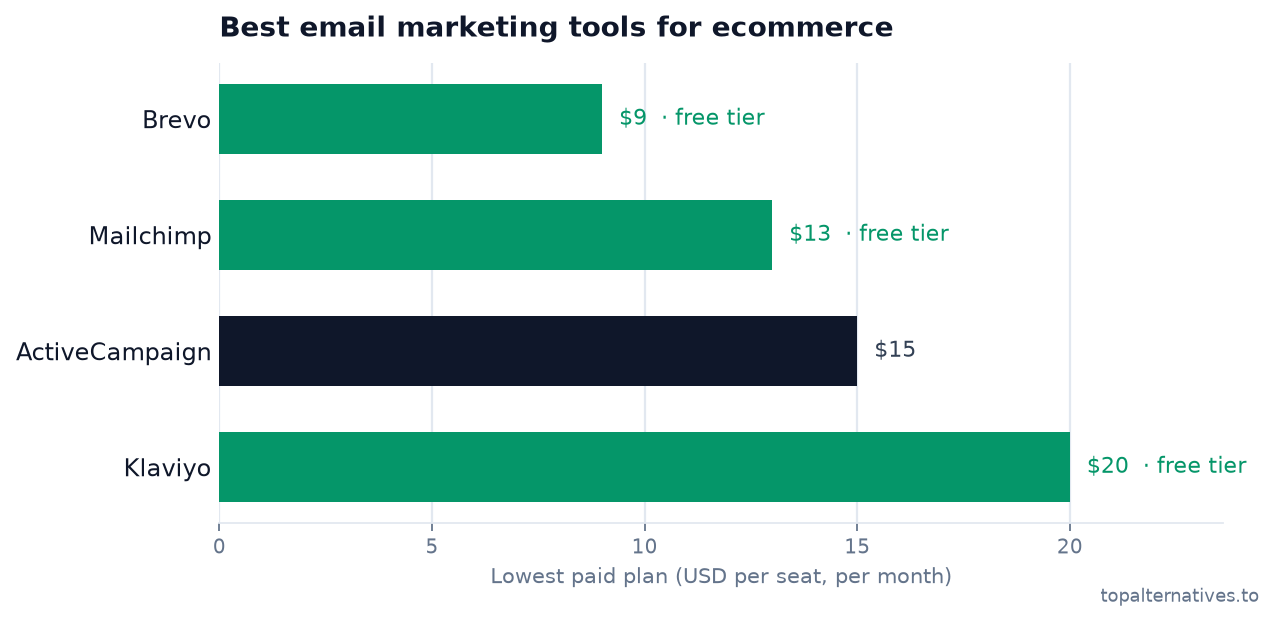
How the four compare
| Tool | Starting price | Billed by | Free plan | Native ecommerce sync | Built-in CRM |
|---|---|---|---|---|---|
| Klaviyo | $20/mo (Email plan, 251-500 active profiles) | active profiles | Yes, up to 250 profiles | Yes, Shopify, BigCommerce, WooCommerce, Magento | No, sold as separate add-ons |
| Mailchimp | $13/mo (Essentials, 500 contacts) | contact count | Yes, up to 250 contacts | Yes, Shopify, WooCommerce, Wix | No |
| Brevo | $9/mo (Starter) | emails sent per month | Yes, 300 emails/day | Shopify integration, not native order sync like Klaviyo | Add-on (Sales Essentials/Advanced) |
| ActiveCampaign | $15/mo (Starter, 1,000 contacts, billed annually) | plan tier + contact count | No, 14-day trial only | Shopify integration, not native order sync | Yes, included on paid plans |
The column that decides this table is "billed by": Klaviyo and Mailchimp charge for the contacts you hold, Brevo charges for the emails you send, and ActiveCampaign charges for a plan tier and a contact band at the same time. Two stores with identical lists can end up with very different invoices purely because of that difference, so read the starting prices as an entry ticket rather than a running cost. Prices are current on each vendor's pricing page as of the dates in our tool profiles. Confirm your own quote before you buy, since real cost depends on your list size and send volume.
Flows: who automates on real store data
Klaviyo is the only one of the four that reads order, cart and browsing data natively, so if flow quality off real store behaviour is your priority it is the default pick. Klaviyo is built around ecommerce data first. It pulls orders, browsing, and cart activity straight from your store platform, so a flow like "browsed but didn't buy" or "bought once, never again" runs off real purchase history rather than email opens alone. Every Email and Email+SMS tier gets the same flow-building features, so upgrading is about list size, not new features.
Mailchimp covers similar ground for Shopify, WooCommerce, and Wix stores, with built-in revenue tracking and generative AI tools on the Standard and Premium plans. The catch is that full branching automation is capped at four steps on the Essentials plan; you need Standard or above for real flow depth. In practice that cap bites the moment you want a welcome series that splits by first purchase versus no purchase, which is usually the second or third flow a store builds.
Brevo and ActiveCampaign both connect to Shopify, but neither pulls order and browsing data as deeply as Klaviyo does out of the box. ActiveCampaign's strength is its own automation builder, which handles branching and multi-condition logic well. It runs off your own event setup, not a native commerce sync. That is fine if someone on your side is willing to define and pass the events you care about, and a problem if you expected product-level triggers to be sitting there on day one.
SMS: what's bundled
Brevo is the only one of the four with SMS and WhatsApp access on every plan, while Klaviyo and ActiveCampaign put messaging behind a higher tier or a paid add-on. Klaviyo splits Email and Email+SMS into separate plans. Email alone starts at $20/month for 251-500 active profiles; add SMS and the same tier starts at $35/month, with extra SMS/MMS billed as credits priced by country and message type.
Brevo bundles SMS and WhatsApp access into every plan, including the free one, though sending volume beyond what's included is priced separately.
Mailchimp lists SMS as part of its platform but doesn't publish a separate SMS price breakdown on its core tiers. If SMS is central to your calendar rather than an occasional extra, that lack of a published rate is itself a reason to get a written quote before committing.
ActiveCampaign treats SMS and WhatsApp as add-ons on top of its core email and automation plans, with its own WhatsApp-specific plans starting at $99/month (billed annually) for a 5,000-contact baseline. Stacked on a per-seat email plan, that turns a cheap-looking starting price into a materially larger monthly commitment.
Cost as your list scales
Your bill is driven by whichever unit the vendor counts, so the cheapest tool for you is decided by the ratio between how many contacts you hold and how often you actually mail them. This is where the four tools genuinely diverge, and it matters more than any single feature.
Klaviyo bills by total active profiles: every contact you could email, whether or not you message them regularly. A large, quiet list costs the same as an actively-emailed one of the same size. Since February 18, 2025, this has applied to all active profiles rather than only recently-emailed contacts, though legacy accounts get a discount capping any increase at 25% of their prior cost.
Mailchimp also bills by contact count, and subscribed, unsubscribed, and non-subscribed contacts all count against your limit unless you manually archive them. The advertised starting prices assume a small list; the real bill climbs as contacts grow, even on the same plan.
Brevo is the outlier: it bills by how many emails you send each month, not by list size. A store with 50,000 contacts that emails twice a month can cost far less than the same list on a per-contact tool. The flip side is that the same billing shape punishes high frequency, so a daily sender with a modest list can end up paying more here than on a contact-based plan.
ActiveCampaign prices on two axes at once, plan tier and contact-count band, and the bill jumps hard at each threshold rather than rising smoothly. As of November 3, 2025, new signups are also billed on total contacts, including unsubscribed and bounced ones. Budget for the step above the one you are on, because crossing a band mid-quarter is not something you can negotiate away after the fact.
What the entry price hides: seats and free tiers
Every headline price here assumes one login and a small list, and growing stores break both assumptions faster than they expect. ActiveCampaign is priced per seat from $15, so each extra person who needs their own login adds to the base before contact bands are even counted; a marketer, a founder and an agency contact is three lines on the invoice, not one. Klaviyo, Mailchimp and Brevo lead with an account-level monthly price instead, which makes them cheaper to open up to a freelancer, though you should still check which tier gates user roles and permissions before promising anyone access.
The free tiers are worth using for testing and little else once orders start arriving. Klaviyo's free plan stops at 250 profiles and Mailchimp's at 250 contacts, both of which a store with any real traffic will pass in a matter of weeks. Brevo's free plan is shaped differently, at 300 emails a day with no contact ceiling, which suits a large dormant list you touch rarely and fails you on a launch or a Black Friday blast. ActiveCampaign has no free tier at all, only a 14-day trial, so it is a purchase decision from day one.
Who each tool is wrong for
The fastest way to shortlist is to rule out the tool whose billing shape fights your sending pattern, rather than to rank features. Klaviyo is wrong for a store sitting on a large, mostly inactive list it mails occasionally, because you pay for every profile whether or not it ever opens anything. Mailchimp is wrong for anyone whose first serious flow needs more than four branching steps, since Essentials caps that and the fix is an upgrade rather than a workaround.
Brevo is wrong for a store whose whole strategy rests on product-level behavioural triggers, and it is also wrong for a high-frequency sender, since the per-email meter runs with every campaign. ActiveCampaign is wrong for a solo operator on a tight budget who wants to start free, and wrong for a team that needs many logins, because per-seat pricing compounds exactly where account-level pricing does not.
If none of the four fit
Three tools sit just outside this shortlist and win narrow cases: MailerLite from $12 per seat for simple, cheap broadcasting, Kit from $39 per seat for creator-style sequences, and Customer.io from $100 per month for event-driven messaging owned by a developer. MailerLite and Kit both have free tiers, so they are testable before you commit, while Customer.io starts at a level that only makes sense once messaging is a core part of the product rather than a marketing channel. Pick MailerLite if your needs are newsletters plus a couple of basic automations, Kit if the store is attached to an audience business, and Customer.io if you have engineering time and want messaging driven by your own events.
Which one to pick
Choose Klaviyo for Shopify-native flows, Brevo for a big list you mail rarely, Mailchimp for a small list you already run, and ActiveCampaign when you want the CRM bundled in. If your store leans on Shopify and you want flows built from real purchase and browsing data, Klaviyo is worth the active-profile pricing. It's the tool most built for the ecommerce job specifically, and the tradeoff is clear rather than hidden: you know going in that your bill tracks your full contact count, whether or not you email everyone on it.
If your list is big but you rarely email all of it, run the numbers on Brevo before renewing anywhere else. Its per-email billing rewards exactly the pattern a lot of stores fall into: a large list built up over years, emailed a few times a month. You give up some of Klaviyo's native commerce depth, but for a store that isn't leaning hard on behavioral segmentation, that's a fair trade for the savings.
If you're starting out, or you already run Shopify through Mailchimp and your list is under a few thousand contacts, staying put is fine until you outgrow the free tier or the four-step automation cap on Essentials. Switching tools before you hit a real limit adds migration work for no gain.
If you want a sales pipeline alongside your email automation instead of buying a separate CRM, ActiveCampaign is the one that includes it on paid plans. It costs more to start than the others here, and there's no free plan, but you're paying for automation depth and CRM together instead of stitching two subscriptions.
For the full ranked list and more alternatives in each direction, see our Klaviyo alternatives and Mailchimp alternatives guides.
Keep reading
FAQ
Does Klaviyo charge more as my list grows even if I don't email everyone?+
Yes. Klaviyo bills by total active profiles, meaning any contact that can be emailed through your account, not only the people you've recently messaged. This has been the case since February 18, 2025; legacy customers get an appreciation discount that caps any resulting increase at 25% of their prior plan cost.
Is Brevo cheaper than Klaviyo for a large list?+
Often, yes, if you don't email that list often. Brevo prices by how many emails you send per month rather than by contact or profile count, so a large but rarely-messaged list can cost much less than the same list on Klaviyo.
Does Mailchimp charge for unsubscribed contacts?+
Yes, by default. Subscribed, unsubscribed, and non-subscribed contacts all count toward your plan's contact limit unless you manually archive the ones you no longer need.
Does ActiveCampaign include a CRM for ecommerce sales tracking?+
Yes. ActiveCampaign's paid plans include a built-in CRM and sales pipeline, with more users and deeper segmentation available on the Pro and Enterprise tiers.
Sources
Should your product be on this list?
If you build a tool that belongs next to the ones above, submit it. A human reviews every submission. Approved products get their own page with pricing and screenshots, plus a place in the comparisons where they fit. It is free. You sign in with your work email so you can follow the decision, and there is no password to create.
Spotted something wrong or out of date? Report it and we'll check it against the source.