Do you still need ZoomInfo in 2026?
You still need ZoomInfo if you want buyer intent, Chorus, and the biggest database in one vendor. Otherwise Apollo, Clay, or RocketReach cost less.
Do you still need ZoomInfo, or has a cheaper tool caught up?
Most teams asking whether they still need ZoomInfo already suspect the answer is no, and for a lot of them it is. You still need ZoomInfo if you depend on its buyer intent signals, its Chorus conversation intelligence, or a contact database large enough that nothing else comes close, and you have the budget for a sales-negotiated contract that Vendr's aggregated deal data puts at a median of about $33,500 a year. If your job is finding verified emails and phone numbers, or building custom enrichment workflows, Apollo, Clay, and RocketReach all do that for less, with prices posted on the page instead of behind a sales call.
The honest way to answer this for your own team is to separate what ZoomInfo does from what you personally use it for. ZoomInfo sells a contact and company database, buyer intent data, Chorus call recording and conversation intelligence, and a Copilot AI layer, all folded into one vendor relationship because the company grew mainly by acquiring other data and engagement tools. If you use two of those four things, you're paying for a bundle built around the other two.
What ZoomInfo costs
ZoomInfo doesn't publish a price above its free Lite tier, which gives 10 contact credits a month (25 on the Community Edition) and basic visitor tracking. Everything past that, Basic, Essentials, and Enterprise, is quoted by a sales rep based on seat count, monthly credit volume, and which data features and integrations you add. Vendr, which aggregates real purchase data across more than 1,500 verified ZoomInfo deals, puts the median contract at roughly $33,500 a year, with actual deals ranging from about $7,200 to $156,000. That range alone tells you the sticker-price question is close to unanswerable until you know your own seat count and credit needs. It also tells you the number is negotiable in both directions: the same product lands at wildly different prices depending on term length, how many modules you take, and whether you are buying in the vendor's quarter-end or yours.
The case for keeping it
ZoomInfo earns its cost when a team uses the parts that make it more than a database. Buyer intent signals flag accounts that are actively researching your category before they've raised their hand, and Chorus layers call recordings and conversation intelligence on top so reps aren't cold-calling a flat list. Copilot then surfaces both of those, plus signals like a prospect browsing a competitor's site, directly inside Salesforce or HubSpot. A mid-market or enterprise RevOps team that has built workflows around all three, and has a rep to negotiate the contract, is the buyer ZoomInfo is built for. Ripping that out to save money usually means losing integrations and signal coverage that took real time to set up.
The case for switching
The case against ZoomInfo comes down to three things: no price you can check before a call, credit limits that run out mid-cycle and can trigger overage fees, and a feature set that keeps shifting as the company folds in newly acquired products, which makes renewals hard to predict. None of that matters if you're a solo founder or small team that only needs to find and verify contacts. For that job, cheaper tools with public pricing cover the same ground. The practical risk of staying is that a contract you cannot benchmark against a public list price tends to grow at renewal, because the only reference point in the room is last year's invoice.
| Tool | Pricing model | Entry price | Free tier | Best for |
|---|---|---|---|---|
| ZoomInfo | Quote-only | None (free Lite tier only) | Yes, 10 credits/month | Buyer intent, Chorus, and database size under one vendor |
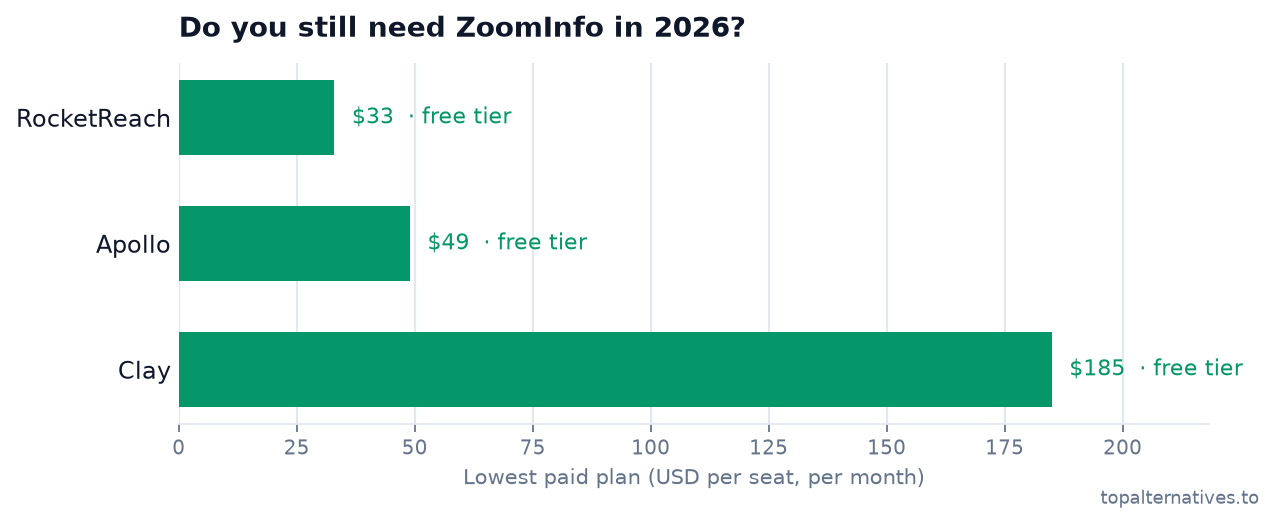
| Apollo | Per seat + credits | $49/seat/month, billed annually | Yes, full 230M+ database, 900 credits/year | A published-price database with sequences and a dialer |
| RocketReach | Per seat | $33/seat/month, billed annually | Yes, 5 lookups | Cheapest published entry price, email-only at that tier |
| Clay | Usage-based | $185/month (Launch, billed monthly) | Yes, 500 actions/month | Waterfall enrichment across 200+ providers, unlimited seats |
All four prices above come from each vendor's own pricing page, checked July 7, 2026. Confirm your own quote before you buy; enterprise pricing on any of these is negotiated.
If you mainly need a searchable contact database
Apollo is the closest like-for-like swap. It posts real per-seat prices, starting at $49/month for Basic billed annually, and its free plan gives full access to the 230M+ contact database rather than a locked sample, useful for checking data quality before you commit to anything. The tradeoff is Apollo's credit system: unlocking an email costs 1 credit but a phone number costs 8, so reps who lean on direct dials can burn through a year's allotment fast, and the Organization tier's 3-seat minimum pushes its real floor to at least $357/month. Apollo isn't the only database-first option either; our ranked field of Apollo competitors covers the rest if it turns out not to fit.
If you're a small team on a tight budget
RocketReach's Essentials plan starts at $33/seat/month billed annually, about $399 a year, the lowest published entry price of the group, for email-only lookups across a database the company says covers 700 million professionals. Autopilot jobs and Sequences add light, semi-automated outreach on top of the raw lookups. The catch is that phone numbers sit behind the $75/seat Pro tier, not Essentials, so anyone who needs direct dials pays more than the headline number suggests. RocketReach is a lookup tool with outreach bolted on, not a system of record, so a team that wants intent signals, call recording, or account scoring will end up buying a second product anyway.
If your real problem is data coverage, not database size
Clay approaches the job differently: instead of selling one proprietary database, it runs waterfall enrichment across more than 200 data providers, so a failed match on one source automatically tries the next, and its Claygent AI agents can answer research questions no structured field covers, like reading a company's careers page. Every plan, including free, includes unlimited seats, and cost tracks usage instead of headcount. Launch starts at $185 a month for 15,000 actions and 2,500 data credits. The real cost is a learning curve: Clay's table-based workflow builder takes longer to pick up than a search box, and unused actions don't roll over month to month.
What the billing shape does to a real bill
The three pricing models here scale on completely different axes, which is why a tool that looks cheap for one team looks absurd for another. Per-seat pricing tracks headcount, usage-based pricing tracks volume, and quote-only pricing tracks how well you negotiate, so the cheapest option depends on which of those three you have most of. At five seats, Apollo and RocketReach are the obvious answers: the bill is small, predictable, and you can add or remove a licence without a conversation. At twenty-five seats the arithmetic flips, because per-seat bills climb in a straight line with hiring while Clay's unlimited seats stay flat and only consumed actions move the number, and a fully loaded per-seat stack starts landing in the same neighbourhood as a negotiated contract with more in it. Flat monthly platform pricing is a third shape again: Amplemarket starts at $600 per month rather than per seat, and Fuse AI starts at $159 per seat, while Ciro is quote-only like ZoomInfo, so it carries the same "you won't know until you call" problem. Before you switch, count seats, count monthly lookups, and check which of the two your prospective vendor bills against.
Who each tool is wrong for, and where the free tiers stop
Every tool on this page is a bad buy for someone, and the free tiers are the fastest way to find out whether you're that someone. Test each one on your own territory list until the free allowance runs out, because that ceiling is exactly where the product stops being free reconnaissance and starts being a purchase decision. ZoomInfo is wrong for a solo founder or a small team that only pulls contacts, since the Lite tier's 10 credits a month barely covers a morning and everything above it needs a sales call. Apollo is wrong for a phone-heavy outbound team on a low tier, because at 8 credits per phone number the 900 credits a year on the free plan disappear quickly and paid allotments follow the same maths. RocketReach is wrong for anyone whose workflow depends on direct dials at the entry price, and its 5 free lookups are a sample, not a trial. Clay is wrong for a team with nobody willing to learn a table-based builder, and its 500 free actions a month go fast once a waterfall runs several providers per row.
The actual test
Ask what you use ZoomInfo for today, not what the sales rep sold you on. If the answer is buyer intent signals plus Chorus plus a database bigger than anything else on the market, you still need ZoomInfo and the contract cost is the price of that combination. If the answer is "we look up emails and phone numbers," you're paying enterprise money for a job Apollo or RocketReach do at a fraction of the cost with the price posted on the page. Our side-by-side ranking of ZoomInfo substitutes walks through all five real options in more depth, including two that go further into AI-driven prospecting than any tool in this table.
Keep reading
FAQ
Does ZoomInfo have a free plan worth using?+
ZoomInfo Lite is free with no credit card required, giving 10 monthly contact credits (25 on the Community Edition) and limited website visitor tracking, enough to test data quality but not to run real outbound.
Why doesn't ZoomInfo publish its prices?+
ZoomInfo's own pricing page lists Basic, Essentials, and Enterprise as custom-quoted based on seats, monthly credit volume, data features, and integrations. Only the free Lite tier has a stated price.
What does a real ZoomInfo contract cost?+
Vendr's aggregated purchase data across more than 1,500 verified deals puts the median ZoomInfo contract at about $33,500 a year, with actual contracts ranging from roughly $7,200 to $156,000 depending on seats and add-ons like intent data.
What's the cheapest real alternative to ZoomInfo?+
RocketReach's Essentials plan starts at $33 a seat a month billed annually, about $399 a year, the lowest published entry price among ZoomInfo's main substitutes, though it's email-only until you move up to Pro.
Sources
Should your product be on this list?
If you build a tool that belongs next to the ones above, submit it. A human reviews every submission. Approved products get their own page with pricing and screenshots, plus a place in the comparisons where they fit. It is free. You sign in with your work email so you can follow the decision, and there is no password to create.
Spotted something wrong or out of date? Report it and we'll check it against the source.