Sales intelligence software cost by team size in 2026
Sales intelligence software cost by team size runs from about $400 a year per seat to a quote-only contract. Here's what a 1, 5, 10, and 25-seat team pays.
Sales intelligence software cost by team size
Sales intelligence software cost by team size depends less on which tool you pick than on how each one bills. Some vendors charge a flat per-seat rate that climbs in a straight line as you add reps. Others bundle a minimum headcount into one price. One bills by usage and doesn't care how many people are logged in. For a 10-person sales team, that difference is the gap between a published annual bill of under $4,000 and a quote-only enterprise contract with no visible ceiling. The practical consequence is that two teams of identical size can pay wildly different amounts for broadly similar contact data, purely because one buys seats and the other buys usage.
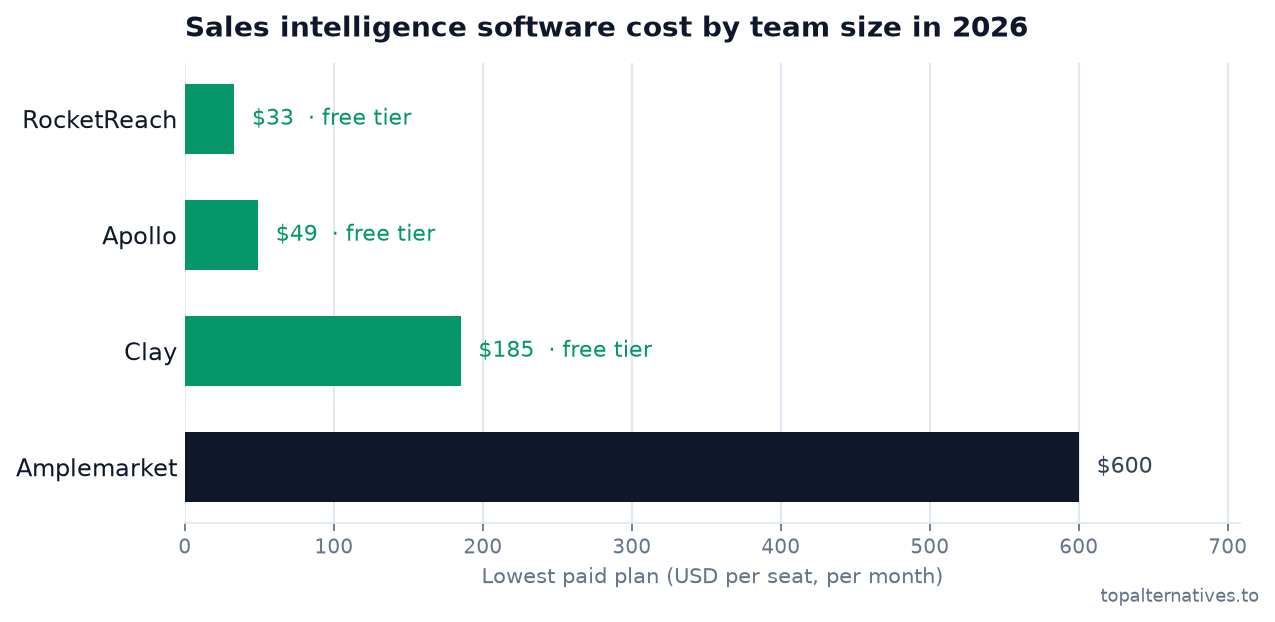
This guide lines up Apollo, RocketReach, Clay, Amplemarket, and ZoomInfo at four common team sizes, 1, 5, 10, and 25 seats, using each vendor's own published rates checked July 7, 2026. Confirm your own quote before you buy. Every vendor here negotiates once you're past the entry tier.
| Team size | Apollo (Basic) | RocketReach (Essentials) | Clay (Launch) | Amplemarket (Startup) | ZoomInfo |
|---|---|---|---|---|---|
| 1 seat | $588/year | $399/year | $2,220/year, flat regardless of seats | $7,200/year, priced for a 2-seat bundle, no smaller tier | Quote-only |
| 5 seats | $2,940/year | $1,995/year | $2,220/year, flat | Quote required past 2 included users | Quote-only |
| 10 seats | $5,880/year | $3,990/year | $2,220/year, flat, unless usage needs Growth | Quote required | Quote-only. Vendr's aggregated deal data puts the median contract at $33,500/year |
| 25 seats | $14,700/year | $9,975/year | $2,220 to $5,940/year depending on usage tier | Quote required | Quote-only |
All per-seat figures assume the cheapest tier that includes the feature set most teams need, billed annually. Higher tiers cost more per seat, and the table below breaks out where each vendor's model bends.
RocketReach and Apollo scale in a straight line, until a tier change bends the curve
RocketReach's Essentials plan has no published seat minimum, so its $33/seat/month rate scales cleanly from one rep to a large team: $399 a year at 1 seat, $3,990 at 10, $9,975 at 25. The catch is that Essentials is email-only. A team that needs phone numbers moves to Pro at $75/seat/month, which comes to $899 a year per seat, or roughly $8,990 for a 10-person team instead of $3,990.
Apollo's Basic tier behaves the same way up to a point: $49/seat/month, or $588 a year per seat, with no seat minimum. But Organization, the tier with SSO and admin controls that a 25-person team is more likely to need, has a 3-seat minimum and jumps to $119/seat/month. A 25-seat team on Organization pays $35,700 a year, more than double the Basic-tier number in the table above. Both vendors also run a credit system on top of the seat price, so a team that reveals a lot of phone numbers can outgrow its allotment before it outgrows its seat tier. The rule for both vendors is that seat count is linear but tier is not, so budget against the plan your team will need at 25 seats rather than the one it can start on at 5.
Clay's price has nothing to do with headcount
Clay is the one tool here where adding reps doesn't change the bill. Every plan, including Launch at $185/month, includes unlimited seats, and the number that moves is monthly actions and data credits, not user count. A 25-person team doing light enrichment can stay on the $2,220-a-year Launch plan, while a 3-person team running heavy waterfall enrichment across hundreds of accounts a day can outgrow Launch and need Growth at $495/month, $5,940 a year, regardless of how small the team is. For a team sizing this against Apollo or RocketReach, the right comparison isn't seats, it's how much enrichment volume the team runs each month. That also makes Clay the hardest of these tools to forecast: credit burn moves with how many enrichment steps each workflow chains together, so a single new sequence can push a small team into the next tier mid-year.
Amplemarket and ZoomInfo don't publish a per-seat number at all
Amplemarket's Startup tier is priced as a 2-user bundle at $600/month, $7,200 a year, and there's no smaller tier for a solo rep. Add a third user and the published price list ends. Amplemarket's own pricing page states that additional seats cost more but doesn't say how much, and the Growth and Elite tiers built for teams past a handful of reps are quote-only.
ZoomInfo never publishes a per-seat number, at any team size. Its Basic, Essentials, and Enterprise tiers are all sold through a sales rep based on seat count, monthly credit volume, and add-ons like buyer intent data. The only dollar figures anyone can point to come from Vendr's aggregated deal data: across more than 1,500 verified ZoomInfo purchases, contracts land anywhere from about $7,200 to $156,000 a year, with a midpoint near $33,500. That spread covers everything from a single-rep deal to a full sales floor, which is exactly why ZoomInfo can't fill in a per-seat column the way Apollo or RocketReach can. Neither vendor can be budgeted from a public price list past its entry tier, so treat both as sales-call purchases and get the written quote before you build the annual plan around them.
Where Ciro and Fuse AI sit on the same shortlist
Two other names come up in the same evaluations and sit at opposite ends of the transparency scale. Fuse AI publishes a rate, from $159 per seat per month as checked July 24, 2026, which puts it above Apollo's $119/seat/month Organization tier and well above RocketReach Pro at $75/seat/month, so it scales in the same straight line but from a higher starting point. Ciro publishes nothing at all and routes every prospective buyer to a demo booking, which makes it behave like ZoomInfo and Amplemarket for budgeting purposes. If you need a number you can put in a spreadsheet this quarter, Fuse AI is quotable from its own page and Ciro is not, and that distinction matters more at small team sizes where nobody has time to run a procurement cycle.
What the free tiers stop covering
Four of these tools have a free tier, and each one stops in a different place. Apollo's free plan is the most generous starting point, with full database access and 900 credits a seat a year, but the ceiling arrives fast for any rep doing daily prospecting. RocketReach's free tier gives a small monthly lookup allowance and no bulk export, which makes it a lookup tool rather than a list-building tool. Clay's free tier hands you credits, not seats, so it runs out on volume rather than headcount. ZoomInfo's free offering exists but does not carry the export, integration, and intent features the paid contract is actually sold for. Free tiers here work for evaluation and for one-off lookups, and they stop working the moment a team needs bulk export, CRM sync, or shared admin controls.
Who each tool is wrong for
Every tool on this list is the wrong buy for someone, and the mismatch is almost always about billing shape rather than data quality. Amplemarket is wrong for a solo founder, because the entry bundle is priced for two users at $600/month with nothing smaller underneath it. Clay is wrong for a large team that just wants clean contact lookups, since you would pay for enrichment volume you never use. RocketReach Essentials is wrong for any team whose reps live on the phone, because phones sit on the $75/seat/month Pro tier. Apollo Basic is wrong for an organisation that needs SSO on day one, since that lives on the $119/seat/month tier with a 3-seat minimum. ZoomInfo and Ciro are wrong for anyone who needs a number before a demo call.
What to budget by team stage
A team of 1 to 4 reps has the cleanest options: RocketReach Essentials at $399 a year per seat if phone numbers aren't a must, or Apollo's free plan, which includes full database access and 900 credits a seat a year, if the team can live inside that credit cap.
A team of 5 to 15 reps is where the per-seat math still holds for Apollo and RocketReach, landing most teams between $2,000 and $9,000 a year depending on tier, and where Clay's flat fee starts to look cheap if the work is enrichment-heavy rather than seat-heavy. Amplemarket's 2-seat bundle stops making sense once a third rep joins, since the published price list ends there.
A team past 25 reps should expect to negotiate no matter which vendor it picks. Apollo's Organization minimum and credit ceilings, RocketReach's Custom Team plan (around $6,000 a year per RocketReach's own page), and any ZoomInfo or Amplemarket quote all move into sales-call territory at that size, and the sticker prices in the table above stop being a reliable guide to the real bill.
For a side-by-side on which of these fits a given workflow, beyond price alone, see our ZoomInfo alternatives, Apollo alternatives, Clay alternatives, and RocketReach alternatives rankings, all scored against the same verified pricing above.
Keep reading
FAQ
How much does sales intelligence software cost for a 10-person sales team?+
It depends on the vendor's billing model. RocketReach Essentials runs about $3,990 a year for 10 seats, and Apollo Basic runs about $5,880. Clay's Launch plan stays at $2,220 a year regardless of seat count since it bills by usage, not headcount. Amplemarket and ZoomInfo don't publish a number past their entry bundles and require a sales quote at that size.
Does sales intelligence software get cheaper per seat as a team grows?+
No, and in some cases it gets more expensive per seat. Apollo and RocketReach charge the same flat per-seat rate at any headcount within a tier, but a larger team is more likely to need a higher tier, like Apollo's Organization plan at $119/seat/month with a 3-seat minimum, which costs more per seat than the entry-level Basic tier.
Which sales intelligence tool charges the same price no matter how many people use it?+
Clay. Every plan, including its free tier, includes unlimited seats, and the bill is set by monthly actions and data credits instead of headcount. A large team doing light enrichment can pay less than a small team running heavy enrichment workflows.
How many seats before ZoomInfo or Amplemarket require a sales call?+
ZoomInfo requires a sales call for every paid tier, at any team size, since it publishes no price above its free Lite plan. Amplemarket publishes one bundled price, $600/month for 2 users, and goes quote-only the moment a team adds a third seat.
Sources
Should your product be on this list?
If you build a tool that belongs next to the ones above, submit it. A human reviews every submission. Approved products get their own page with pricing and screenshots, plus a place in the comparisons where they fit. It is free. You sign in with your work email so you can follow the decision, and there is no password to create.
Spotted something wrong or out of date? Report it and we'll check it against the source.