Stytch Review
API-first login, signup, and user management for developers who want to build the UI themselves
Is this your product? Claim this page · Request a change
Looking for a Stytch alternative? See our ranked comparison.→What is Stytch?
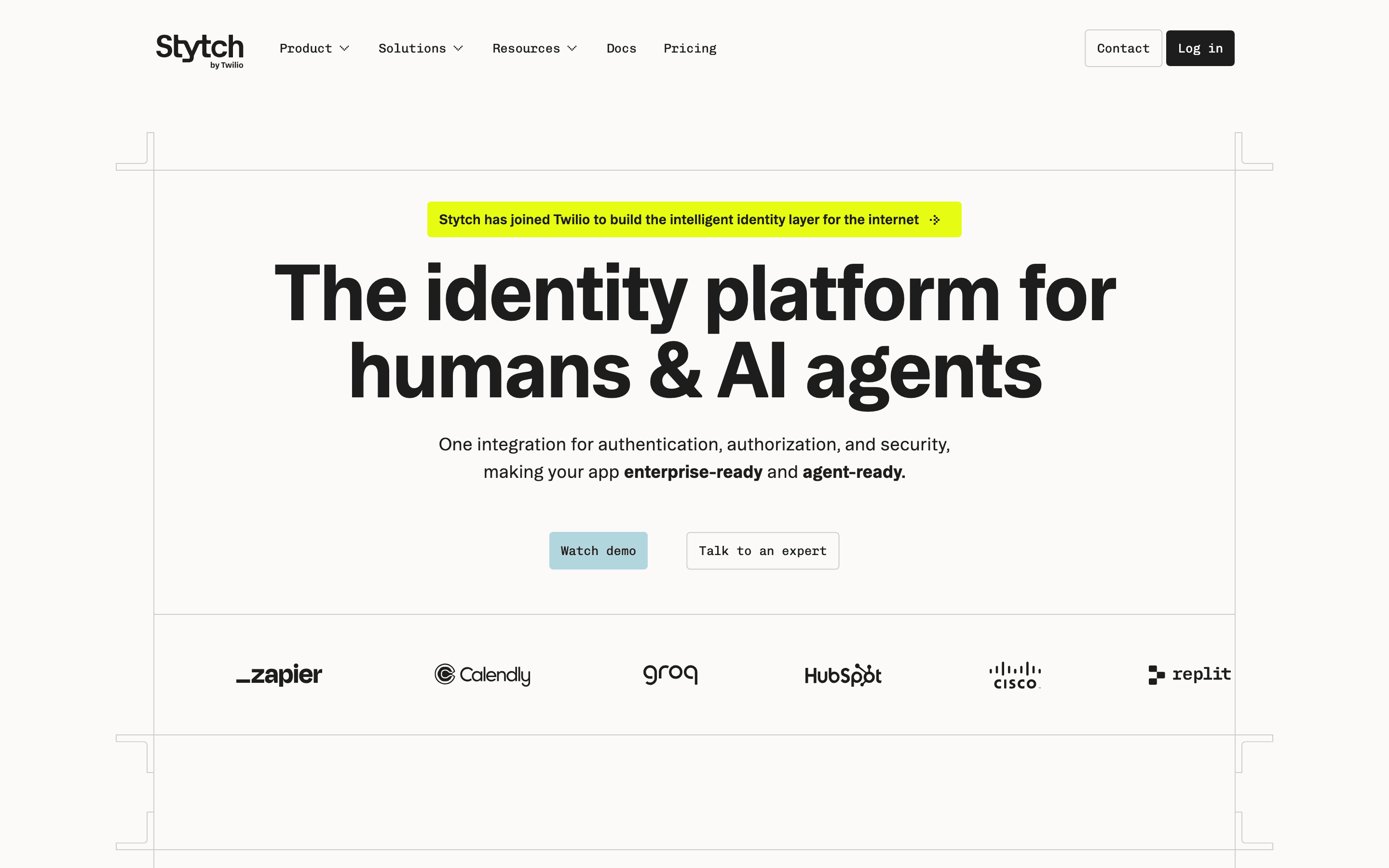
Stytch is an authentication API and set of SDKs for adding login, signup, and session management to an app. You call its APIs directly or drop in its pre-built UI components, and it handles passwords, magic links, passkeys, OTP, OAuth, SSO (SAML/OIDC), MFA, and machine-to-machine (M2M) auth for service accounts. It has separate product lines for consumer apps (B2C) and multi-tenant business apps (B2B), the B2B side adds organizations, roles, and an embeddable admin portal so your customers can manage their own SSO and SCIM setup.
Stytch also sells device fingerprinting and fraud-detection signals as an add-on, aimed at catching bot signups and account takeover attempts at the point of login.
In October 2025 Stytch was acquired by Twilio, which is positioning it as the identity layer behind Twilio's broader communications platform. It's still sold and run as a standalone product for now.
Stytch screenshots
Who it's for
- ✓ Developers who want full control over the login UI and are fine wiring up an API rather than an embedded widget
- ✓ B2B SaaS teams that need per-tenant SSO/SCIM and an admin portal they can hand to enterprise customers
- ✓ Teams that want a headless auth backend behind their own custom frontend
Who should look elsewhere
- ✗ Teams that want a fully managed hosted login page they can set up in minutes with no coding
- ✗ Small teams that want predictable flat pricing instead of usage-based billing
Pros
- + Free tier covers 10,000 MAU with core features like SSO, RBAC, and sessions, not a crippled trial
- + Clean, well-documented API with SDKs for most major frameworks
- + B2B product handles multi-tenant SSO/SCIM and org management out of the box, which most competitors bolt on later
- + Supports newer methods like passkeys and OAuth CIMD, not just password and magic-link basics
Cons
- – The real cost past the free tier isn't public. You only see two specific overage fees (SSO/SCIM connections, fraud fingerprints); the core per-MAU rate requires a sales conversation
- – Extra SSO/SCIM connections cost $125/connection/month, which adds up fast if you sell to many enterprise customers each needing their own connection
- – No self-serve flat-rate plan. Pricing is metered usage plus a separate quote-only enterprise tier, harder to budget than a flat per-seat price
- – Now owned by Twilio post-acquisition (Oct 2025), which adds uncertainty about long-term pricing and roadmap independence
Stytch pricing
What you pay for
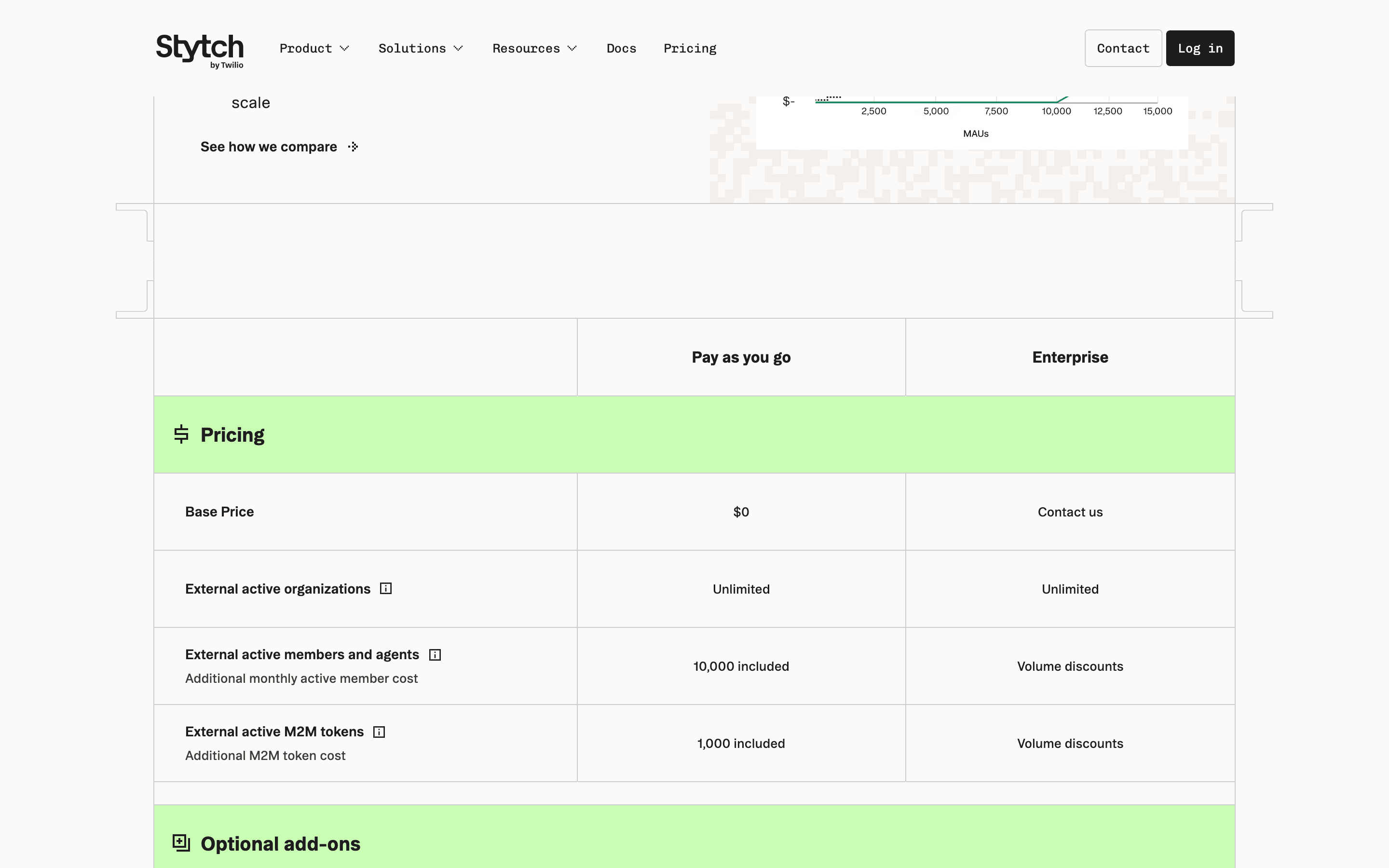
You pay for Stytch by monthly active user rather than by seat, with the first 10,000 MAU a month free across unlimited organizations. Past that, Stytch charges for usage with volume discounts, but the actual per-MAU rate isn't posted, only two specific overage fees are public: extra SSO/SCIM connections and extra fraud-prevention fingerprint checks. Enterprise plans with an SLA, HIPAA support, and dedicated support are quote-only.
It has a free plan, so you can start at no cost in Authentication & User Management.
| Plan | Price | Highlights |
|---|---|---|
| Pay as you go | Free | First 10,000 monthly active users and AI agents free · Unlimited organizations · 5 SSO or SCIM connections included · 1,000 machine-to-machine tokens included · 10,000 fraud-prevention device fingerprints included · Volume discounts on usage past the free limits |
| Enterprise | Custom | Custom MAU and connection rates · 99.99% uptime SLA · HIPAA / BAA support · Private Slack support channel · Migration assistance from another provider |
Stytch is metered on monthly active users (MAU), not seats. Everyone gets 10,000 free MAU a month, then pays for what they use past that with volume discounts, but the exact per-MAU overage rate isn't published, you get a quote once you're past the free tier. Two costs are listed plainly: extra SSO/SCIM connections past the 5 included are $125 per connection per month, and fraud-prevention fingerprints past the free 10,000 are $0.005 each. Removing Stytch branding and adding your own is a one-time $99 fee that covers all your projects. Enterprise pricing is custom and requires talking to sales.
Pricing verified July 22, 2026 · source
How Stytch's pricing compares
Stytch next to its closest alternatives on entry price, billing, and whether pricing is public.
| Tool | Starting price | Billing | Free option | Pricing disclosed |
|---|---|---|---|---|
| Stytch | Free | usage-based | Yes | Partly public |
| Auth0 | $35/user/mo | tiered | Yes | Partly public |
| Clerk | $25/mo | tiered | Yes | Partly public |
| WorkOS | Free | usage-based | Yes | Partly public |
| SuperTokens | Free tier + custom | usage-based | Yes | Not disclosed |
| Frontegg | Free tier + custom | usage-based | Yes | Not disclosed |
Is Stytch still actively developed?
Last significant update: October 2025. Stytch added support for CIMD (client ID metadata documents) for OAuth, letting OAuth clients register and be verified without a manual client registration step.
Top Stytch alternatives
Stytch FAQ
Is Stytch free?+
Yes, up to 10,000 monthly active users and AI agents a month, with core features like SSO, sessions, and RBAC included, not a stripped-down trial.
How does Stytch charge past the free tier?+
It's metered by monthly active user with volume discounts, but Stytch doesn't publish the per-MAU overage rate on its pricing page, you get that number by contacting sales. Two costs it does publish: $125 per extra SSO/SCIM connection per month, and $0.005 per fraud-prevention fingerprint past the included 10,000.
Does Stytch host the login UI for me?+
You can use its pre-built UI components or call the API directly and build your own screens. It's built for developers who want to own the frontend, not a drop-in hosted login page.
Who owns Stytch now?+
Twilio acquired Stytch in October 2025 to use it as the identity layer across Twilio's platform. Stytch is still run as its own product.